
Bones More Bones Osteology The science that deals
Bones, & More Bones
Osteology • The science that deals with the study of bones. • Each bone is an organ that plays a part in how the skeletal system functions. • The skeletal system of an adult is made up of 206 bones. – This number varies by age, for example, at birth, our bodies consist of about 270 bones. – Over the first 3 -5 years of our lives, the number actually increases to over 300. – At your age the number actually decreases because the bones fuse (connect) together.

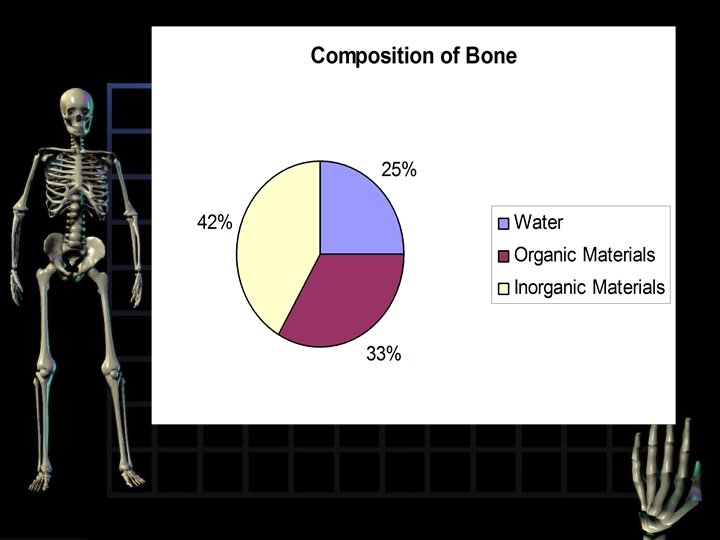
Composition of Bones • ¼ of the weight is composed of water. • 1/3 of the weight is organic material such as the protein, ossein. • The rest of the weight is composed of inorganic materials such as calcium, phosphorus, magnesium, and small amounts of iron, potassium, sodium, chlorine, and fluorine.
Layers of Bone (1) • The outer surface of the bone is called periosteum. – It’s a thin, dense layer that contains nerves and blood vessels to nourish the bone. • The next layer is made up of compact bone. – This part is smooth and very hard. – This is the part you see when you look at a skeleton.

Layers of Bone (2) • Within the compact bone are several layers of cancellous bone. – This looks a bit like sponge. – Not as hard as compact bone, but still very strong. • The cancellous bone protects the bone marrow, which is the innermost layer of bone. – Sort of like a thick jelly. – Produces new blood cells.
How Do Bones Grow? • Bones are made of a network of calcium laid down by cells. • During childhood, as you are growing, the cartilage grows and is slowly replaced by bone, with help from calcium • As kids grow, special cells at the end of bones add new calcium to the network of bone. • Children have layers of these cells in the shape of plates at the ends of their bones. – These are called “growth plates, ” and they close up when kids reach their full adult height.
When Do Bones Stop Growing? • There is no exact age for humans to stop growing. • Once the epiphysis (the rounded end of a long bone) has fused to the bone and the growth plate is closed, the bone will stop growing. • This usually occurs between the ages of 15 -25.

Bone Classification • Anatomical Position – Axial or Appendicular • Shape – Long, Short, Flat, and Irregular

Axial Bones • 80 bones which lie along the central, vertical axis of the body and support and protect the head and torso.
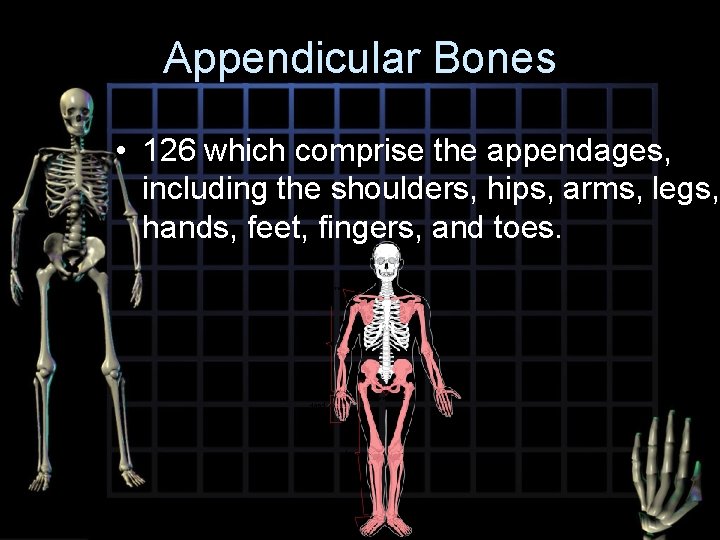
Appendicular Bones • 126 which comprise the appendages, including the shoulders, hips, arms, legs, hands, feet, fingers, and toes.
Shapes • Long bones: Strong bones, such as the femur, found in the arms and legs. • Short bones: Over ½ of which can be found in the hands and feet, are as broad as they are long. • Flat bones: Thin, flat bones, such as the ribs and skull, which serve to protect vital body organs. • Irregular Bones: Have shapes that do not fit with the other types of bones, such as vertebrae
Functions of Bones • There are five main functions of bones: – Support – Protection – Body Movement – Production of Blood Cells – Mineral Storage
Support • One function of the skeleton is to provide support for your body. • The skeleton forms the base to which muscles and other soft tissue attach. – Without the support of your bones, like your vertebral column, you would not be able to stand up • Did You Know? ? ? – A giraffe and a human have the same number of bones in their necks.

Protection • The second function of the skeletal system is to provide protection for the soft, delicate parts of your body. – For example: your cranium (skull) and spine protect your central nervous system while your ribcage protects your heart. • Did You Know? ? ? – Your jawbone is actually the hardest bone in your body.
Body Movement (1) • In order to move, muscles need to pull on bones. • When muscles contract, the bones to which they are attached act as levers and cause different body parts to move. • The movement takes place at the connection between bones, which is called a joint.
Bone Movement (2) • Cartilage and Ligaments help move the joints. • Synovial fluid acts as a lubricant to keep the joints moving smoothly. • Joints are classified by their range of movement. Some are immovable (fixed), some are partially movable (such as the ones found in your spine) allow for flexibility but not a wide range of movement, and freely movable joints (hinged, ball-and-socket, gliding, saddle, and pivot).
Body Movement (2) • There are different types of joints in your body: – A hinged joint, like the one in your knee, allows you to move your leg back and forth just like a door hinge. – A fixed joint, like your skull, has very little movement at all. – A ball-and-socket joint, like the one in your shoulder or leg, allows you to move your leg or arm 360° like a shower head.
Body Movement (3) – A gliding joint, such as the ones in your wrist and foot, allow for limited movement. – A saddle joint, such as the one in your thumb, allows for greater movement than either a hinge or a gliding joint. It gives the thumb the ability to cross over the palm. – A pivot joint, such as the one between your head and spine, allows one bone to rotate around another.
Production of Blood Cells • It is in the hollow center of bones that bone marrow makes new red and white blood cells. – The red blood cells ensure that oxygen is distributed to all parts of your body. – The white blood cells are responsible for fighting off germs and disease.
Mineral Storage • Bones are storage sites for many minerals. • These minerals give bones their rigidity (hardness) and much of its weight. • Bones contain a lot of calcium. – Calcium is important for bone growth and development. – It is also important for muscle contractions.
- Slides: 21