
Bones and Soft Tissues Aids in body movement
Bones and Soft Tissues

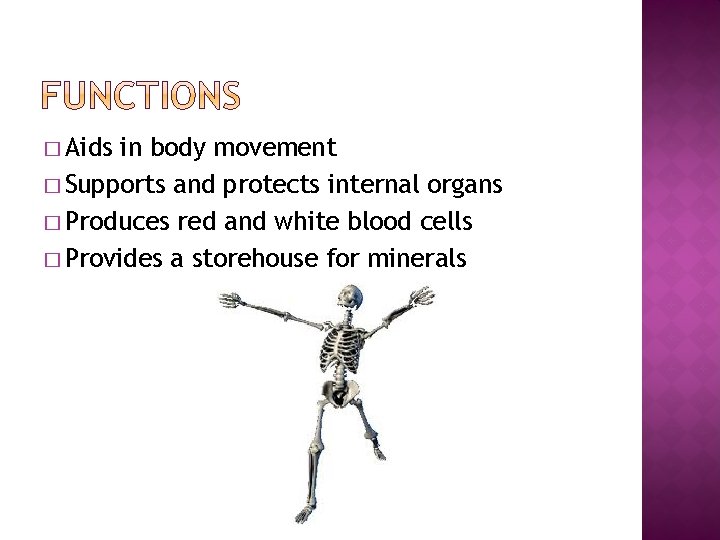
� Aids in body movement � Supports and protects internal organs � Produces red and white blood cells � Provides a storehouse for minerals
� Adult= 206 bones � Infant = 270 bones � As humans grow those 64 bones will fuse together into the full 206 bones.
�There are only minor differences between the male and female skeleton. �Men’s bones tend to be larger and heavier when compared to women’s bones �Woman’s pelvis is wider than a man’s
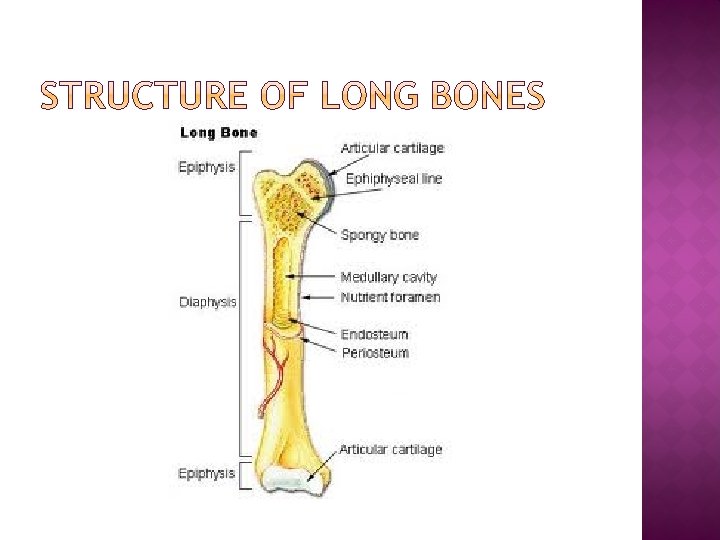
� Long - Femur � Flat - Skull � Irregular - Spine � Short - Phalanges
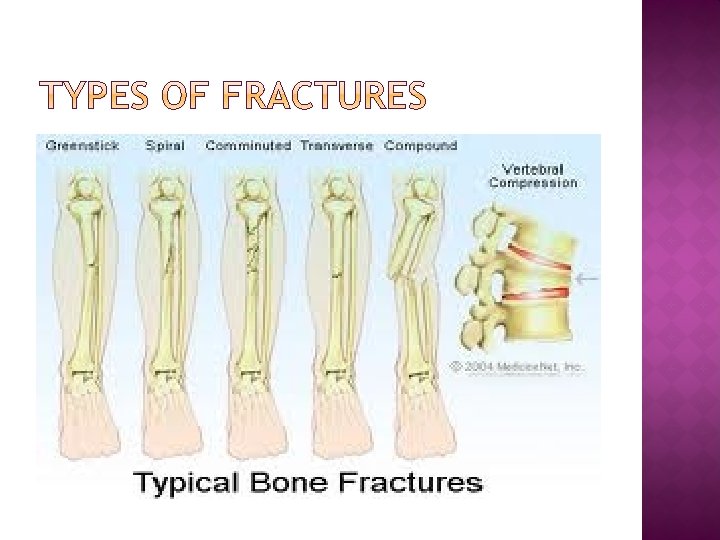
� Simple or Closed – a break in the bone that may be complete or incomplete, but does not break the skin. � Greenstick – an incomplete break in the diaphysis of the bone occurring in children. � Comminuted – Occurs when force on the bone is so great that it breaks into 3 or more pieces.
� Stress – Occurs when a bone is stressed by overuse, poor muscle balance, lack of flexibility, weakness, or biomechanical problems � Epiphyseal plate fx – Growth plate fx. Most common in children age 10 -16 and usually the result of sport participation � Compound or Open – a complete break in the bone where the bone ends separate and break through the skin
� Strains: caused by twisting or pulling of a muscle or tendon �Acute: caused by trauma or a blow to the body �Chronic: result of overuse, prolonged, repetitive movement �Sites: commonly the hamstring and quadriceps in sports such as soccer, football, track, wrestling, hockey �Hand forearm strains result from sports such as tennis, throwing sports, and gymnastics

� Pain, muscle spasm, and muscle weakness � Localized swelling, cramping, or imflammation and some loss of function
� Grade I – Overstretched or minor tears in the muscle or tendon ; looks normal, painful to touch, painful during athletics and stretching � Grade II – Partial tear in the muscle or tendon ; swelling, bruising, inability to use limb, may limp on affected leg, may be unable to fully extend limb
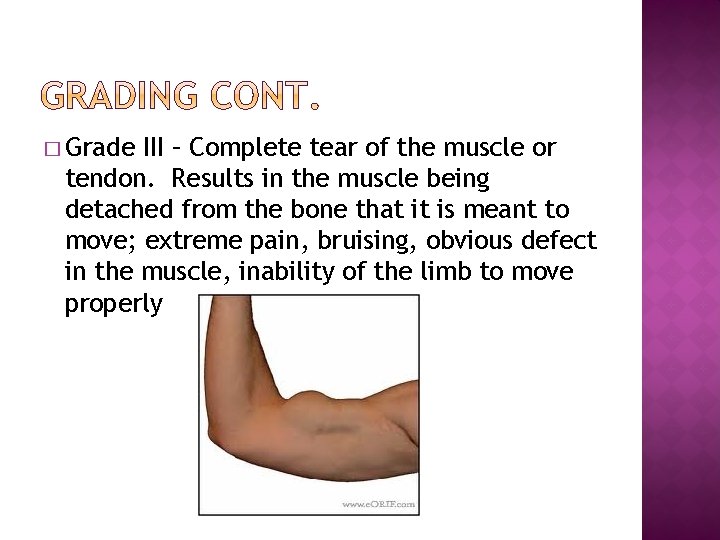
� Grade III – Complete tear of the muscle or tendon. Results in the muscle being detached from the bone that it is meant to move; extreme pain, bruising, obvious defect in the muscle, inability of the limb to move properly
� Two stages of treatment �Stage 1 – reduce swelling and pain RICE – Rest, Ice, Compression, Elevation for 24 -48 hours Stage 2 – Rehabilitation – stretching, exercise program to restore range of motion and strength For Grade III Strains, surgery may be required.
� Factors that determine Return to Play – �Sport �Location of strain �Severity of strain �Pain tolerance �Age �History
� Do sport specific stretching exercises daily � Always warm up properly and never stretch a cold muscle � Maintain a healthy, well balanced diet to keep muscle strong � Wear properly fitted shoes � Maintain a healthy weight
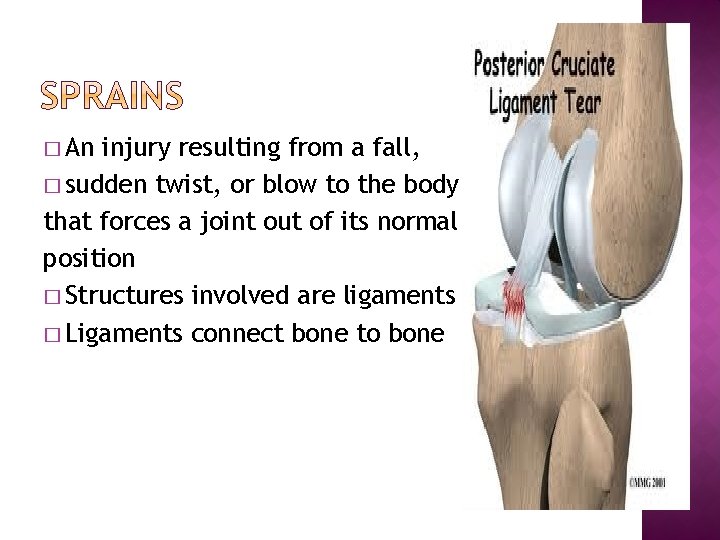
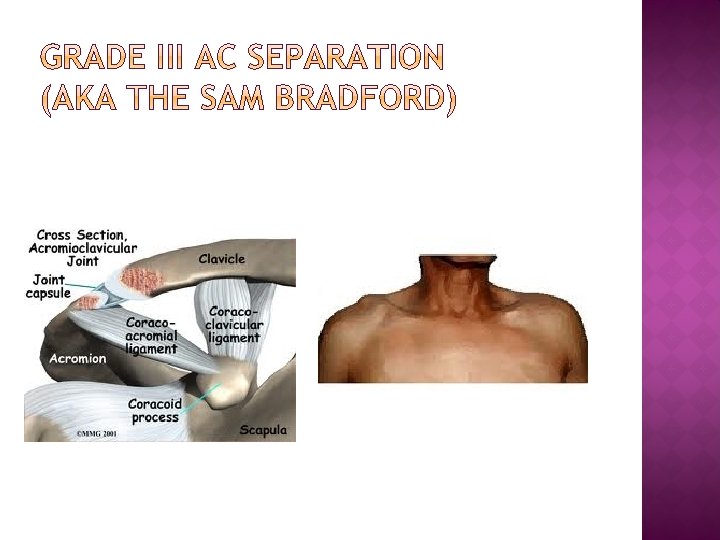
� An injury resulting from a fall, � sudden twist, or blow to the body that forces a joint out of its normal position � Structures involved are ligaments � Ligaments connect bone to bone
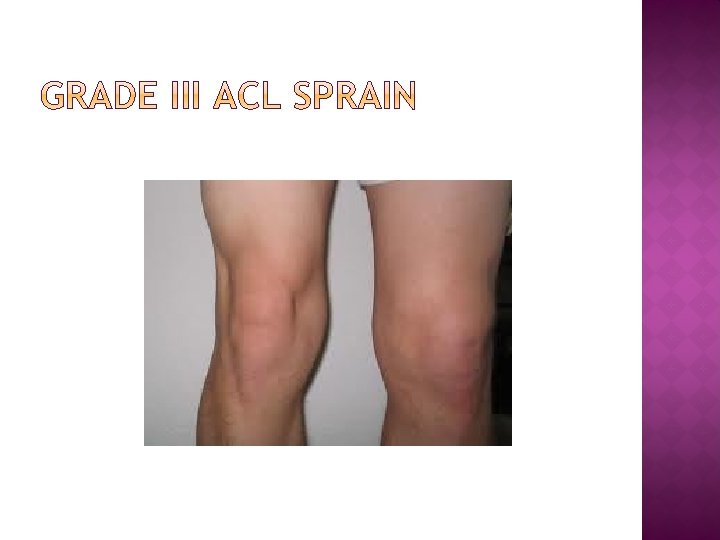
� Same as strains – I, II, and III � Grade I – mild; overstretching or slight tearing of the ligament with no joint instability and no loss of function � Grade II – Moderate; partial tearing and characterized by bruising, moderate pain, and swelling. Difficulty bearing weight or using the limb. Requires x-ray and/or MRI � Grade III – Severe; Complete rupture. Severe pain, swelling, bruising and loss of function, Possible deformity. X-ray, MRI, possible surgery
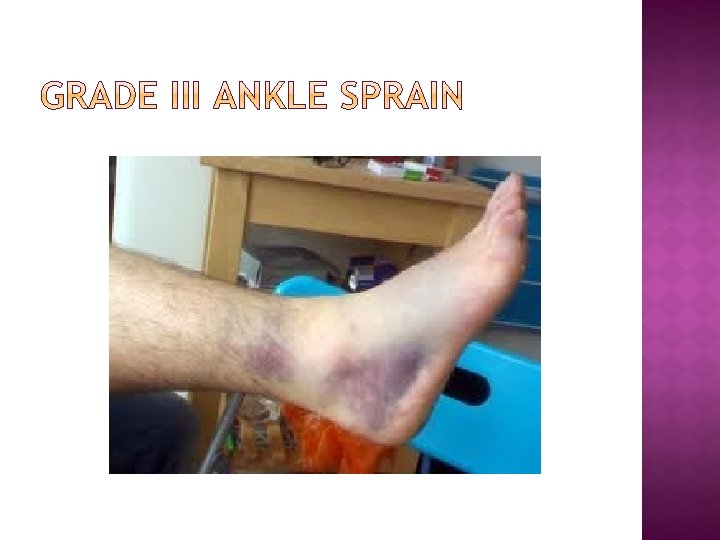
� Similar to a strain � RICE � May require X-ray to rule out a fracture � May require MRI to determine extent of the tear and whether surgery is required
� Inflammation of the fibrous tissue that connects muscle to bone � Can be the result of abnormal gliding motion of the tendon � Can follow a muscle strain � People who begin an exercise program or progress with activity too quickly � Overuse
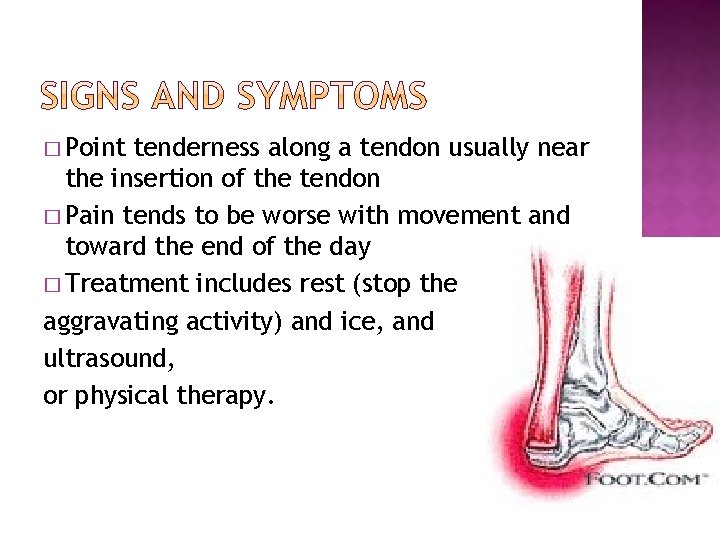
� Point tenderness along a tendon usually near the insertion of the tendon � Pain tends to be worse with movement and toward the end of the day � Treatment includes rest (stop the aggravating activity) and ice, and ultrasound, or physical therapy.
� Inflammation of the bursa � Bursa are fluid filled sacs within and around your joints. � They decrease friction allowing for smooth movement � Can become inflamed when repetitive movements or prolonged pressure is applied to the area
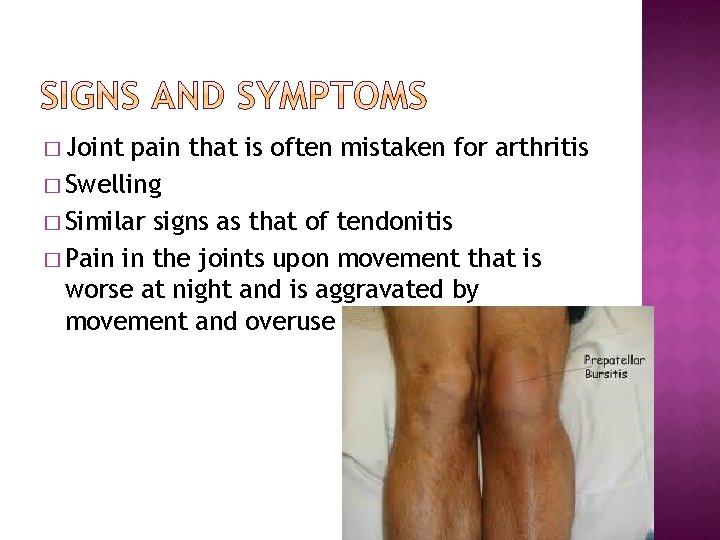
� Joint pain that is often mistaken for arthritis � Swelling � Similar signs as that of tendonitis � Pain in the joints upon movement that is worse at night and is aggravated by movement and overuse
� Avoid activity that led to the injury � NSAIDS � Drainage of the bursa by a physician, Injection of cortisone, or removal of the bursa entirely � Prevention: Strengthen muscles around the joint, avoid repetitive stress, cushion joints, and don’t over do it!
� Inflammation: the body’s reaction to invasion by an infectious agent or physical, chemical, or traumatic damage. � Signs and Symptoms: redness, pain, swelling, heat � Causes: infection or tissue damage
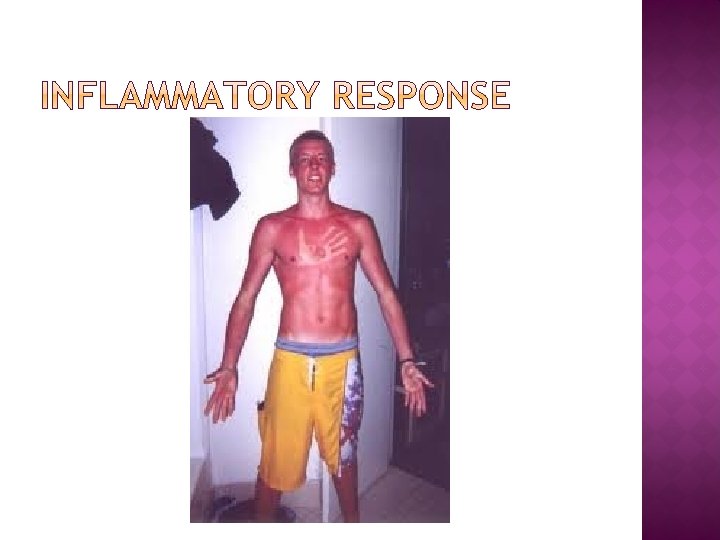
� The inflammatory response is a defense mechanism that is put in to effect by the immune system The body concentrates immune-system cells and their products at the site of the damage in order to speed the healing process.
� Blood supply to the damaged tissue increases due to dilation of blood vessels. � Capillary permeability increases allowing for the exchange of specialized cells to the injury site � White blood cells migrate toward the injured or infected site.
� Ice is useful for controlling pain/inflammation if used appropriately � Ice should be used during the first 24 -48 hours following an injury � Ice is a vasoconstrictor, meaning that it shrinks blood vessels in order to control swelling � If we control swelling, then we control pain/inflammation
� Plain ice packs may be applied directly to the skin for a period of 20 minutes unless it is the foot area. Then only apply for 10 -15 minutes � Chemical cold packs should never be applied directly to the skin. Use a barrier such as a towel or pillowcase between the skin and cold pack to prevent frostbite
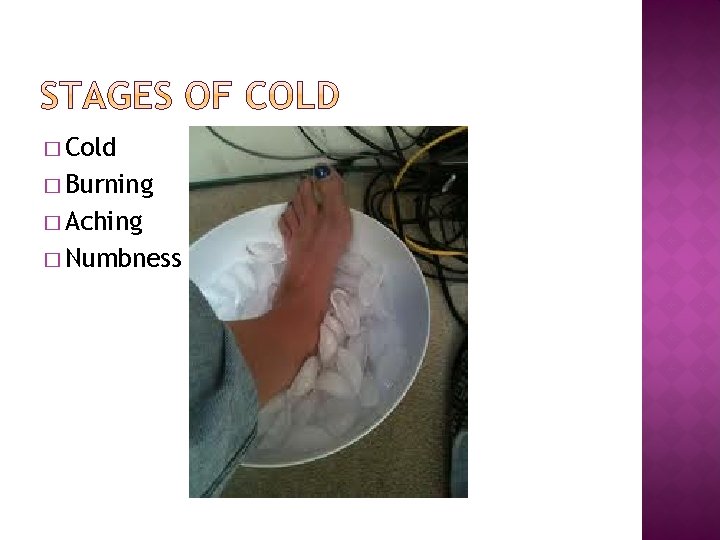
� Cold � Burning � Aching � Numbness
� Do not use heat within the first 48 hours of sustaining an injury � Use heat for joint or muscle stiffness or general achiness…not pain. � Use moist heat if possible � Use for about 20 minutes
- Slides: 37