
Bone Structure Introduction What does a bones structure
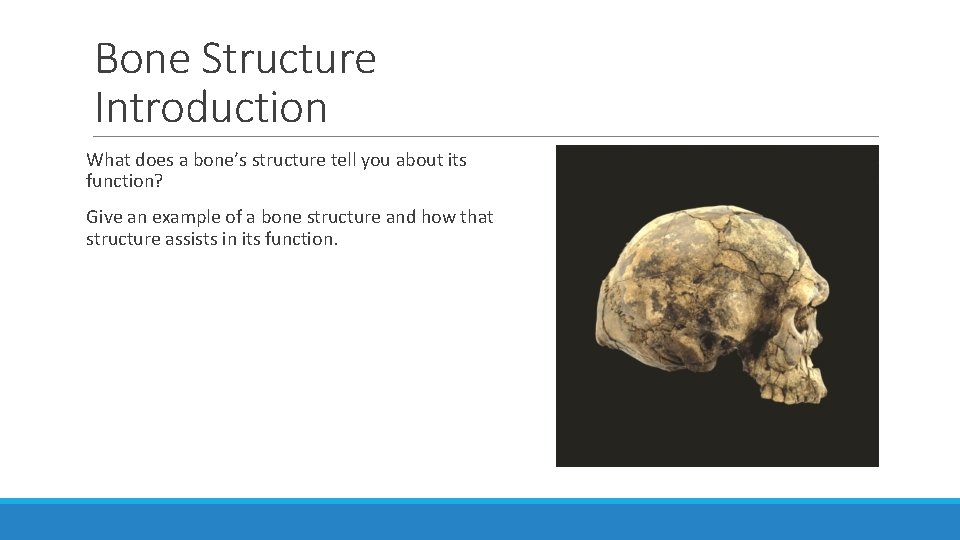
Bone Structure Introduction What does a bone’s structure tell you about its function? Give an example of a bone structure and how that structure assists in its function.

Bone Structure Explicit Instruction Bones differ in size and shape, yet are similar in several ways. Parts of a Long Bone ◦ Expanded ends of bones that form joints with adjacent bones are called epiphyses. ◦ Articular cartilages (hyaline cartilage) cover the epiphyses. ◦ The shaft of the bone is the diaphysis. ◦ A tough layer of vascular connective tissue, called the periosteum, covers the bone and is continuous with ligaments and tendons.
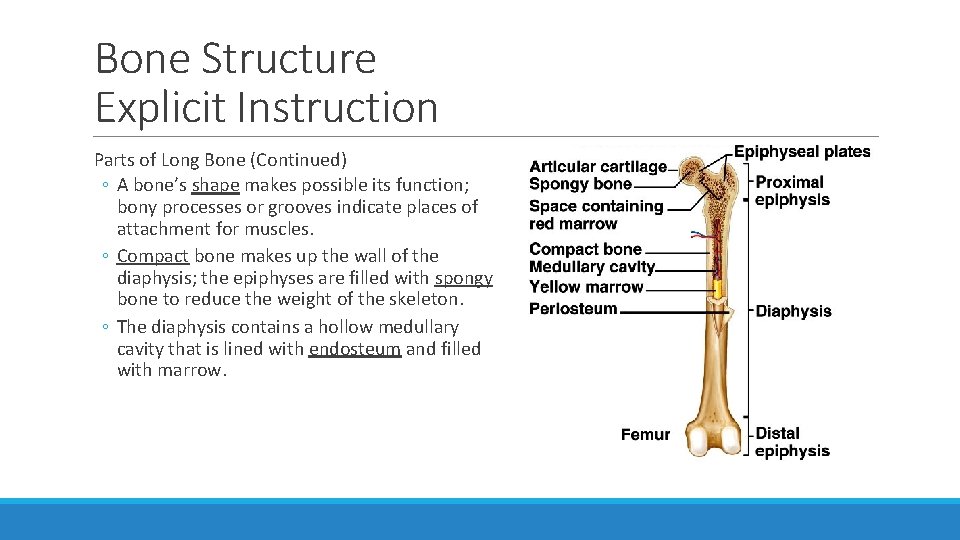
Bone Structure Explicit Instruction Parts of Long Bone (Continued) ◦ A bone’s shape makes possible its function; bony processes or grooves indicate places of attachment for muscles. ◦ Compact bone makes up the wall of the diaphysis; the epiphyses are filled with spongy bone to reduce the weight of the skeleton. ◦ The diaphysis contains a hollow medullary cavity that is lined with endosteum and filled with marrow.

Bone Structure Explicit Instruction Microscopic Structure ◦ Bone cells (osteocytes) are located within lacunae that lie in concentric circles around osteonic canals. ◦ Osteocytes pass nutrients and gases in the matrix through canaliculi. ◦ Intercellular material consists of collagen and inorganic salts. ◦ In compact bone, osteocytes and intercellular material are organized into osteons that are cemented together.
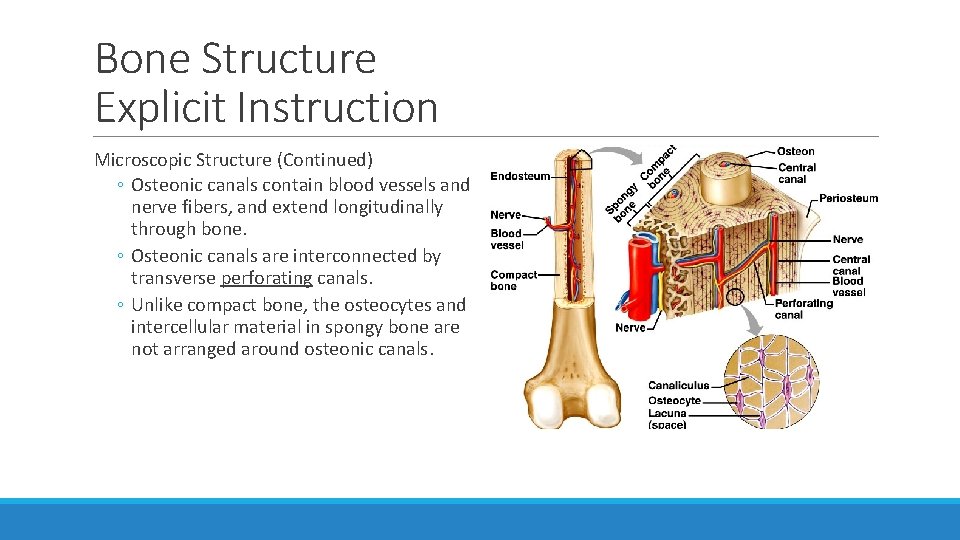
Bone Structure Explicit Instruction Microscopic Structure (Continued) ◦ Osteonic canals contain blood vessels and nerve fibers, and extend longitudinally through bone. ◦ Osteonic canals are interconnected by transverse perforating canals. ◦ Unlike compact bone, the osteocytes and intercellular material in spongy bone are not arranged around osteonic canals.
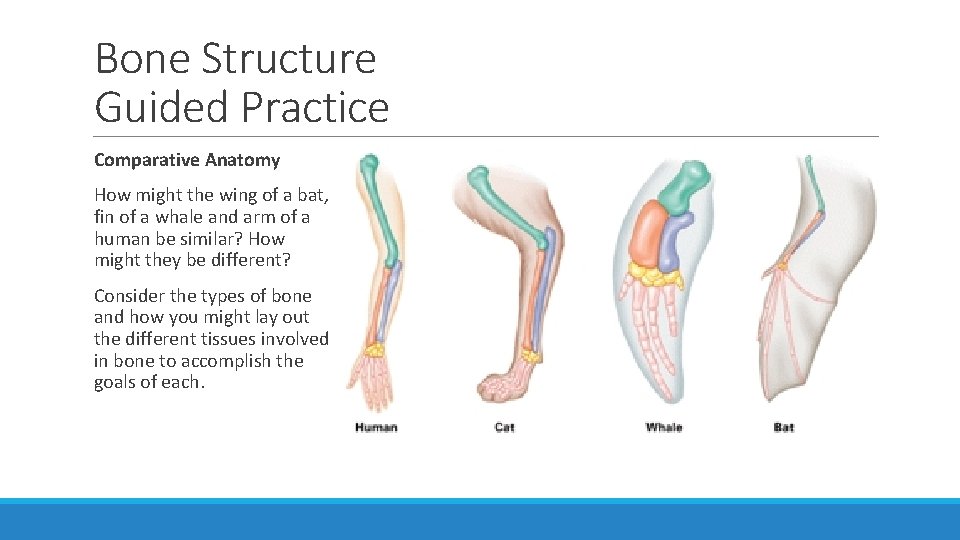
Bone Structure Guided Practice Comparative Anatomy How might the wing of a bat, fin of a whale and arm of a human be similar? How might they be different? Consider the types of bone and how you might lay out the different tissues involved in bone to accomplish the goals of each.

Bone Structure Independent Practice 1. Explain how bones are classified (5 types). 2. List five major parts of a long bone. 3. How do compact and spongy bone differ in their structure? Why do you suppose bone has both compact and spongy bone? 4. Describe the microscopic structure of compact bone (be thorough in your response). * Begin familiarizing yourself with the 206 bones that make up the human skeleton.
- Slides: 7