
Bone remodeling Deposition of Bone by the Osteoblasts

Bone remodeling

Deposition of Bone by the Osteoblasts. Bone is con tinually being deposited by osteoblasts, and it is continu ally being resorbed where osteoclasts are active. This mechanism is always is in balance (called bone remodelling). Any disturbance of this mechanism ill causes a disease. For example increase osteocyte activity will causes osteoporosis or increase activity of osteocyte followed by increased activity of osteoblast with abnormal bone causes Paget's disease Osteoblasts are found on the outer surfaces of the bones and in the bone cavities. A small amount of osteo blastic activity occurs continually in all living bones (on about 4 percent of all surfaces at any given time in an constantly.

Resorption of Bone—Function of the Osteoclasts. Bone is also being continually resorbed in the presence of osteoclasts, which are large, phagocytic, multinucleated cells (containing as many as 50 nuclei), abundant mitochondria and a large number of vacuoles and lysosomes) that are derivatives of monocytes or monocyte like cells formed in the bone marrow. The osteoclasts are normally active on less than 1 percent of the bone surfaces of an adult. Osteoblast secret three materials receptor activator for nuclear factor κ B ligand (RANKL) macrophage colony stimulating factor (M CSF) osteo protegerin (OPG), sometimes called osteo clasto genesis inhibitory factor
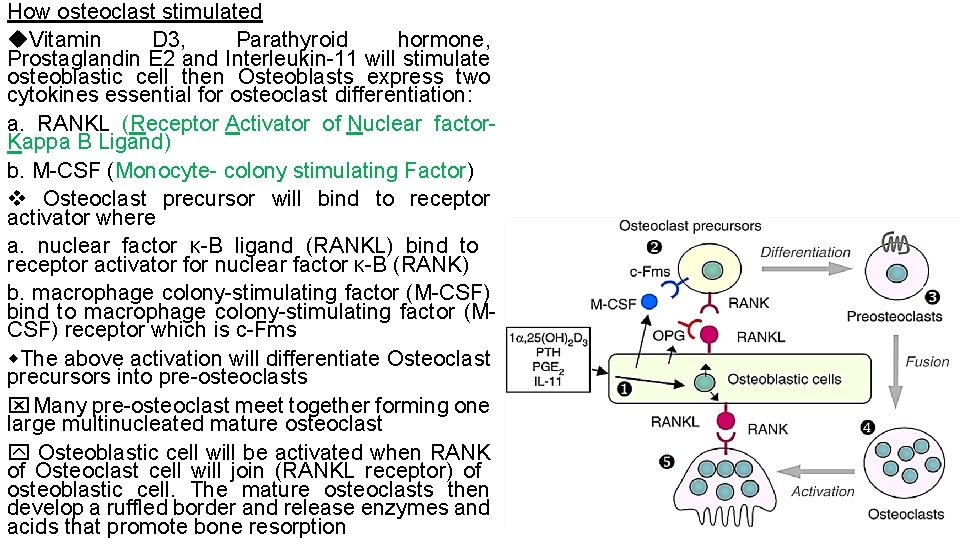
How osteoclast stimulated Vitamin D 3, Parathyroid hormone, Prostaglandin E 2 and Interleukin 11 will stimulate osteoblastic cell then Osteoblasts express two cytokines essential for osteoclast differentiation: a. RANKL (Receptor Activator of Nuclear factor Kappa B Ligand) b. M CSF (Monocyte colony stimulating Factor) Osteoclast precursor will bind to receptor activator where a. nuclear factor κ B ligand (RANKL) bind to receptor activator for nuclear factor κ B (RANK) b. macrophage colony stimulating factor (M CSF) bind to macrophage colony stimulating factor (M CSF) receptor which is c Fms The above activation will differentiate Osteoclast precursors into pre osteoclasts Many pre osteoclast meet together forming one large multinucleated mature osteoclast Osteoblastic cell will be activated when RANK of Osteoclast cell will join (RANKL receptor) of osteoblastic cell. The mature osteoclasts then develop a ruffled border and release enzymes and acids that promote bone resorption
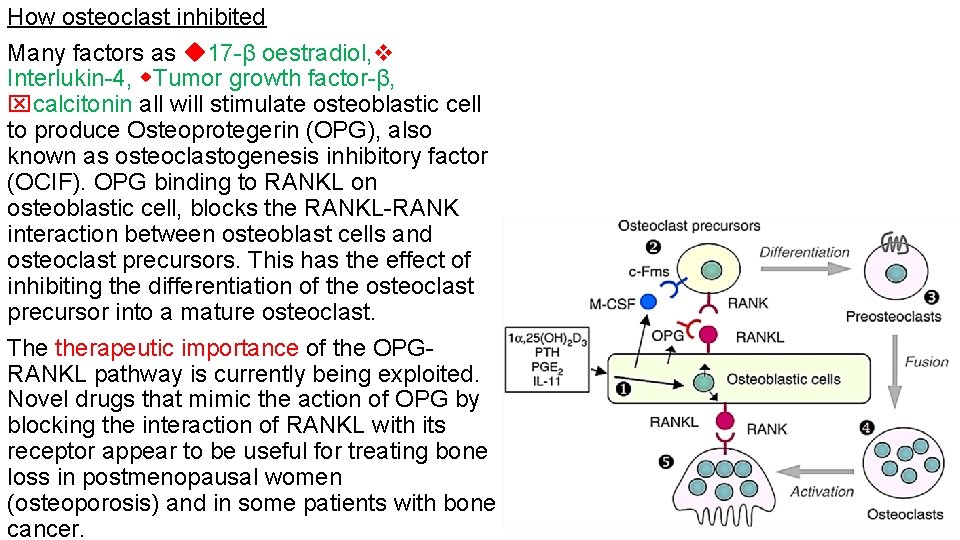
How osteoclast inhibited Many factors as 17 β oestradiol, Interlukin 4, Tumor growth factor β, calcitonin all will stimulate osteoblastic cell to produce Osteoprotegerin (OPG), also known as osteoclastogenesis inhibitory factor (OCIF). OPG binding to RANKL on osteoblastic cell, blocks the RANKL RANK interaction between osteoblast cells and osteoclast precursors. This has the effect of inhibiting the differentiation of the osteoclast precursor into a mature osteoclast. The therapeutic importance of the OPG RANKL pathway is currently being exploited. Novel drugs that mimic the action of OPG by blocking the interaction of RANKL with its receptor appear to be useful for treating bone loss in postmenopausal women (osteoporosis) and in some patients with bone cancer.

Mechanism of osteoclast mediated bone resorption Histologically, bone absorption occurs immediately adjacent to the osteoclasts. Osteoclasts erode and absorb previously formed bone. They become attached to bone via integrins in a membrane extension called the sealing zone. This creates an isolated area between the bone and a portion of the osteoclast. The mechanism of this resorp tion is believed to be the following: The villi secrete two types of substances: (1) proteolytic enzymes, released from the lysosomes of the osteoclasts, and a. Cathepsin K is the major protease involved in the degradation of type I collagen and other non collagenous proteins b. Matrix metallo proteinases (MMPs) (2) Resorption pit at ruffled border (villus like projections toward the bone): Several acids, including citric acid and lactic acid, (they acidify the area to approximately p. H 4. 0) released from the mitochondria and secretory vesicles. The enzymes digest or dissolve the organic matrix of the bone, and the acids cause dissolution of the bone salts. The osteoclastic cells also imbibe ﺗﻤﺘﺺ minute particles of bone matrix and crystals by phagocytosis, eventually also dis soluting these particles and releasing the products into the blood.
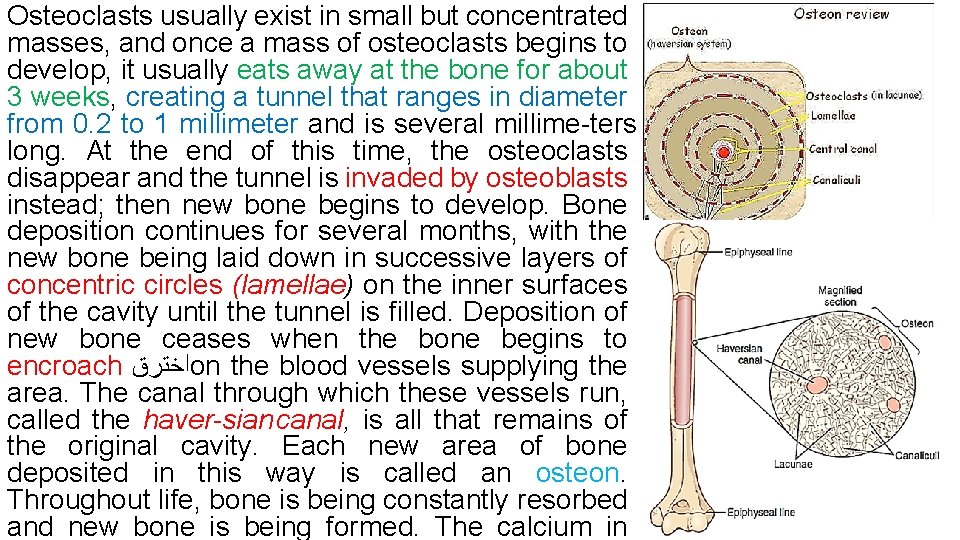
Osteoclasts usually exist in small but concentrated masses, and once a mass of osteoclasts begins to develop, it usually eats away at the bone for about 3 weeks, creating a tunnel that ranges in diameter from 0. 2 to 1 millimeter and is several millime ters long. At the end of this time, the osteoclasts disappear and the tunnel is invaded by osteoblasts instead; then new bone begins to develop. Bone deposition continues for several months, with the new bone being laid down in successive layers of concentric circles (lamellae) on the inner surfaces of the cavity until the tunnel is filled. Deposition of new bone ceases when the bone begins to encroach ﺍﺧﺘﺮﻕ on the blood vessels supplying the area. The canal through which these vessels run, called the haver sian canal, is all that remains of the original cavity. Each new area of bone deposited in this way is called an osteon. Throughout life, bone is being constantly resorbed and new bone is being formed. The calcium in

Value of Continual Bone Remodeling. The continual deposition and resorption of bone have several physiolog ically important functions. First, bone ordinarily adjusts its strength in proportion to the degree of bone stress. Consequently, bones thicken when subjected to heavy loads. Second, even the shape of the bone can be rear rangedfor proper support of mechanical forces by depo sitionand resorption of bone in accordance with stress patterns. Third, because old bone becomes relatively brittle ﻫﺶ and weak, new organic matrix is needed as the old organic matrix degenerates. In this manner, the normal toughness of bone is maintained. ﺑﺴﺒﺐ ﺗﻤﺰﻕ ﺍﻟﻜﻮﻻﺟﻴﻦ ﻧﺘﻴﺠﺔ ﺍﻟﺴﺘﺮﺱ the bones of children in whom the rates of deposition and absorption are rapid show little brittleness in comparison with the bones of the elderly, in whom the rates of deposition and

Control of the rate of boned ﺗﺤﺪﻳﺪ ﺷﻜﻞ ﺍﻟﻌﻈﻢ position by bone “Stress. ” Bone stress determines osteoblastic deposition and cal cification of bone Bone is deposited in proportion to the com pressional load that the bone must carry. For instance, a. the bones of athletes become considerably heavier than those of non athletes. b. if a person has one leg in a cast but continues to walk on the opposite leg, c. the bone of the leg in the cast becomes thin and as much as 30 percent remains thick and normally calcified. Therefore, continual physical stress stimulates osteoblastic deposition and cal cification of bone. Bone stress determines the shape of bones under certain circumstances. For instance, if a long bone of the leg breaks in its center and then heals at an angle, the compression stress on the inside of the angle causes increased deposition of bone. Increased resorption occurs on the outer side of the angle where the bone is not com pressed. After many years of increased deposition on the inner side of the angulated bone and resorption on the outer side, the bone can become almost straight, espe cially in children because of the rapid remodeling of bone at younger ages.
- Slides: 9