
Bone Fracture Recall Three types of Stress Tension
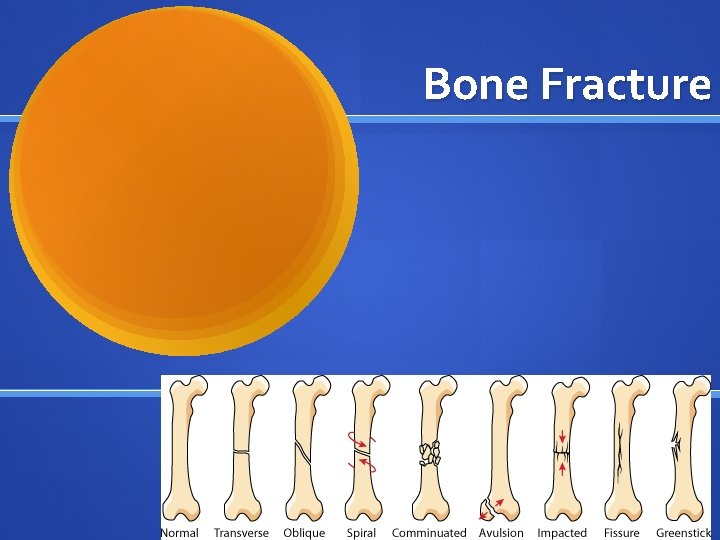
Bone Fracture
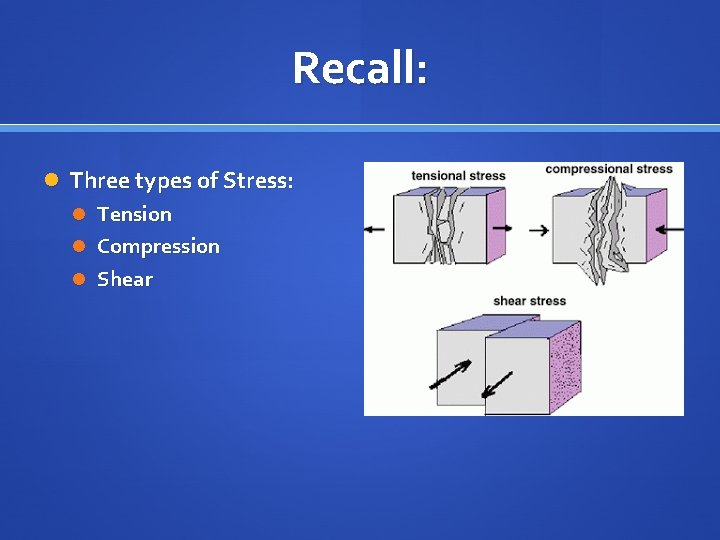
Recall: Three types of Stress: Tension Compression Shear
Compression Shortens an object. Load pushing molecules more tightly together Bones are designed for compression. As you stand, your bones (Femur, tibia, etc. ) are supporting your body weight. This body weight is a result of gravity acting on your mass. This causes compressive stress (load) on your bones. Can lead to bruising of soft tissues or crushing fractures of bones
Tension Pulling apart of molecules, resulting in elongation of material. More likely to lead to bone fracture. https: //www. youtube. com/watch? v=FT 8 Xg 98 uw 1 o
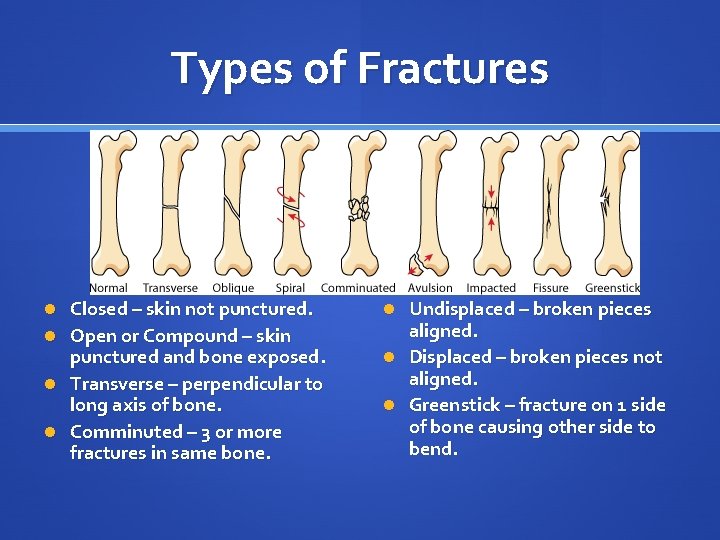
Types of Fractures Closed – skin not punctured. Open or Compound – skin punctured and bone exposed. Transverse – perpendicular to long axis of bone. Comminuted – 3 or more fractures in same bone. Undisplaced – broken pieces aligned. Displaced – broken pieces not aligned. Greenstick – fracture on 1 side of bone causing other side to bend.
Healing Nature of Bones have the ability to heal Key Players: Osteoclasts – break down bone Osteoblasts – build new bone http: //www. exogen. com/physicians/how-it-works/
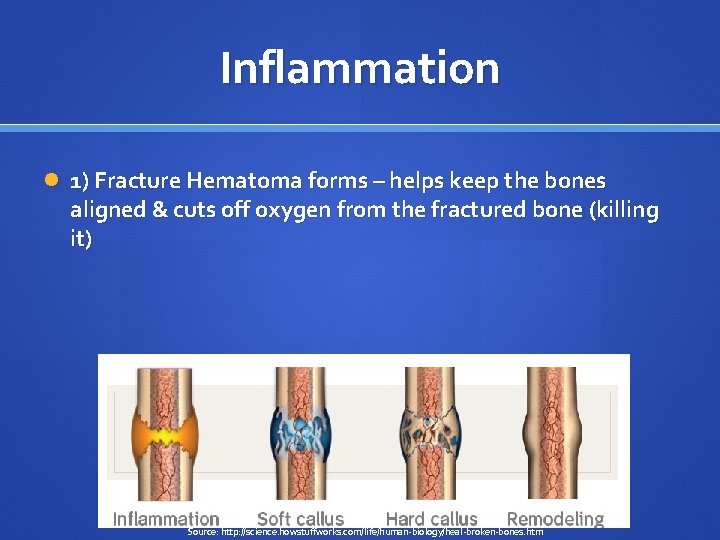
Inflammation 1) Fracture Hematoma forms – helps keep the bones aligned & cuts off oxygen from the fractured bone (killing it) Source: http: //science. howstuffworks. com/life/human-biology/heal-broken-bones. htm
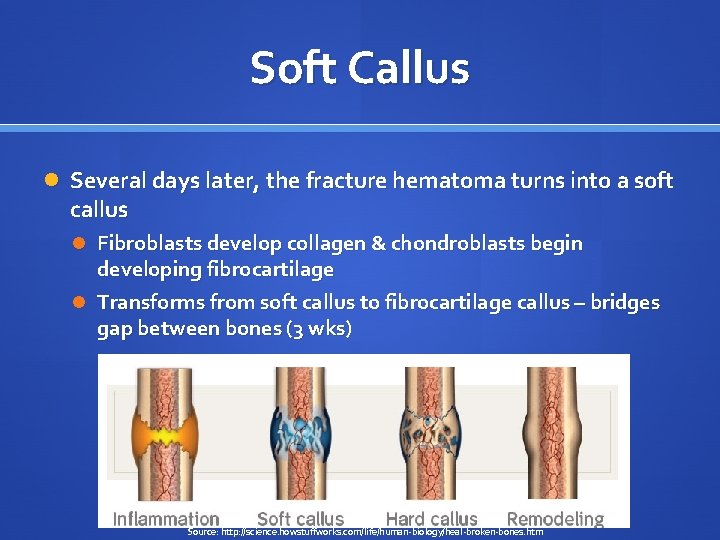
Soft Callus Several days later, the fracture hematoma turns into a soft callus Fibroblasts develop collagen & chondroblasts begin developing fibrocartilage Transforms from soft callus to fibrocartilage callus – bridges gap between bones (3 wks) Source: http: //science. howstuffworks. com/life/human-biology/heal-broken-bones. htm
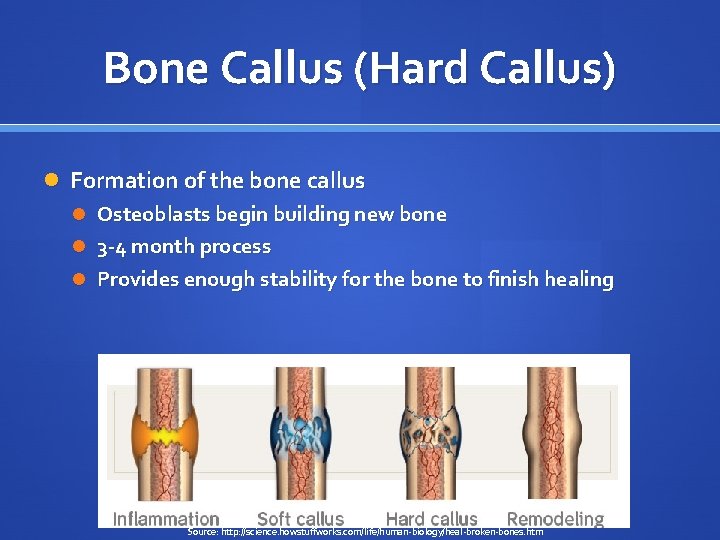
Bone Callus (Hard Callus) Formation of the bone callus Osteoblasts begin building new bone 3 -4 month process Provides enough stability for the bone to finish healing Source: http: //science. howstuffworks. com/life/human-biology/heal-broken-bones. htm
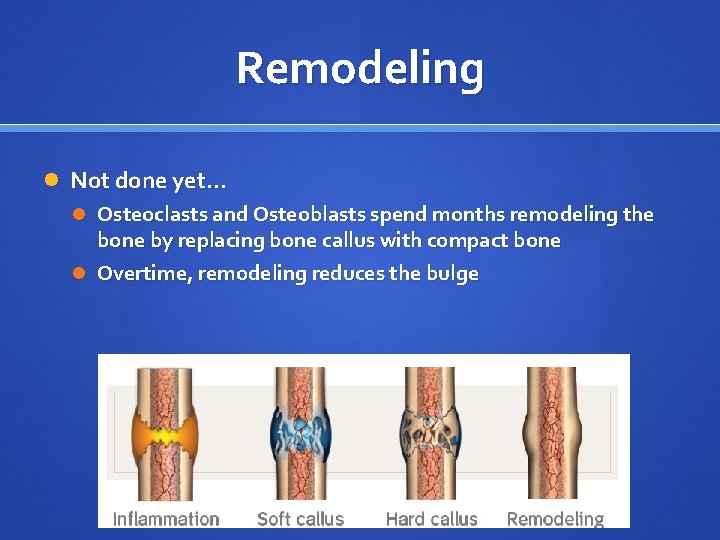
Remodeling Not done yet… Osteoclasts and Osteoblasts spend months remodeling the bone by replacing bone callus with compact bone Overtime, remodeling reduces the bulge
Weight-lifting causes small fractures to occur in our bones, but DON’T panic! These fractures signal osteoclasts to come remove the damaged bone and osteoblasts to build new bone. Overtime, you end up with stronger, healthier bones! Also, remember, the more muscles your have, the more bone you need at your joints to hold those muscles, further strengthening your bones.
Bone Repair and Biomedical Engineering
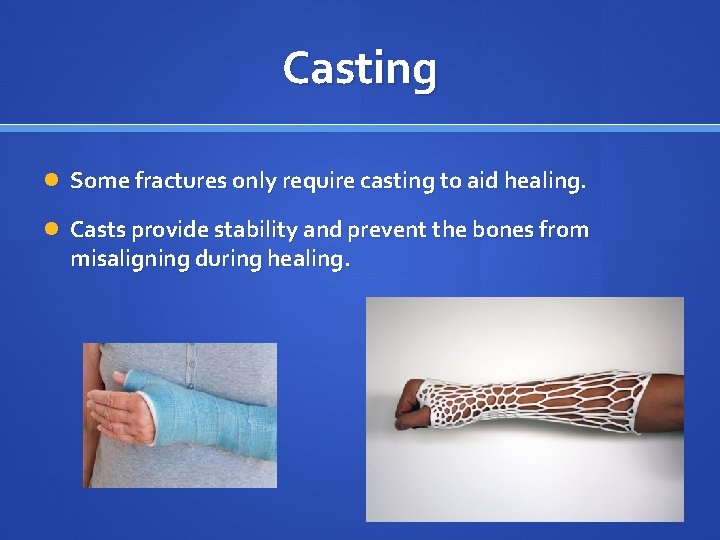
Casting Some fractures only require casting to aid healing. Casts provide stability and prevent the bones from misaligning during healing.
Repairing Bones: Overview Some serious breaks need the aid of engineers because: Need to restore function and position Likely not to heal correctly High risk of infection Very long healing time Biomedical engineers use internal and external fixation approaches While beneficial, added challenges and possible complications exist
Internal vs. External Fixation Internal fixation: External fixation: Temporary or permanent Temporary repair supports fixtures directly attached to the bone under the skin, for alignment and support outside of the skin that stabilize and align bone while the body heals pins screws in bone to hold in place rods or nails metal braces or casts plates can be externally adjusted screws wires grafting
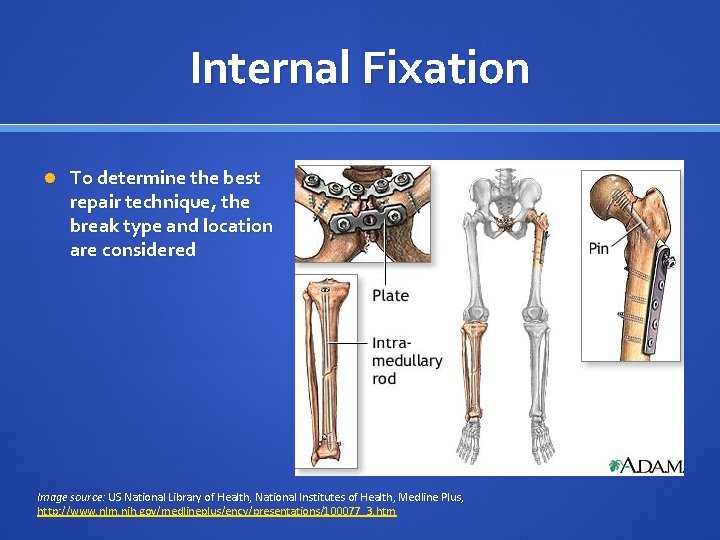
Internal Fixation To determine the best repair technique, the break type and location are considered Image source: US National Library of Health, National Institutes of Health, Medline Plus, http: //www. nlm. nih. gov/medlineplus/ency/presentations/100077_3. htm
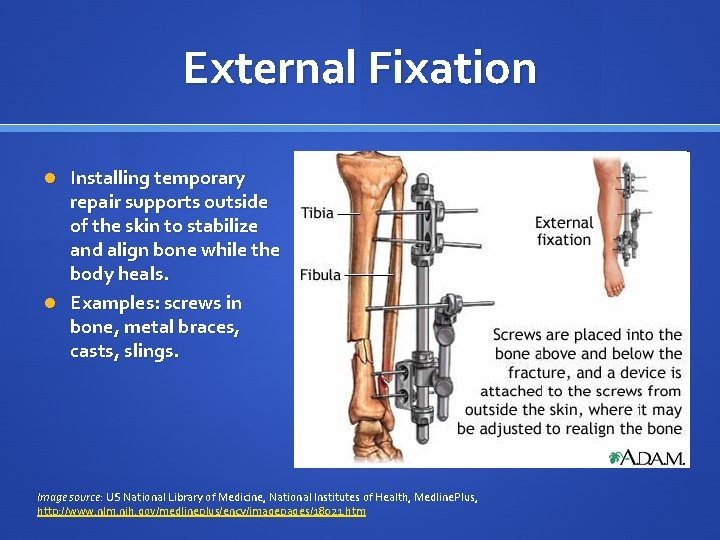
External Fixation Installing temporary repair supports outside of the skin to stabilize and align bone while the body heals. Examples: screws in bone, metal braces, casts, slings. Image source: US National Library of Medicine, National Institutes of Health, Medline. Plus, http: //www. nlm. nih. gov/medlineplus/ency/imagepages/18021. htm
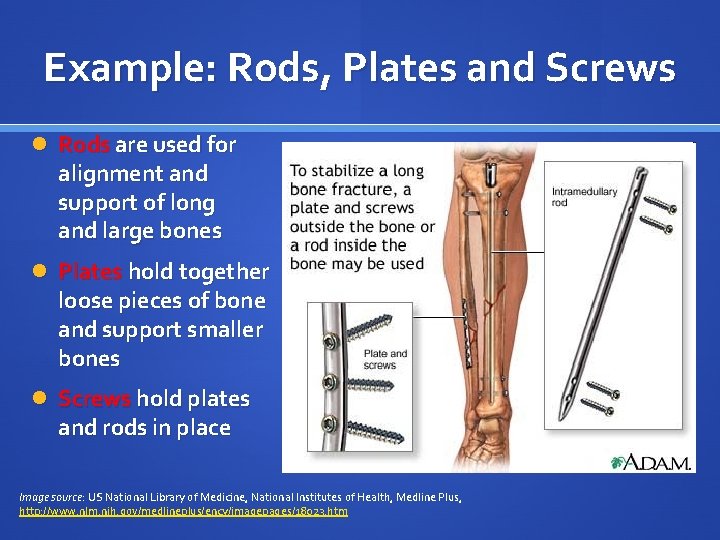
Example: Rods, Plates and Screws Rods are used for alignment and support of long and large bones Plates hold together loose pieces of bone and support smaller bones Screws hold plates and rods in place Image source: US National Library of Medicine, National Institutes of Health, Medline Plus, http: //www. nlm. nih. gov/medlineplus/ency/imagepages/18023. htm
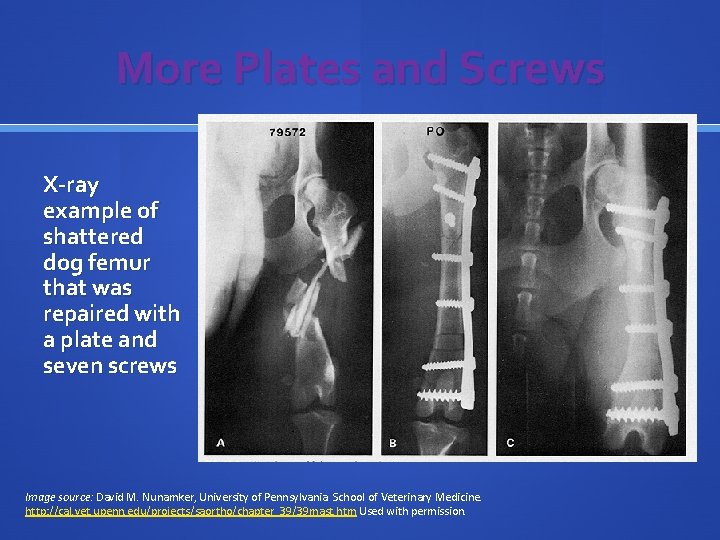
More Plates and Screws X-ray example of shattered dog femur that was repaired with a plate and seven screws Image source: David M. Nunamker, University of Pennsylvania School of Veterinary Medicine. http: //cal. vet. upenn. edu/projects/saortho/chapter_39/39 mast. htm Used with permission.
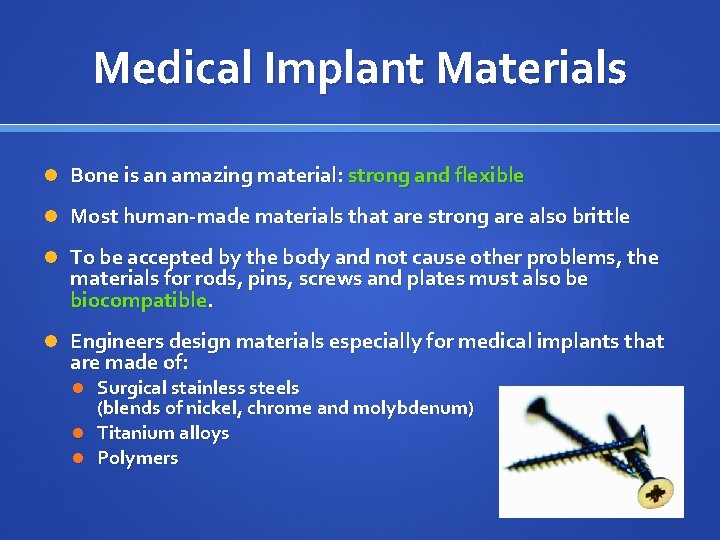
Medical Implant Materials Bone is an amazing material: strong and flexible Most human-made materials that are strong are also brittle To be accepted by the body and not cause other problems, the materials for rods, pins, screws and plates must also be biocompatible. Engineers design materials especially for medical implants that are made of: Surgical stainless steels (blends of nickel, chrome and molybdenum) Titanium alloys Polymers
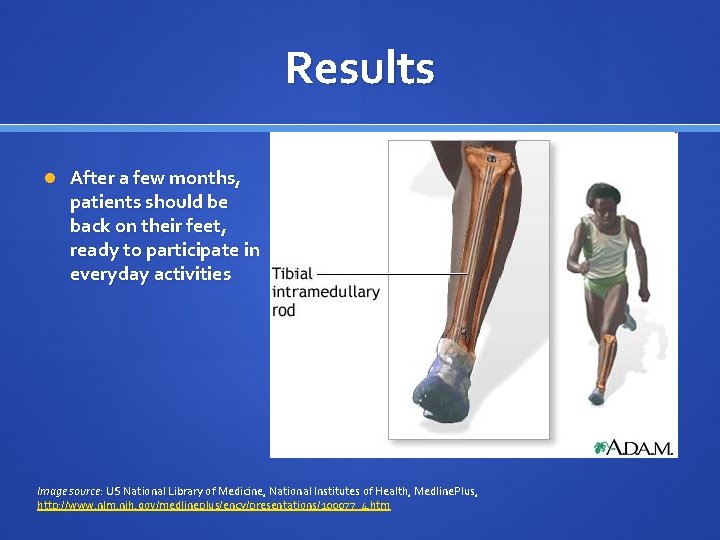
Results After a few months, patients should be back on their feet, ready to participate in everyday activities Image source: US National Library of Medicine, National Institutes of Health, Medline. Plus, http: //www. nlm. nih. gov/medlineplus/ency/presentations/100077_4. htm
Your Design Challenge You will engineer a device to support the broken bone throughout healing. Your device will be tested in the same way the bone was broken. Can you make it stronger? Things to consider: Strong? Minimally invasive? Compatible? Inexpensive? Ease of implementation?
Prediction How many lbs can a chicken bone hold?
Breaking Bones Form a group of 3. Take turns breaking the bones. Convert Kg to lbs. 1 Kg = 2. 20 lbs **Multiply your Kg value by 2. 20 to convert to lbs.
- Slides: 24