
Bone Decalcification and Fracture Strength GW 4 B
Bone Decalcification and Fracture Strength GW 4 B Aims/Objective & Hypothesis: The objective of this lab is to understand how density affects the fracture strength of materials. The central hypothesis is that bones which undergo decalcification will have a statistically significant lower fracture strength when compared to bones with no mineral loss. An extrapolation of this lab is to understand osteoporosis and its adverse effects by simulating similar bone deterioration. University of Pennsylvania Department of Bioengineering

Methods, Protocol & Equipment: • Remove meat from bones. Find the density of all bones by weighing them and using volume displacement. • Randomly select half of the bones (n = 10), place into a small bin and cover them completely with Rapid. Cal Immuno. Leave for half hour. • Using Bio Pac software and the pendulum apparatus, find fracture strengths of the original wood surrogates and the modified wood surrogates. • Find the fracture strength of the control (unmodified) group of bones, record geometry of break point. • Remove bones from Rapid. Cal, and recalculate density. Calculate percent of density lost for each bone. • Find fracture strength of decalcified bones, record geometry of break point. • Compare fracture strength of the two sample groups of wood surrogates. • Compare fracture strength of the two sample groups of bone. University of Pennsylvania Department of Bioengineering
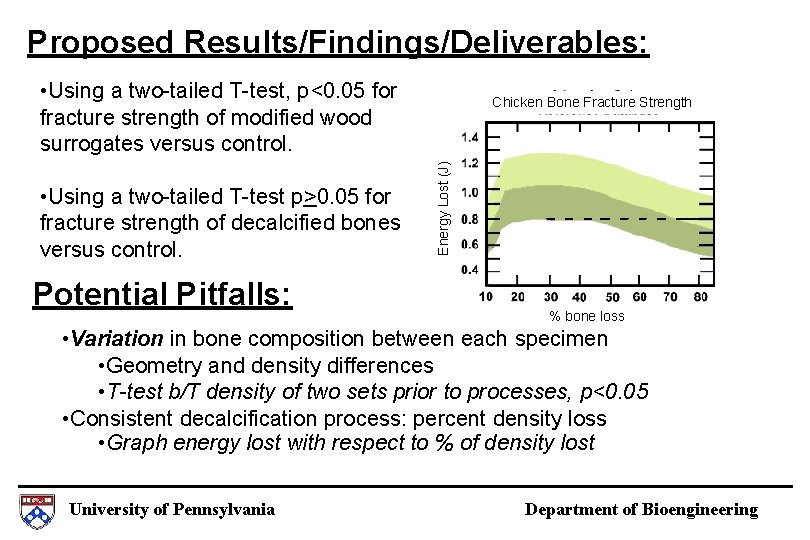
Proposed Results/Findings/Deliverables: • Using a two-tailed T-test, p<0. 05 for fracture strength of modified wood surrogates versus control. Potential Pitfalls: Energy Lost (J) • Using a two-tailed T-test p>0. 05 for fracture strength of decalcified bones versus control. Chicken Bone Fracture Strength % bone loss • Variation in bone composition between each specimen • Geometry and density differences • T-test b/T density of two sets prior to processes, p<0. 05 • Consistent decalcification process: percent density loss • Graph energy lost with respect to % of density lost University of Pennsylvania Department of Bioengineering
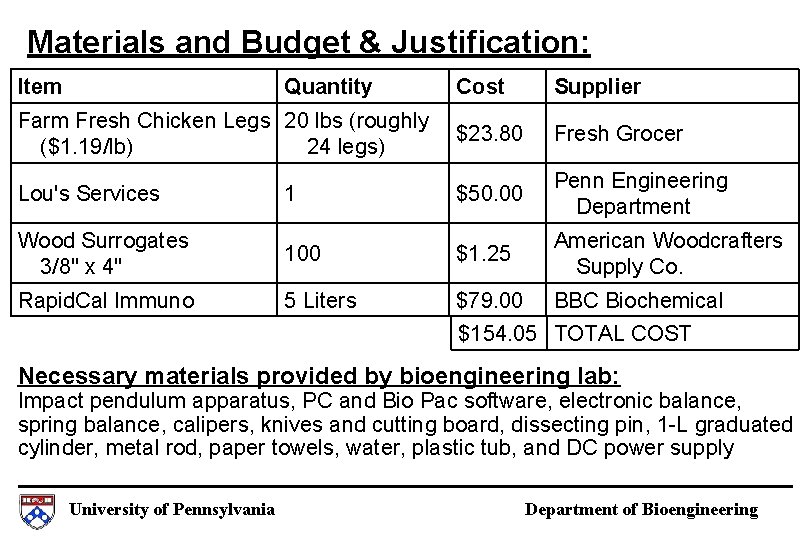
Materials and Budget & Justification: Item Quantity Farm Fresh Chicken Legs 20 lbs (roughly ($1. 19/lb) 24 legs) Lou's Services 1 Cost Supplier $23. 80 Fresh Grocer $50. 00 Penn Engineering Department Wood Surrogates 3/8" x 4" 100 $1. 25 American Woodcrafters Supply Co. Rapid. Cal Immuno 5 Liters $79. 00 BBC Biochemical $154. 05 TOTAL COST Necessary materials provided by bioengineering lab: Impact pendulum apparatus, PC and Bio Pac software, electronic balance, spring balance, calipers, knives and cutting board, dissecting pin, 1 -L graduated cylinder, metal rod, paper towels, water, plastic tub, and DC power supply University of Pennsylvania Department of Bioengineering
- Slides: 4