
Bone Composition Development 5 functions of bones 1
Bone Composition & Development
5 functions of bones: 1. Provide points for attachment of 2. 3. 4. 5. muscles Protect and support softer tissues House blood-producing cells Store in-organic salts Contain passageways for blood vessels & nerves

Structure of a Long bone: Examples: femur, humerus, phalanges What is an Epiphysis? l Expanded portion at the end of each bone l Coated with articular cartilage

What is a diaphysis? Shaft of the bone Periosteum: l Completely encloses bone (except for articular cartilage) l Very tough covering l Helps attach ligaments & tendons l Helps to form & repair bone
What are the 2 types of bone? 1. Compact bone (cortical) l Tightly packed l Walls of diaphysis are made of this l Continuous matrix with no gaps
2. Spongy Bone (cancellous) l Makes up most of the epiphyses l Numerous branching bony plates l Irregular connecting spaces here help reduce bone’s weight
What is the medullary cavity? Semirigid tube with a hollow chamber that forms within the diaphysis l Made up of space & spongy bone

What is the endosteum? Inside layer of cells that line medullary cavity l Bone marrow fills this area
Osteo = bone Bone cells: osteocytes l Where l In are they located? lacunae (chambers that form circles around Haversian (central) canals l Communicate through canaliculi **spongy bone also has osteocytes, etc…. but not in an organized fashion
What is an osteon? An entire cylinder (made up of canals, lacunae)
What is a Volkmann’s canal? Connect Haversian canals to each other

Osteons Central canals Compact Bone Perforating canals Interstitial lamellae
Bones replace 1 of 2 ways: 1. Intramembranous: originate between sheet-like layers of connective tissue Eg: skull bones 2. Endochondral: begin as masses of hyaline cartilage that bone eventually replaces
Osteoblasts: Bone-forming cells Osteoblasts + matrix = osteocytes
Endochondral Bone Development: 1. Cartilage breaks down & disappears in middle of diaphysis l Periosteum forms around diaphysis
2. Primary Ossification Center l Spongy bone replaces broken down cartilage 3. Thin layer of compact bone forms around Primary OC -epiphysis continue to grow
4. Secondary Ossification Center l Spongy grows in all directions within epiphyses
5. Epiphyseal Plate (Growth plate) Band of cartilage that separates Ocs l As cells grow & multiply, the plate thicken, and the bone lengthens l l Osteoclasts = break down bone l Growth continues until epiphyseal plate ossifies
Bone remodeling Process of osteoclasts reabsorbing and osteoblasts replacing the bone
What affects bone growth? 1. Nutrition 2. Exposure to sunlight 3. Hormonal secretions 4. Physical exercise
Why is growth hormone important? Stimulates division of cartilage cells within the epiphyseal (growth) plates -secreted from the pituitary gland
Hematopoiesis: Blood cell formation
Bone Marrow Red Marrow Mainly found in infants Produces blood cells…very important! In adults: in spongy bone of skull, ribs, sternum, clavicle, vertebrae, hip Yellow Marrow Red marrow in infants usually turns into yellow marrow in adults Stores fat Does NOT produce blood cells If deficient blood cells in adults, can possibly turn back into red marrow
How does a fracture heal? 1. Osteoblasts invade area 2. Spongy bone develops 3. Fibrocartilage forms in distant areas (cartilaginous callous) 4. Bony callous forms 5. Osteoclasts remove extra bone, leaving you with one that looks like new
Types of fractures: 1. Open or closed? Complete/incomplete? Open (compound): breaks the skin Closed (simple): does not break the skin Complete: fracture goes all the way through bone Incomplete: fracture does NOT go all the way through bone
2. What type of fracture line? Transverse: straight across; at a right angle Oblique: at an angle Comminuted: bone fragments into many pieces Spiral: spirals around bone Greenstick: incomplete; bone is often bent Stress fracture: hairline break caused by overuse Impacted (buckle) fracture: ends are pushed together 3. Is the bone displaced? Displaced: not in alignment Not displaced: in normal alignment
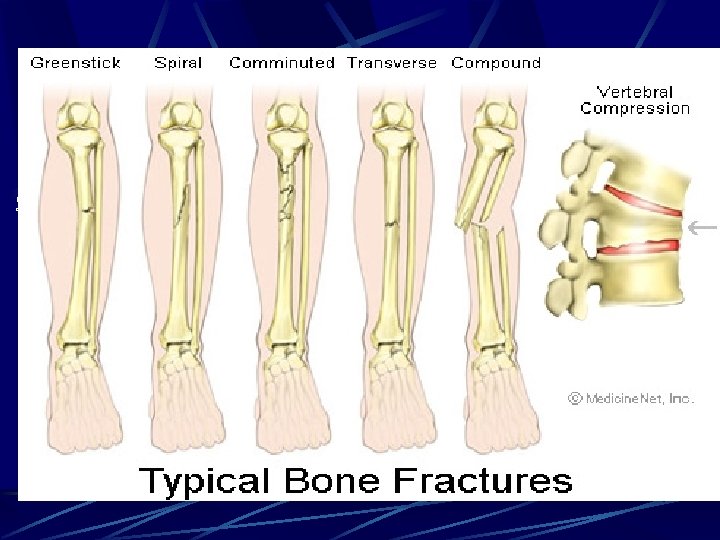
Next, there needs to be a description of the fracture line. Does the fracture line go across the bone ( transverse), at an angle (oblique) or does it spiral? Is the fracture in two pieces or is it comminuted, in multiple pieces?
- Slides: 27