
Bone Basics Functions of bone Provide the body
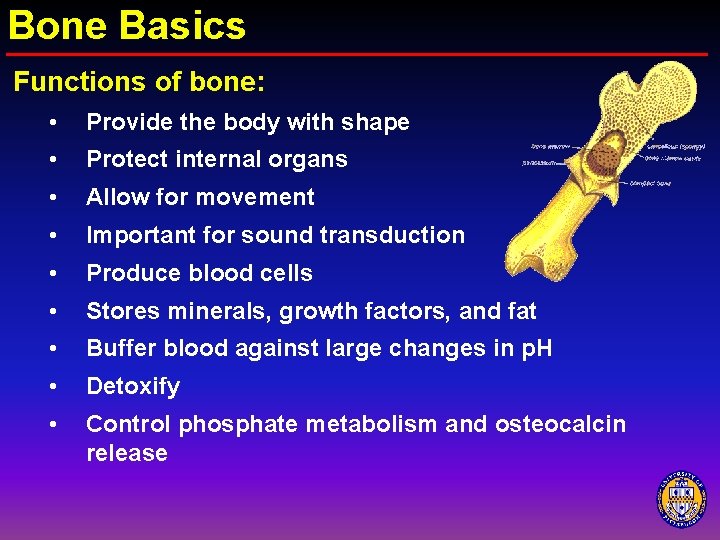
Bone Basics Functions of bone: • Provide the body with shape • Protect internal organs • Allow for movement • Important for sound transduction • Produce blood cells • Stores minerals, growth factors, and fat • Buffer blood against large changes in p. H • Detoxify • Control phosphate metabolism and osteocalcin release
Bone Basics Bone is composed of many tissues: • Osseous tissue – gives rigidity and structure • Marrow – produces new blood cells • Endosteum/periosteum – line the inner and outer surfaces of bone • Nerves – signaling pathway • Blood vessels – transportation of minerals and nutrients • Cartilage – protective connective tissue
Bone Basics There are several different types of bones: • Long – most important with movement. Contact a head (mostly cancellous bone) and a long shaft with a compact bone shell and cancellous center (eg femur). • Short – small and used for complex movements (eg metacarpal). • Flat – protect inner organs (eg ribs or skull plates). • Irregular – odd shaped (eg vertabrae). • Sesamoid – small bones within tendons (eg patella).
Bone Basics Compact/Cortical bone • Dense matrix on outside of bones. Give mechanical strength and provides a surface for ligament and tendon attachment. Makes up 80% of body’s weight. Functional unit is the osteon. Spongey/Trabecular/Cancellous bone • Spongey matrix is site for marrow and blood manufacturing. Shock absorbing. Found in bone centers and in heads of long bones.
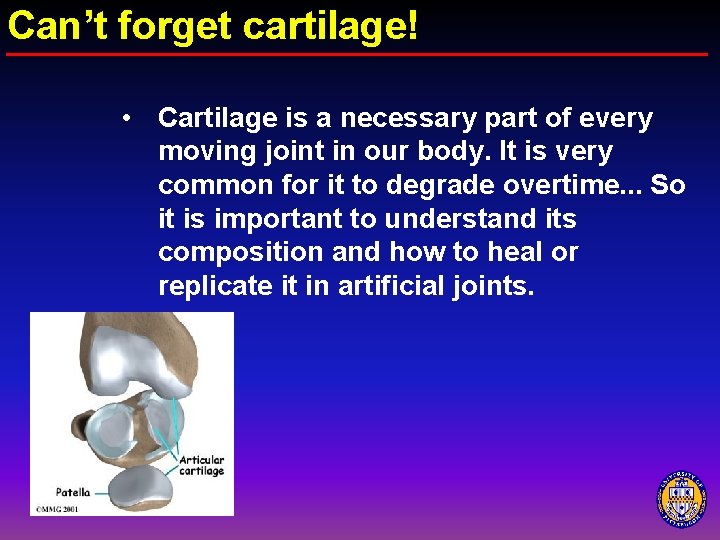
Can’t forget cartilage! • Cartilage is a necessary part of every moving joint in our body. It is very common for it to degrade overtime. . . So it is important to understand its composition and how to heal or replicate it in artificial joints.
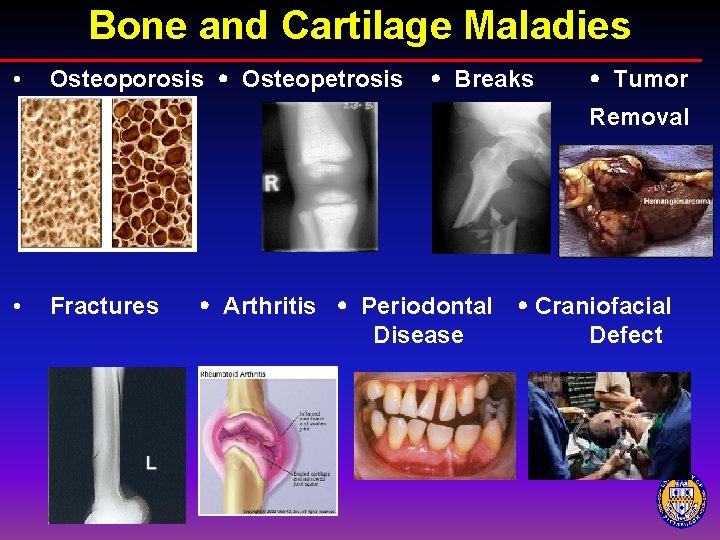
Bone and Cartilage Maladies • Osteoporosis Osteopetrosis Breaks Tumor Removal • Fractures Arthritis Periodontal Disease Craniofacial Defect

BLUE: Section 1 Material friction and joints
Objectives 1. Understand the friction of everyday materials versus a joint’s friction. • Past experiences with slippery materials 2. Graph material interactions, compare to organic materials. • Perform pendulum and force tests, graph results. 3. Understand the current biomaterials field and its contributions. • Look into current materials such as UHMWPE and artificial joints.
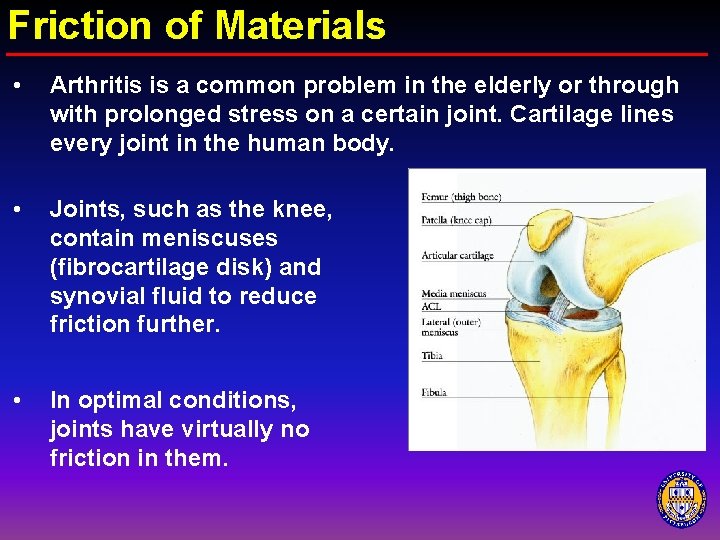
Friction of Materials • Arthritis is a common problem in the elderly or through with prolonged stress on a certain joint. Cartilage lines every joint in the human body. • Joints, such as the knee, contain meniscuses (fibrocartilage disk) and synovial fluid to reduce friction further. • In optimal conditions, joints have virtually no friction in them.
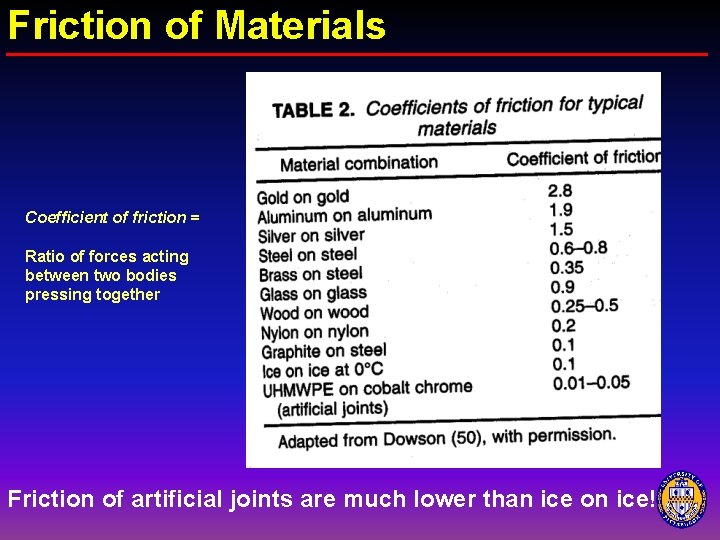
Friction of Materials Coefficient of friction = Ratio of forces acting between two bodies pressing together Friction of artificial joints are much lower than ice on ice!
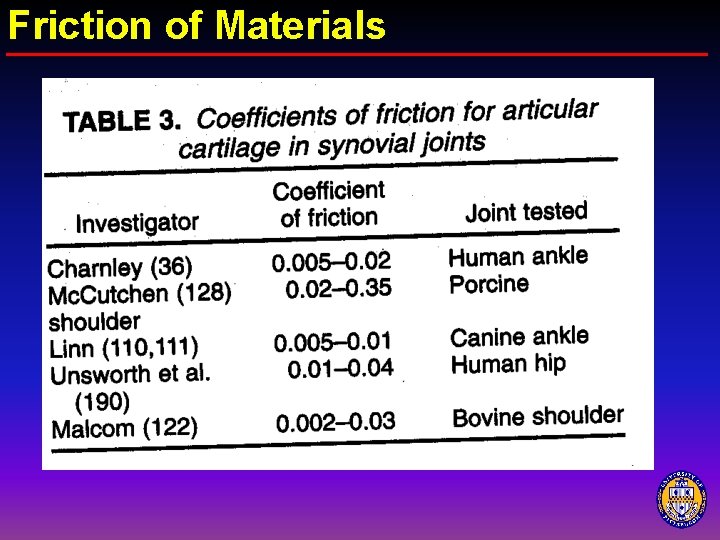
Friction of Materials
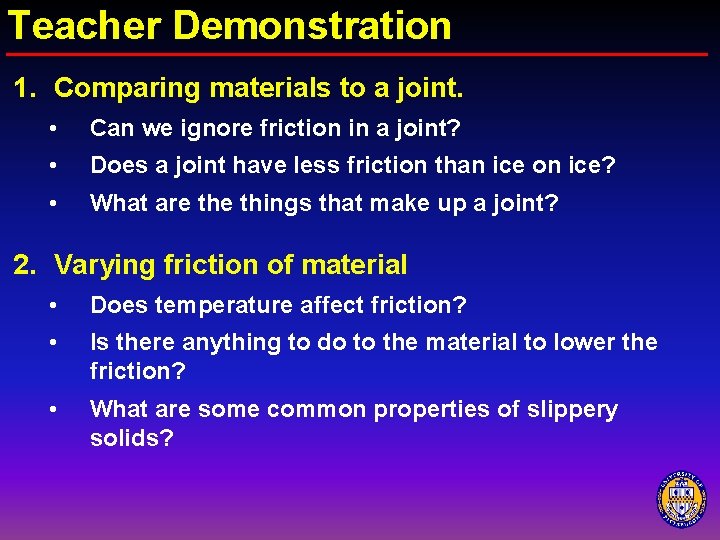
Teacher Demonstration 1. Comparing materials to a joint. • Can we ignore friction in a joint? • Does a joint have less friction than ice on ice? • What are things that make up a joint? 2. Varying friction of material • Does temperature affect friction? • Is there anything to do to the material to lower the friction? • What are some common properties of slippery solids?

Student Activity Goal: Test a variety of materials’ frictions using a pendulum and force pull test to compare what material models a human joint the best.
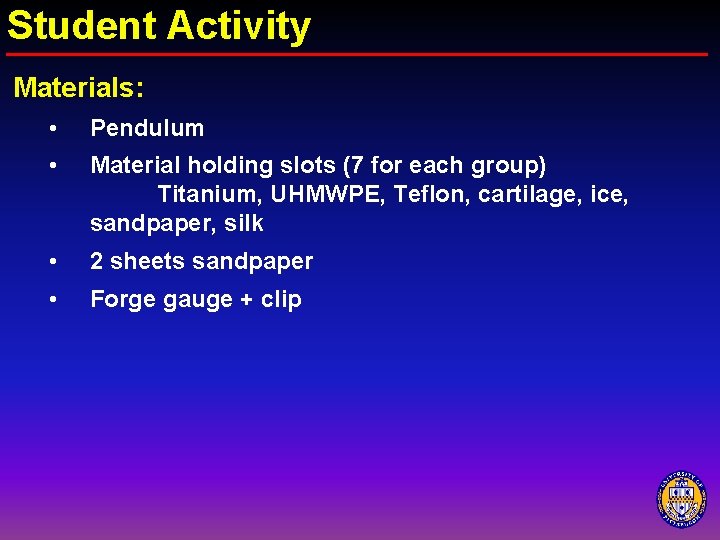
Student Activity Materials: • Pendulum • Material holding slots (7 for each group) Titanium, UHMWPE, Teflon, cartilage, ice, sandpaper, silk • 2 sheets sandpaper • Forge gauge + clip
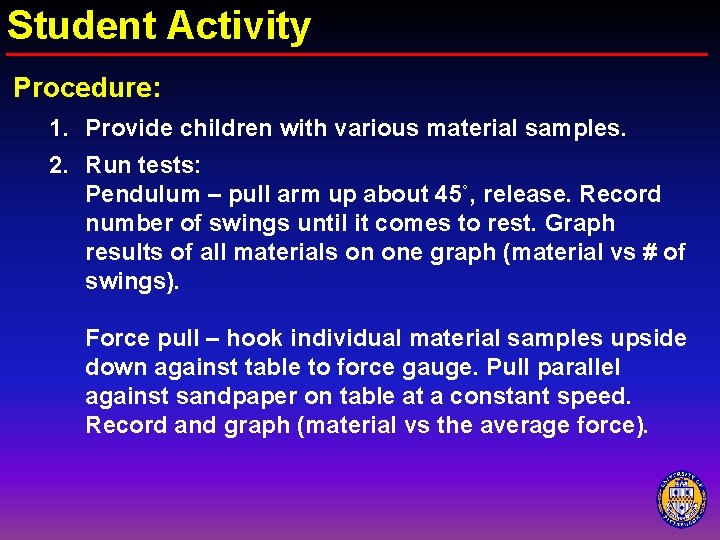
Student Activity Procedure: 1. Provide children with various material samples. 2. Run tests: Pendulum – pull arm up about 45˚, release. Record number of swings until it comes to rest. Graph results of all materials on one graph (material vs # of swings). Force pull – hook individual material samples upside down against table to force gauge. Pull parallel against sandpaper on table at a constant speed. Record and graph (material vs the average force).
Student Activity Questions: • How did the materials compare? • How do the results compare to initial thoughts? • When would certain materials be best to use (besides their friction property)? • What can we combine with these materials to make them better? • Is it possible to make a better a material than something like UHMWPE?

BLUE: Section 2 Grafts
Grafts • When a bone is broken or fractured, it can often be reset in a splint or with metal pins or screws with surgery. However, if a gap remains in a bone over about 1 cm, a bone graft will be needed. A graft can repair holes, deformities, fractures, and areas destroyed by cancer. • 3 types of grafts: Osteogenesis- live osteoblasts from the graft create new bone in the host. Osteoinduction- bone morphogenic factor (BMP) within graft stimulates host’s stem cells to become new bone. Osteoconduction- graft has organic/nonorganic scaffold (matrix) for host cells to build on.
Grafts • Autograft- comes from host’s body. Can come from hip or rib. Con: longer surgery, another site for possible infection, and not enough bone available to use. • Allograft – from a cadaver. Used when large amounts of bone are needed, if the graft is needed in the hip, or if the host’s bone is cancerous and cannot be harvested. Con: possibility for rejection, long integration period into host, and possibility for diseases to be transferred from cadaver.
Student Activity Goal: Show bone grafts as harvested, inserted, and removed.
Student Activity Materials: • Plaster bone with chunks removed • Hip model (hard foam) • Skin colored Foamies to cover bone and hip • Scalpels • Surgeon needles + thread • 500 m. L beaker with colored water.
Student Activity Procedure: 1. Slice open fake hip with scalpel, remove hip chunk. Place aside. 2. Suture hip incision. 3. Reshape removed hip piece to fit hole. Soak piece in “BMP” solution (colored water). 4. Slice open skin above leg injury. Place in graft. Suture closed.

Student Activity Questions: • Was it better to use an allograft or autograph in this situation? • What things need to be considered during healing time? • Where would this kind of graft work/not work?
BLUE: Section 3 Making a plaster bone model + strength test

Objectives 1. Look at bone composition and structure, injuries, and grafts. • Define types of bones and their function. Look at different graft types and insertion process. 2. Build a bone and evaluate each model’s strengths vs weaknesses. • Make a plaster bone with analogous inorganic additives. Perform force tests and analyze reasons for structural failure. 3. Reflect on the necessity of certain structural components. Look into the prosthetic industry. • Give examples of artificial legs and look at final force versus position graphs.
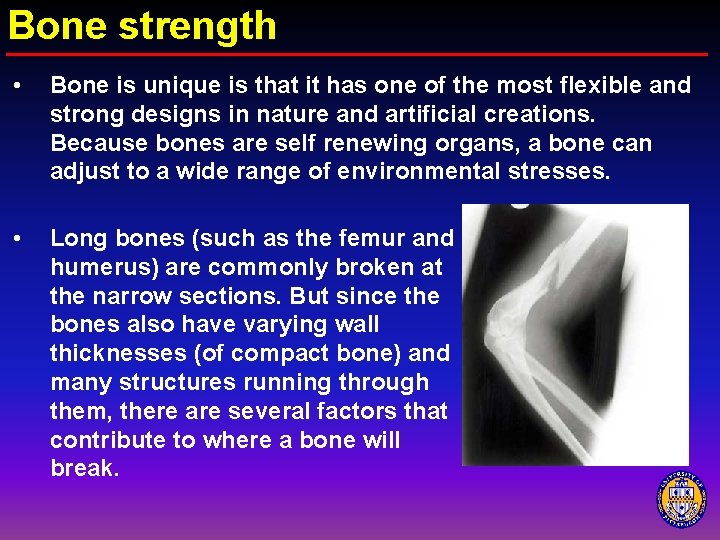
Bone strength • Bone is unique is that it has one of the most flexible and strong designs in nature and artificial creations. Because bones are self renewing organs, a bone can adjust to a wide range of environmental stresses. • Long bones (such as the femur and humerus) are commonly broken at the narrow sections. But since the bones also have varying wall thicknesses (of compact bone) and many structures running through them, there are several factors that contribute to where a bone will break.
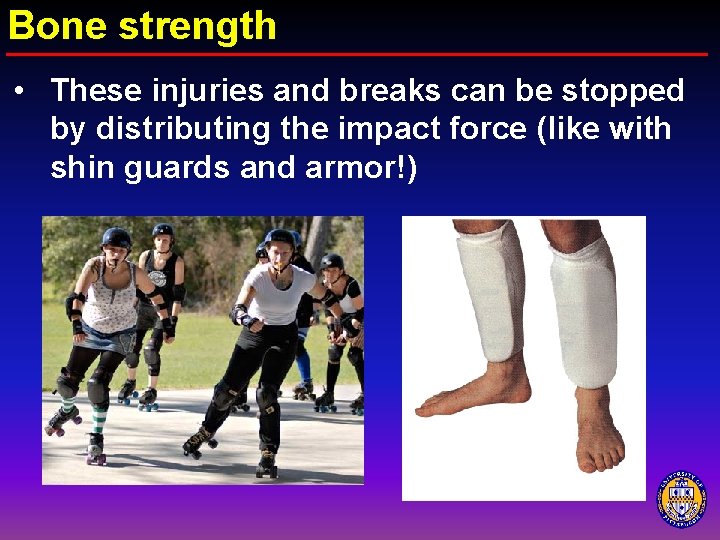
Bone strength • These injuries and breaks can be stopped by distributing the impact force (like with shin guards and armor!)
Student Activity Goal: Make a bone out of plaster and other materials. Test its strength (half with, half without guard)
Student Activity Materials: • Foamies "skin” • Plaster of Paris "compact bone” • Pipecleaners "osteon canals” • Wooden dowel “bone strength substitute” • Thread pieces “collagen” • Bone mold • Scalpel • Weights + bucket (up to 15 kilos) • Flexible acrylic sheet • Electrical tape
Student Activity Procedure: 1. Design strongest bone using limited resources given 2. Fill mold with combo of pipe cleaners, hard foam, dowels and thread pieces. 3. Fill with Plaster of Paris. Cure overnight. 4. Design a shin guard using electrical tape and acrylic sheet. 5. Set up force test. A) - Hang weights from band around bone. Add each weight at timed and equal intervals. B) – Attach shin guard and repeat A. 6. Record time and weight before break for A and B.
Student Activity Questions: • What was the best setup? • How does this compare to a real bone break? • How did the shin guard help? • What other protection could have been used? • How does duration and force affect this situation? What about for a real bone? • What type of force tests should be tried on other types of bones (cranial, pelvis…)?
- Slides: 31