
Bone Anchored Hearing Aids Dr Amir Soltani Clinical
Bone Anchored Hearing Aids Dr. Amir Soltani Clinical Audiologist UBC Resident Otology Lecture Series BC Children Hospital Sep 13, 2013
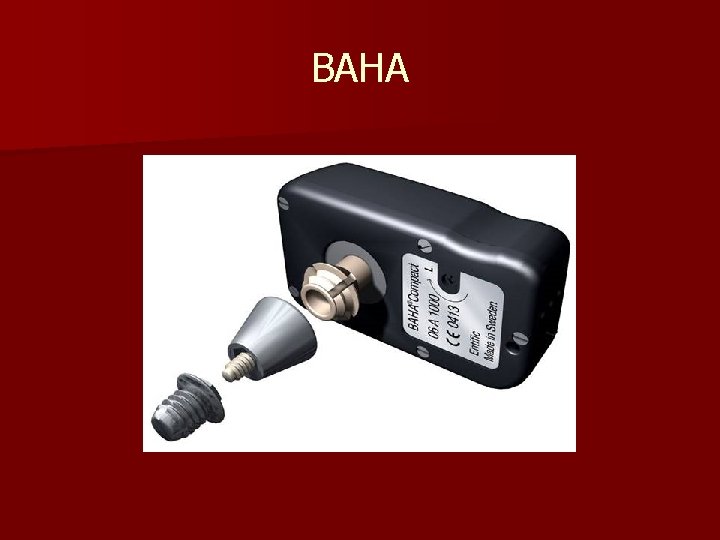
BAHA www. dramirsoltani. com/links/baha n What is the BAHA system n A well recognized hearing treatment for conductive and mixed hearing losses since 1977 , As well as SSD n The BAHA system is composed of three parts: a titanium implant, an external abutment and a sound processor
BAHA
BAHA In the early 1960 s it has discovered that titanium provides an excellent material for implantable devices. Titanium is accepted by the human body and forms a bond with surrounding bone. n This is a process termed “osseointegration, ” which takes place as the titanium implant integrates and forms a permanent structure with the living bone. The process of bone osseointegration is also the foundation for dental implants. . n
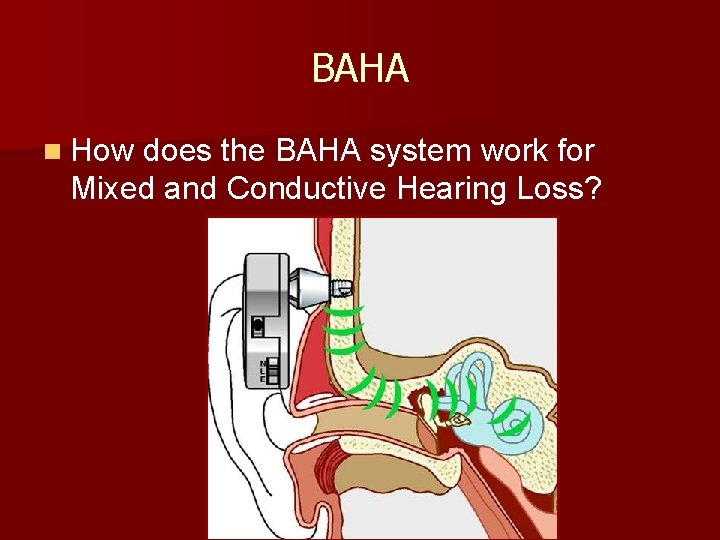
BAHA n How does the BAHA system work for Mixed and Conductive Hearing Loss?

BAHA n n A sound processor picks up sound vibrations. An abutment is attached to the sound processor and the implant. The abutment transfers the sound vibrations from the processor to the implant. n Titanium implant is placed in the mastoid process, where it fuses with the living bone (osseointegration). The implant transfers the sound vibrations to the functioning cochlea. n This creates direct (percutaneous) bone conduction. In contrast, traditional BC hearing aids connect indirectly to the bone through unbroken skin (transcutaneous) and work by exerting pressure against the skull.
BAHA n Types of hearing loss the BAHA system can help n Mixed and Conductive hearing loss – unilateral or bilateral fitting – Due to examples such as: § Chronic otitis media § Congenital atresia § Cholesteatoma § Middle ear dysfunction/disease § External otitis
BAHA n The Baha Sound Processor snaps on to the abutment. The processor is small, discreet and is available in a variety of colors. The volume controls are conveniently located for easy adjustments.
BAHA n BAHA Candidate Mixed and Conductive Hearing Loss n > 5 years of age n < 45 d. B HL BC PTA > or equal to 60% speech discrimination scores n Symmetric bone conduction thresholds are defined as less than 10 d. B difference in average or less than 15 d. B at individual frequencies (0. 5, 1, 2, and 4 Khz)
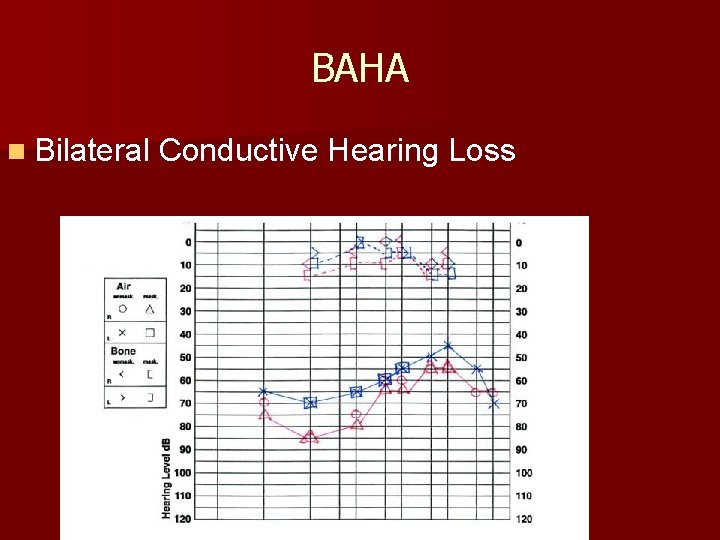
BAHA n Bilateral Conductive Hearing Loss

BAHA n Biateral mixed hearing loss
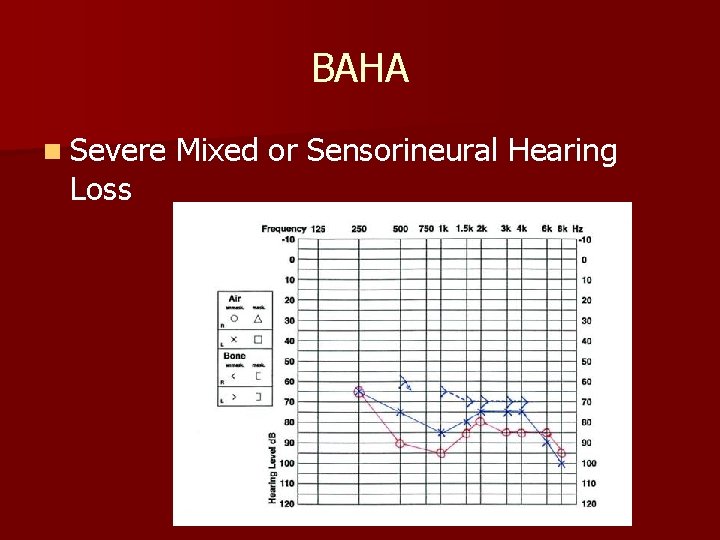
BAHA n Severe Loss Mixed or Sensorineural Hearing
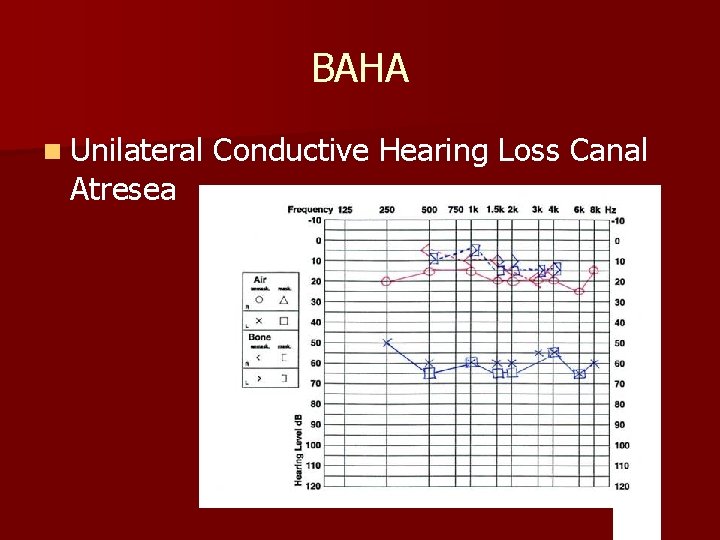
BAHA n Unilateral Atresea Conductive Hearing Loss Canal
BAHA n Audiological n 1: Assessments: Pure tone Audiometry, including AC&BC testing n 2: Speech tests through insert receiver or headphones + Bone vibrator testing n A: SRT B: SDS C: Quick SIN
BAHA n Impedance testing includling: (If possible) Conventional (low probe tone) tympanometry and high probe tone if necessary n Acoustic reflex thresholds, Ipsi & Contra Lateral stimuli n n OAE
BAHA n Test Rod n The test rod is used as a pre-operative device. It is particularly useful for potential candidates who are on the limits of the audiological criteria or if there is uncertainty as to which side to place the implant. The test rod can also be used to demonstrate the abutment, snap coupling and sound processor.
BAHA n Counseling n 1: Introduction ( How it works) n 2: Benefit – Limitation n 3: Documentation & Pre-post fitting assessments Questionnaire (Cosi-Aphab) n 4: Realistic expectation
BAHA n Sound processors from Cochlear n 1: BAHA 3 n 2: BP 100 & BP 110 n 3: BAHA Intenseo n 4: BAHA Davino n 5: BAHA Compact n 6: Classic 300 n 7: Cordell
BAHA n Oticon product n 1: Ponto n 2: Ponto pro n **Programmable, under Noah, 4 memory, 10 band frequency shaping, adaptive multi directional mic, data logging
BAHA n Direct bone conduction Summary: n Works independently of ear canal and middle ear n Direct transmission gives clear sound n Preoperative testing possible n High wearing comfort n Safe and simple surgery
BAHA n Advantages of the BAHA system in comparison to other alternatives Mixed and Conductive Hearing Loss n Over bone conduction devices n More comfortable n Better sound quality n Aesthetic appearance
BAHA n Over n No air conduction devices occlusion of the ear canal n No feedback problems n Sound bypasses the middle ear
BAHA n Over reconstructive surgery n Predictable results n Low risk for the patient n Reversible surgery
BAHA n Disadvantages of other devices Mixed and Conductive Hearing Loss n Bone conduction devices n Discomfort n Poor sound quality n Cumbersome
BAHA n Air conduction devices n Presence of ear mould aggravates infection n Acoustic feedback n Dependent on middle ear function
BAHA n Reconstructive n Potential surgery risk of hearing damage n Less predictable outcome
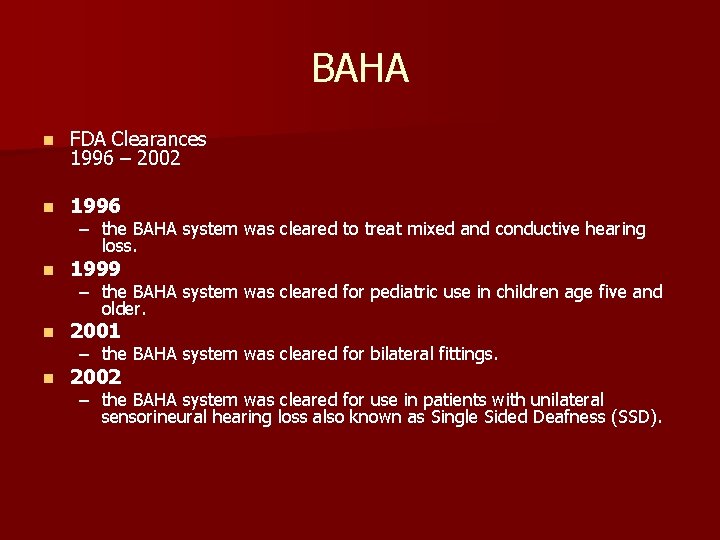
BAHA n FDA Clearances 1996 – 2002 n 1996 n 1999 n 2001 n 2002 – the BAHA system was cleared to treat mixed and conductive hearing loss. – the BAHA system was cleared for pediatric use in children age five and older. – the BAHA system was cleared for bilateral fittings. – the BAHA system was cleared for use in patients with unilateral sensorineural hearing loss also known as Single Sided Deafness (SSD).
BAHA
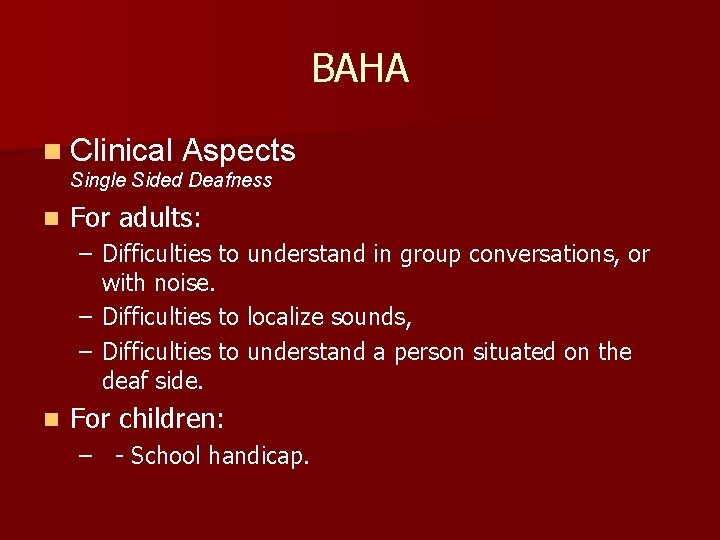
BAHA n Clinical Aspects Single Sided Deafness n For adults: – Difficulties to understand in group conversations, or with noise. – Difficulties to localize sounds, – Difficulties to understand a person situated on the deaf side. n For children: – - School handicap.
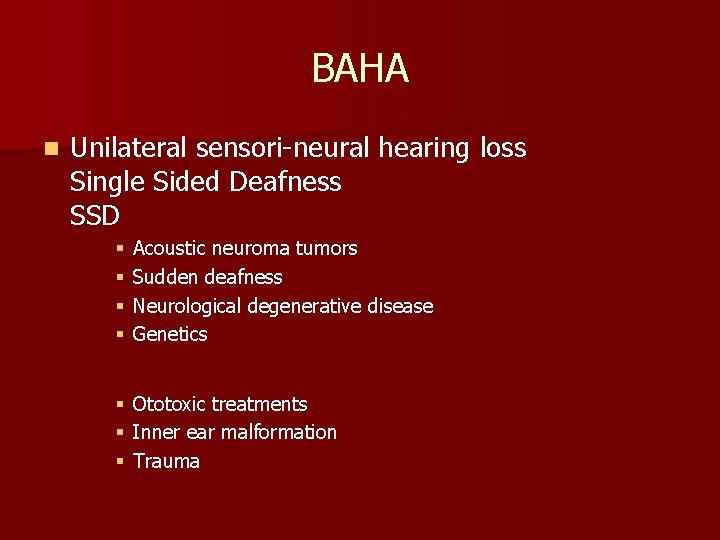
BAHA n Unilateral sensori-neural hearing loss Single Sided Deafness SSD § § Acoustic neuroma tumors Sudden deafness Neurological degenerative disease Genetics § Ototoxic treatments § Inner ear malformation § Trauma
BAHA n n n Options available 1: BAHA, Implanted in the mastoid of poorer ear, transcranial routine of signal 2: Transcranial CROS, BTE or ITE power aid fitted to the poorer ear 3: Trans Ear, Quasi BC fitted to the poorer ear 4: Wireless CROS(Phonak, Unitron) 5: Wired CROS
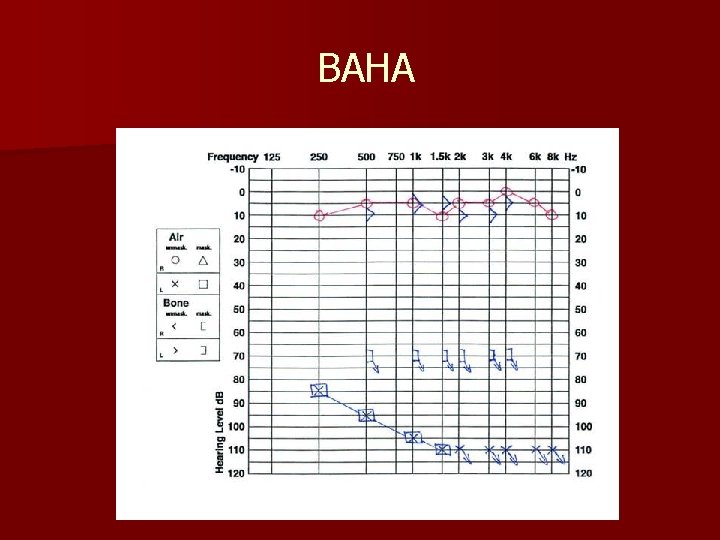
BAHA n BAHA Candidate n > 5 years of age Intended to improve speech recognition Intended for patients with SSD or unilateral sensorineural hearing loss when the other ear is normal Normal hearing is defined as PTA AC threshold equal to or better than 20 d. B at. 5, 1, 2 and 3 k. Hz For patients who cannot or will not use AC CROS HA Functions by transcranial routing of the signal n n n Single Sided Deafness
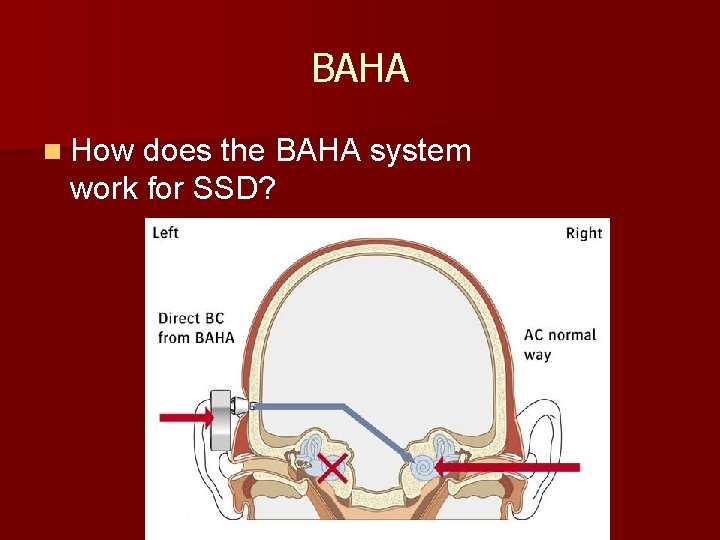
BAHA n How does the BAHA system work for SSD?
BAHA
BAHA n Advantages of the BAHA system in comparison to other alternatives Single Sided Deafness n n n Effective approach in patients with unilateral deafness Alleviates the degree of hearing handicap resulting from the head shadow effect Improves speech intelligibility in noise Improves the patient’s quality of life Provided a greater perceived benefit compared to CROS system
BAHA n Head-shadow Effect n Minimal effect at 1500 Hz, but continues upward to approximately 15 d. B at 5000 Hz (Staab 1988 b) For speech the overall reduction of effective intensity is approximately 6 d. B (Tillman et. al. , 1963) Its effect on speech intelligibility is approximately a reduction of 23% when sound is coming directly from the ‘bad’ ear side. Binaural amplification in eliminating the head shadow effect can be about 25% or 6 d. B improvement in the S/N ratio (from the Handbook of Clinical Audiology, Katz) n n n Review
BAHA n Conclusion Why BAHA for Single Sided Deafness n n n Effective approach in patients with unilateral deafness Alleviates the degree of hearing handicap resulting from the head shadow effect Improves speech intelligibility in noise Improves the patient’s quality of life Provided a greater perceived benefit compared to CROS system
- Slides: 37