
Bonding What are ionic bonds and how are
Bonding
What are ionic bonds, and how are they formed? Computer Lab: Ionic Bonds • Go to http: //www. pbslearningmedia. org/asset/ lsps 07_int_ionicbonding/ • Read each screen and follow the directions where appropriate. • Answer the questions on the screens in your packet.
What are polar and nonpolar covalent bonds, and how are they formed? Computer Lab: Covalent Bonds • Go to http: //www. pbslearningmedia. org/asset/ lsps 07_int_covalentbonding/ • Read each screen and follow the directions where appropriate. • Answer the questions on the screens in your packet.
What are polar and nonpolar covalent bonds, and how are they formed? (Packet Pg 4) Compare/Contrast: Ionic and Covalent Bonds • Differences with regard to: – How are the bonds formed? – What is the charge on the atoms? – How many bonds can be formed between the atoms? – What types of atoms are involved?

What are polar and nonpolar covalent bonds, and how are they formed? Computer Lab: Compound Treasure Hunt • You will receive a set of compounds. For each compound, write the name (from the card), the formula, the common name or purpose, and identify whether or not it contains ionic bonds.
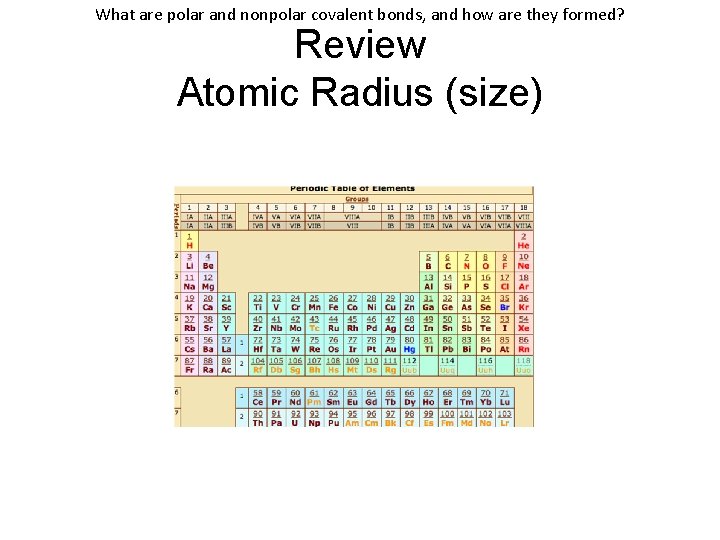
What are polar and nonpolar covalent bonds, and how are they formed? Review Atomic Radius (size)
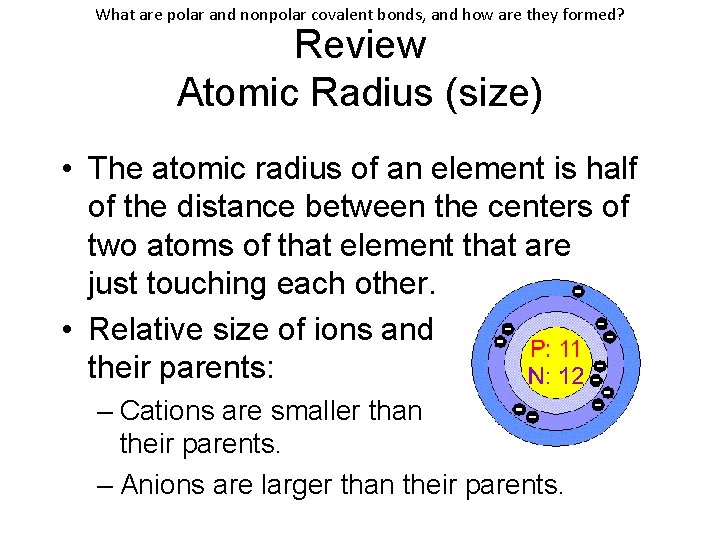
What are polar and nonpolar covalent bonds, and how are they formed? Review Atomic Radius (size) • The atomic radius of an element is half of the distance between the centers of two atoms of that element that are just touching each other. • Relative size of ions and their parents: – Cations are smaller than their parents. – Anions are larger than their parents.
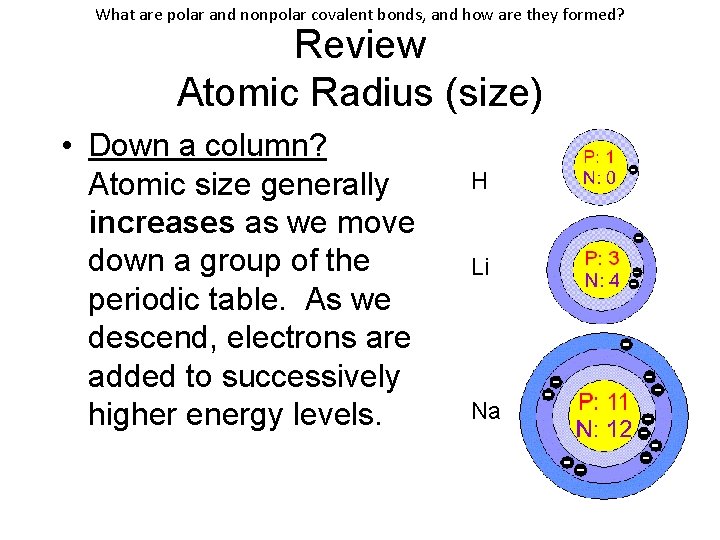
What are polar and nonpolar covalent bonds, and how are they formed? Review Atomic Radius (size) • Down a column? Atomic size generally increases as we move down a group of the periodic table. As we descend, electrons are added to successively higher energy levels. H Li Na
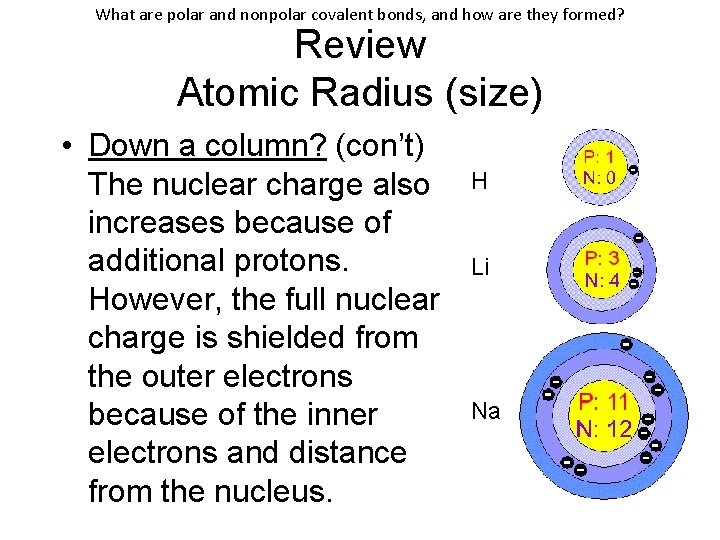
What are polar and nonpolar covalent bonds, and how are they formed? Review Atomic Radius (size) • Down a column? (con’t) The nuclear charge also increases because of additional protons. However, the full nuclear charge is shielded from the outer electrons because of the inner electrons and distance from the nucleus. H Li Na
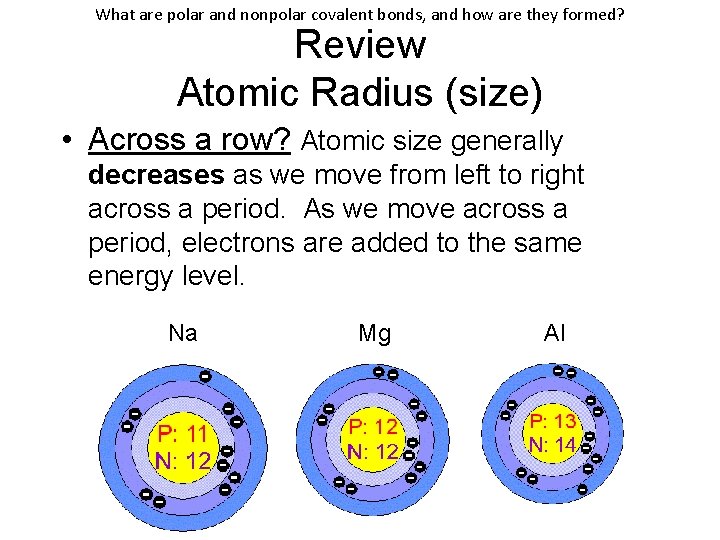
What are polar and nonpolar covalent bonds, and how are they formed? Review Atomic Radius (size) • Across a row? Atomic size generally decreases as we move from left to right across a period. As we move across a period, electrons are added to the same energy level. Na Mg Al
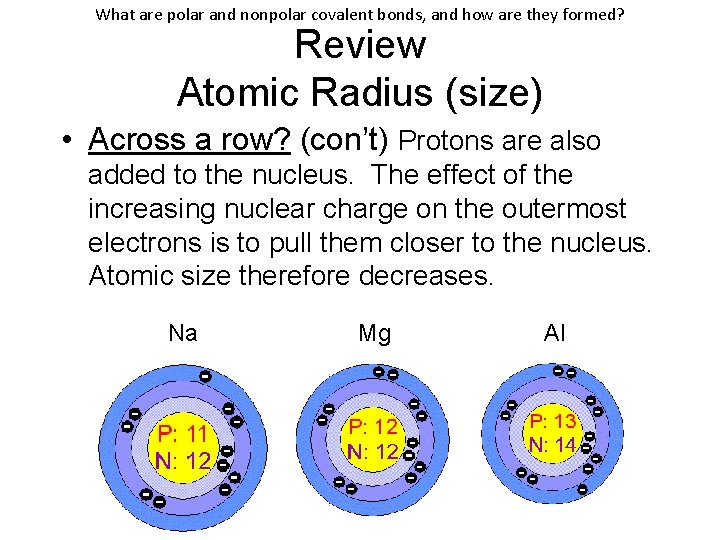
What are polar and nonpolar covalent bonds, and how are they formed? Review Atomic Radius (size) • Across a row? (con’t) Protons are also added to the nucleus. The effect of the increasing nuclear charge on the outermost electrons is to pull them closer to the nucleus. Atomic size therefore decreases. Na Mg Al
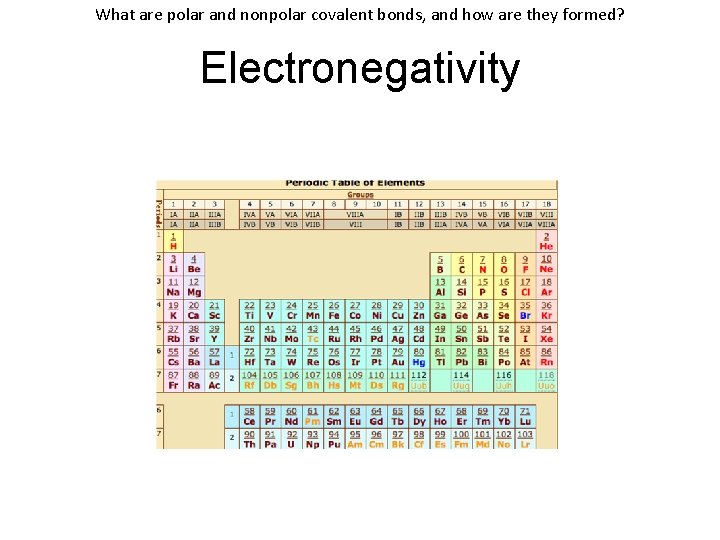
What are polar and nonpolar covalent bonds, and how are they formed? Electronegativity
What are polar and nonpolar covalent bonds, and how are they formed? Electronegativity Ability of an atom in a molecule to attract electrons to itself. It is a measure of how “greedy” an atom is for electrons. Exceptions: Noble gases are not included in this general trend.
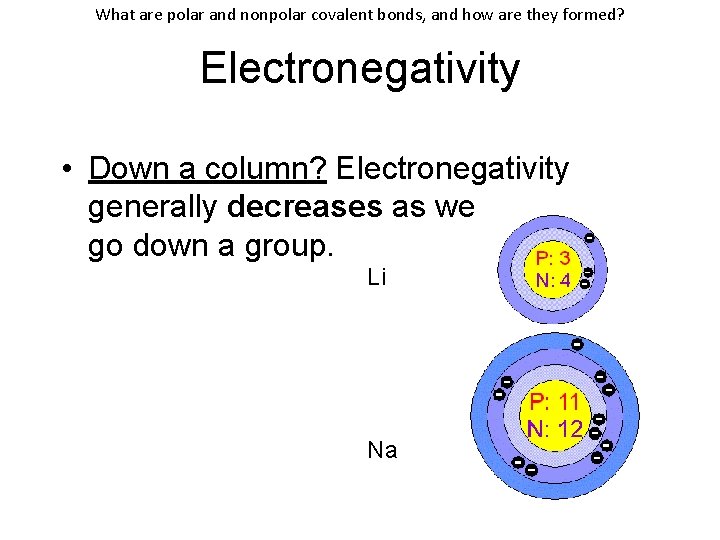
What are polar and nonpolar covalent bonds, and how are they formed? Electronegativity • Down a column? Electronegativity generally decreases as we go down a group. Li Na
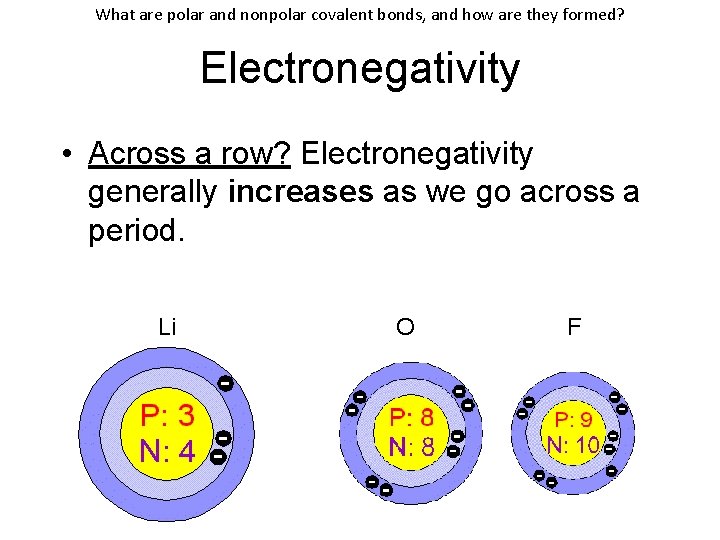
What are polar and nonpolar covalent bonds, and how are they formed? Electronegativity • Across a row? Electronegativity generally increases as we go across a period. Li O F
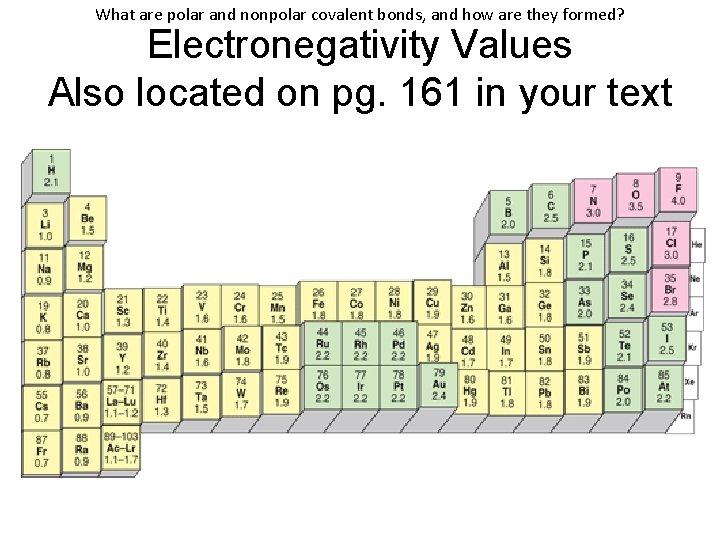
What are polar and nonpolar covalent bonds, and how are they formed? Electronegativity Values Also located on pg. 161 in your text
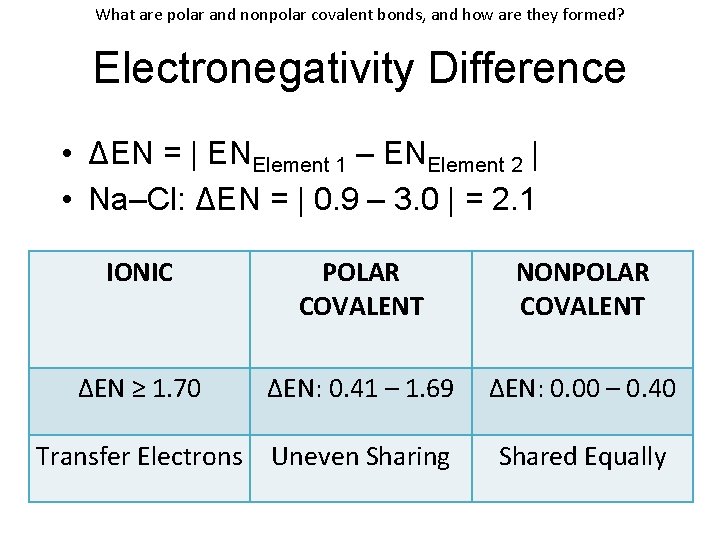
What are polar and nonpolar covalent bonds, and how are they formed? Electronegativity Difference • ΔEN = | ENElement 1 – ENElement 2 | • Na–Cl: ΔEN = | 0. 9 – 3. 0 | = 2. 1 IONIC POLAR COVALENT NONPOLAR COVALENT ΔEN ≥ 1. 70 ΔEN: 0. 41 – 1. 69 ΔEN: 0. 00 – 0. 40 Transfer Electrons Uneven Sharing Shared Equally
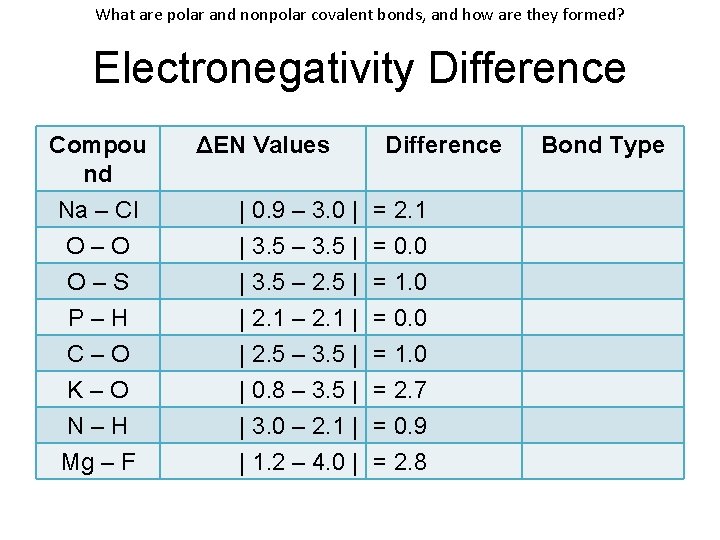
What are polar and nonpolar covalent bonds, and how are they formed? Electronegativity Difference Compou nd Na – Cl O–O O–S P–H C–O K–O N–H Mg – F ΔEN Values | 0. 9 – 3. 0 | | 3. 5 – 3. 5 | | 3. 5 – 2. 5 | | 2. 1 – 2. 1 | | 2. 5 – 3. 5 | | 0. 8 – 3. 5 | | 3. 0 – 2. 1 | | 1. 2 – 4. 0 | Difference = 2. 1 = 0. 0 = 1. 0 = 2. 7 = 0. 9 = 2. 8 Bond Type
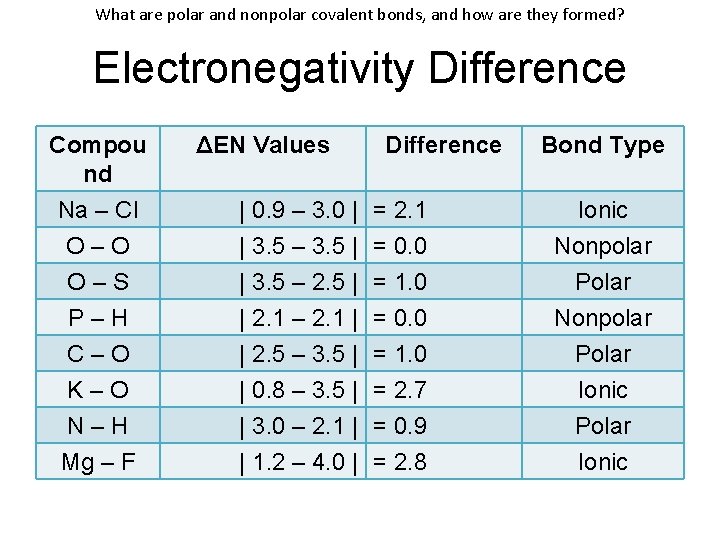
What are polar and nonpolar covalent bonds, and how are they formed? Electronegativity Difference Compou nd Na – Cl O–O O–S P–H C–O K–O N–H Mg – F ΔEN Values | 0. 9 – 3. 0 | | 3. 5 – 3. 5 | | 3. 5 – 2. 5 | | 2. 1 – 2. 1 | | 2. 5 – 3. 5 | | 0. 8 – 3. 5 | | 3. 0 – 2. 1 | | 1. 2 – 4. 0 | Difference = 2. 1 = 0. 0 = 1. 0 = 2. 7 = 0. 9 = 2. 8 Bond Type Ionic Nonpolar Polar Ionic
What are polar and nonpolar covalent bonds, and how are they formed? Dipole Moments • Represents the atom’s polarity magnitude and direction (+ –)
What are polar and nonpolar covalent bonds, and how are they formed? Dipole Moments • Khan Academy: • https: //www. khanacademy. org/science/organ ic-chemistry/gen-chemreview/electronegativity-polarity/v/dipolemoment
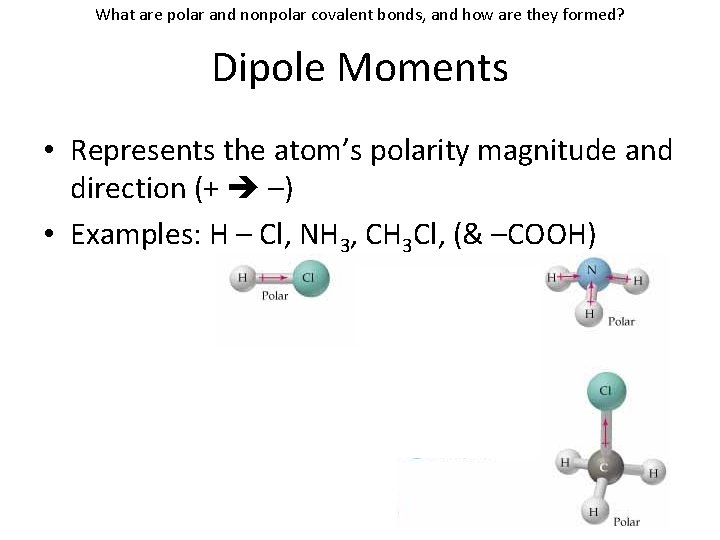
What are polar and nonpolar covalent bonds, and how are they formed? Dipole Moments • Represents the atom’s polarity magnitude and direction (+ –) • Examples: H – Cl, NH 3, CH 3 Cl, (& –COOH)
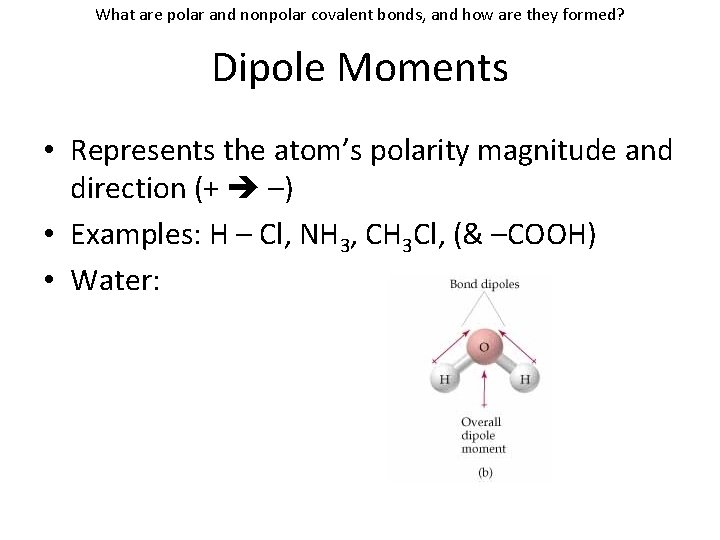
What are polar and nonpolar covalent bonds, and how are they formed? Dipole Moments • Represents the atom’s polarity magnitude and direction (+ –) • Examples: H – Cl, NH 3, CH 3 Cl, (& –COOH) • Water:
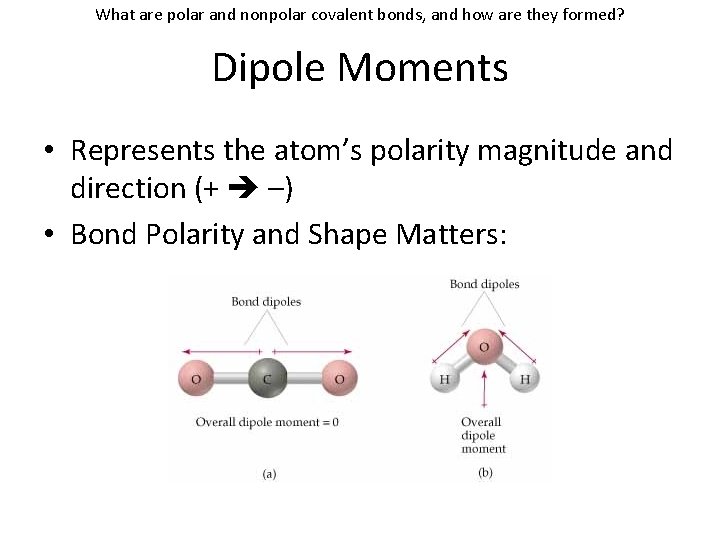
What are polar and nonpolar covalent bonds, and how are they formed? Dipole Moments • Represents the atom’s polarity magnitude and direction (+ –) • Bond Polarity and Shape Matters:
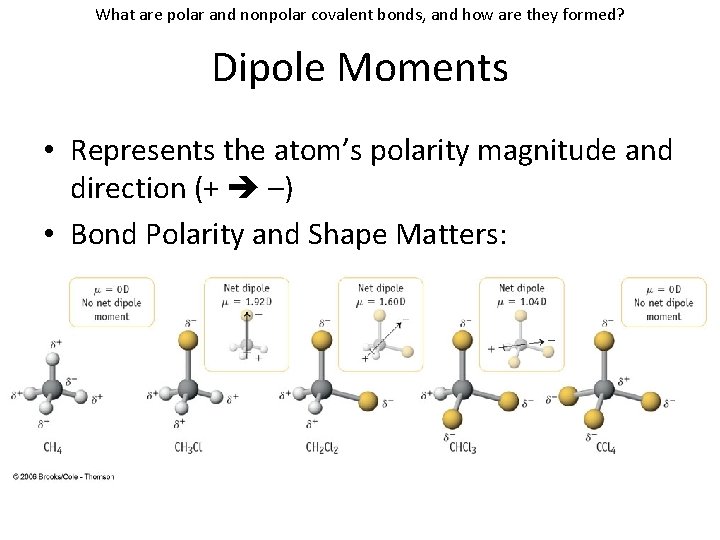
What are polar and nonpolar covalent bonds, and how are they formed? Dipole Moments • Represents the atom’s polarity magnitude and direction (+ –) • Bond Polarity and Shape Matters:
What are polar and nonpolar covalent bonds, and how are they formed? Compare & Contrast: Polar & Nonpolar Covalent • Differences with regard to: – Electronegativity Difference – Polar Positive and Polar Negative Side WRT Electronegativity – Can it have Permanent Dipole Moment? – Effect of Molecule Shape
What are polar and nonpolar covalent bonds, and how are they formed? REVIEW • Bonds involve electrons.
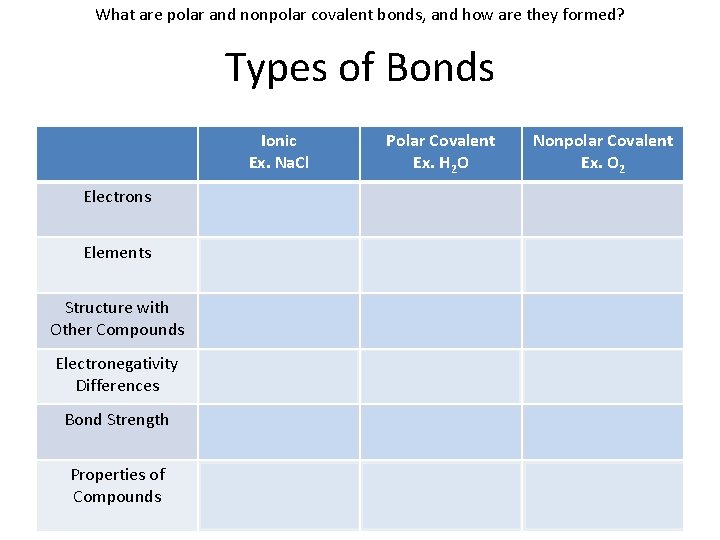
What are polar and nonpolar covalent bonds, and how are they formed? Types of Bonds Ionic Ex. Na. Cl Polar Covalent Ex. H 2 O Nonpolar Covalent Ex. O 2 Electrons Transferred Elements Metals & Nonmetals Structure with Other Compounds Fixed Solid Crystals Random Close Arrangement No Structure Bond Strength Strong Inter: Moderate Intra: Weak Inter: Weak Intra: Weak Properties of Compounds Conducts Electricity High Melting Point Dissolves Ions; Moderate Melting Point Does not mix with polar cmpds; Low Melting Point Electronegativity Differences
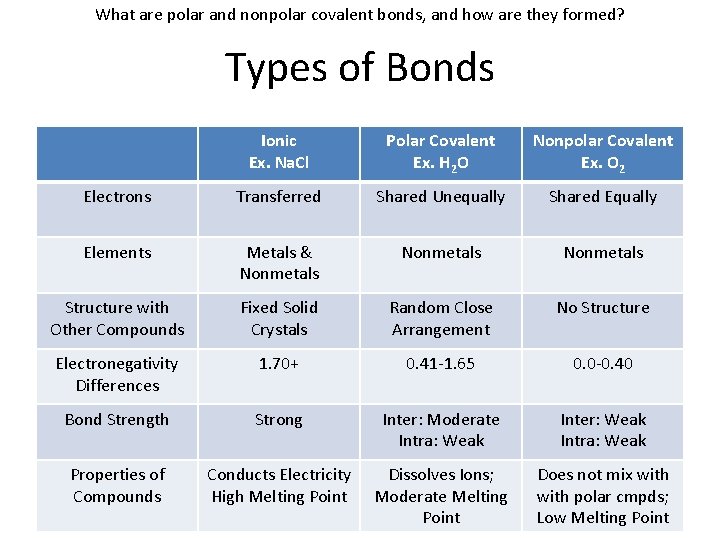
What are polar and nonpolar covalent bonds, and how are they formed? Types of Bonds Ionic Ex. Na. Cl Polar Covalent Ex. H 2 O Nonpolar Covalent Ex. O 2 Electrons Transferred Shared Unequally Shared Equally Elements Metals & Nonmetals Structure with Other Compounds Fixed Solid Crystals Random Close Arrangement No Structure Electronegativity Differences 1. 70+ 0. 41 -1. 65 0. 0 -0. 40 Bond Strength Strong Inter: Moderate Intra: Weak Inter: Weak Intra: Weak Properties of Compounds Conducts Electricity High Melting Point Dissolves Ions; Moderate Melting Point Does not mix with polar cmpds; Low Melting Point
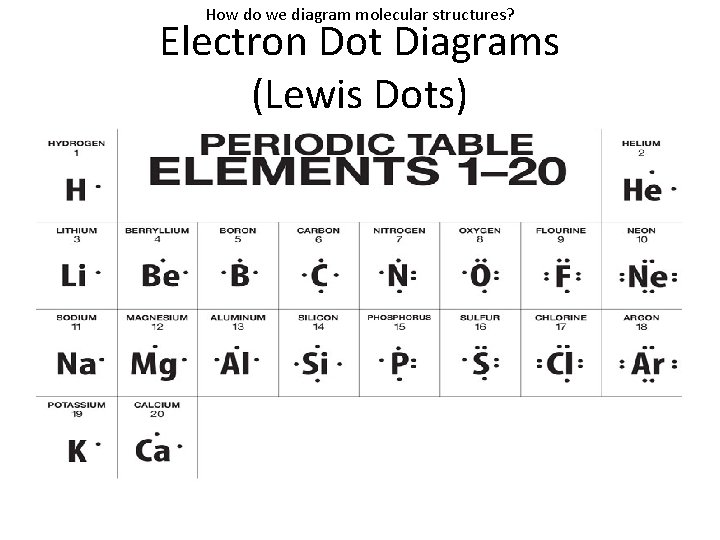
How do we diagram molecular structures? Electron Dot Diagrams (Lewis Dots)
How do we diagram molecular structures? Steps for Writing Lewis Dots 1. Obtain the sum of the valence electrons from all of the atoms. Do not worry about keeping track of which electrons come from which atoms. It is the total number of valence electrons that is important.
How do we diagram molecular structures? Steps for Writing Lewis Dots 2. Use one pair of electrons to form a bond between each pair of bound atoms. For convenience, a line (instead of a pair of dots) is often used to indicate each pair of bonding electrons.
How do we diagram molecular structures? Steps for Writing Lewis Dots 3. Arrange the remaining electrons to satisfy the duet rule for hydrogen and the octet rule for each second-row element. (Ex. SO 42 -; NH 41+)
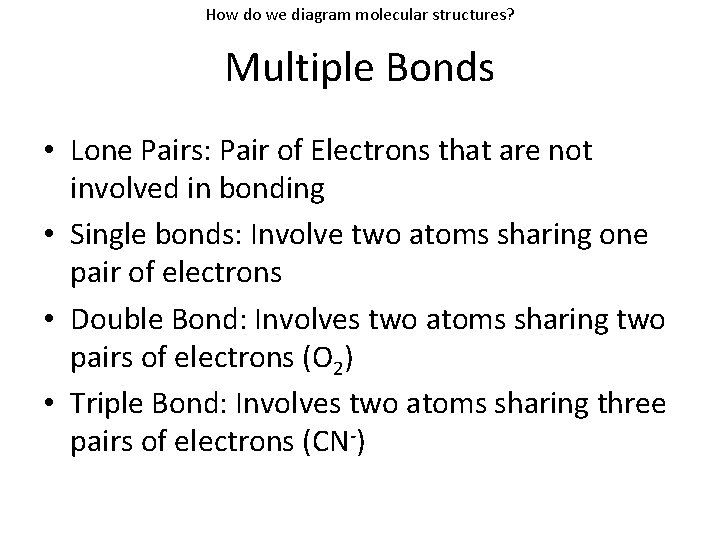
How do we diagram molecular structures? Multiple Bonds • Lone Pairs: Pair of Electrons that are not involved in bonding • Single bonds: Involve two atoms sharing one pair of electrons • Double Bond: Involves two atoms sharing two pairs of electrons (O 2) • Triple Bond: Involves two atoms sharing three pairs of electrons (CN-)
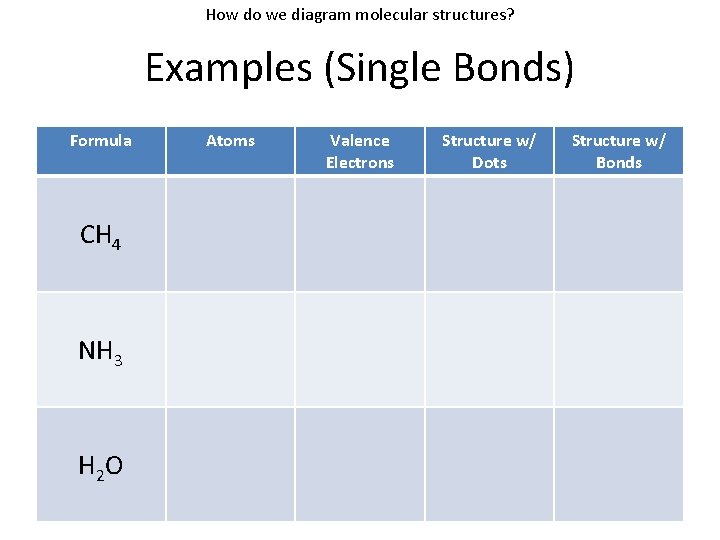
How do we diagram molecular structures? Examples (Single Bonds) Formula CH 4 NH 3 H 2 O Atoms Valence Electrons Structure w/ Dots Structure w/ Bonds
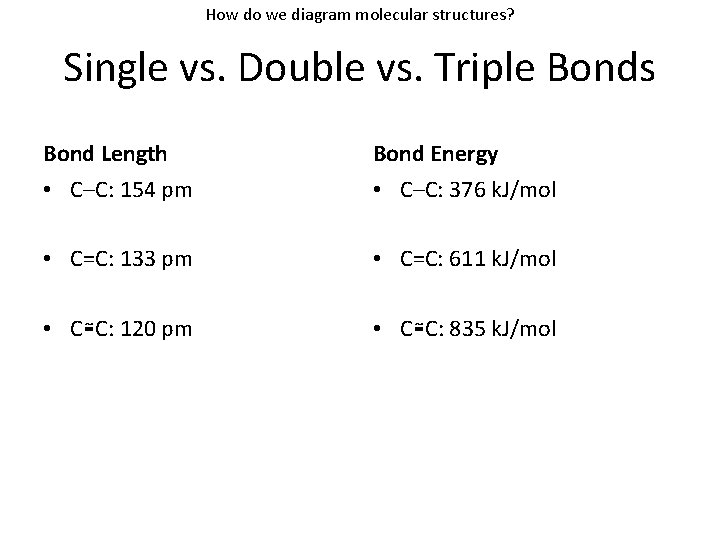
How do we diagram molecular structures? Single vs. Double vs. Triple Bonds Bond Length Bond Energy • C–C: 154 pm • C–C: 376 k. J/mol • C=C: 133 pm • C=C: 611 k. J/mol • C≅C: 120 pm • C≅C: 835 k. J/mol
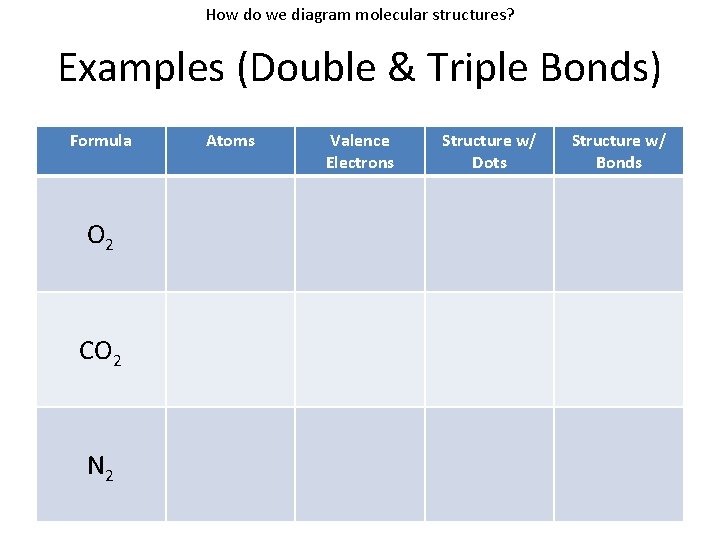
How do we diagram molecular structures? Examples (Double & Triple Bonds) Formula O 2 CO 2 N 2 Atoms Valence Electrons Structure w/ Dots Structure w/ Bonds
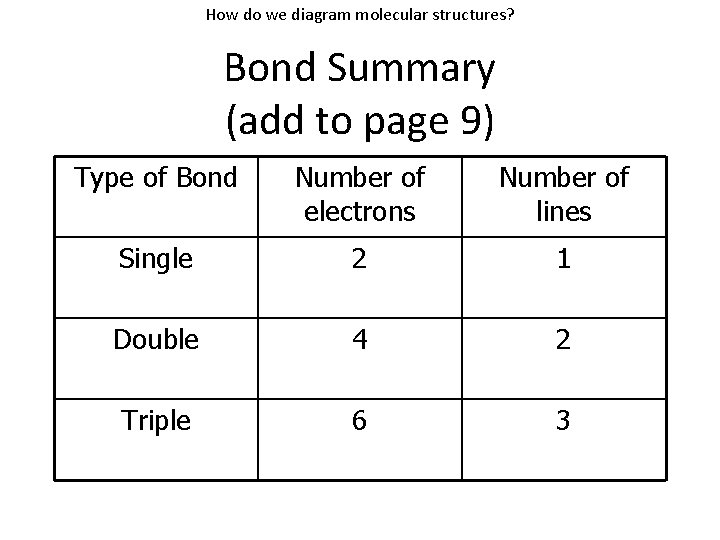
How do we diagram molecular structures? Bond Summary (add to page 9) Type of Bond Number of electrons Number of lines Single 2 1 Double 4 2 Triple 6 3
How do we diagram molecular structures? Polyatomic Ions
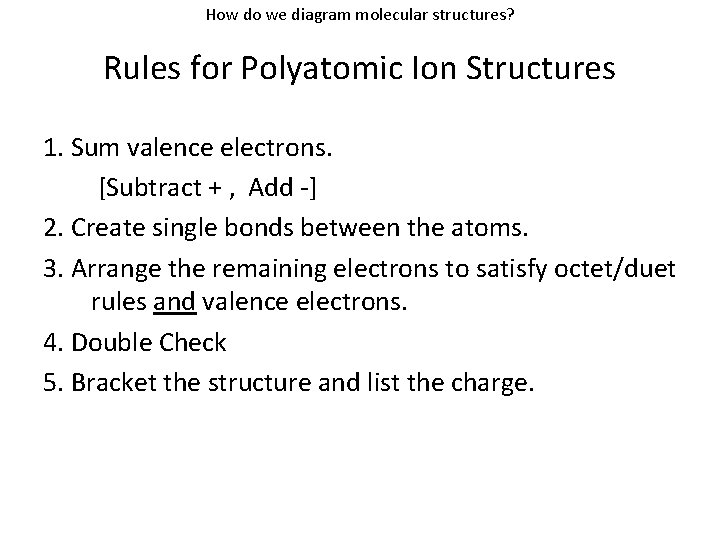
How do we diagram molecular structures? Rules for Polyatomic Ion Structures 1. Sum valence electrons. [Subtract + , Add -] 2. Create single bonds between the atoms. 3. Arrange the remaining electrons to satisfy octet/duet rules and valence electrons. 4. Double Check 5. Bracket the structure and list the charge.
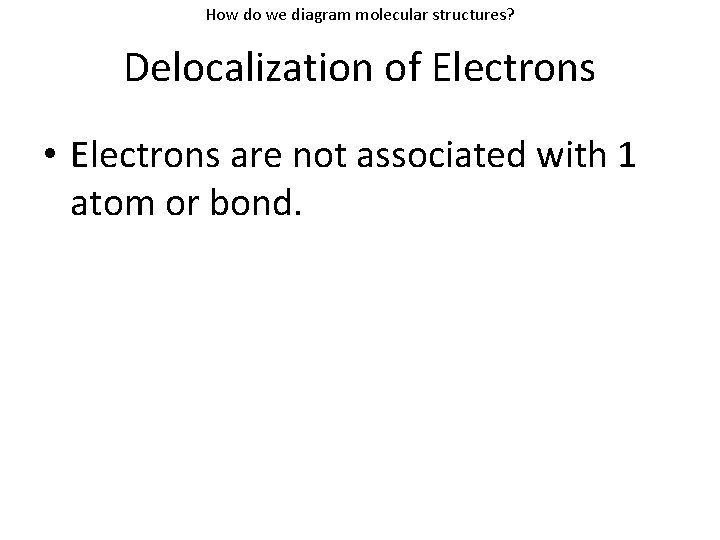
How do we diagram molecular structures? Delocalization of Electrons • Electrons are not associated with 1 atom or bond.
How do we diagram molecular structures? Polyatomic Ions A group of covalently bonded atoms with an overall charge.
How do we diagram molecular structures? Resonance • Resonance: Having more than one Lewis structure that can be drawn for the molecule. • Examples: CO 2 • Resonance structures – The individual resonance forms. – Separated by a double headed arrow
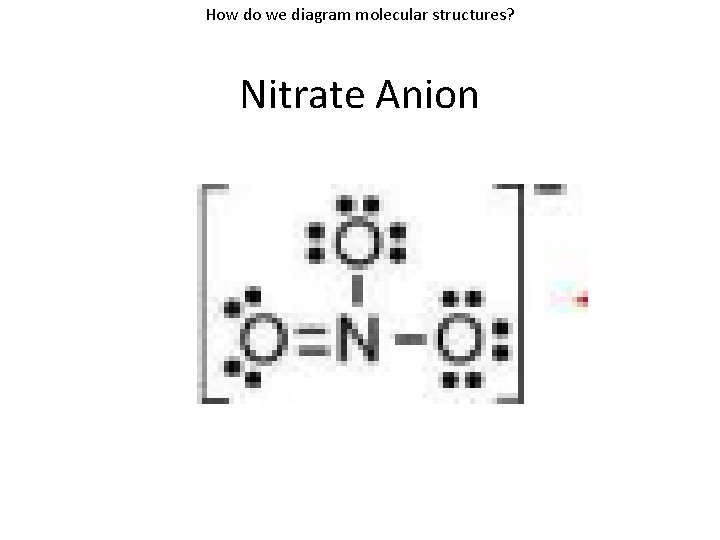
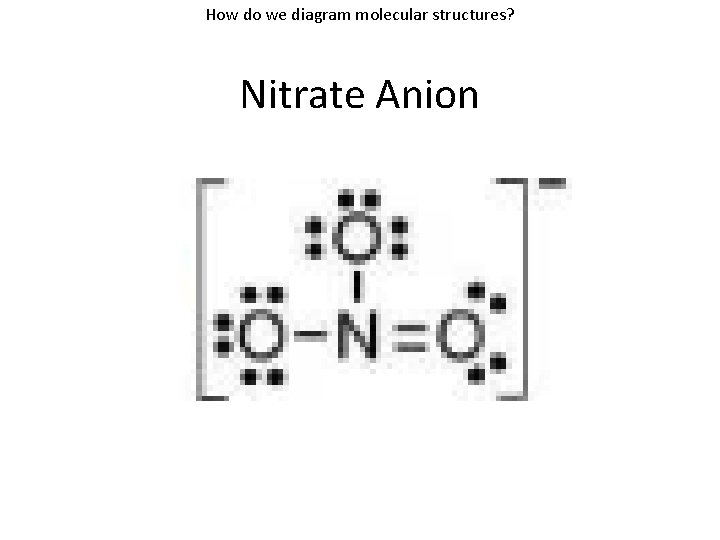
How do we diagram molecular structures? Examples • Hydroxide • Ammonium • Carbonate • Nitrate
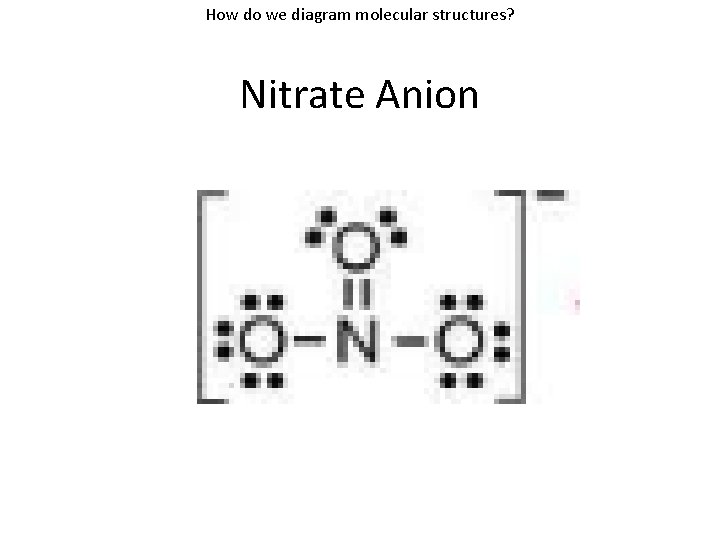
How do we diagram molecular structures? Nitrate Anion
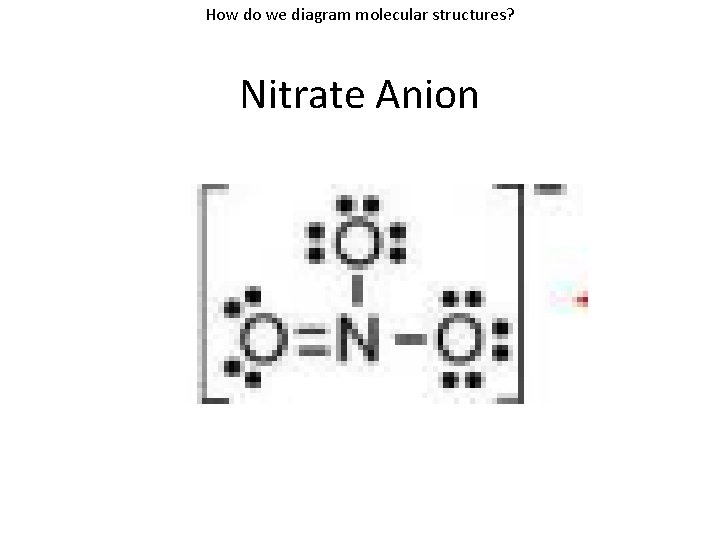
How do we diagram molecular structures? Nitrate Anion
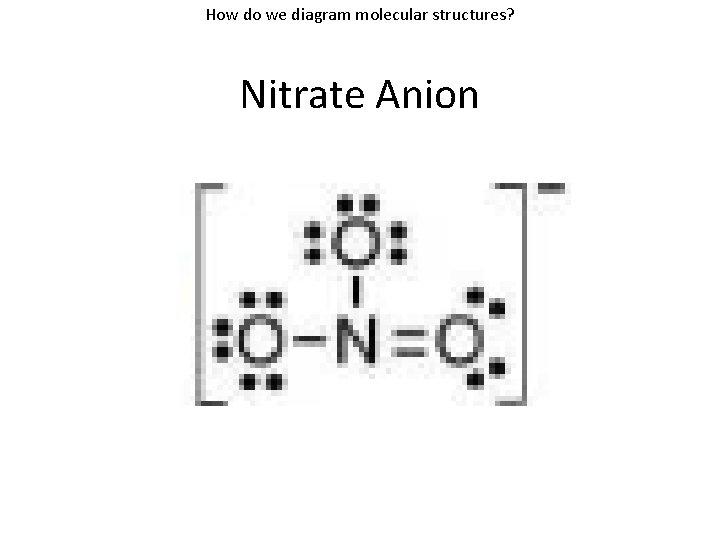
How do we diagram molecular structures? Nitrate Anion
How do we diagram molecular structures? Resonance Bonding that cannot be represented by a single Lewis Structure
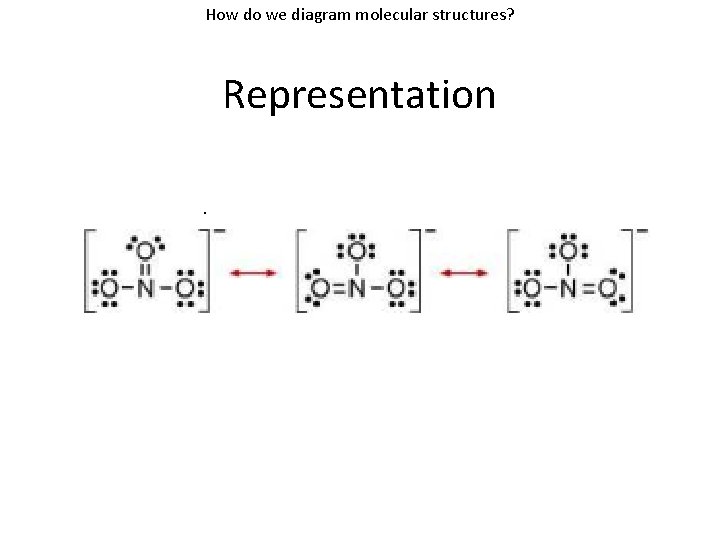
How do we diagram molecular structures? Representation
How do we diagram molecular structures? Other Resonance Examples Some regular molecules (without a charge) also exhibit resonance because they resist their normal Lewis Structure. O 3 (cannot form regular structure due to angles) SO 2 (same as above)
How do we diagram molecular structures? Practice Lewis Structures Polyatomic: 1. Cyanide 2. Phosphate 3. Nitrite (2) Regular: 4. F 2 5. HCN 6. C 2 H 4
How do I determine the geometry of a molecule using VSEPR theory? VSEPR • Valence Shell Electron Pair Repulsion • Used to predict the shapes and polarities of molecules • Molecular shapes are predicted based on the fact that electron pairs (bonding and nonbonding) arrange themselves to be as far apart as possible in order to minimize repulsions.
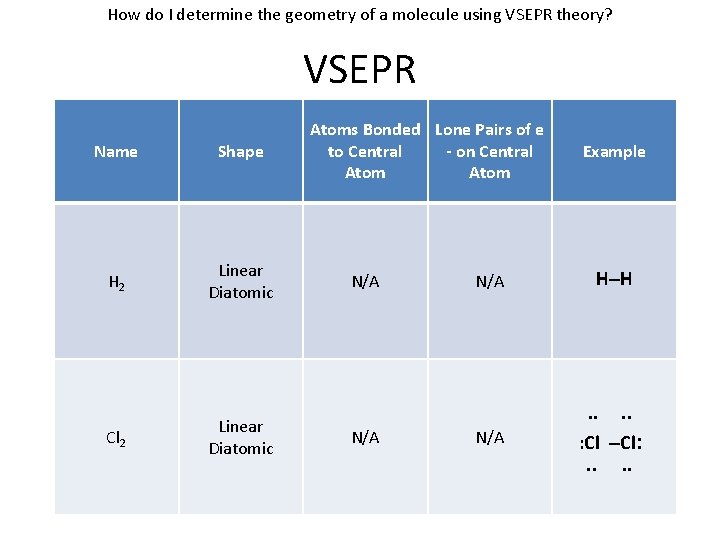
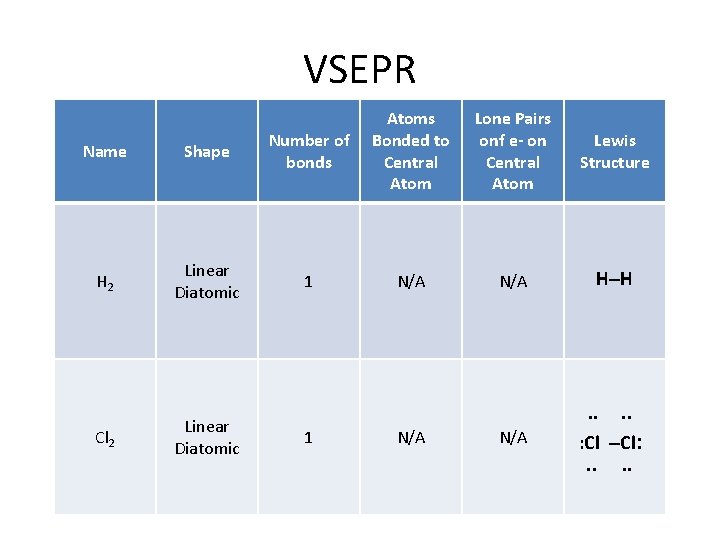
How do I determine the geometry of a molecule using VSEPR theory? VSEPR Name Shape H 2 Linear Diatomic Cl 2 Linear Diatomic Atoms Bonded Lone Pairs of e to Central - on Central Atom N/A Example H–H . . N/A . . : Cl –Cl: . .
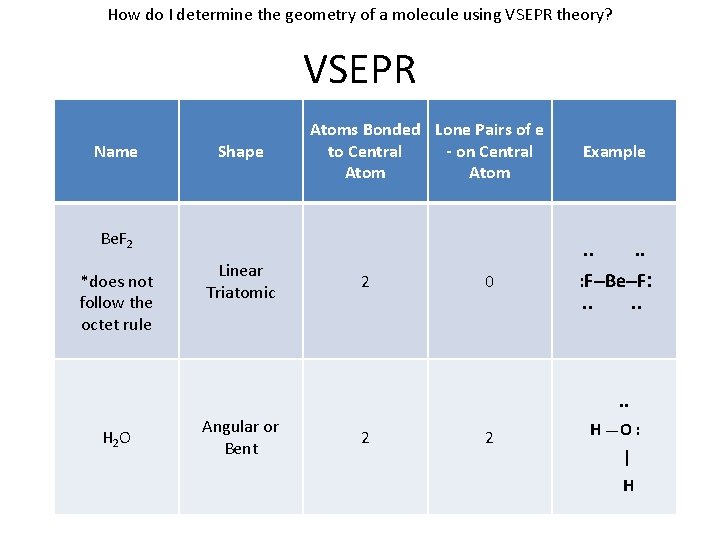
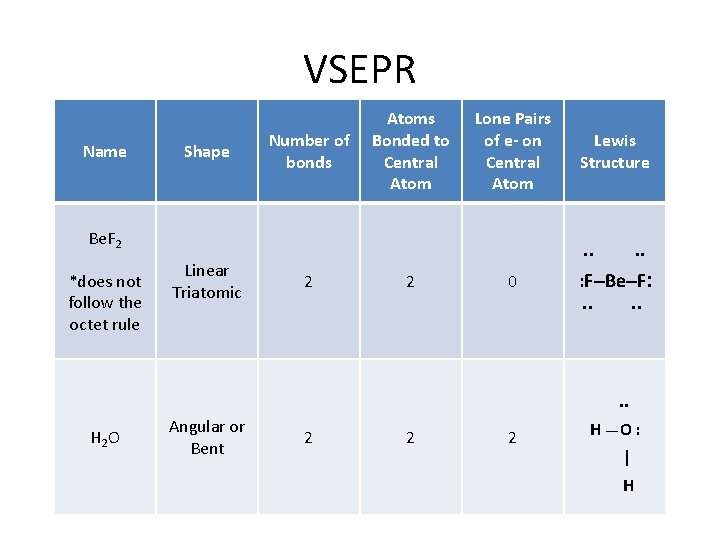
How do I determine the geometry of a molecule using VSEPR theory? VSEPR Name Shape Atoms Bonded Lone Pairs of e to Central - on Central Atom Be. F 2 *does not follow the octet rule Linear Triatomic Example . . 2 0 . . : F–Be–F: . . . H 2 O Angular or Bent 2 2 H __ O : | H
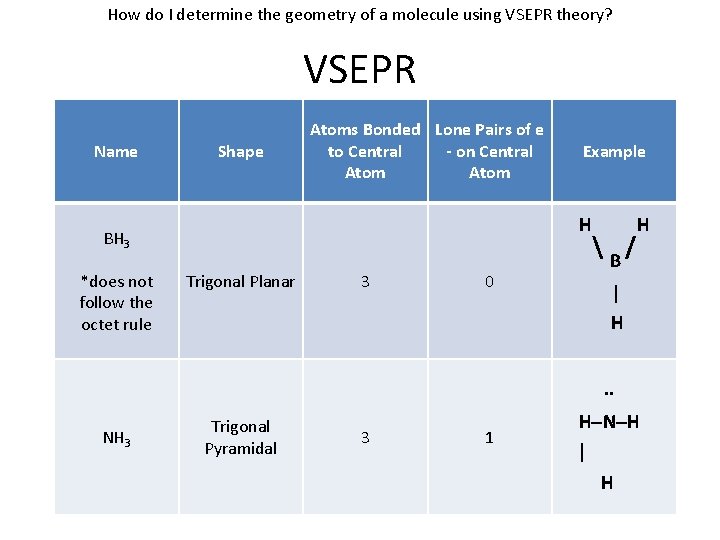
How do I determine the geometry of a molecule using VSEPR theory? VSEPR Name Shape Atoms Bonded Lone Pairs of e to Central - on Central Atom H BH 3 *does not follow the octet rule Example Trigonal Planar 3 0 H B/ | H. . NH 3 Trigonal Pyramidal 3 1 H–N–H | H
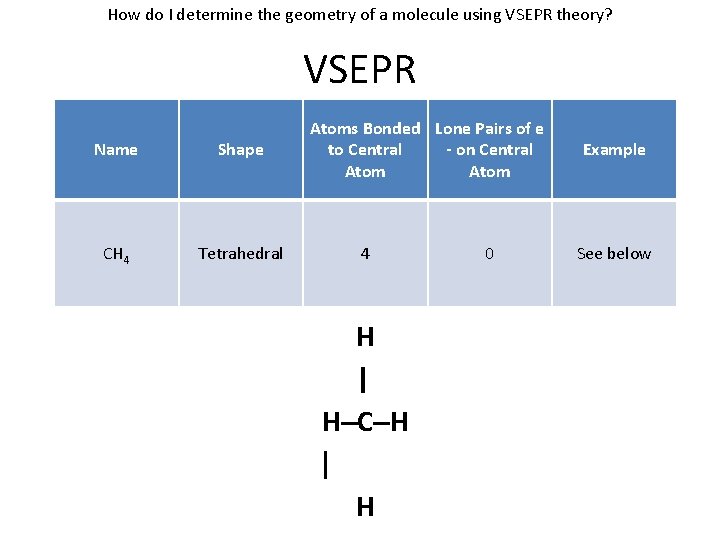
How do I determine the geometry of a molecule using VSEPR theory? VSEPR Name Shape CH 4 Tetrahedral Atoms Bonded Lone Pairs of e to Central - on Central Atom 4 H | H–C–H | H 0 Example See below
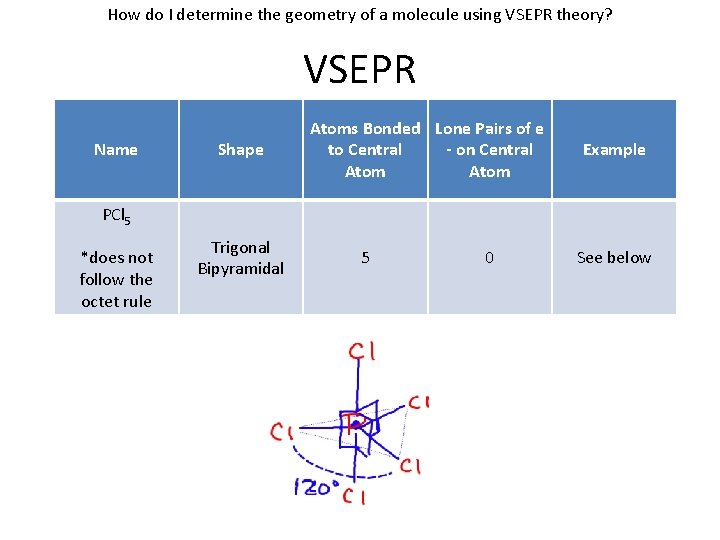
How do I determine the geometry of a molecule using VSEPR theory? VSEPR Name Shape Atoms Bonded Lone Pairs of e to Central - on Central Atom Example PCl 5 *does not follow the octet rule Trigonal Bipyramidal 5 0 See below
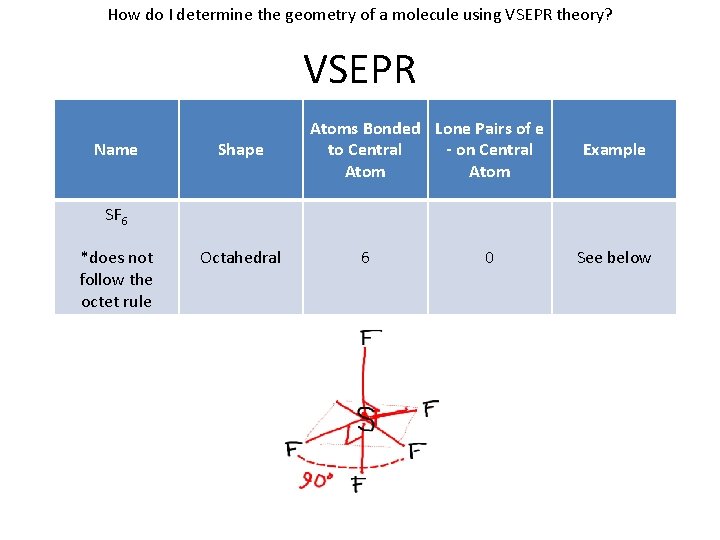
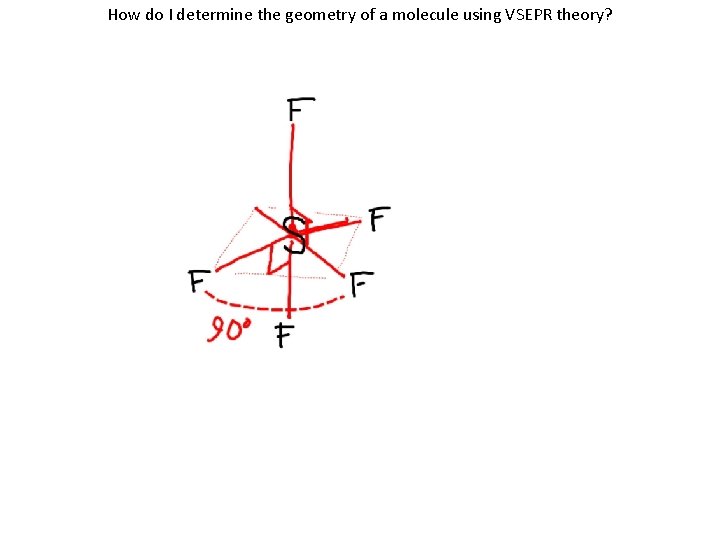
How do I determine the geometry of a molecule using VSEPR theory? VSEPR Name Shape Atoms Bonded Lone Pairs of e to Central - on Central Atom Example SF 6 *does not follow the octet rule Octahedral 6 0 See below
What forces hold molecules together? Intermolecular Forces • • 3 Types of Intermolecular Forces: London Dispersion Dipole – Dipole Hydrogen Bonding
What forces hold molecules together? Computer Lab: Intermolecular Forces • Go to https: //www. wisconline. com/Learning. Content/gch 6804/ind ex. html Read each screen and follow the directions where appropriate. • Answer the questions on the screens in your packet.
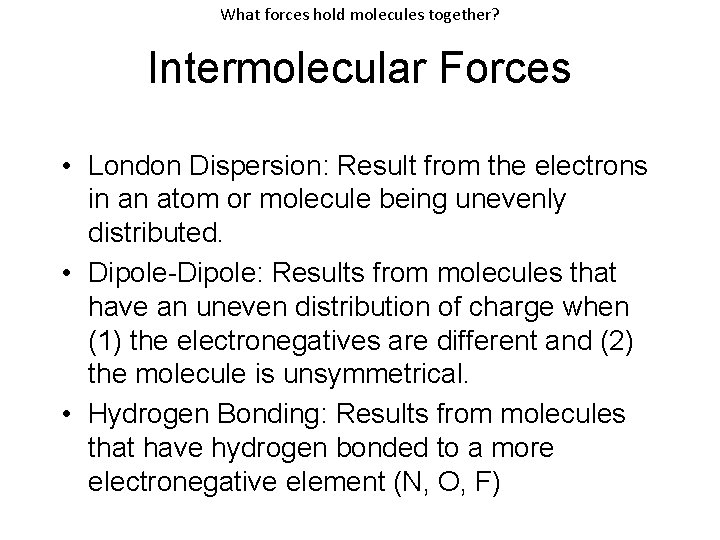
What forces hold molecules together? Intermolecular Forces • London Dispersion: Result from the electrons in an atom or molecule being unevenly distributed. • Dipole-Dipole: Results from molecules that have an uneven distribution of charge when (1) the electronegatives are different and (2) the molecule is unsymmetrical. • Hydrogen Bonding: Results from molecules that have hydrogen bonded to a more electronegative element (N, O, F)
How do we diagram molecular structures? Nitrate Anion
How do we diagram molecular structures? Nitrate Anion
VSEPR Name Shape Number of bonds Atoms Bonded to Central Atom H 2 Linear Diatomic 1 N/A Cl 2 Linear Diatomic Lone Pairs onf e- on Central Atom Lewis Structure N/A H–H . . 1 N/A . . : Cl –Cl: . .
VSEPR Name Shape Number of bonds Atoms Bonded to Central Atom Lone Pairs of e- on Central Atom Be. F 2 *does not follow the octet rule Linear Triatomic Lewis Structure . . 2 2 0 . . : F–Be–F: . . . H 2 O Angular or Bent 2 2 2 H __ O : | H
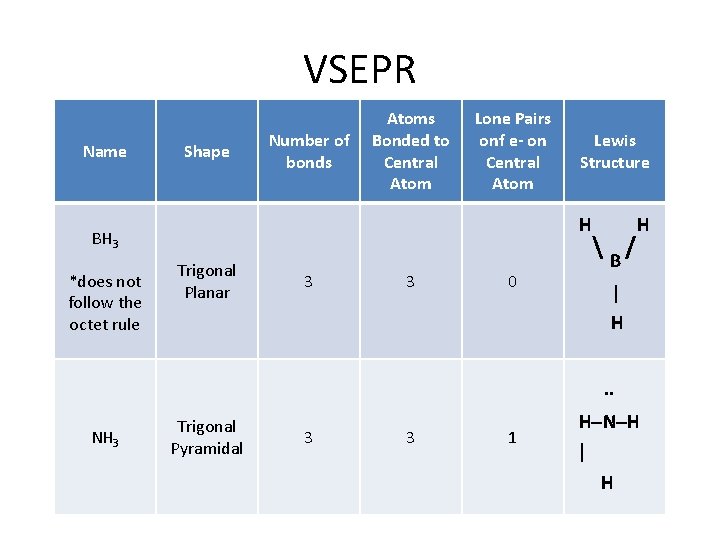
VSEPR Name Shape Number of bonds Atoms Bonded to Central Atom Lone Pairs onf e- on Central Atom H BH 3 *does not follow the octet rule Lewis Structure Trigonal Planar 3 3 0 H B/ | H. . NH 3 Trigonal Pyramidal 3 3 1 H–N–H | H
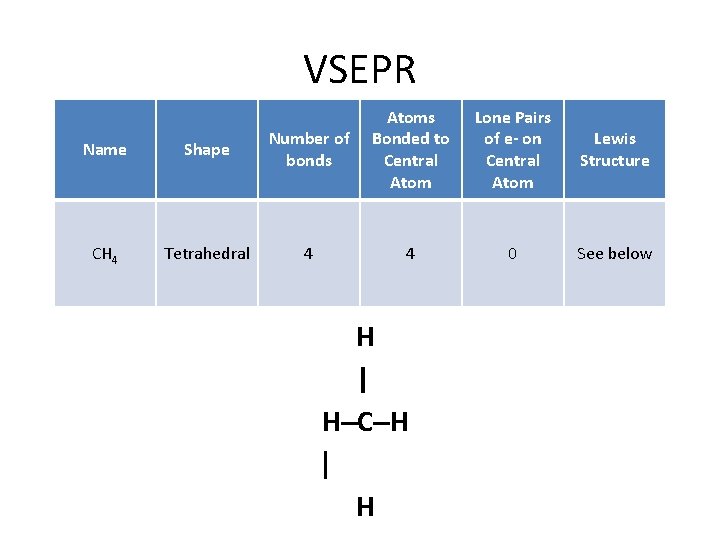
VSEPR Name Shape Number of bonds Atoms Bonded to Central Atom CH 4 Tetrahedral 4 4 H | H–C–H | H Lone Pairs of e- on Central Atom Lewis Structure 0 See below
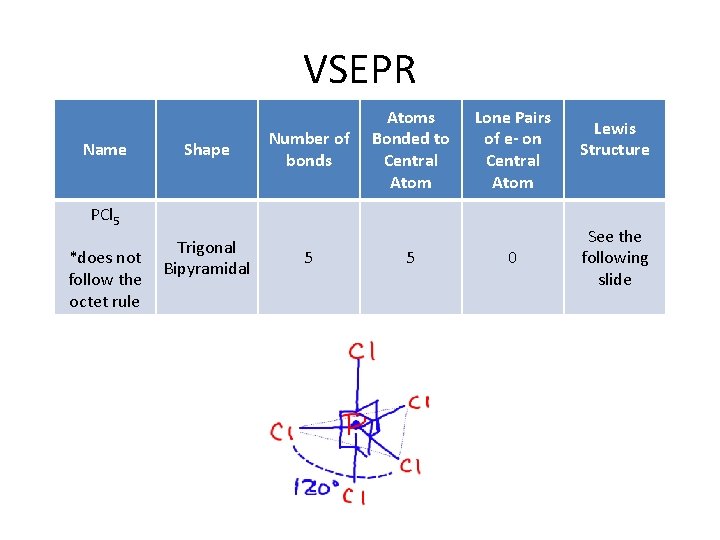
VSEPR Name Shape Number of bonds Atoms Bonded to Central Atom Lone Pairs of e- on Central Atom PCl 5 *does not follow the octet rule Trigonal Bipyramidal 5 5 0 Lewis Structure See the following slide
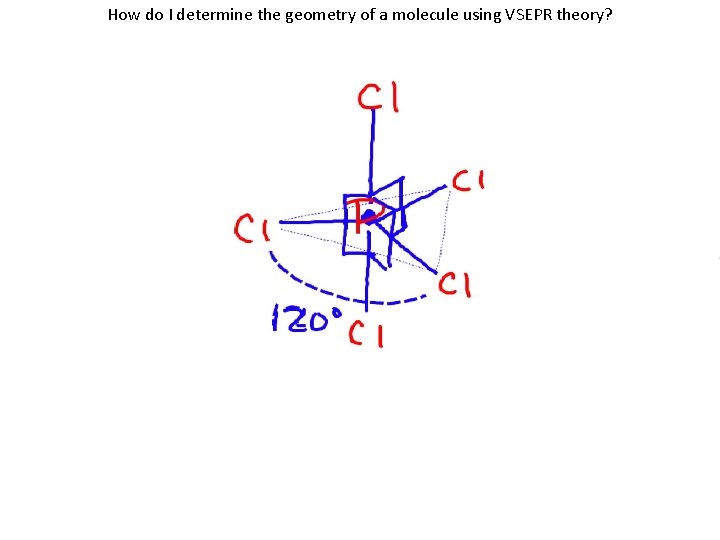
How do I determine the geometry of a molecule using VSEPR theory?
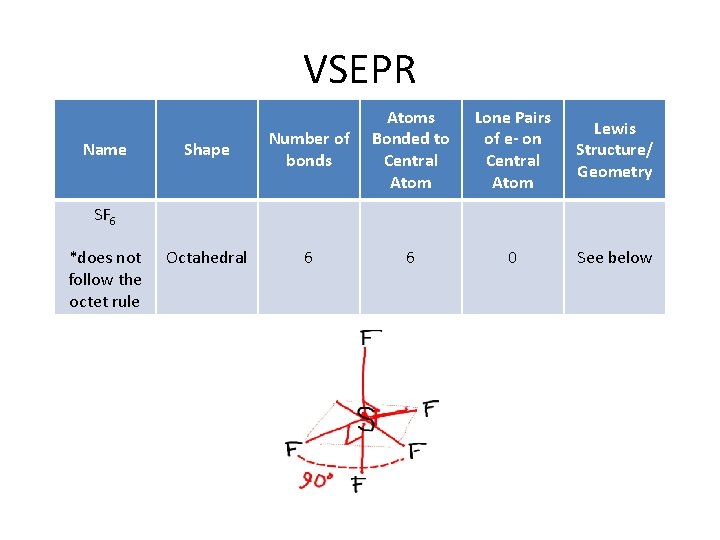
VSEPR Name Shape Number of bonds Atoms Bonded to Central Atom Lone Pairs of e- on Central Atom Lewis Structure/ Geometry Octahedral 6 6 0 See below SF 6 *does not follow the octet rule
How do I determine the geometry of a molecule using VSEPR theory?
- Slides: 71