
Bonding UNIT 7 Properties of Ionic Compounds In

Bonding UNIT 7

Properties of Ionic Compounds In an ionic compound, large numbers of positive and negative ions exist together in a ratio determined by the number of electrons transferred from the metal atom to the nonmetal atom. Each sodium ion is bonded with six chloride ions. And each chloride is bonded to six sodium ions in what is called the crystal lattice. Due to the strength of the crystal lattice structure, ionic compounds have: High melting points (solids at room temperature) High boiling points High hardness High conductivity when dissolved or melted Shatter when force is applied In the case of Na. Cl, there is no such thing as 1 Na and 1 Cl. Which one would it be? Rather it is a 1: 1 ratio.
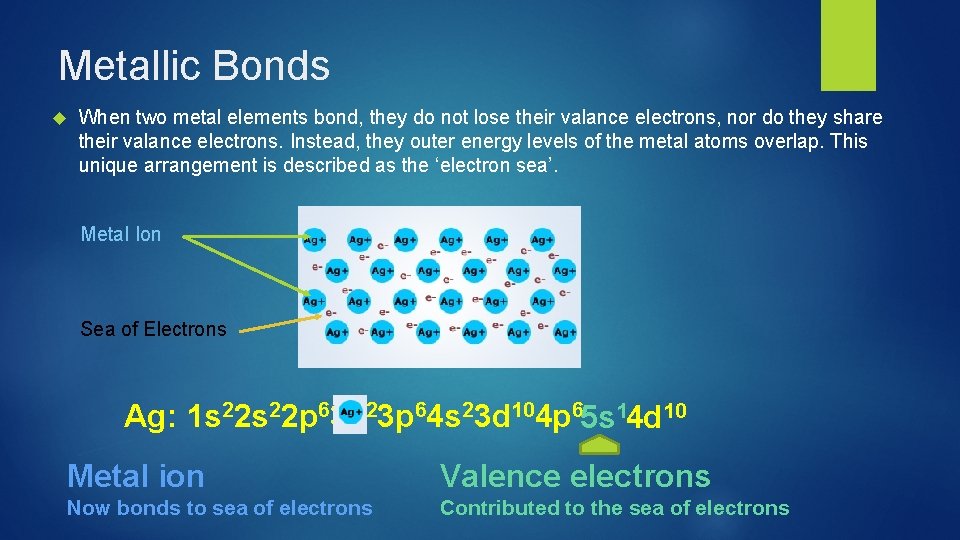
Metallic Bonds When two metal elements bond, they do not lose their valance electrons, nor do they share their valance electrons. Instead, they outer energy levels of the metal atoms overlap. This unique arrangement is described as the ‘electron sea’. Metal Ion Sea of Electrons Ag: 1 s 22 p 63 s 23 p 64 s 23 d 104 p 65 s 14 d 10 Metal ion Valence electrons Now bonds to sea of electrons Contributed to the sea of electrons
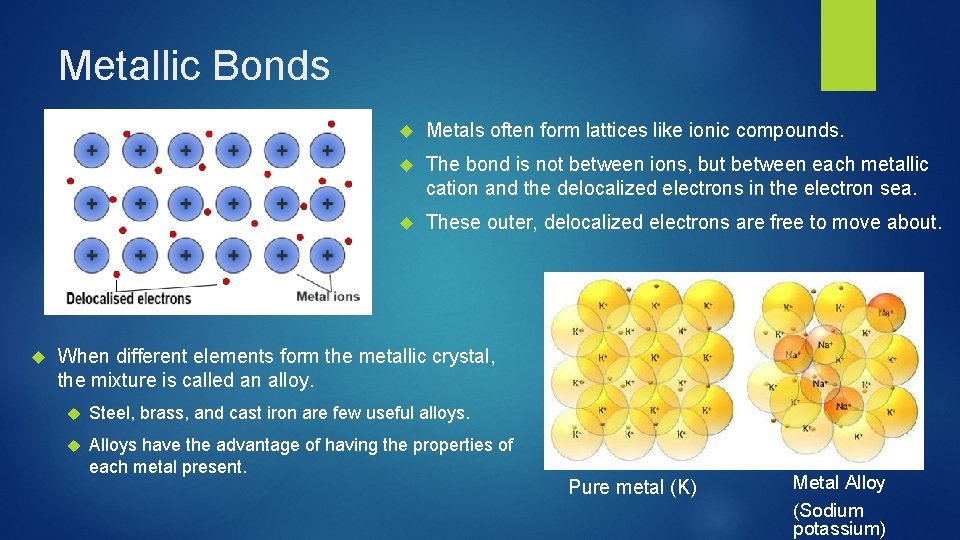
Metallic Bonds Metals often form lattices like ionic compounds. The bond is not between ions, but between each metallic cation and the delocalized electrons in the electron sea. These outer, delocalized electrons are free to move about. When different elements form the metallic crystal, the mixture is called an alloy. Steel, brass, and cast iron are few useful alloys. Alloys have the advantage of having the properties of each metal present. Pure metal (K) Metal Alloy (Sodium potassium)
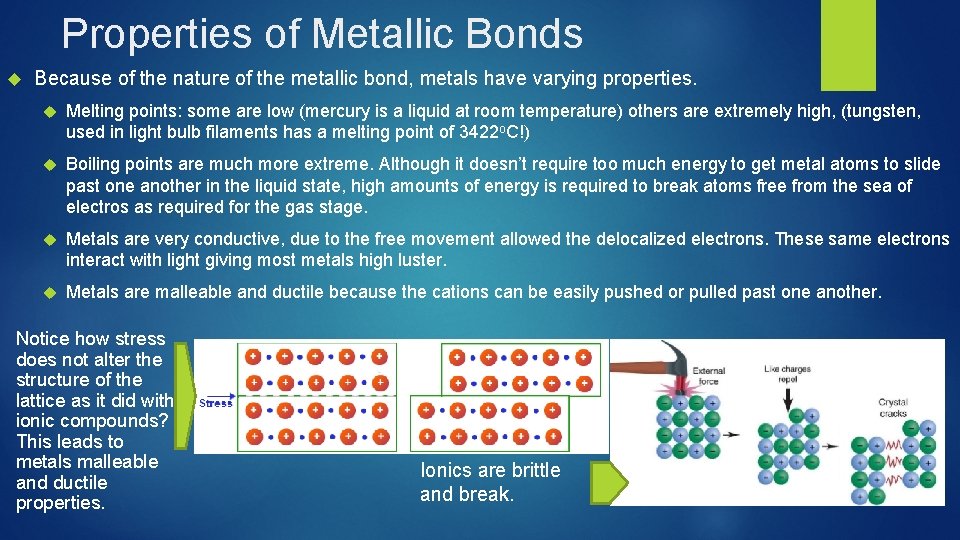
Properties of Metallic Bonds Because of the nature of the metallic bond, metals have varying properties. Melting points: some are low (mercury is a liquid at room temperature) others are extremely high, (tungsten, used in light bulb filaments has a melting point of 3422 o. C!) Boiling points are much more extreme. Although it doesn’t require too much energy to get metal atoms to slide past one another in the liquid state, high amounts of energy is required to break atoms free from the sea of electros as required for the gas stage. Metals are very conductive, due to the free movement allowed the delocalized electrons. These same electrons interact with light giving most metals high luster. Metals are malleable and ductile because the cations can be easily pushed or pulled past one another. Notice how stress does not alter the structure of the lattice as it did with ionic compounds? This leads to metals malleable and ductile properties. Ionics are brittle and break.
HW 7. 3 Assigned: Monday, Nov 6 Due: Tuesday, Nov 7 DUE ON SEPARATE SHEET OF PAPER 1. What properties characterize ionic compounds? 2. Why are alloys more useful than pure metals? 3. What is meant by the terms ductile and malleable? 4. Which of the following pairs of atoms would you expect to combine chemically to form an ionic compound? a. Li and S b. O and S c. Al and O d. F and Cl e. I and K f. H and N 5. Show the bonds and write the correct formula unit for the following ionic compounds: a. K & Cl b. Ba & S c. Mg & Br d. Li & O
- Slides: 6