
Bonding The way things are joined together Describe
Bonding The way things are joined together * ** *** Describe simply the structure of an ionic bond (G) Classify chemicals as covalent/ionic based on properties (F) Know metals and non-metals combine by transferring electrons (C)
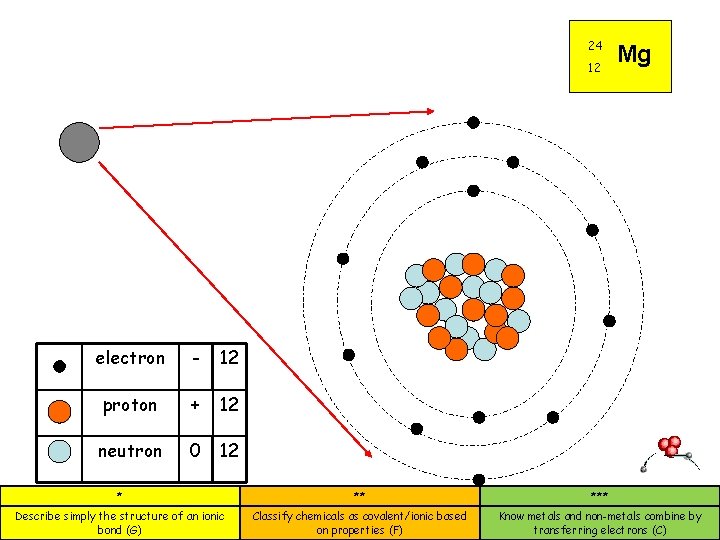
24 12 electron - 12 proton + 12 neutron 0 12 Mg * ** *** Describe simply the structure of an ionic bond (G) Classify chemicals as covalent/ionic based on properties (F) Know metals and non-metals combine by transferring electrons (C)
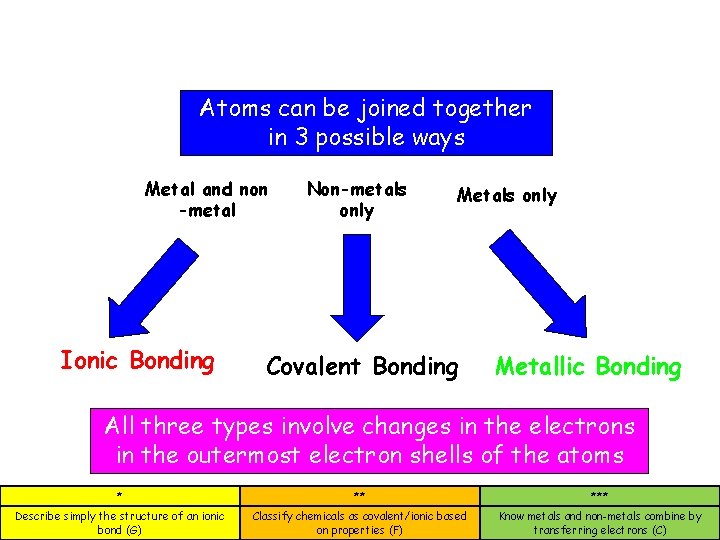
Atoms can be joined together in 3 possible ways Metal and non -metal Ionic Bonding Non-metals only Metals only Covalent Bonding Metallic Bonding All three types involve changes in the electrons in the outermost electron shells of the atoms * ** *** Describe simply the structure of an ionic bond (G) Classify chemicals as covalent/ionic based on properties (F) Know metals and non-metals combine by transferring electrons (C)
Ionic bonds + and - charges * ** *** Describe simply the structure of an ionic bond (G) Classify chemicals as covalent/ionic based on properties (F) Know metals and non-metals combine by transferring electrons (C)
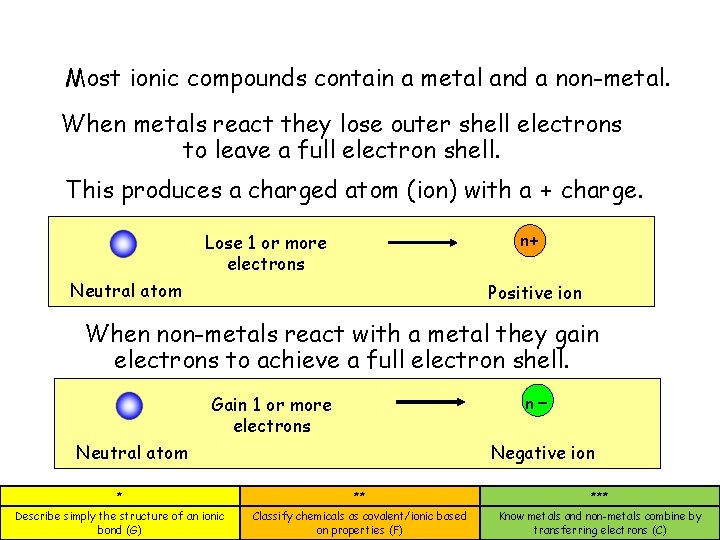
Most ionic compounds contain a metal and a non-metal. When metals react they lose outer shell electrons to leave a full electron shell. This produces a charged atom (ion) with a + charge. n+ Lose 1 or more electrons Neutral atom Positive ion When non-metals react with a metal they gain electrons to achieve a full electron shell. n- Gain 1 or more electrons Neutral atom Negative ion * ** *** Describe simply the structure of an ionic bond (G) Classify chemicals as covalent/ionic based on properties (F) Know metals and non-metals combine by transferring electrons (C)
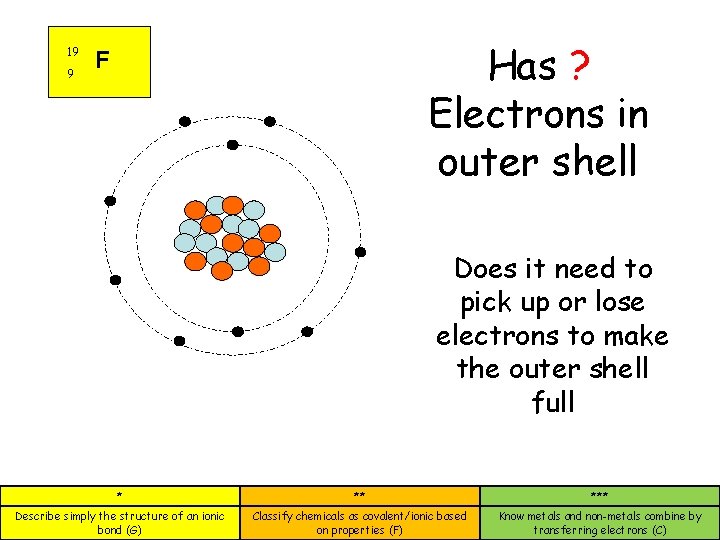
19 9 Has ? Electrons in outer shell F Does it need to pick up or lose electrons to make the outer shell full * ** *** Describe simply the structure of an ionic bond (G) Classify chemicals as covalent/ionic based on properties (F) Know metals and non-metals combine by transferring electrons (C)
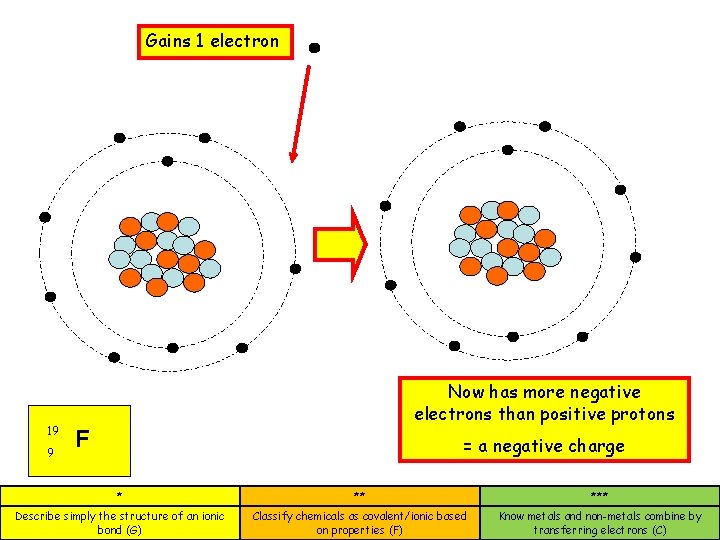
Gains 1 electron 19 9 Now has more negative electrons than positive protons F = a negative charge * ** *** Describe simply the structure of an ionic bond (G) Classify chemicals as covalent/ionic based on properties (F) Know metals and non-metals combine by transferring electrons (C)
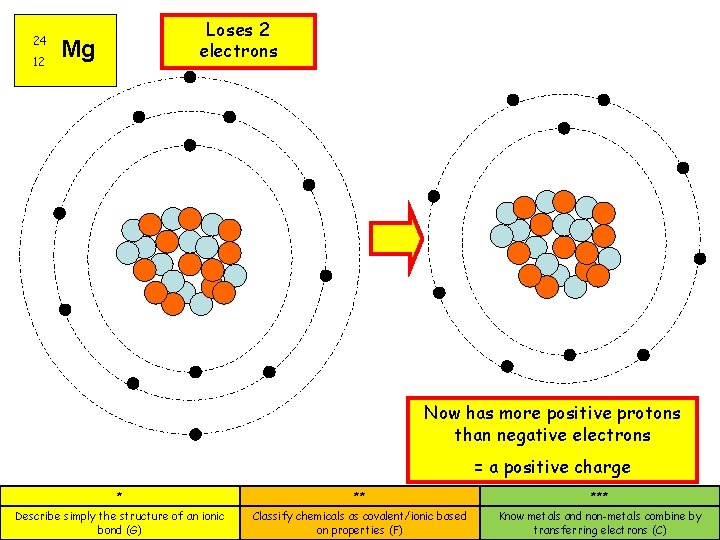
24 12 Loses 2 electrons Mg Now has more positive protons than negative electrons = a positive charge * ** *** Describe simply the structure of an ionic bond (G) Classify chemicals as covalent/ionic based on properties (F) Know metals and non-metals combine by transferring electrons (C)
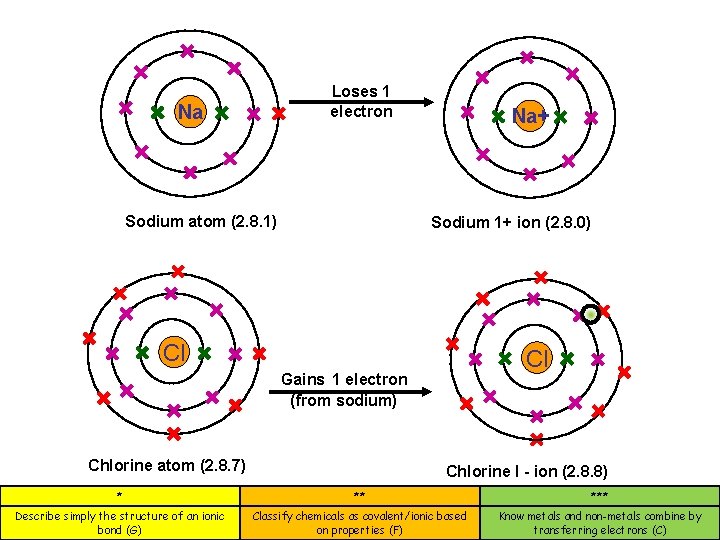
Loses 1 electron Na Sodium atom (2. 8. 1) Na+ Sodium 1+ ion (2. 8. 0) Cl Cl Gains 1 electron (from sodium) Chlorine atom (2. 8. 7) Chlorine I - ion (2. 8. 8) * ** *** Describe simply the structure of an ionic bond (G) Classify chemicals as covalent/ionic based on properties (F) Know metals and non-metals combine by transferring electrons (C)
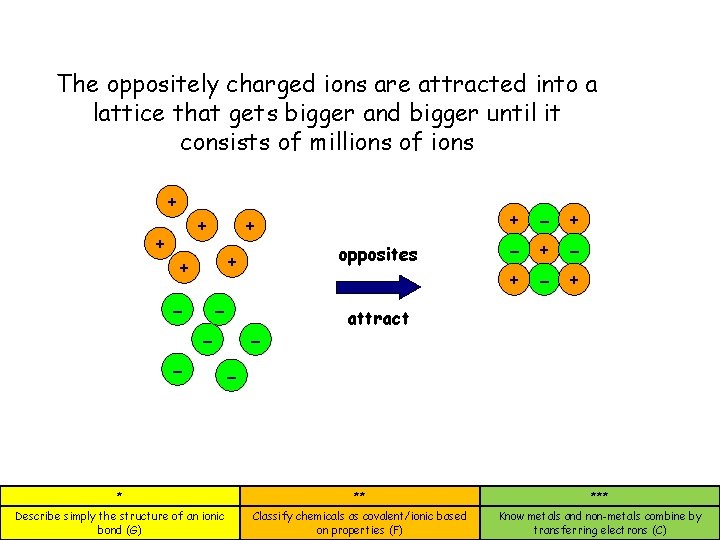
The oppositely charged ions are attracted into a lattice that gets bigger and bigger until it consists of millions of ions + + - + + opposites + + - - + + attract * ** *** Describe simply the structure of an ionic bond (G) Classify chemicals as covalent/ionic based on properties (F) Know metals and non-metals combine by transferring electrons (C)
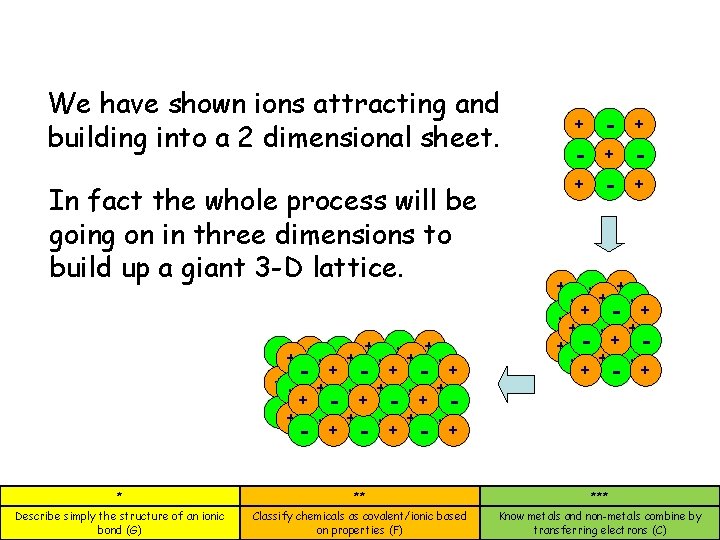
We have shown ions attracting and building into a 2 dimensional sheet. In fact the whole process will be going on in three dimensions to build up a giant 3 -D lattice. -+ +- + - + + -+ -+ -+ +- -+ +- + - + + - +- + -+ +- -+ + -- ++ -+ +- -+ + * ** *** Describe simply the structure of an ionic bond (G) Classify chemicals as covalent/ionic based on properties (F) Know metals and non-metals combine by transferring electrons (C)
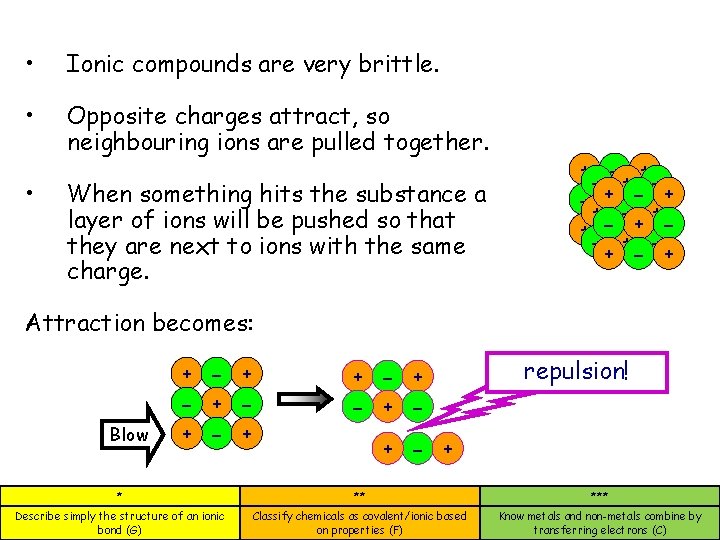
• Ionic compounds are very brittle. • Opposite charges attract, so neighbouring ions are pulled together. • When something hits the substance a layer of ions will be pushed so that they are next to ions with the same charge. + + -+ -+ -+ +---+ ++ + -+ +- -+ + Attraction becomes: + Blow + + - + + + - - repulsion! + + - + * ** *** Describe simply the structure of an ionic bond (G) Classify chemicals as covalent/ionic based on properties (F) Know metals and non-metals combine by transferring electrons (C)
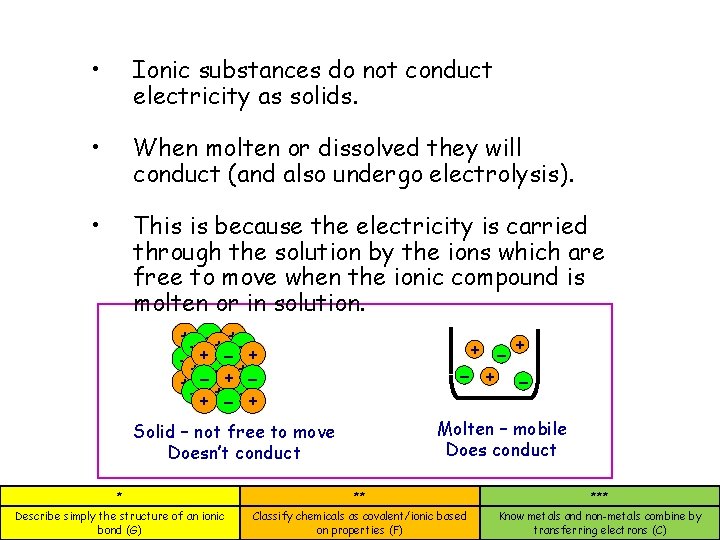
• Ionic substances do not conduct electricity as solids. • When molten or dissolved they will conduct (and also undergo electrolysis). • This is because the electricity is carried through the solution by the ions which are free to move when the ionic compound is molten or in solution. + -+++--+ + -+ -+ --+ ++ - + + -+ +--+ Molten – mobile Does conduct Solid – not free to move Doesn’t conduct * ** *** Describe simply the structure of an ionic bond (G) Classify chemicals as covalent/ionic based on properties (F) Know metals and non-metals combine by transferring electrons (C)
The ionic bonds are very strong. Will that make ionic compounds have a high or low boiling point? High * ** *** Describe simply the structure of an ionic bond (G) Classify chemicals as covalent/ionic based on properties (F) Know metals and non-metals combine by transferring electrons (C)
Covalent bonding Sharing. * ** *** Describe simply the structure of an ionic bond (G) Classify chemicals as covalent/ionic based on properties (F) Know metals and non-metals combine by transferring electrons (C)
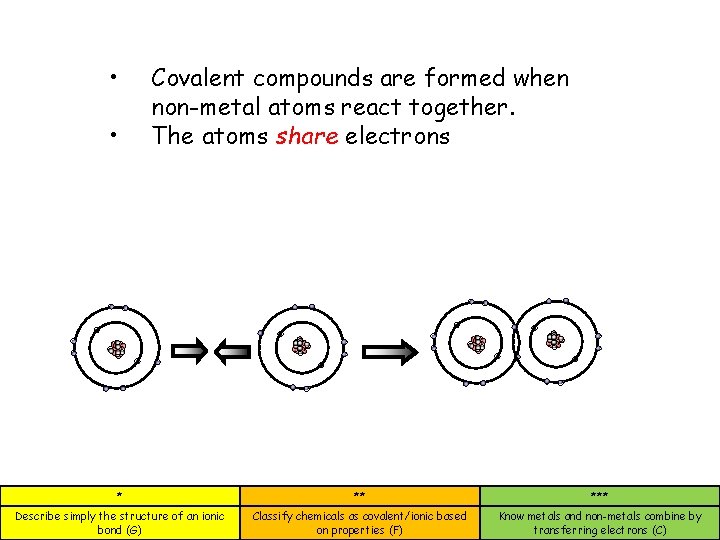
• • Covalent compounds are formed when non-metal atoms react together. The atoms share electrons * ** *** Describe simply the structure of an ionic bond (G) Classify chemicals as covalent/ionic based on properties (F) Know metals and non-metals combine by transferring electrons (C)
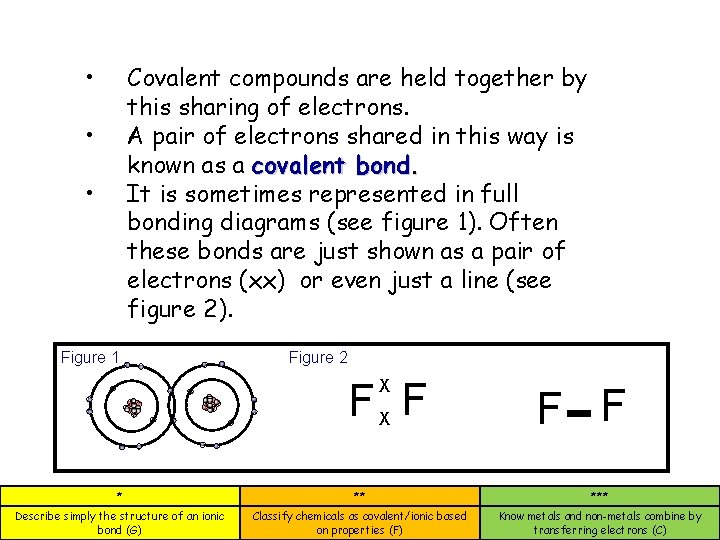
• Covalent compounds are held together by this sharing of electrons. A pair of electrons shared in this way is known as a covalent bond. It is sometimes represented in full bonding diagrams (see figure 1). Often these bonds are just shown as a pair of electrons (xx) or even just a line (see figure 2). • • Figure 1 Figure 2 FX F X - F F * ** *** Describe simply the structure of an ionic bond (G) Classify chemicals as covalent/ionic based on properties (F) Know metals and non-metals combine by transferring electrons (C)
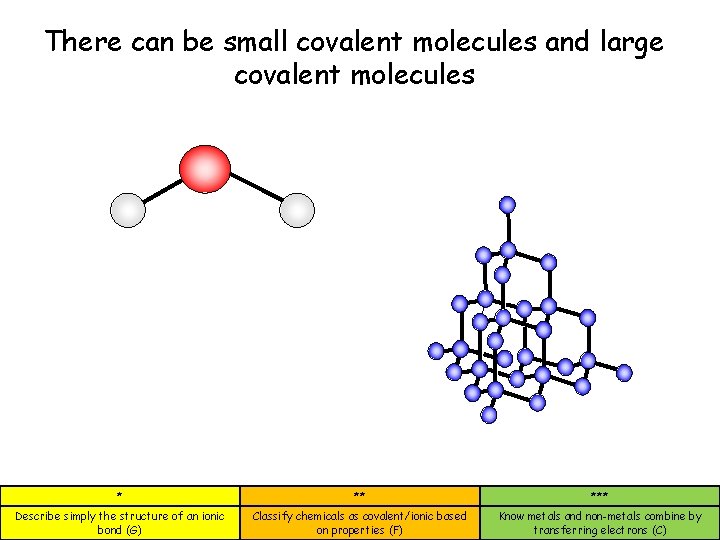
There can be small covalent molecules and large covalent molecules * ** *** Describe simply the structure of an ionic bond (G) Classify chemicals as covalent/ionic based on properties (F) Know metals and non-metals combine by transferring electrons (C)
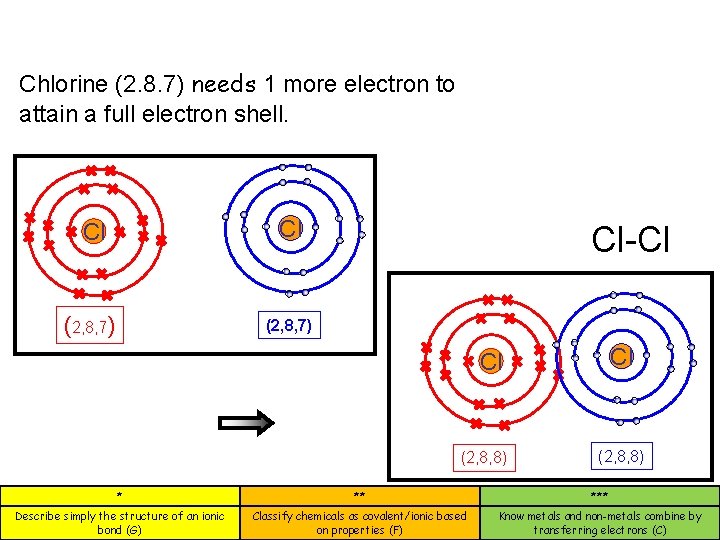
Chlorine (2. 8. 7) needs 1 more electron to attain a full electron shell. Cl Cl (2, 8, 7) Cl-Cl Cl Cl (2, 8, 8) * ** *** Describe simply the structure of an ionic bond (G) Classify chemicals as covalent/ionic based on properties (F) Know metals and non-metals combine by transferring electrons (C)
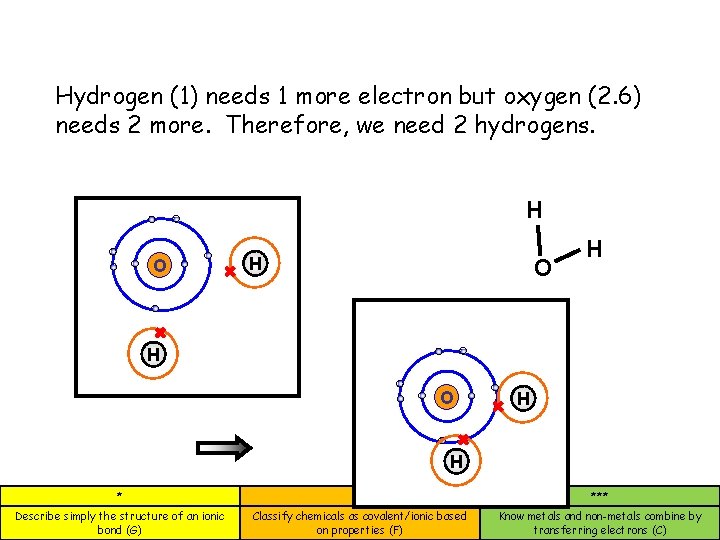
Hydrogen (1) needs 1 more electron but oxygen (2. 6) needs 2 more. Therefore, we need 2 hydrogens. H O H H * ** *** Describe simply the structure of an ionic bond (G) Classify chemicals as covalent/ionic based on properties (F) Know metals and non-metals combine by transferring electrons (C)
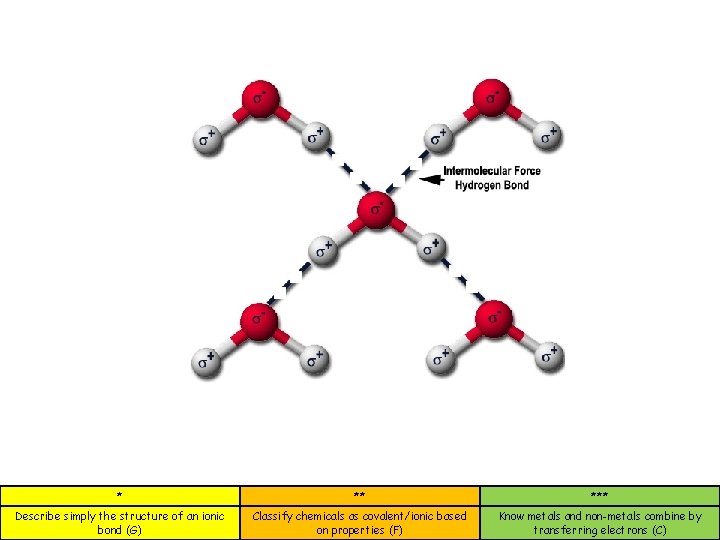
The bonds between ATOMS that share electrons are STRONG The bonds between molecules that don’t share electrons are WEAK What effect will this have on the melting and boiling points? Will they be high or low? Low * ** *** Describe simply the structure of an ionic bond (G) Classify chemicals as covalent/ionic based on properties (F) Know metals and non-metals combine by transferring electrons (C)
Do these covalent molecules conduct electricity? No Will they dissolve in water and spread out like ionic solids? No * ** *** Describe simply the structure of an ionic bond (G) Classify chemicals as covalent/ionic based on properties (F) Know metals and non-metals combine by transferring electrons (C)
Metallic bond * ** *** Describe simply the structure of an ionic bond (G) Classify chemicals as covalent/ionic based on properties (F) Know metals and non-metals combine by transferring electrons (C)
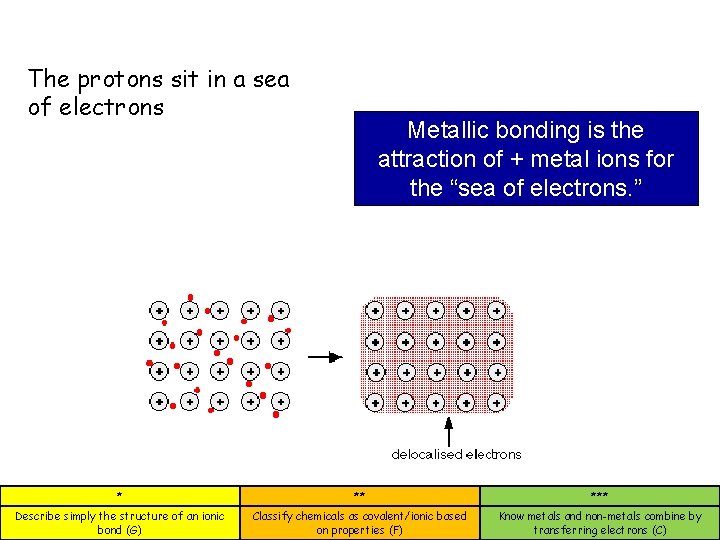
The protons sit in a sea of electrons Metallic bonding is the attraction of + metal ions for the “sea of electrons. ” * ** *** Describe simply the structure of an ionic bond (G) Classify chemicals as covalent/ionic based on properties (F) Know metals and non-metals combine by transferring electrons (C)
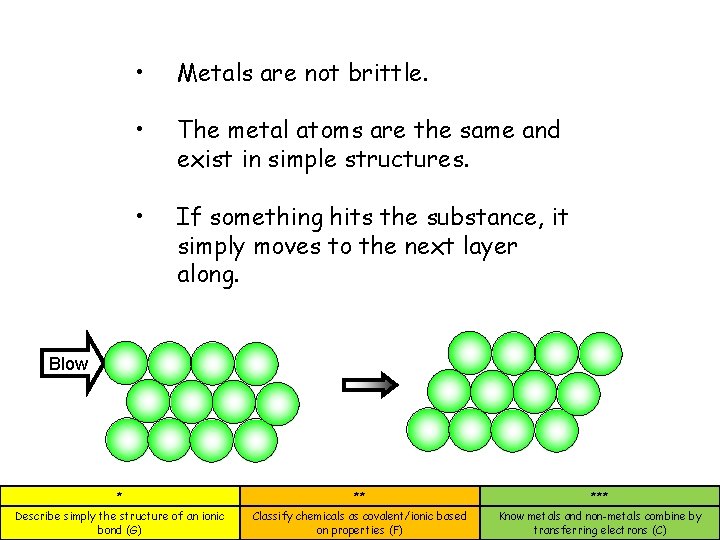
• Metals are not brittle. • The metal atoms are the same and exist in simple structures. • If something hits the substance, it simply moves to the next layer along. Blow * ** *** Describe simply the structure of an ionic bond (G) Classify chemicals as covalent/ionic based on properties (F) Know metals and non-metals combine by transferring electrons (C)
Like ionic bonds the metallic bonds are strong. Will melting points be high or low? High If the sea of electrons can flow, will metals conduct electricity? yes * ** *** Describe simply the structure of an ionic bond (G) Classify chemicals as covalent/ionic based on properties (F) Know metals and non-metals combine by transferring electrons (C)
* ** *** Describe simply the structure of an ionic bond (G) Classify chemicals as covalent/ionic based on properties (F) Know metals and non-metals combine by transferring electrons (C)
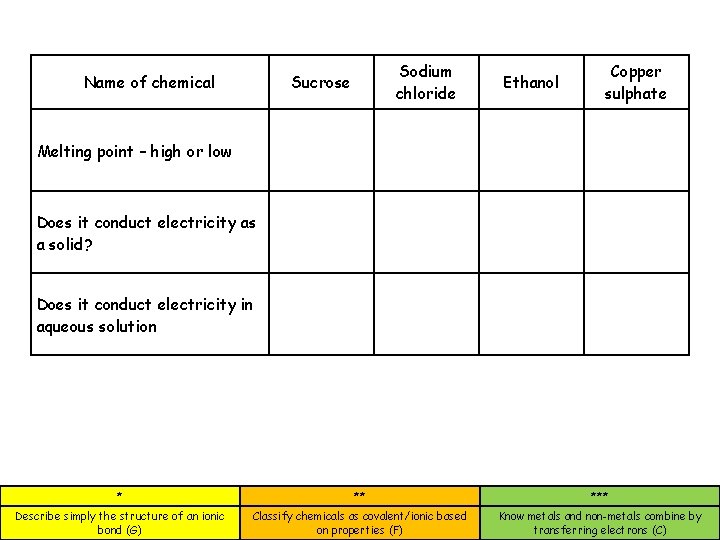
Name of chemical Sodium chloride Sucrose Copper sulphate Ethanol Melting point – high or low Does it conduct electricity as a solid? Does it conduct electricity in aqueous solution * ** *** Describe simply the structure of an ionic bond (G) Classify chemicals as covalent/ionic based on properties (F) Know metals and non-metals combine by transferring electrons (C)
- Slides: 28