
Bonding Structures 1 2 7 8 4 5
Bonding Structures 1 2 7 8 4 5 10 11 3 9 13 14 17 Nat 5 15 18 16 19 6 12
Why do atoms form bonds? To achieve a stable electron arrangement
Are electrons transferred or shared in a covalent bond? Electrons are shared
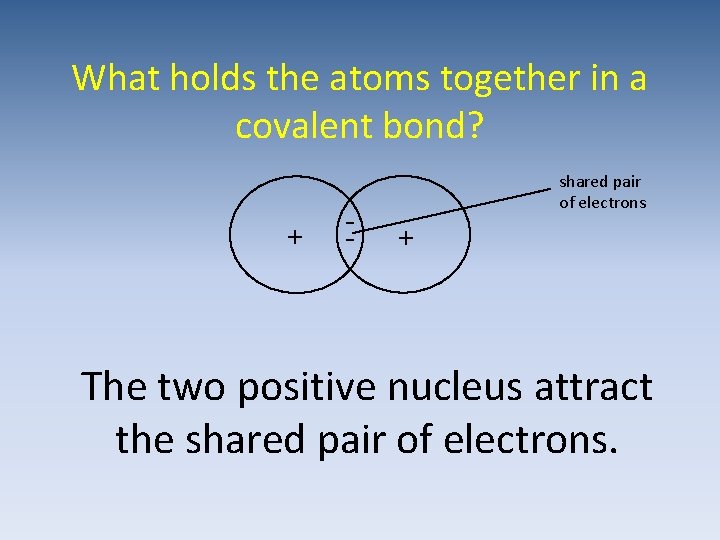
What holds the atoms together in a covalent bond? + - shared pair of electrons + The two positive nucleus attract the shared pair of electrons.
Which type of atoms form covalent bonds. Non-metal
Is a covalent bond a strong or weak force of attraction? Strong
When is an ionic bond formed ? When a metal combines with a non -metal
Do metals lose or gain electrons? Metals lose electrons
What is formed when a metal loses electrons? A positive ion + X
Do non-metal atoms lose or gain electrons? Gain electrons
What is formed when a non-metal atom gains electrons? A negative ion Y-
What is formed when there is a force of attraction between oppositely charged ion? An ionic bond
Which of the following are covalent compounds? Sodium chloride, potassium fluoride, nitrogen dioxide, iron oxide, sulphur dioxide Nitrogen dioxide and sulphur dioxide (compounds made up of non-metal atoms)
What is a molecule? A group of atoms held together by covalent bonds.
What is meant by diatomic? Two atoms joined together
Name the diatomic elements? hydrogen H 2, nitrogen N 2, oxygen O 2, fluorine F 2, chlorine Cl 2, bromine Br 2, iodine I 2
Is carbon monoxide or carbon dioxide a diatomic compound? Carbon monoxide CO (2 atoms) - carbon dioxide CO 2 is a molecule made up of 3 atoms.
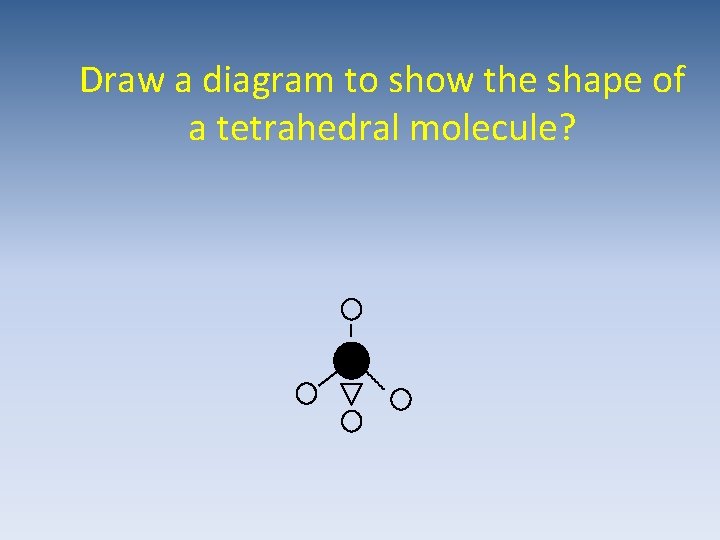
Draw a diagram to show the shape of a tetrahedral molecule?
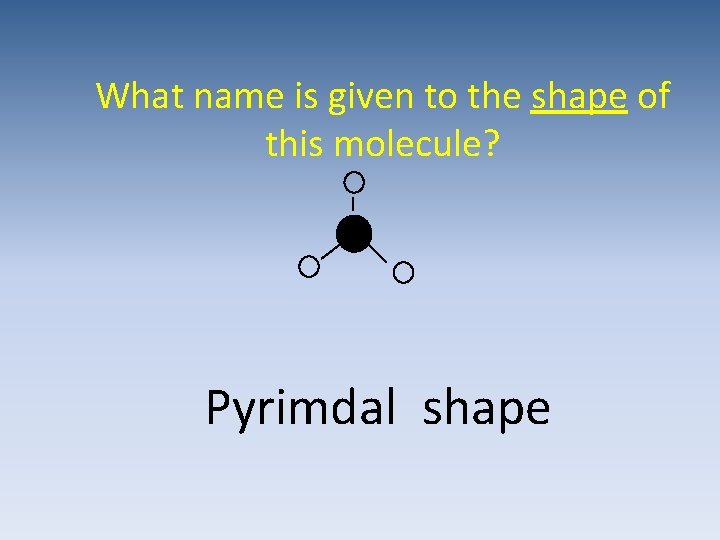
What name is given to the shape of this molecule? Pyrimdal shape
Which type of substances exist as a lattice structure? Covalent network - a giant lattice of covalently bonded atoms. Ionic - a giant lattice of oppositely charged ions. Metals - a giant lattice of positively charged ions and delocalised electrons
- Slides: 20