
Bonding Introduction May 12 Compound 2 or more
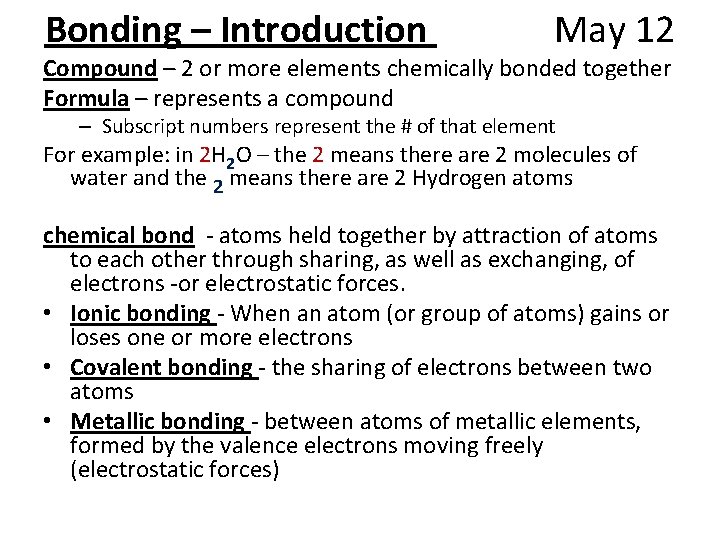
Bonding – Introduction May 12 Compound – 2 or more elements chemically bonded together Formula – represents a compound – Subscript numbers represent the # of that element For example: in 2 H 2 O – the 2 means there are 2 molecules of water and the 2 means there are 2 Hydrogen atoms chemical bond - atoms held together by attraction of atoms to each other through sharing, as well as exchanging, of electrons -or electrostatic forces. • Ionic bonding - When an atom (or group of atoms) gains or loses one or more electrons • Covalent bonding - the sharing of electrons between two atoms • Metallic bonding - between atoms of metallic elements, formed by the valence electrons moving freely (electrostatic forces)
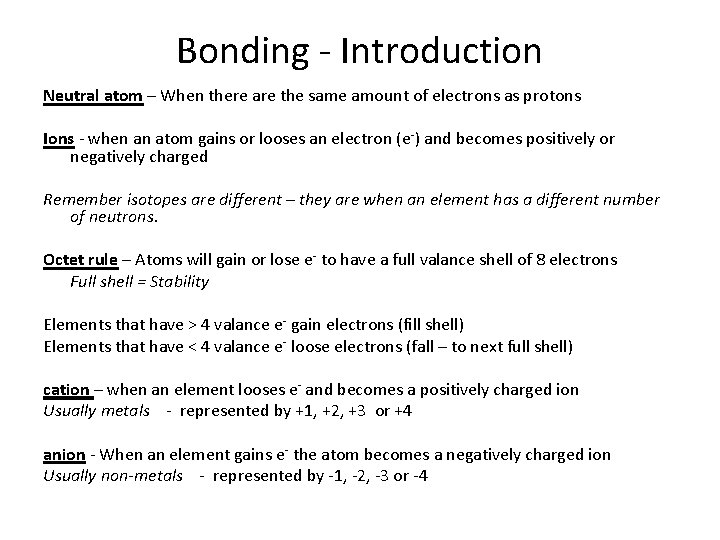
Bonding - Introduction Neutral atom – When there are the same amount of electrons as protons Ions - when an atom gains or looses an electron (e-) and becomes positively or negatively charged Remember isotopes are different – they are when an element has a different number of neutrons. Octet rule – Atoms will gain or lose e- to have a full valance shell of 8 electrons Full shell = Stability Elements that have > 4 valance e- gain electrons (fill shell) Elements that have < 4 valance e- loose electrons (fall – to next full shell) cation – when an element looses e- and becomes a positively charged ion Usually metals - represented by +1, +2, +3 or +4 anion - When an element gains e- the atom becomes a negatively charged ion Usually non-metals - represented by -1, -2, -3 or -4

Example of ionic bonding when Na and Cl combine • sodium (on the left) loses its one valence electron to chlorine (on the right), resulting in a positively charged sodium ion (left) and a negatively charged chlorine ion (right).
- Slides: 3