
Bonding General Concepts Chapter 8 Copyright 2000 by
Bonding: General Concepts Chapter 8 Copyright© 2000 by Houghton Mifflin Company. All rights reserved. 1
Overview ü Types of chemical bonds, Electronegativity, Bond polarity and Dipole Moments. ü The Ions: electron configurations, size, formula, lattice energy calculations. ü Covalent bonds: model, bond energies, chemical reactions. ü Lewis structure, exceptions to the octet rule, resonance. ü Molecular structure models from Valence Shell Electron Pair Model “VSEPR” for single and multiple bonds. Copyright© 2000 by Houghton Mifflin Company. All rights reserved. 2
Bonds Forces that hold groups of atoms together and make them function as a unit. Na. Cl – attraction is electrostatic since Na+ and Cl- are the Stable forms for these elements. This is an example of “Ionic Bonding” Copyright© 2000 by Houghton Mifflin Company. All rights reserved. 3
Bond Energy 4 It is the energy required to break a bond. 4 It gives us information about the strength of a bonding interaction, as well as radius. Copyright© 2000 by Houghton Mifflin Company. All rights reserved. 4
Bond Length The distance where the system energy is a minimum. Copyright© 2000 by Houghton Mifflin Company. All rights reserved. 5
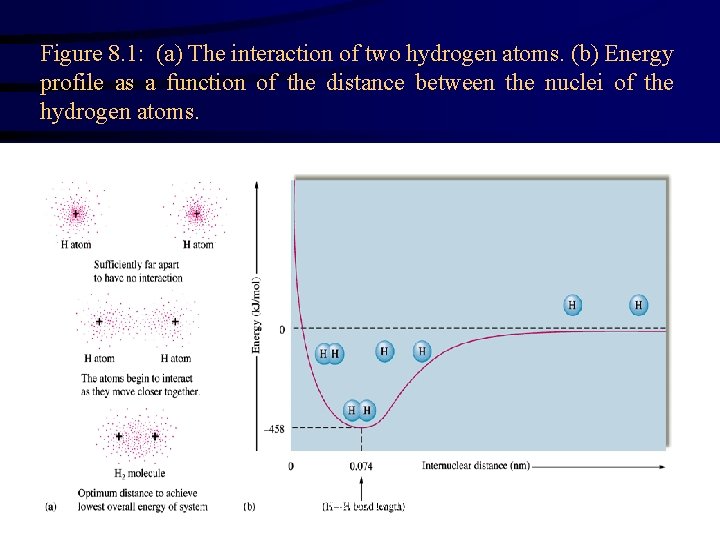
Figure 8. 1: (a) The interaction of two hydrogen atoms. (b) Energy profile as a function of the distance between the nuclei of the hydrogen atoms. Copyright© 2000 by Houghton Mifflin Company. All rights reserved. 6
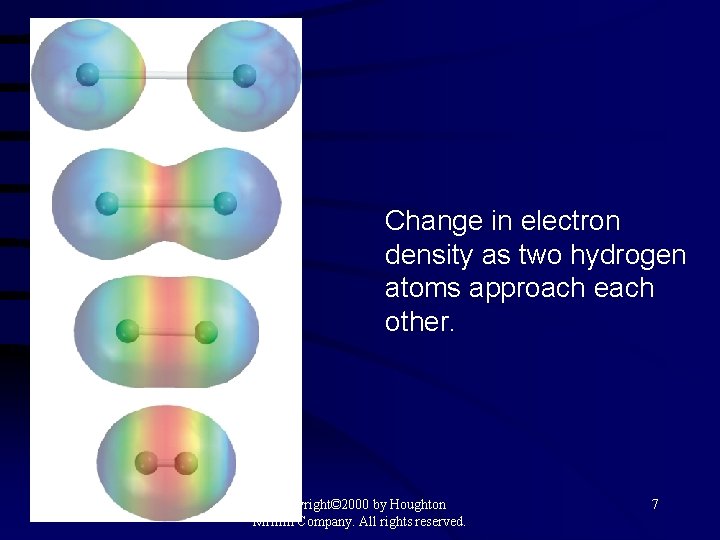
Change in electron density as two hydrogen atoms approach each other. Copyright© 2000 by Houghton Mifflin Company. All rights reserved. 7
Covalent Bond Ø No electron transfer Ø Electrons are shared between two atoms, positioned between the two nuclei Ø Example: H 2, O 2, H 2 O, CO 2, etc. Copyright© 2000 by Houghton Mifflin Company. All rights reserved. 8
Ionic Bonds 4 Formed from electrostatic attractions of closely packed, oppositely charged ions. 4 Formed when an atom that easily loses electrons reacts with one that has a high electron affinity. Copyright© 2000 by Houghton Mifflin Company. All rights reserved. 9
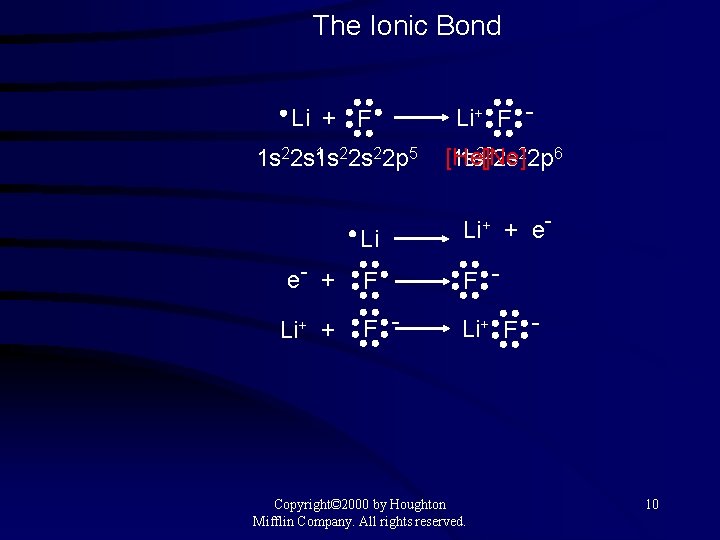
The Ionic Bond Li + F 1 22 s 22 p 5 1 s 22 s 1 s e- + Li+ F [He] 1 s 1 s 2[2 Ne] 2 s 22 p 6 Li Li+ + e- F F - Li+ F - Copyright© 2000 by Houghton Mifflin Company. All rights reserved. 10
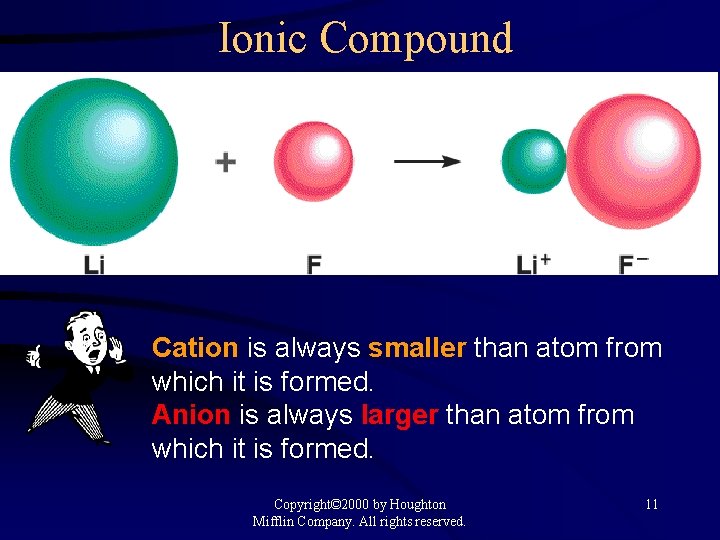
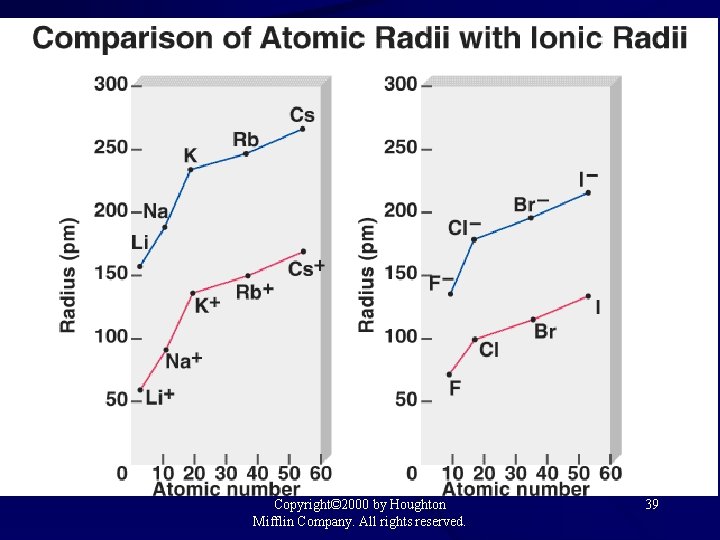
Ionic Compound Cation is always smaller than atom from which it is formed. Anion is always larger than atom from which it is formed. Copyright© 2000 by Houghton Mifflin Company. All rights reserved. 11
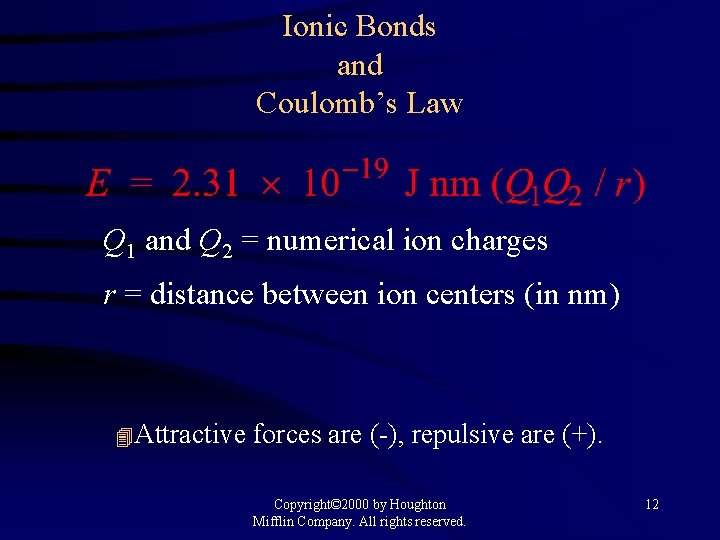
Ionic Bonds and Coulomb’s Law Q 1 and Q 2 = numerical ion charges r = distance between ion centers (in nm) 4 Attractive forces are (-), repulsive are (+). Copyright© 2000 by Houghton Mifflin Company. All rights reserved. 12
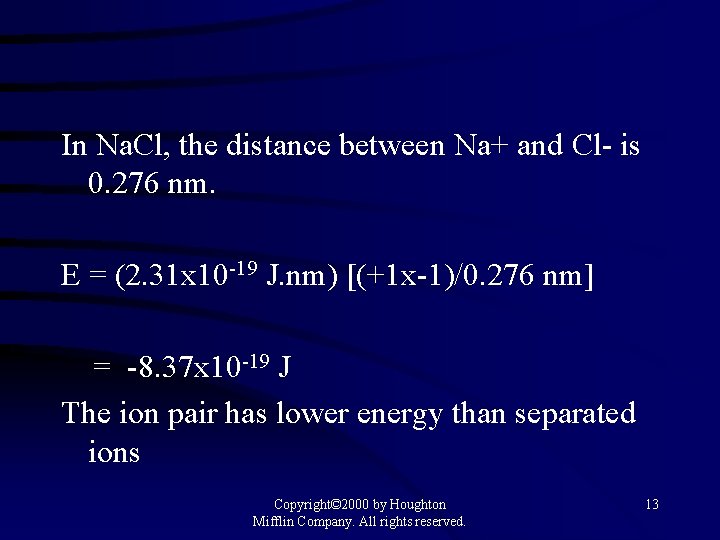
In Na. Cl, the distance between Na+ and Cl- is 0. 276 nm. E = (2. 31 x 10 -19 J. nm) [(+1 x-1)/0. 276 nm] = -8. 37 x 10 -19 J The ion pair has lower energy than separated ions Copyright© 2000 by Houghton Mifflin Company. All rights reserved. 13
Covalent or Ionic? Ø Covalent and ionic are simply extreme cases. Ø Most molecules share electrons but “Unequally” due to the difference in electronegativity and electron affinity. Ø This will give rise to a dipole moment and the molecule becomes polar. Copyright© 2000 by Houghton Mifflin Company. All rights reserved. 14
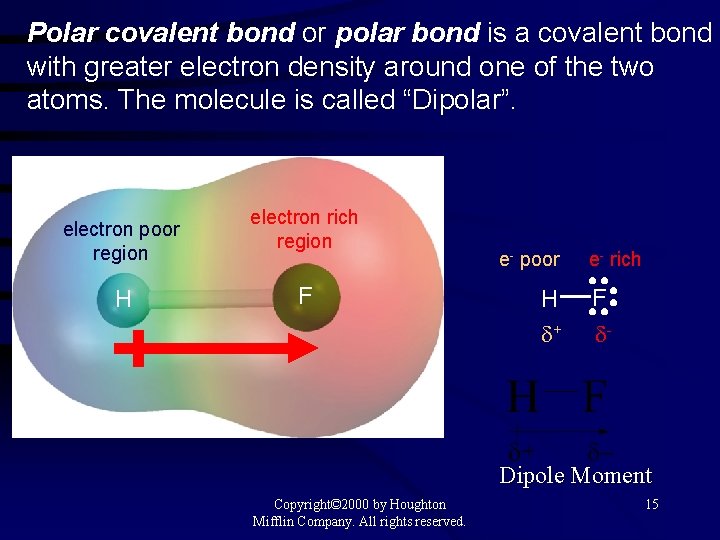
Polar covalent bond or polar bond is a covalent bond with greater electron density around one of the two atoms. The molecule is called “Dipolar”. electron poor region H electron rich region F e- poor H d+ e- rich F d- Dipole Moment Copyright© 2000 by Houghton Mifflin Company. All rights reserved. 15
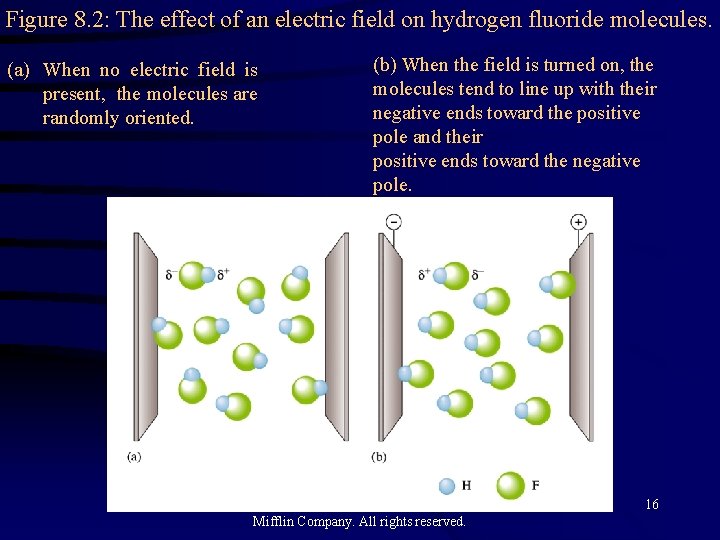
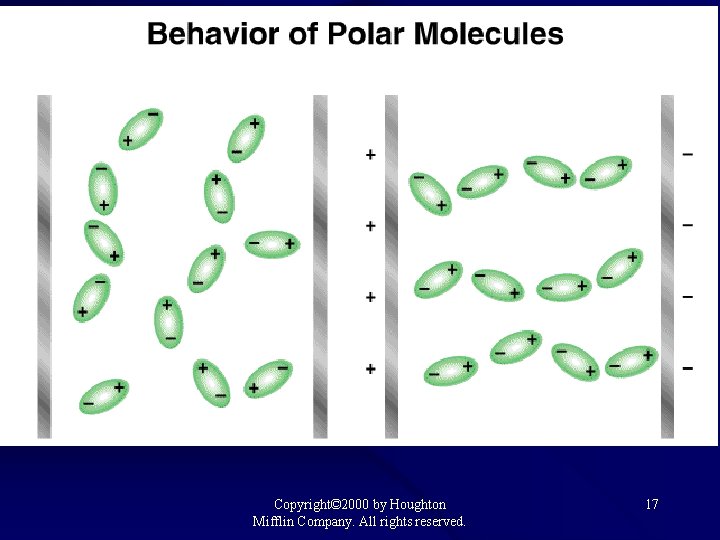
Figure 8. 2: The effect of an electric field on hydrogen fluoride molecules. (a) When no electric field is present, the molecules are randomly oriented. (b) When the field is turned on, the molecules tend to line up with their negative ends toward the positive pole and their positive ends toward the negative pole. Copyright© 2000 by Houghton Mifflin Company. All rights reserved. 16
Copyright© 2000 by Houghton Mifflin Company. All rights reserved. 17
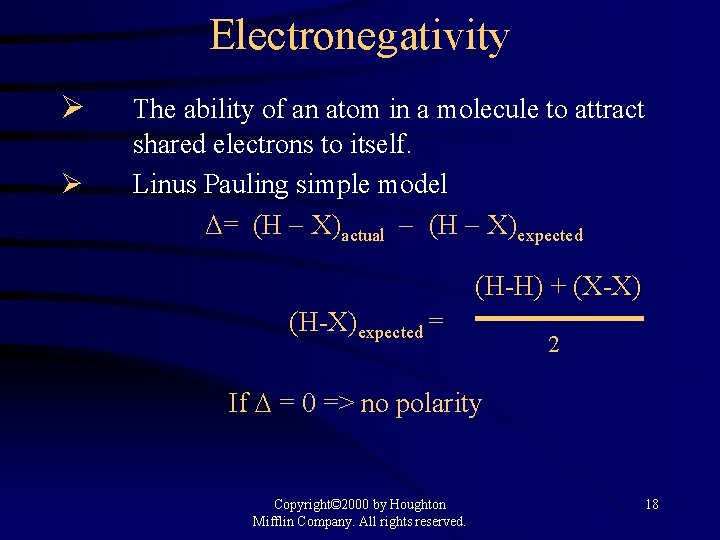
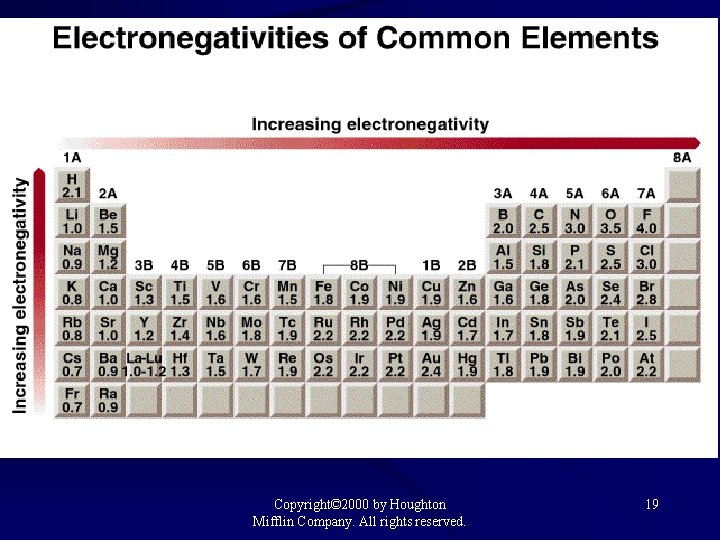
Electronegativity Ø Ø The ability of an atom in a molecule to attract shared electrons to itself. Linus Pauling simple model Δ= (H X)actual (H X)expected (H-H) + (X-X) (H-X)expected = 2 If = 0 => no polarity Copyright© 2000 by Houghton Mifflin Company. All rights reserved. 18
Copyright© 2000 by Houghton Mifflin Company. All rights reserved. 19
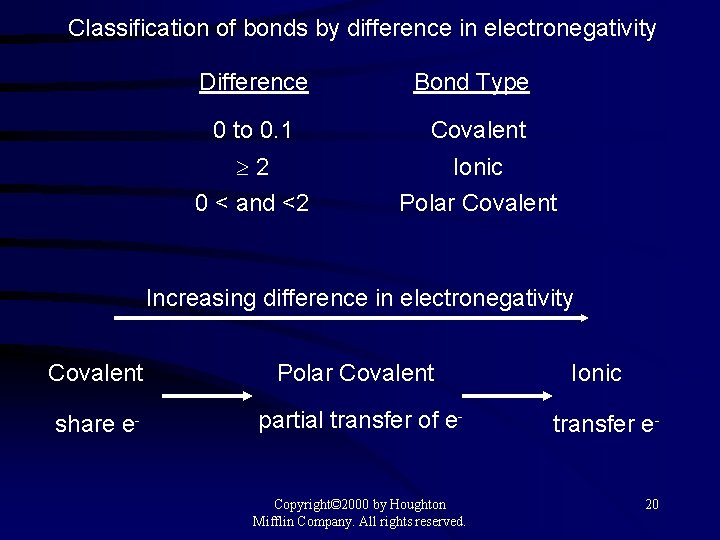
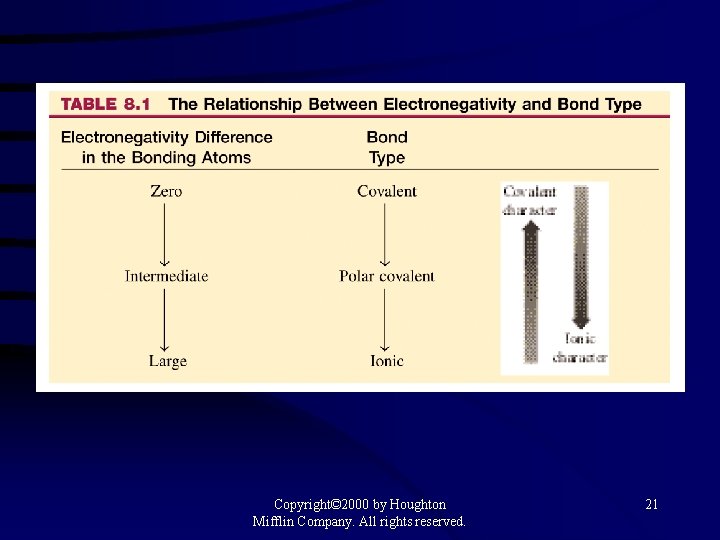
Classification of bonds by difference in electronegativity Difference Bond Type 0 to 0. 1 Covalent 2 0 < and <2 Ionic Polar Covalent Increasing difference in electronegativity Covalent Polar Covalent Ionic share e- partial transfer of e- transfer e- Copyright© 2000 by Houghton Mifflin Company. All rights reserved. 20
Copyright© 2000 by Houghton Mifflin Company. All rights reserved. 21
S Ex 8. 1 Order the following according to increasing polarity. H-H, O-H, H-Cl, S-H, and F-H Copyright© 2000 by Houghton Mifflin Company. All rights reserved. 22
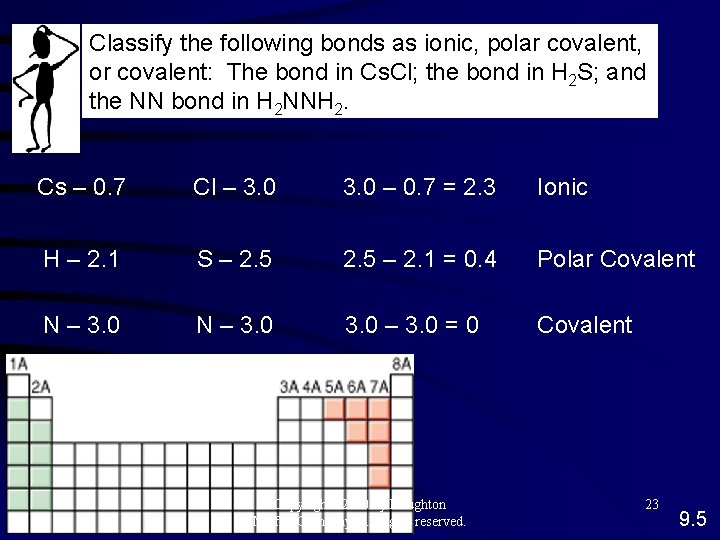
Classify the following bonds as ionic, polar covalent, or covalent: The bond in Cs. Cl; the bond in H 2 S; and the NN bond in H 2 NNH 2. Cs – 0. 7 Cl – 3. 0 – 0. 7 = 2. 3 Ionic H – 2. 1 S – 2. 5 – 2. 1 = 0. 4 Polar Covalent N – 3. 0 – 3. 0 = 0 Covalent Copyright© 2000 by Houghton Mifflin Company. All rights reserved. 23 9. 5
Polyatomic Molecules May exhibit dipole moment depending on their structure i. e. arrangement in space Copyright© 2000 by Houghton Mifflin Company. All rights reserved. 24
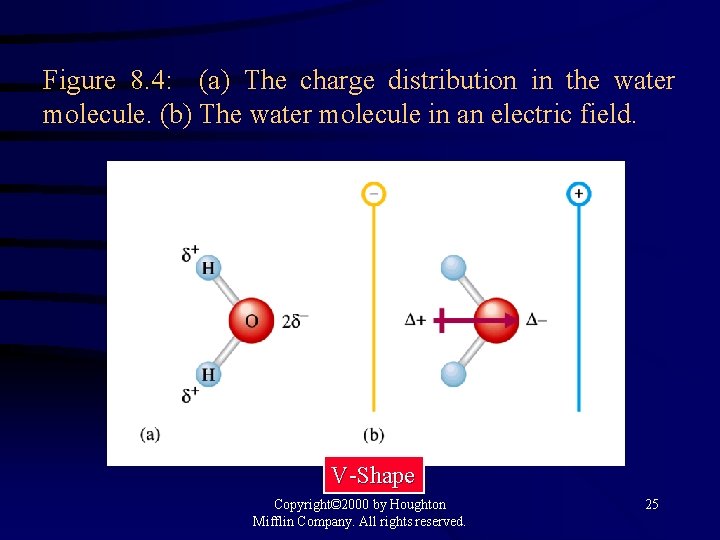
Figure 8. 4: (a) The charge distribution in the water molecule. (b) The water molecule in an electric field. V-Shape Copyright© 2000 by Houghton Mifflin Company. All rights reserved. 25
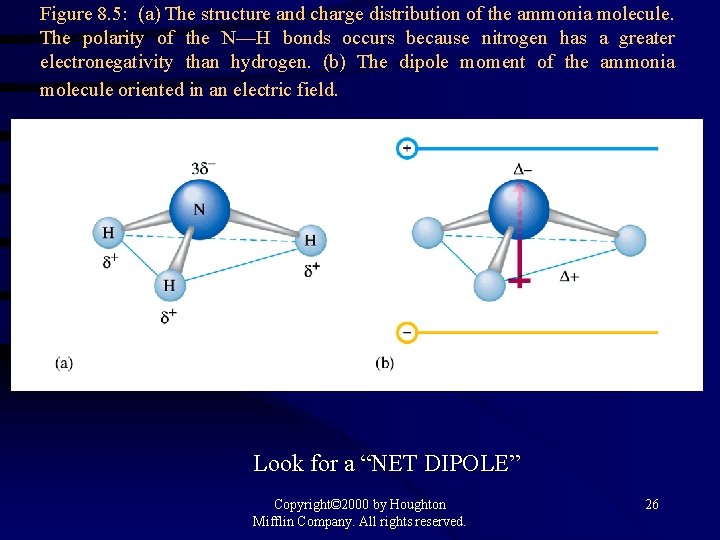
Figure 8. 5: (a) The structure and charge distribution of the ammonia molecule. The polarity of the N—H bonds occurs because nitrogen has a greater electronegativity than hydrogen. (b) The dipole moment of the ammonia molecule oriented in an electric field. Look for a “NET DIPOLE” Copyright© 2000 by Houghton Mifflin Company. All rights reserved. 26
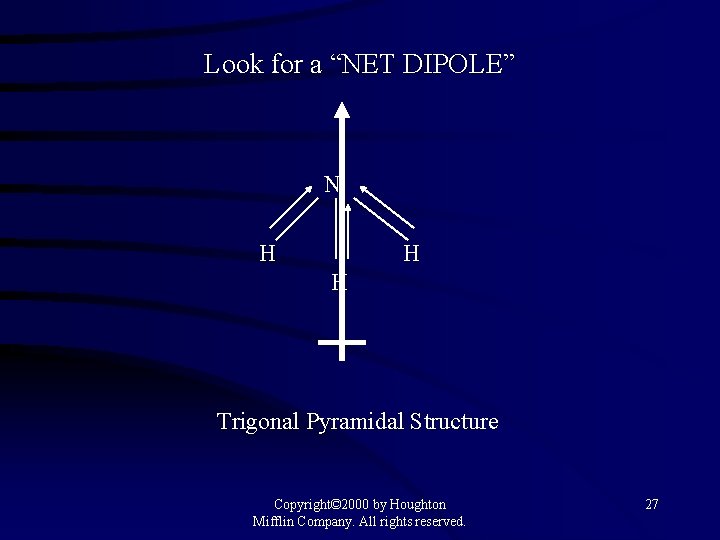
Look for a “NET DIPOLE” N H H H Trigonal Pyramidal Structure Copyright© 2000 by Houghton Mifflin Company. All rights reserved. 27

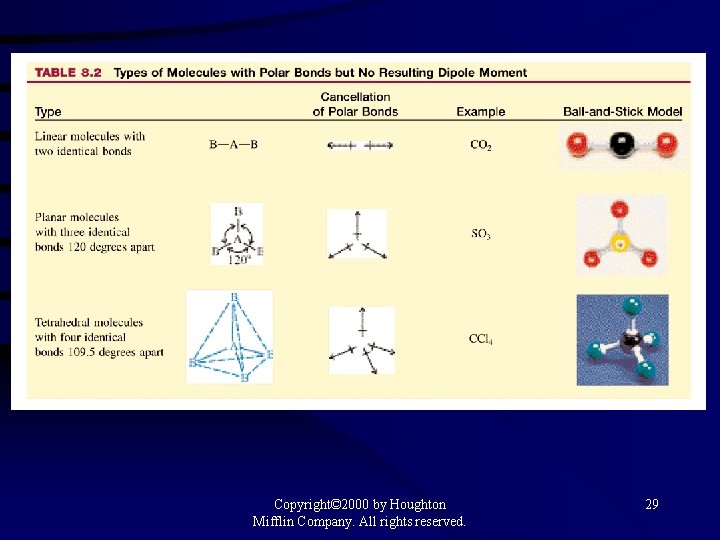
The carbon dioxide molecule CO 2: The opposed bond polarities cancel out, and the carbon dioxide has no dipole moment: Non-polar molecule Note: The C-O bond is polar, but the net dipole is Zero Example: SO 3, CCl 4, etc. Copyright© 2000 by Houghton Mifflin Company. All rights reserved. 28
Copyright© 2000 by Houghton Mifflin Company. All rights reserved. 29
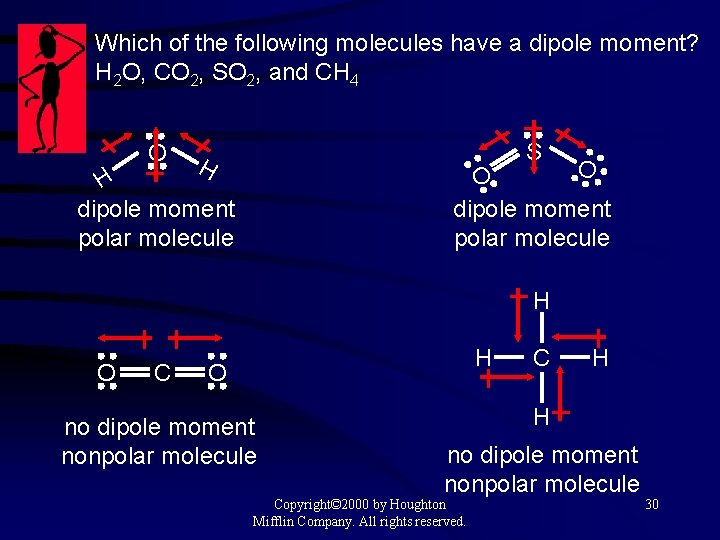
Which of the following molecules have a dipole moment? H 2 O, CO 2, SO 2, and CH 4 O S H O O dipole moment polar molecule H O C H O no dipole moment nonpolar molecule C H H no dipole moment nonpolar molecule Copyright© 2000 by Houghton Mifflin Company. All rights reserved. 30
Compounds ü Two nonmetals react: They share electrons to achieve NGEC (Noble Gas Electron Configurations) and form covalent bonds. ü A nonmetal and a representative group metal react (ionic compound): The valence orbitals of the metal are emptied (cation) to achieve NGEC. The valence electron configuration of the nonmetal (anion) achieves NGEC. Copyright© 2000 by Houghton Mifflin Company. All rights reserved. 31
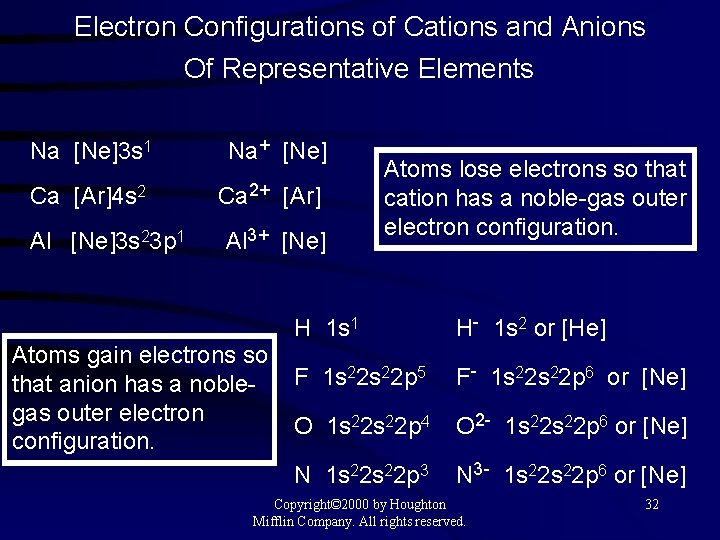
Electron Configurations of Cations and Anions Of Representative Elements Na [Ne]3 s 1 Na+ [Ne] Ca [Ar]4 s 2 Ca 2+ [Ar] Al [Ne]3 s 23 p 1 Al 3+ [Ne] Atoms gain electrons so that anion has a noblegas outer electron configuration. Atoms lose electrons so that cation has a noble-gas outer electron configuration. H 1 s 1 H- 1 s 2 or [He] F 1 s 22 p 5 F- 1 s 22 p 6 or [Ne] O 1 s 22 p 4 O 2 - 1 s 22 p 6 or [Ne] N 1 s 22 p 3 N 3 - 1 s 22 p 6 or [Ne] Copyright© 2000 by Houghton Mifflin Company. All rights reserved. 32
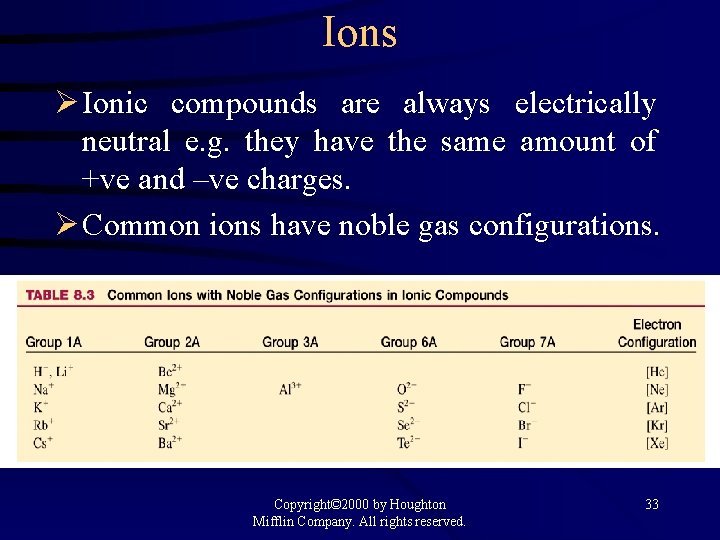
Ions Ø Ionic compounds are always electrically neutral e. g. they have the same amount of +ve and –ve charges. Ø Common ions have noble gas configurations. Copyright© 2000 by Houghton Mifflin Company. All rights reserved. 33
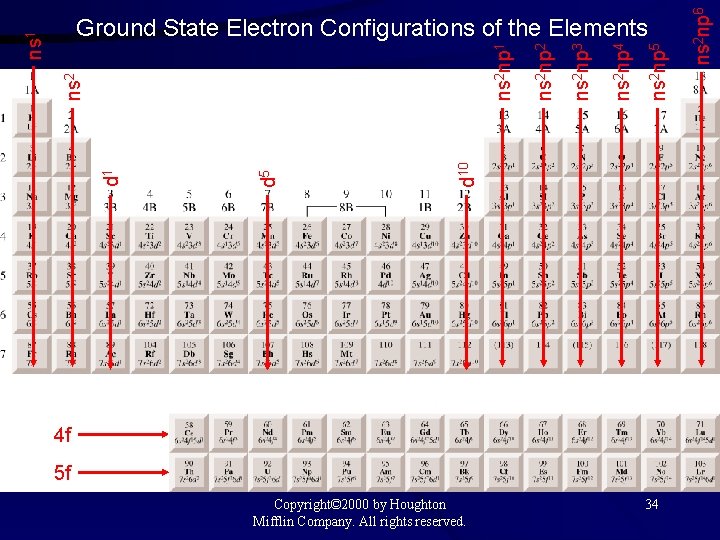
4 f 5 f Copyright© 2000 by Houghton Mifflin Company. All rights reserved. 34 ns 2 np 6 ns 2 np 5 ns 2 np 4 ns 2 np 3 ns 2 np 2 ns 2 np 1 d 10 d 5 d 1 ns 2 ns 1 Ground State Electron Configurations of the Elements
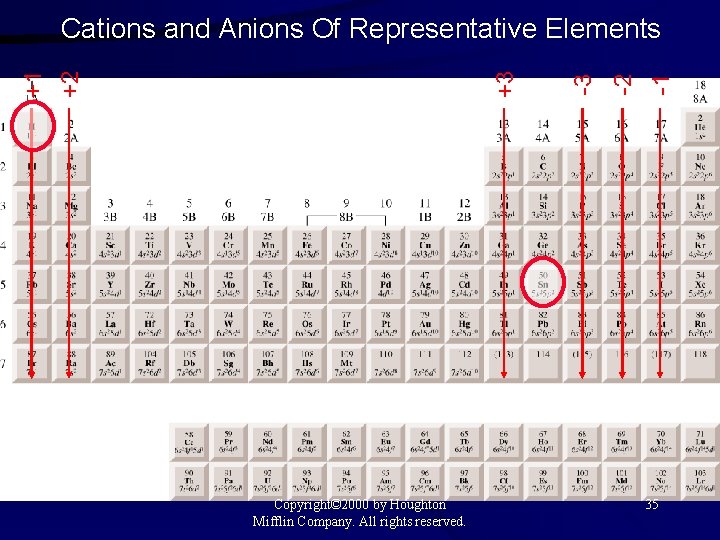
Copyright© 2000 by Houghton Mifflin Company. All rights reserved. -1 -2 -3 +3 +2 +1 Cations and Anions Of Representative Elements 35
Notes on Ions Ø Hydrogen may form H+ or HØ Tin forms Sn 2+ and Sn 4+. Ø Transition metals exhibit a more complicated behavior. Copyright© 2000 by Houghton Mifflin Company. All rights reserved. 36
Example of Ionic Compounds Ø Mg. O magnesium oxide is formed of Mg 2+ and O 2 -. Ø Ca. O formed from Ca 2+ and O 2 -. Ø Al 2 O 3 is formed of 2 Al 3+ and 3 O 2 -. Copyright© 2000 by Houghton Mifflin Company. All rights reserved. 37
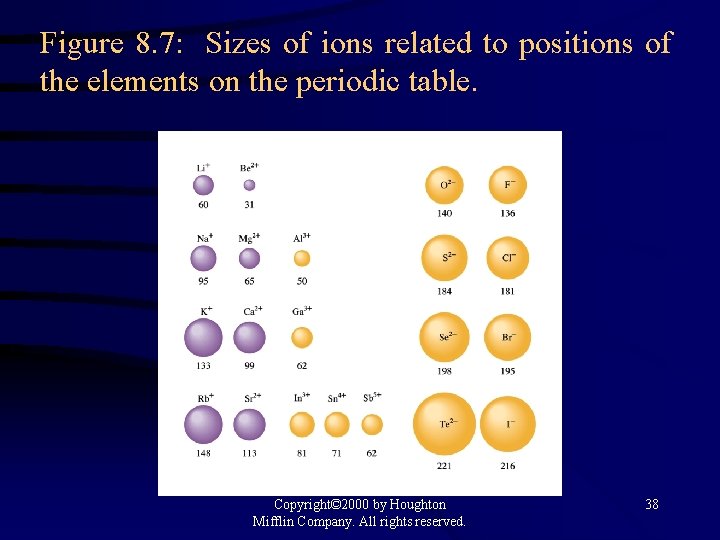
Figure 8. 7: Sizes of ions related to positions of the elements on the periodic table. Copyright© 2000 by Houghton Mifflin Company. All rights reserved. 38
Copyright© 2000 by Houghton Mifflin Company. All rights reserved. 39
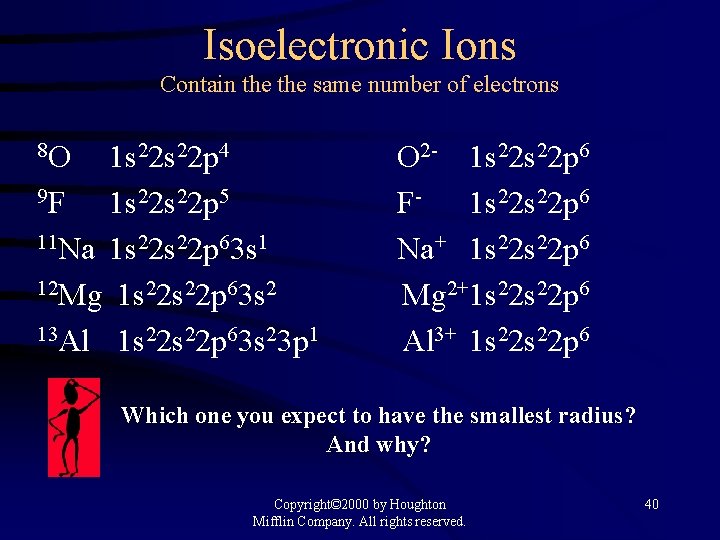
Isoelectronic Ions Contain the same number of electrons 8 O 1 s 22 p 4 9 F 1 s 22 p 5 11 Na 1 s 22 p 63 s 1 12 Mg 1 s 22 p 63 s 2 13 Al 1 s 22 p 63 s 23 p 1 O 2 - 1 s 22 p 6 F- 1 s 22 p 6 Na+ 1 s 22 p 6 Mg 2+1 s 22 p 6 Al 3+ 1 s 22 p 6 Which one you expect to have the smallest radius? And why? Copyright© 2000 by Houghton Mifflin Company. All rights reserved. 40
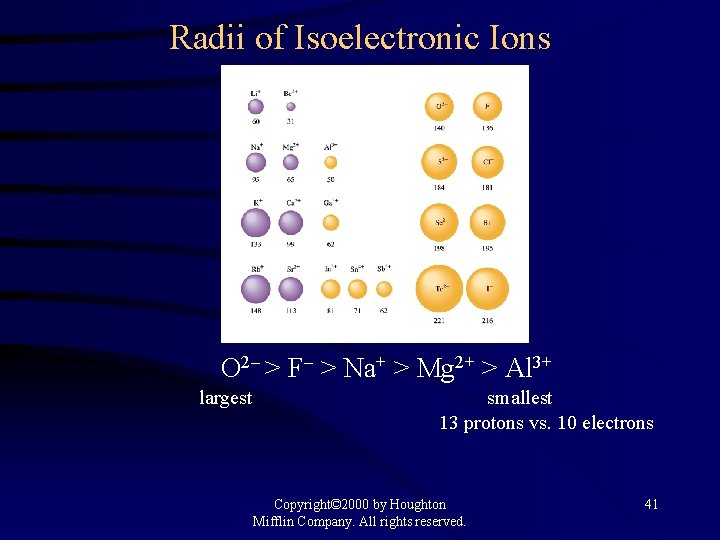
Radii of Isoelectronic Ions O 2 > F > Na+ > Mg 2+ > Al 3+ largest smallest 13 protons vs. 10 electrons Copyright© 2000 by Houghton Mifflin Company. All rights reserved. 41
Example Choose the largest ion in each of the following groups: 1. Li+, Na+, K+, Rb+, Cs+ 2. Ba 2+ , Cs+ , I- , Te 2 - Copyright© 2000 by Houghton Mifflin Company. All rights reserved. 42
To Reiterate ü Cation is smaller than parent atom. ü Anion is larger than parent atom. ü Size increase down in a group (+ve or –ve). ü The larger the mass number the smaller the size for isoelectronic cations and anions. Copyright© 2000 by Houghton Mifflin Company. All rights reserved. 43
Why Compounds Exist? The driving force behind the naturally occurring compounds (such as Na. Cl, H 2 O, etc. ) is to yield a stable lower energy form. A stable form is a an arrangement of atoms, held together by bonding that prevent decomposition. This bonding energy when ions condense from gas phase into ionic solid is called Lattice Energy. Copyright© 2000 by Houghton Mifflin Company. All rights reserved. 44
Lattice Energy The change in energy when separated gaseous ions are packed together to form an ionic solid. M+(g) + X (g) MX(s) Lattice energy is negative (exothermic) from the point of view of the system. Copyright© 2000 by Houghton Mifflin Company. All rights reserved. 45
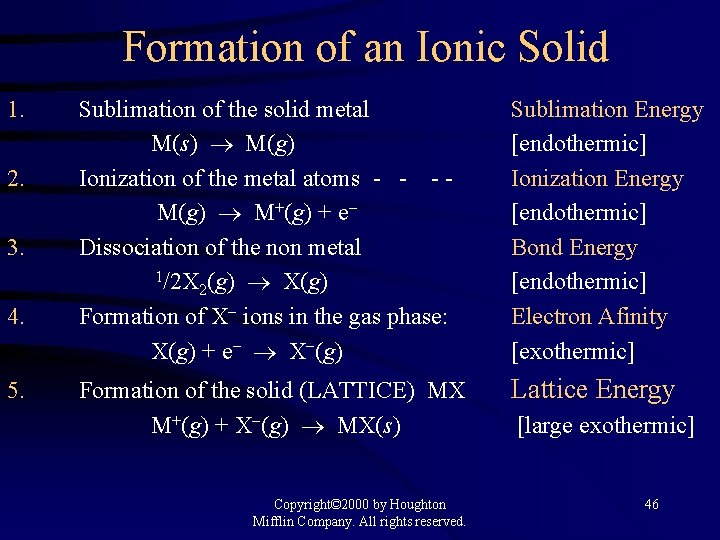
Formation of an Ionic Solid 1. 2. 3. 4. 5. Sublimation of the solid metal M(s) M(g) Ionization of the metal atoms - - - M(g) M+(g) + e Dissociation of the non metal 1/2 X (g) X(g) 2 Formation of X ions in the gas phase: X(g) + e X (g) Sublimation Energy [endothermic] Ionization Energy [endothermic] Bond Energy [endothermic] Electron Afinity [exothermic] Formation of the solid (LATTICE) MX M+(g) + X (g) MX(s) Lattice Energy Copyright© 2000 by Houghton Mifflin Company. All rights reserved. [large exothermic] 46
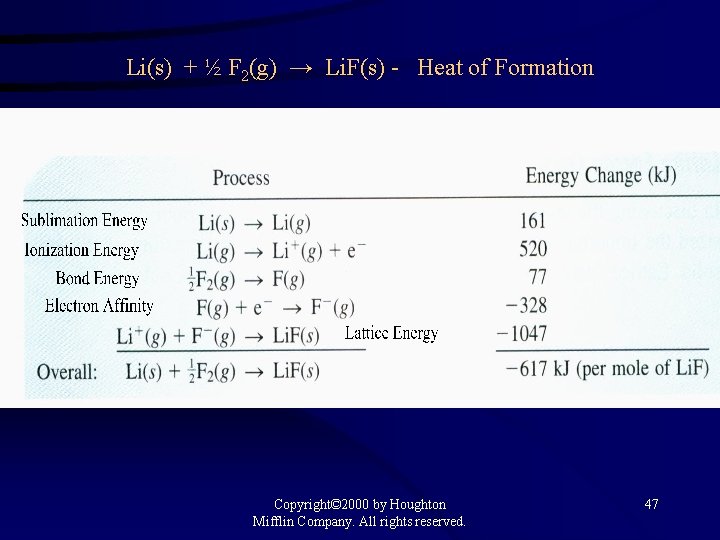
Li(s) + ½ F 2(g) → Li. F(s) - Heat of Formation Copyright© 2000 by Houghton Mifflin Company. All rights reserved. 47
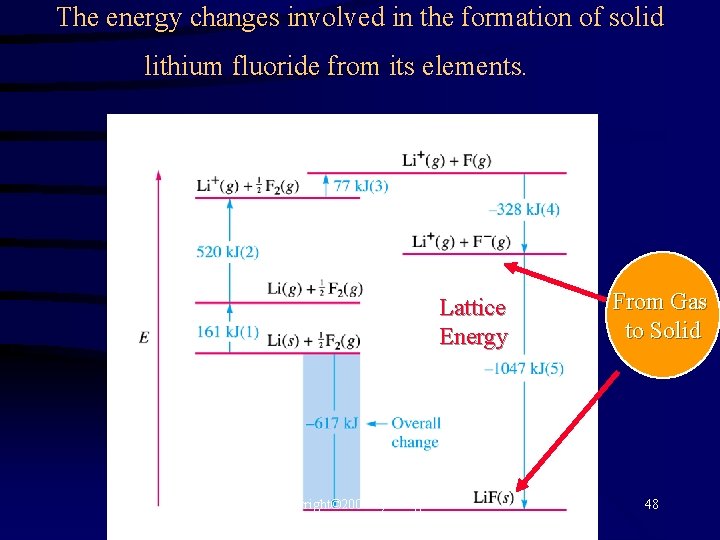
The energy changes involved in the formation of solid lithium fluoride from its elements. Lattice Energy Copyright© 2000 by Houghton Mifflin Company. All rights reserved. From Gas to Solid 48
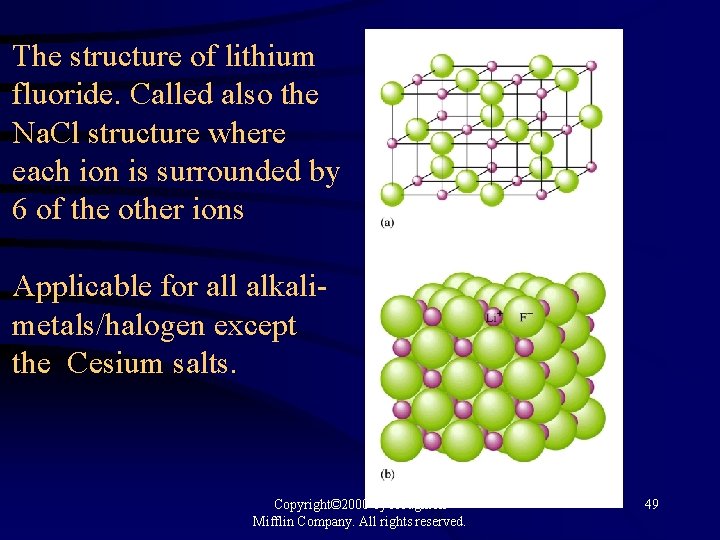
The structure of lithium fluoride. Called also the Na. Cl structure where each ion is surrounded by 6 of the other ions Applicable for all alkalimetals/halogen except the Cesium salts. Copyright© 2000 by Houghton Mifflin Company. All rights reserved. 49
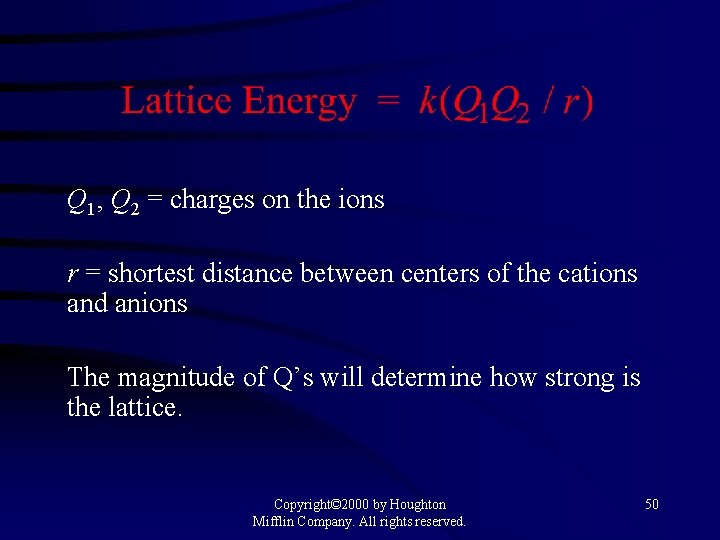
Q 1, Q 2 = charges on the ions r = shortest distance between centers of the cations and anions The magnitude of Q’s will determine how strong is the lattice. Copyright© 2000 by Houghton Mifflin Company. All rights reserved. 50
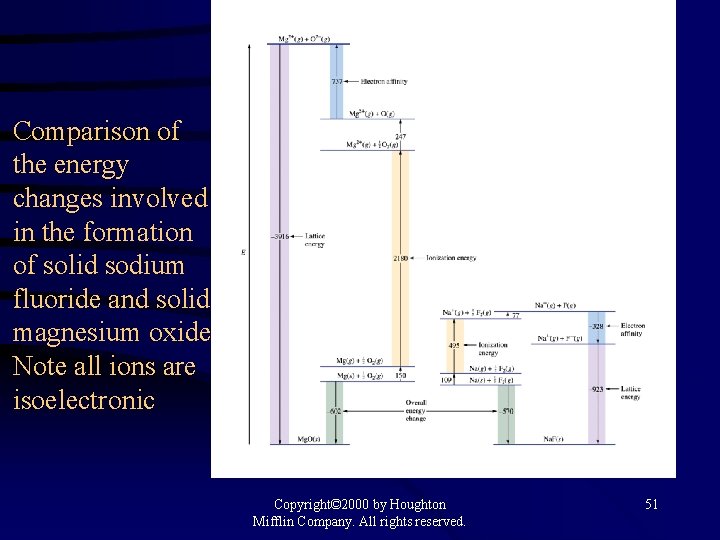
Comparison of the energy changes involved in the formation of solid sodium fluoride and solid magnesium oxide. Note all ions are isoelectronic Copyright© 2000 by Houghton Mifflin Company. All rights reserved. 51
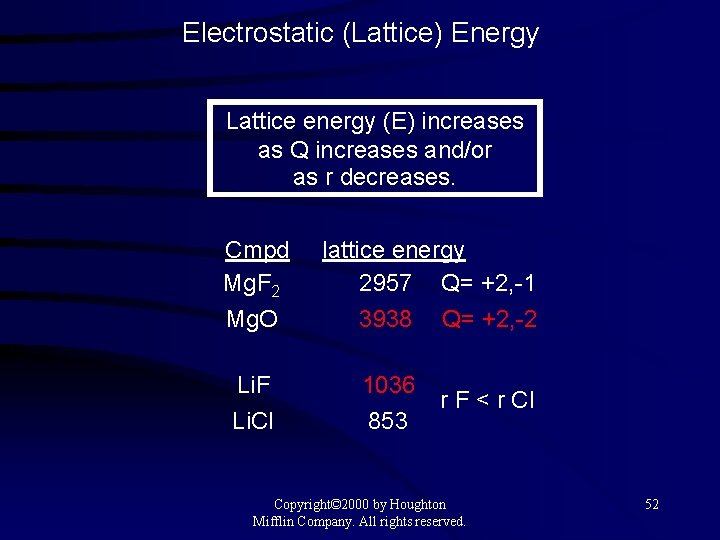
Electrostatic (Lattice) Energy Lattice energy (E) increases as Q increases and/or as r decreases. Cmpd Mg. F 2 Mg. O Li. F Li. Cl lattice energy 2957 Q= +2, -1 3938 Q= +2, -2 1036 853 r F < r Cl Copyright© 2000 by Houghton Mifflin Company. All rights reserved. 52
A Model for Covalent Bond Models are attempts to explain how nature operates on the microscopic level based on experiences in the macroscopic world. Copyright© 2000 by Houghton Mifflin Company. All rights reserved. 53
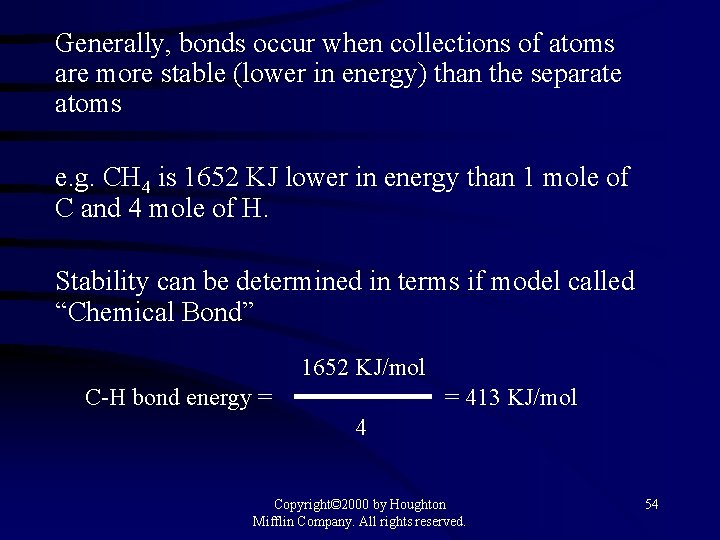
Generally, bonds occur when collections of atoms are more stable (lower in energy) than the separate atoms e. g. CH 4 is 1652 KJ lower in energy than 1 mole of C and 4 mole of H. Stability can be determined in terms if model called “Chemical Bond” 1652 KJ/mol C-H bond energy = = 413 KJ/mol 4 Copyright© 2000 by Houghton Mifflin Company. All rights reserved. 54
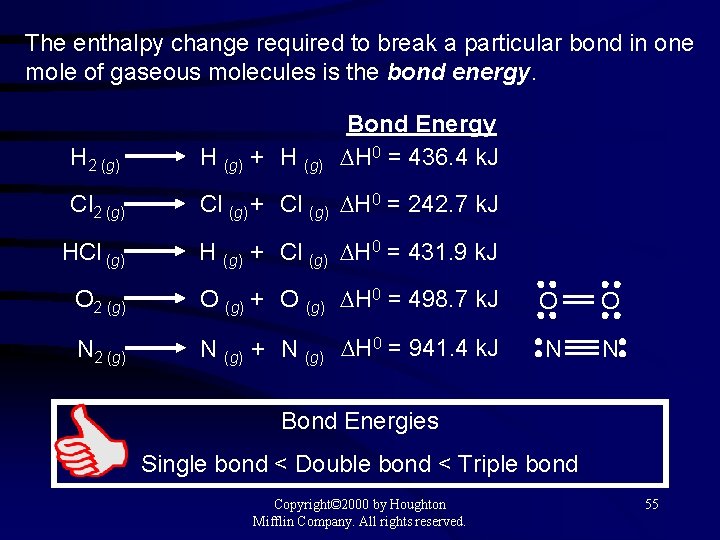
The enthalpy change required to break a particular bond in one mole of gaseous molecules is the bond energy. Bond Energy H 0 = 436. 4 k. J H 2 (g) H (g) + H (g) Cl 2 (g) Cl (g) + Cl (g) H 0 = 242. 7 k. J HCl (g) H (g) + Cl (g) H 0 = 431. 9 k. J O 2 (g) O (g) + O (g) H 0 = 498. 7 k. J O O N 2 (g) N (g) + N (g) H 0 = 941. 4 k. J N N Bond Energies Single bond < Double bond < Triple bond Copyright© 2000 by Houghton Mifflin Company. All rights reserved. 55
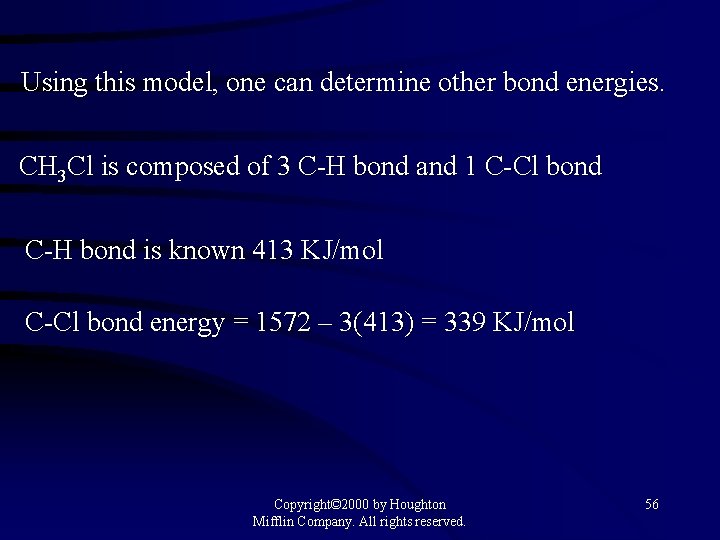
Using this model, one can determine other bond energies. CH 3 Cl is composed of 3 C-H bond and 1 C-Cl bond C-H bond is known 413 KJ/mol C-Cl bond energy = 1572 – 3(413) = 339 KJ/mol Copyright© 2000 by Houghton Mifflin Company. All rights reserved. 56
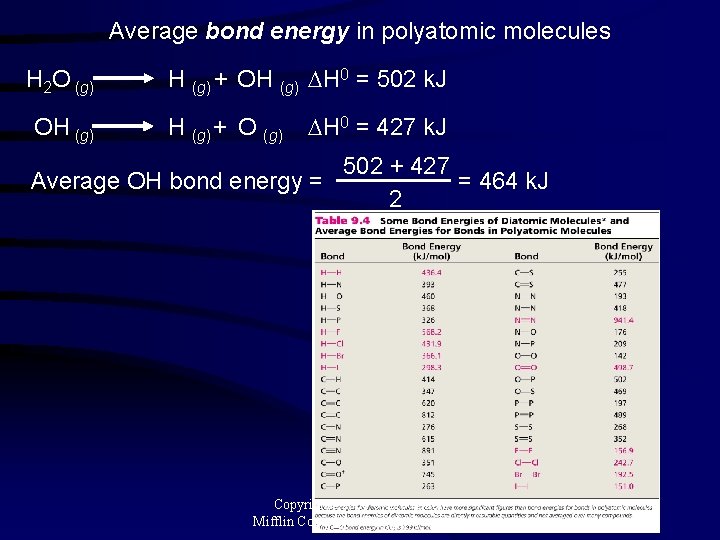
Average bond energy in polyatomic molecules H 2 O (g) OH (g) + OH (g) H 0 = 502 k. J H (g) + O (g) H 0 = 427 k. J 502 + 427 = 464 k. J Average OH bond energy = 2 Copyright© 2000 by Houghton Mifflin Company. All rights reserved. 57
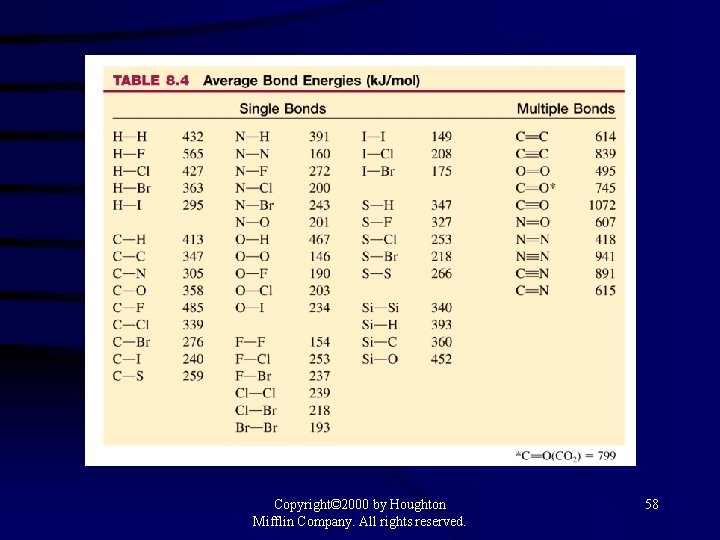
Copyright© 2000 by Houghton Mifflin Company. All rights reserved. 58
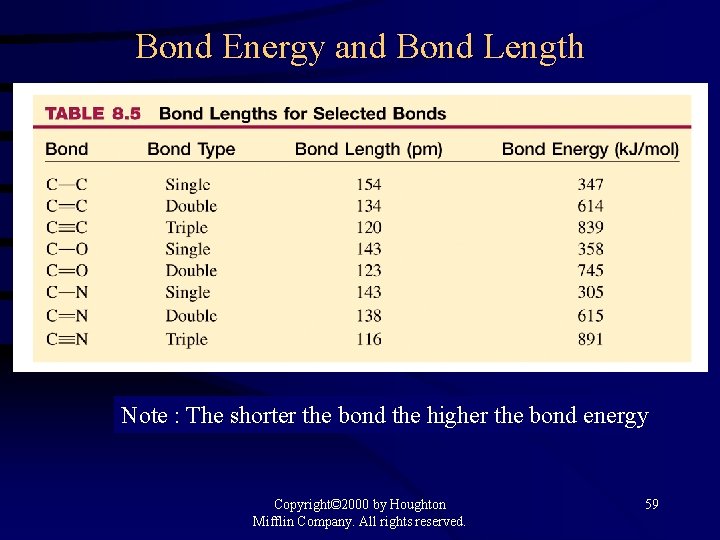
Bond Energy and Bond Length Note : The shorter the bond the higher the bond energy Copyright© 2000 by Houghton Mifflin Company. All rights reserved. 59
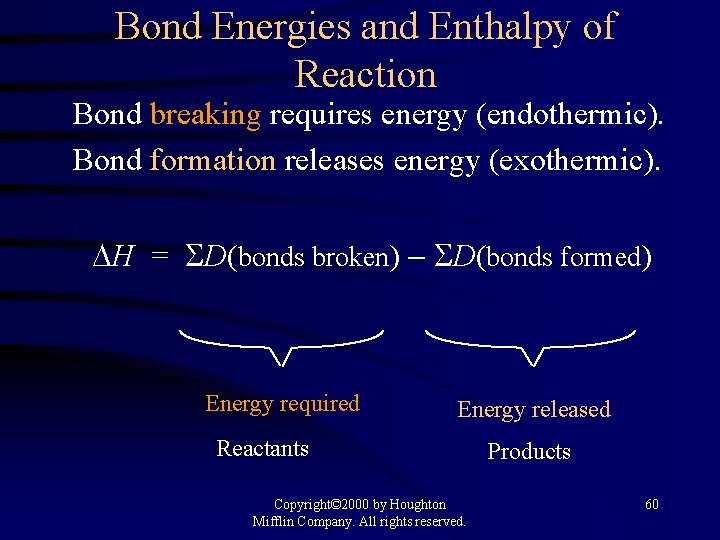
Bond Energies and Enthalpy of Reaction Bond breaking requires energy (endothermic). Bond formation releases energy (exothermic). H = D(bonds broken) D(bonds formed) Energy required Energy released Reactants Copyright© 2000 by Houghton Mifflin Company. All rights reserved. Products 60
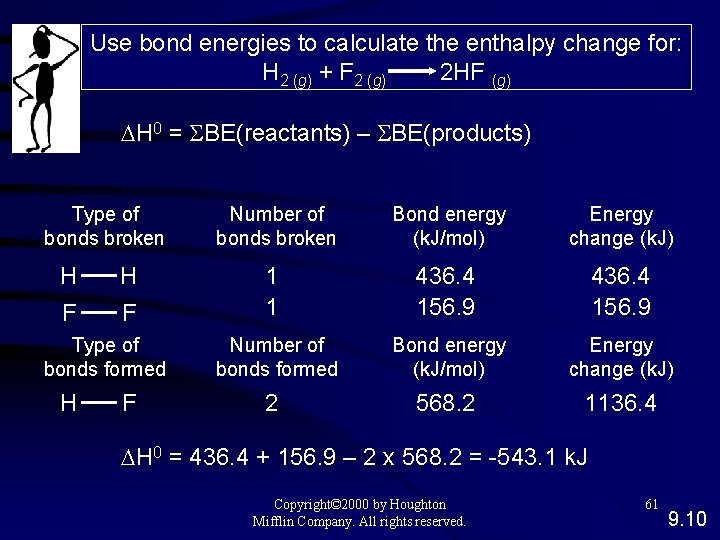
Use bond energies to calculate the enthalpy change for: H 2 (g) + F 2 (g) 2 HF (g) H 0 = BE(reactants) – BE(products) Type of bonds broken H H F F Type of bonds formed H F Number of bonds broken Bond energy (k. J/mol) Energy change (k. J) 1 1 436. 4 156. 9 Number of bonds formed Bond energy (k. J/mol) Energy change (k. J) 2 568. 2 1136. 4 H 0 = 436. 4 + 156. 9 – 2 x 568. 2 = -543. 1 k. J Copyright© 2000 by Houghton Mifflin Company. All rights reserved. 61 9. 10
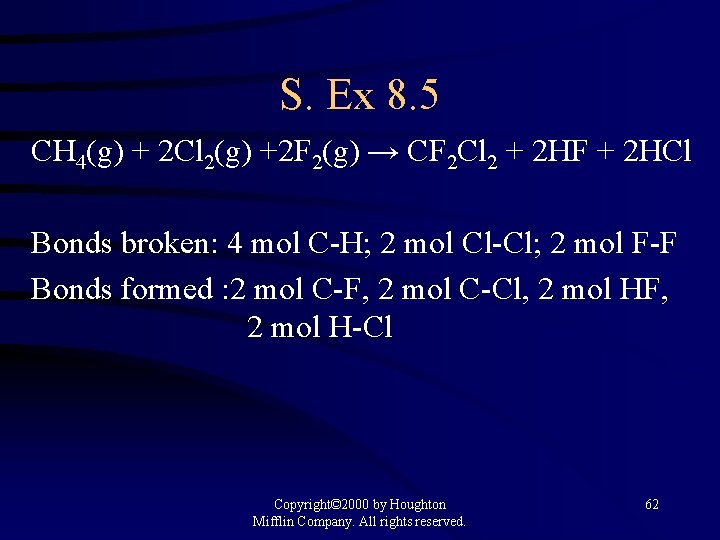
S. Ex 8. 5 CH 4(g) + 2 Cl 2(g) +2 F 2(g) → CF 2 Cl 2 + 2 HF + 2 HCl Bonds broken: 4 mol C-H; 2 mol Cl-Cl; 2 mol F-F Bonds formed : 2 mol C-F, 2 mol C-Cl, 2 mol HF, 2 mol H-Cl Copyright© 2000 by Houghton Mifflin Company. All rights reserved. 62
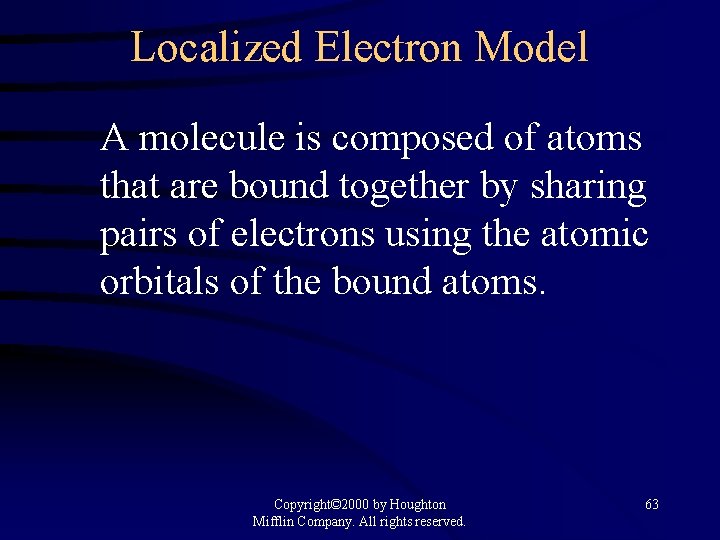
Localized Electron Model A molecule is composed of atoms that are bound together by sharing pairs of electrons using the atomic orbitals of the bound atoms. Copyright© 2000 by Houghton Mifflin Company. All rights reserved. 63
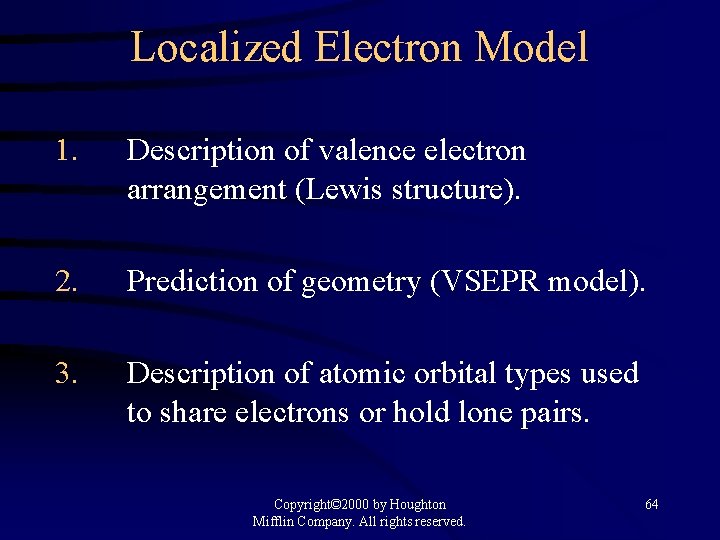
Localized Electron Model 1. Description of valence electron arrangement (Lewis structure). 2. Prediction of geometry (VSEPR model). 3. Description of atomic orbital types used to share electrons or hold lone pairs. Copyright© 2000 by Houghton Mifflin Company. All rights reserved. 64
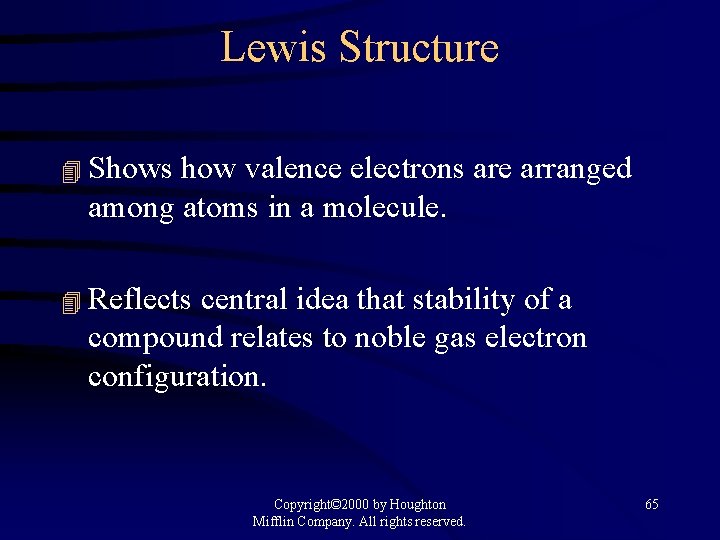
Lewis Structure 4 Shows how valence electrons are arranged among atoms in a molecule. 4 Reflects central idea that stability of a compound relates to noble gas electron configuration. Copyright© 2000 by Houghton Mifflin Company. All rights reserved. 65
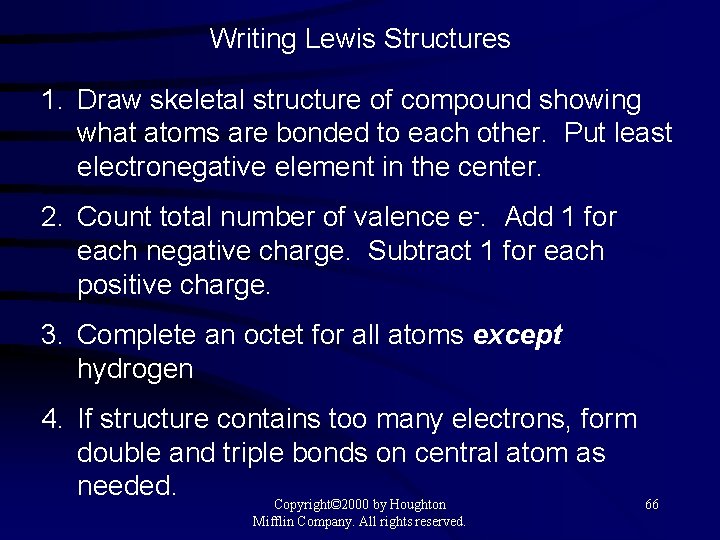
Writing Lewis Structures 1. Draw skeletal structure of compound showing what atoms are bonded to each other. Put least electronegative element in the center. 2. Count total number of valence e-. Add 1 for each negative charge. Subtract 1 for each positive charge. 3. Complete an octet for all atoms except hydrogen 4. If structure contains too many electrons, form double and triple bonds on central atom as needed. Copyright© 2000 by Houghton 66 Mifflin Company. All rights reserved.
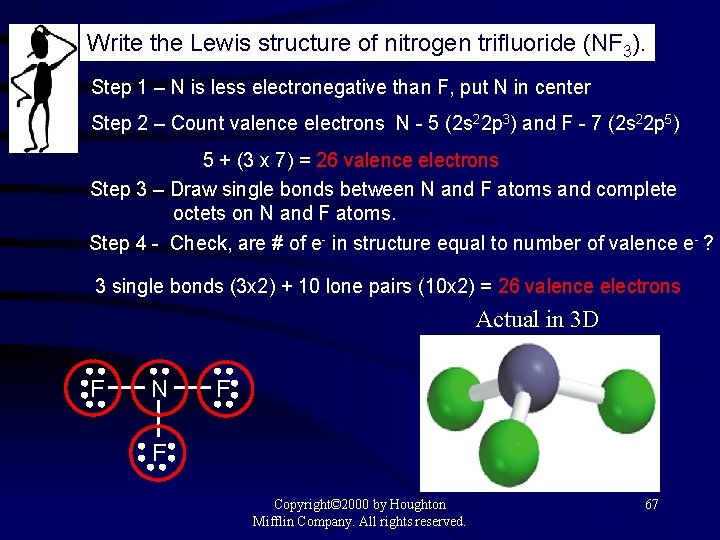
Write the Lewis structure of nitrogen trifluoride (NF 3). Step 1 – N is less electronegative than F, put N in center Step 2 – Count valence electrons N - 5 (2 s 22 p 3) and F - 7 (2 s 22 p 5) 5 + (3 x 7) = 26 valence electrons Step 3 – Draw single bonds between N and F atoms and complete octets on N and F atoms. Step 4 - Check, are # of e- in structure equal to number of valence e- ? 3 single bonds (3 x 2) + 10 lone pairs (10 x 2) = 26 valence electrons Actual in 3 D F N F F Copyright© 2000 by Houghton Mifflin Company. All rights reserved. 67
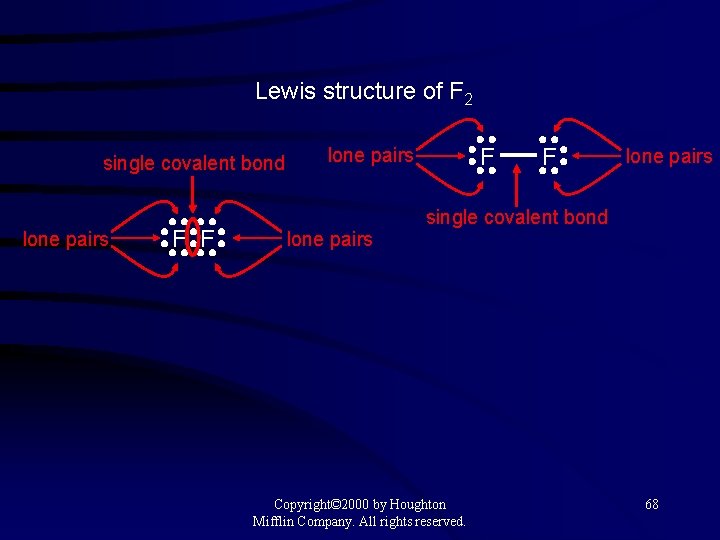
Lewis structure of F 2 single covalent bond lone pairs F F F lone pairs single covalent bond Copyright© 2000 by Houghton Mifflin Company. All rights reserved. 68
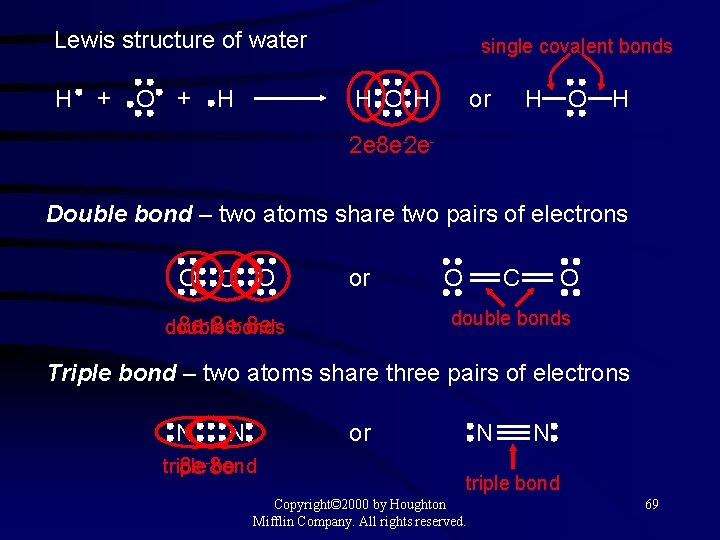
Lewis structure of water H + O + H single covalent bonds H O H or H O H 2 e-8 e-2 e. Double bond – two atoms share two pairs of electrons O C O or O O C double bonds - 8 e 8 e- 8 ebonds double Triple bond – two atoms share three pairs of electrons N N triple bond 8 e-8 e or N N triple bond Copyright© 2000 by Houghton Mifflin Company. All rights reserved. 69
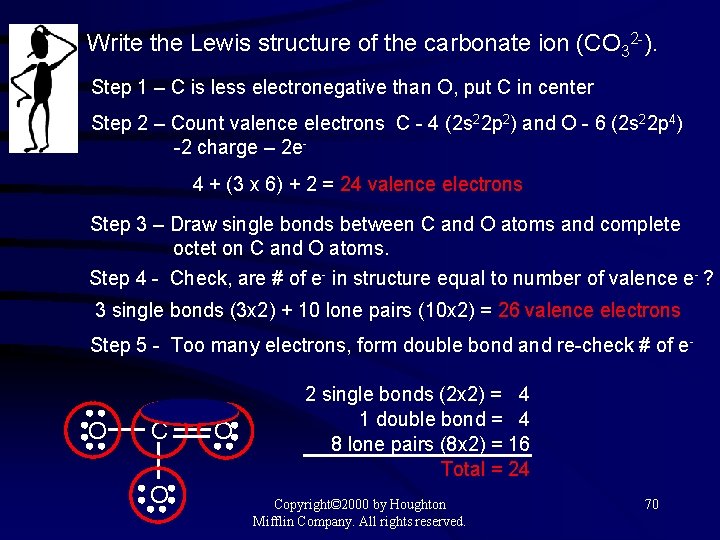
Write the Lewis structure of the carbonate ion (CO 32 -). Step 1 – C is less electronegative than O, put C in center Step 2 – Count valence electrons C - 4 (2 s 22 p 2) and O - 6 (2 s 22 p 4) -2 charge – 2 e 4 + (3 x 6) + 2 = 24 valence electrons Step 3 – Draw single bonds between C and O atoms and complete octet on C and O atoms. Step 4 - Check, are # of e- in structure equal to number of valence e- ? 3 single bonds (3 x 2) + 10 lone pairs (10 x 2) = 26 valence electrons Step 5 - Too many electrons, form double bond and re-check # of e- O C O O 2 single bonds (2 x 2) = 4 1 double bond = 4 8 lone pairs (8 x 2) = 16 Total = 24 Copyright© 2000 by Houghton Mifflin Company. All rights reserved. 70
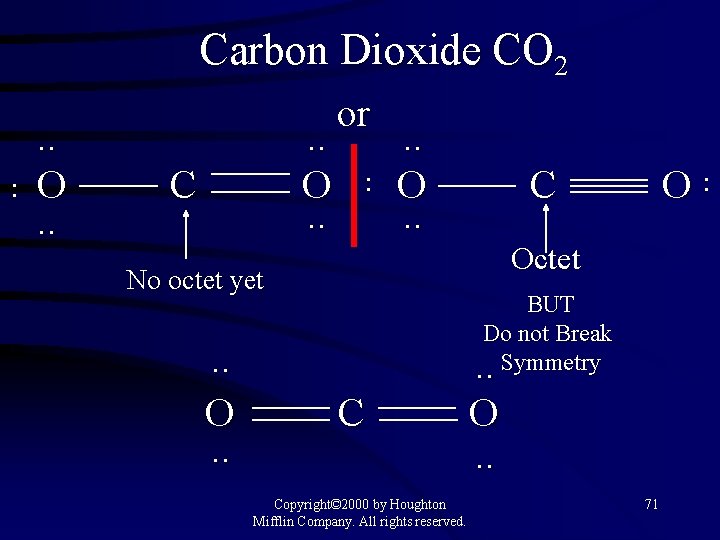
Carbon Dioxide CO 2 C . . O. . O Octet No octet yet . . O. . C BUT Do not Break Symmetry C Copyright© 2000 by Houghton Mifflin Company. All rights reserved. . . O. . 71 . . O. . or
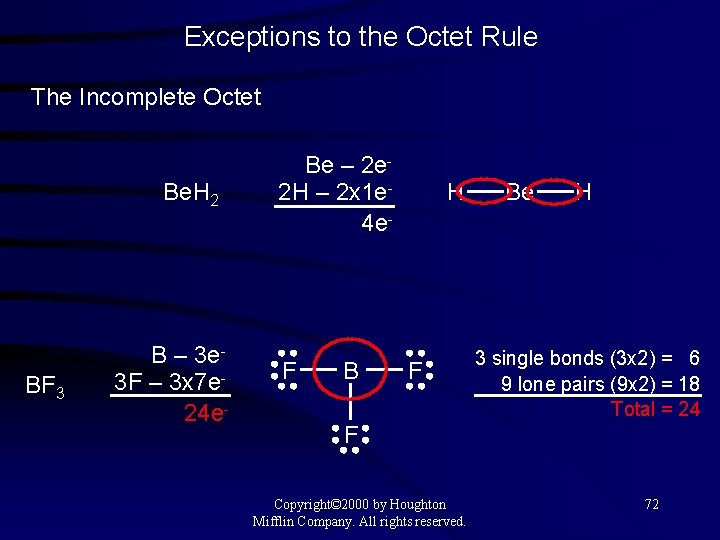
Exceptions to the Octet Rule The Incomplete Octet Be. H 2 BF 3 B – 3 e 3 F – 3 x 7 e 24 e- Be – 2 e 2 H – 2 x 1 e 4 e- F B H F Be H 3 single bonds (3 x 2) = 6 9 lone pairs (9 x 2) = 18 Total = 24 F Copyright© 2000 by Houghton Mifflin Company. All rights reserved. 72
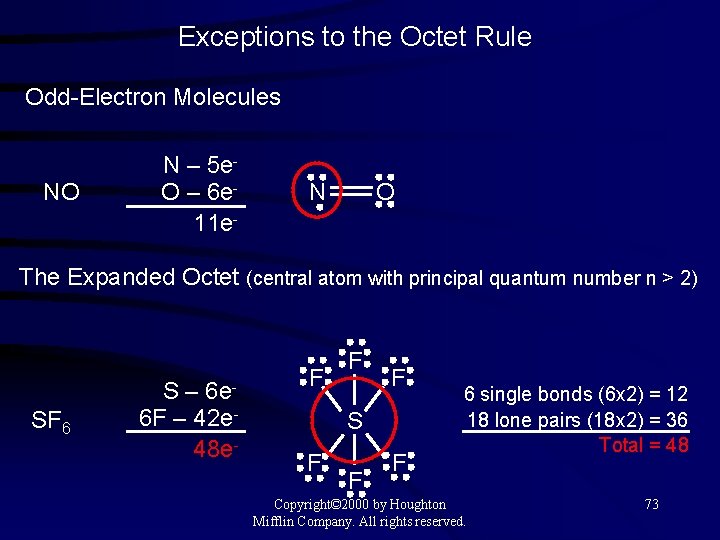
Exceptions to the Octet Rule Odd-Electron Molecules NO N – 5 e. O – 6 e 11 e- N O The Expanded Octet (central atom with principal quantum number n > 2) SF 6 S – 6 e 6 F – 42 e 48 e- F F F S F F F 6 single bonds (6 x 2) = 12 18 lone pairs (18 x 2) = 36 Total = 48 Copyright© 2000 by Houghton Mifflin Company. All rights reserved. 73
Comments About the Octet Rule 4 2 nd row elements C, N, O, F observe the octet rule. 4 2 nd row elements B and Be often have fewer than 8 electrons around themselves - they are very reactive (BF 3, Be. H 2, etc. . ). 4 3 rd row and heavier elements CAN exceed the octet rule using empty valence d orbitals (SF 6, PCl 5, etc. ). 4 When writing Lewis structures, satisfy octets first, then place electrons around elements having available d orbitals. Copyright© 2000 by Houghton Mifflin Company. All rights reserved. 74
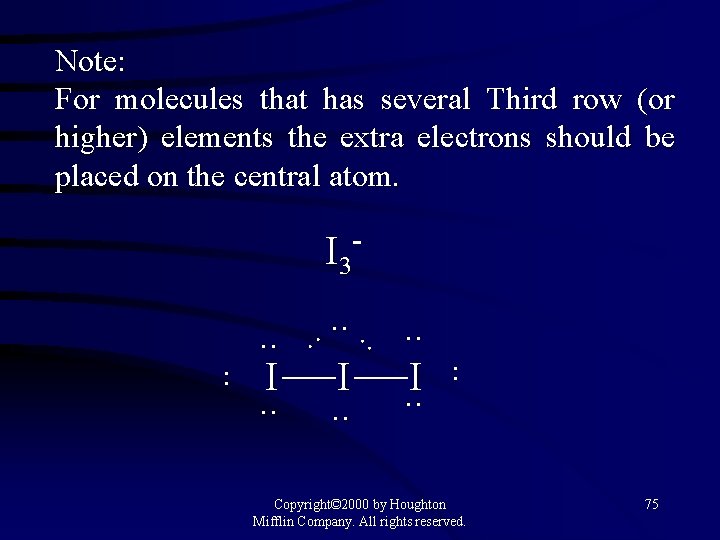
Note: For molecules that has several Third row (or higher) elements the extra electrons should be placed on the central atom. - I 3 . . . I . . . . I. . Copyright© 2000 by Houghton Mifflin Company. All rights reserved. 75
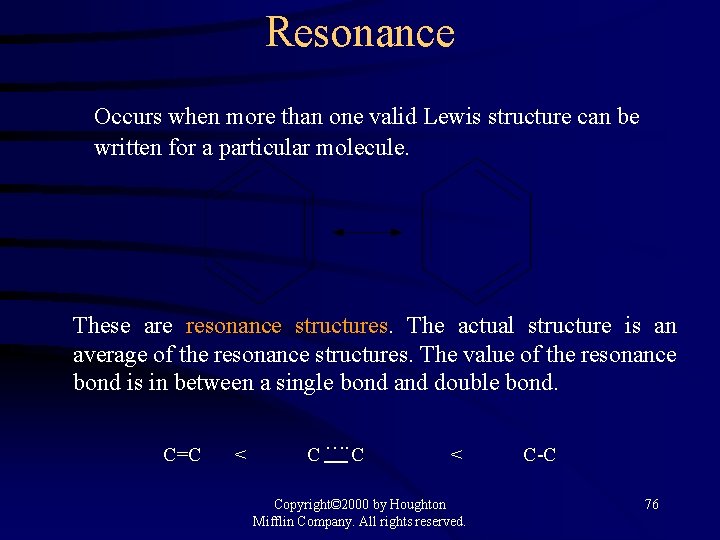
Resonance Occurs when more than one valid Lewis structure can be written for a particular molecule. These are resonance structures. The actual structure is an average of the resonance structures. The value of the resonance bond is in between a single bond and double bond. C=C < C …. C < Copyright© 2000 by Houghton Mifflin Company. All rights reserved. C-C 76
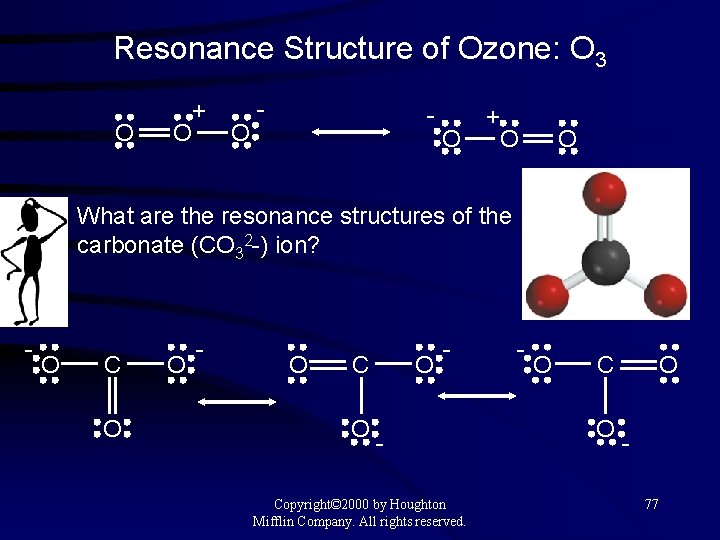
Resonance Structure of Ozone: O 3 O O + O - - O + O O What are the resonance structures of the carbonate (CO 32 -) ion? - O C O O - - Copyright© 2000 by Houghton Mifflin Company. All rights reserved. - O C O O 77
How the charges in the previous examples were depicted? Calculate the Formal charge on each atom. Copyright© 2000 by Houghton Mifflin Company. All rights reserved. 78
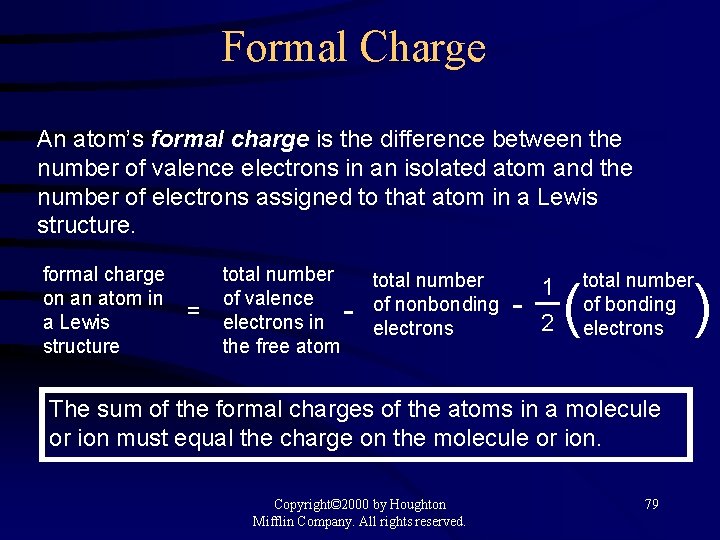
Formal Charge An atom’s formal charge is the difference between the number of valence electrons in an isolated atom and the number of electrons assigned to that atom in a Lewis structure. formal charge on an atom in a Lewis structure = total number of valence electrons in the free atom - total number of nonbonding electrons - 1 2 ( total number of bonding electrons ) The sum of the formal charges of the atoms in a molecule or ion must equal the charge on the molecule or ion. Copyright© 2000 by Houghton Mifflin Company. All rights reserved. 79
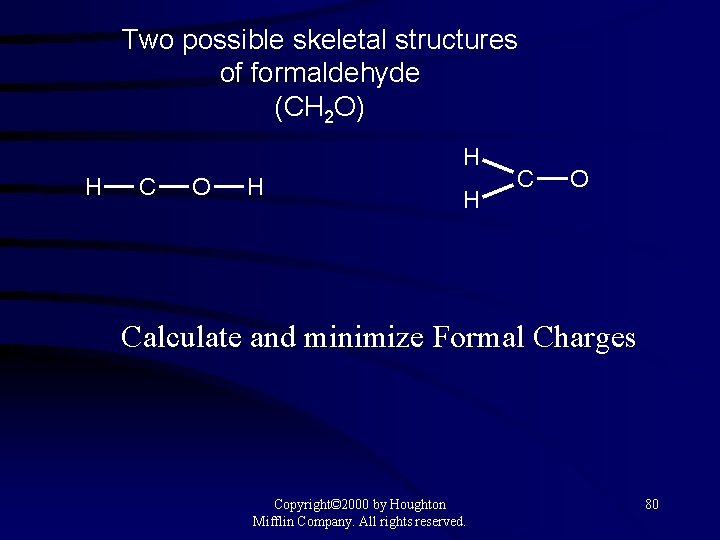
Two possible skeletal structures of formaldehyde (CH 2 O) H H C O Calculate and minimize Formal Charges Copyright© 2000 by Houghton Mifflin Company. All rights reserved. 80
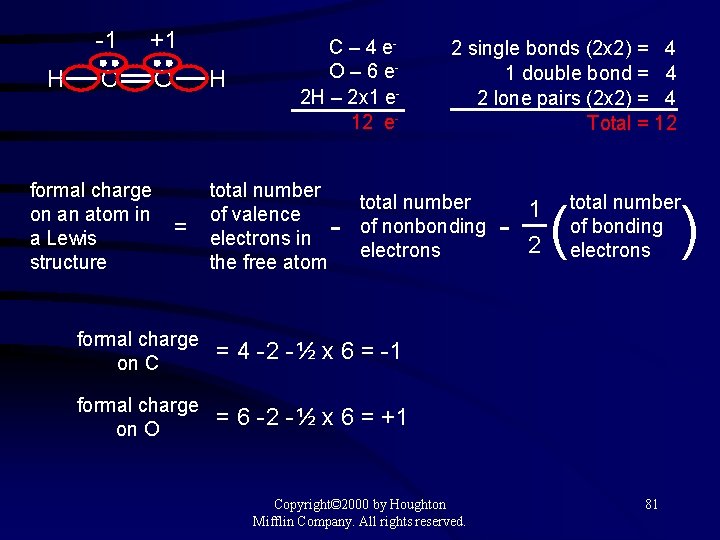
H -1 +1 C O formal charge on an atom in a Lewis structure H = C – 4 e. O – 6 e 2 H – 2 x 1 e 12 e- total number of valence electrons in the free atom - 2 single bonds (2 x 2) = 4 1 double bond = 4 2 lone pairs (2 x 2) = 4 Total = 12 total number of nonbonding electrons formal charge on C = 4 -2 - ½ x 6 = -1 formal charge on O = 6 -2 - ½ x 6 = +1 Copyright© 2000 by Houghton Mifflin Company. All rights reserved. - 1 2 ( total number of bonding electrons ) 81
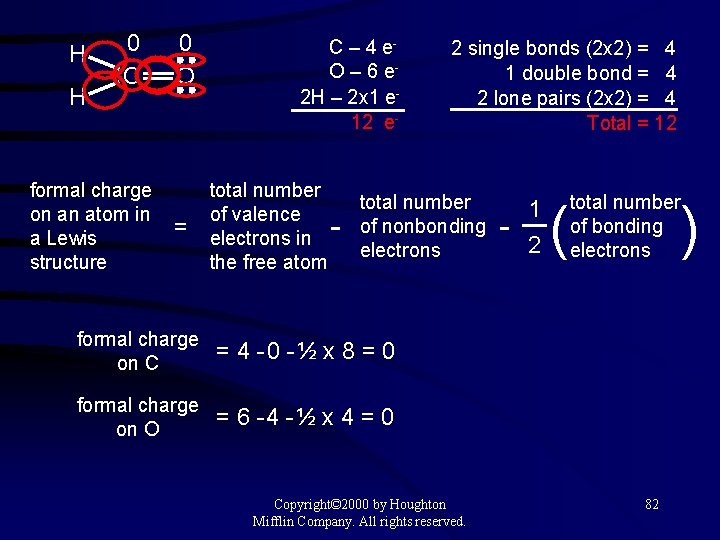
H H 0 C formal charge on an atom in a Lewis structure 0 O = C – 4 e. O – 6 e 2 H – 2 x 1 e 12 etotal number of valence electrons in the free atom - 2 single bonds (2 x 2) = 4 1 double bond = 4 2 lone pairs (2 x 2) = 4 Total = 12 total number of nonbonding electrons formal charge on C = 4 - 0 -½ x 8 = 0 formal charge on O = 6 -4 - ½ x 4 = 0 Copyright© 2000 by Houghton Mifflin Company. All rights reserved. - 1 2 ( total number of bonding electrons ) 82
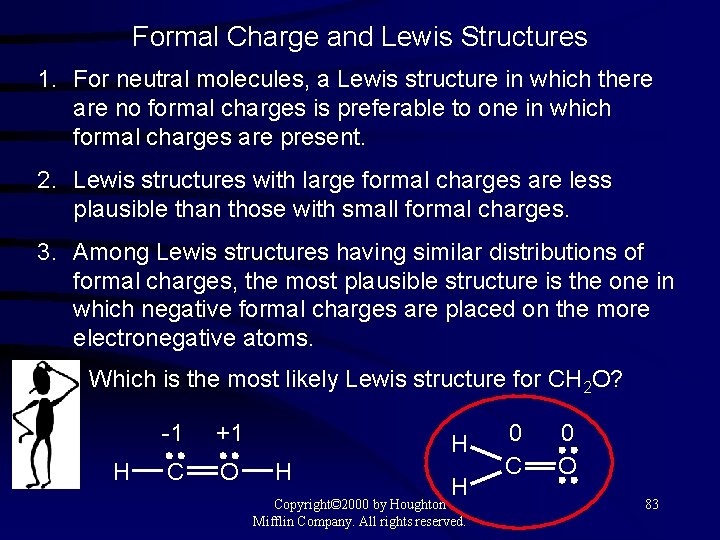
Formal Charge and Lewis Structures 1. For neutral molecules, a Lewis structure in which there are no formal charges is preferable to one in which formal charges are present. 2. Lewis structures with large formal charges are less plausible than those with small formal charges. 3. Among Lewis structures having similar distributions of formal charges, the most plausible structure is the one in which negative formal charges are placed on the more electronegative atoms. Which is the most likely Lewis structure for CH 2 O? H -1 +1 C O H H H Copyright© 2000 by Houghton Mifflin Company. All rights reserved. 0 C 0 O 83
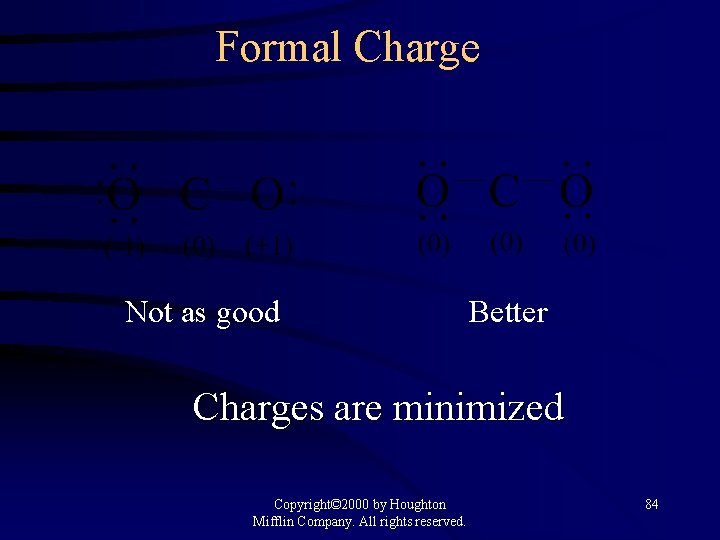
Formal Charge Not as good Better Charges are minimized Copyright© 2000 by Houghton Mifflin Company. All rights reserved. 84
Formal charges of sulfate ion Copyright© 2000 by Houghton Mifflin Company. All rights reserved. 85
VSEPR Model The structure around a given atom is determined principally by minimizing electron pair repulsions. Copyright© 2000 by Houghton Mifflin Company. All rights reserved. 86
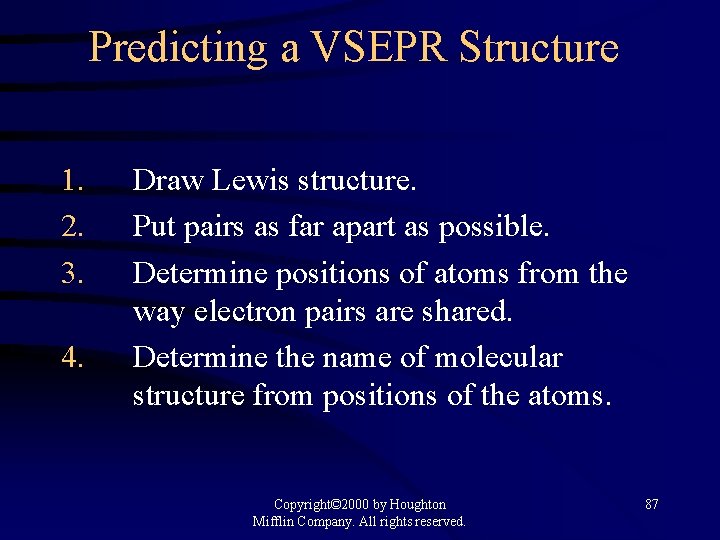
Predicting a VSEPR Structure 1. 2. 3. 4. Draw Lewis structure. Put pairs as far apart as possible. Determine positions of atoms from the way electron pairs are shared. Determine the name of molecular structure from positions of the atoms. Copyright© 2000 by Houghton Mifflin Company. All rights reserved. 87
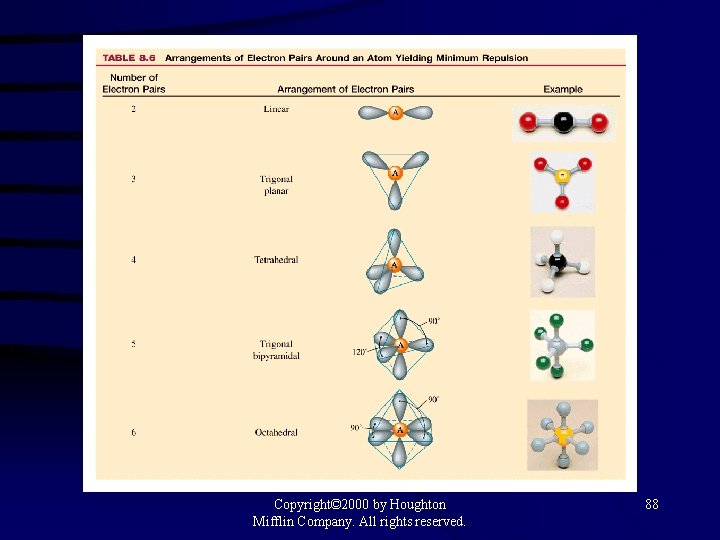
Copyright© 2000 by Houghton Mifflin Company. All rights reserved. 88
Predict the structure of NH 3 Copyright© 2000 by Houghton Mifflin Company. All rights reserved. 89
Molecular structure of water molecule Copyright© 2000 by Houghton Mifflin Company. All rights reserved. 90
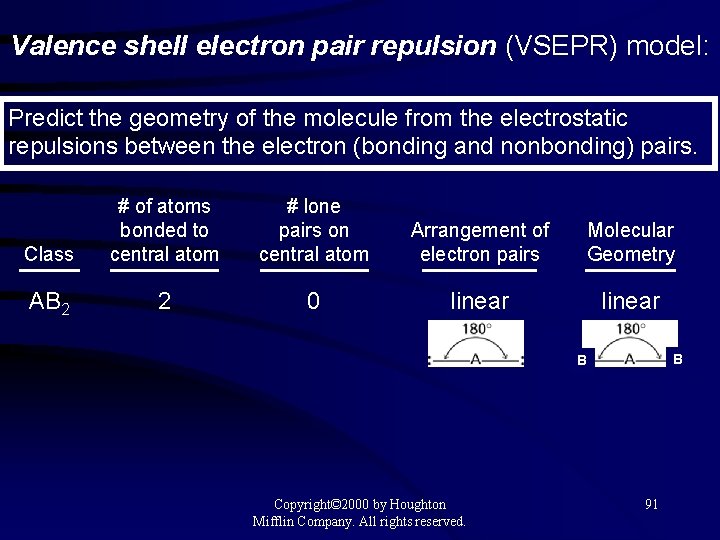
Valence shell electron pair repulsion (VSEPR) model: Predict the geometry of the molecule from the electrostatic repulsions between the electron (bonding and nonbonding) pairs. Class # of atoms bonded to central atom # lone pairs on central atom Arrangement of electron pairs Molecular Geometry AB 2 2 0 linear B B Copyright© 2000 by Houghton Mifflin Company. All rights reserved. 91
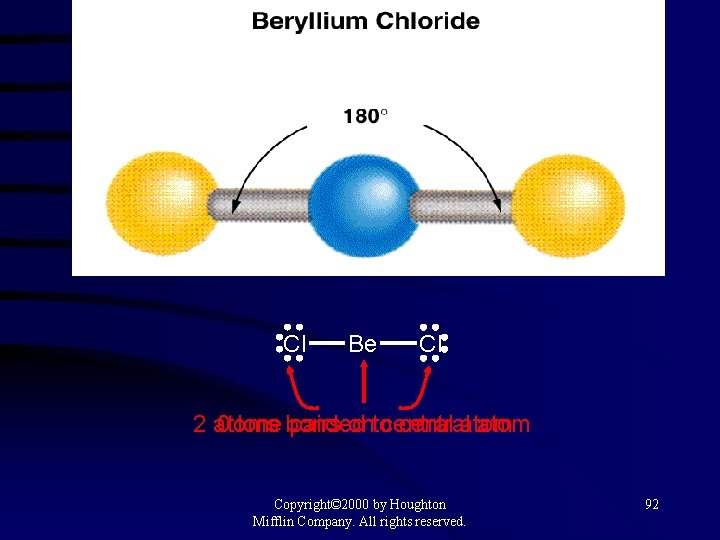
Cl Be Cl 0 lone bonded pairs ontocentral 2 atoms centralatom Copyright© 2000 by Houghton Mifflin Company. All rights reserved. 92
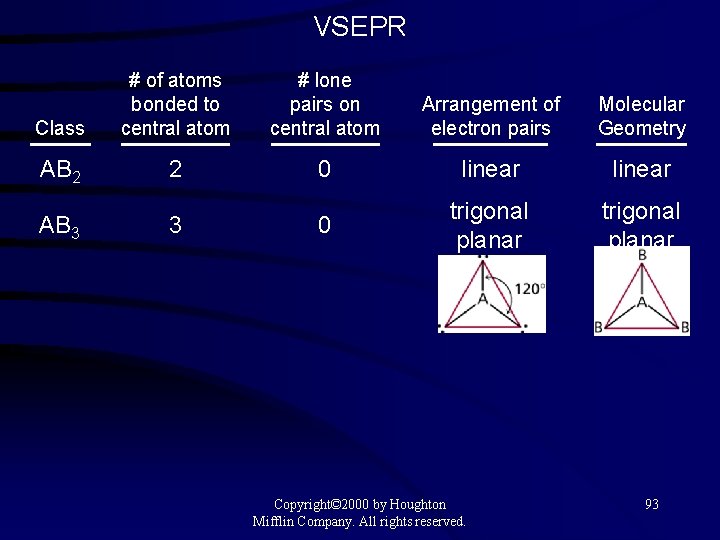
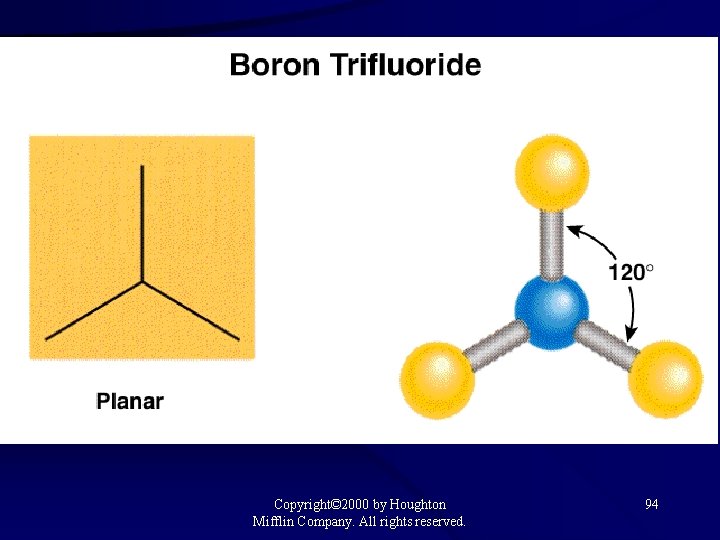
VSEPR Class # of atoms bonded to central atom # lone pairs on central atom Arrangement of electron pairs Molecular Geometry AB 2 2 0 linear 0 trigonal planar AB 3 3 Copyright© 2000 by Houghton Mifflin Company. All rights reserved. 93
Copyright© 2000 by Houghton Mifflin Company. All rights reserved. 94
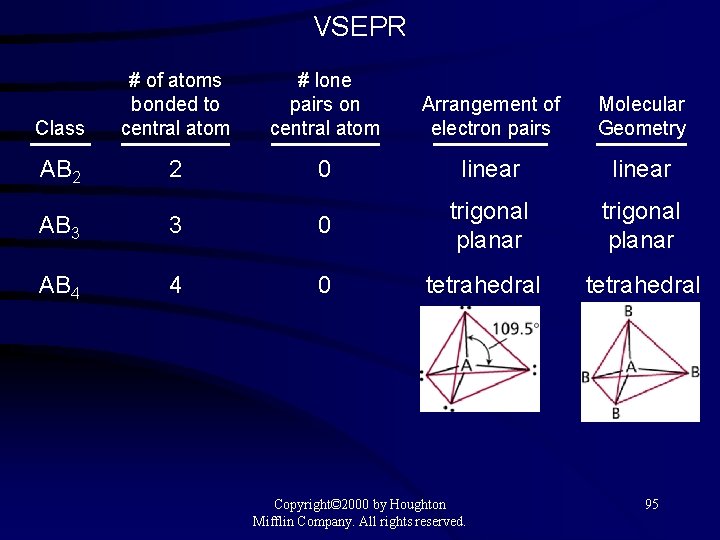
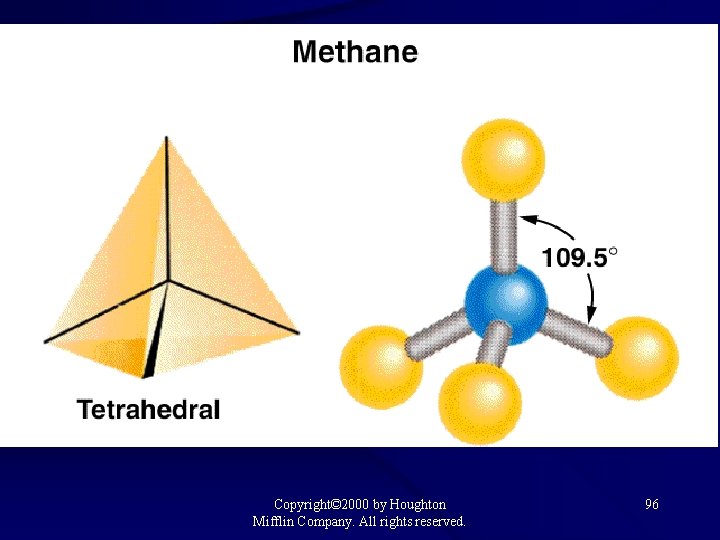
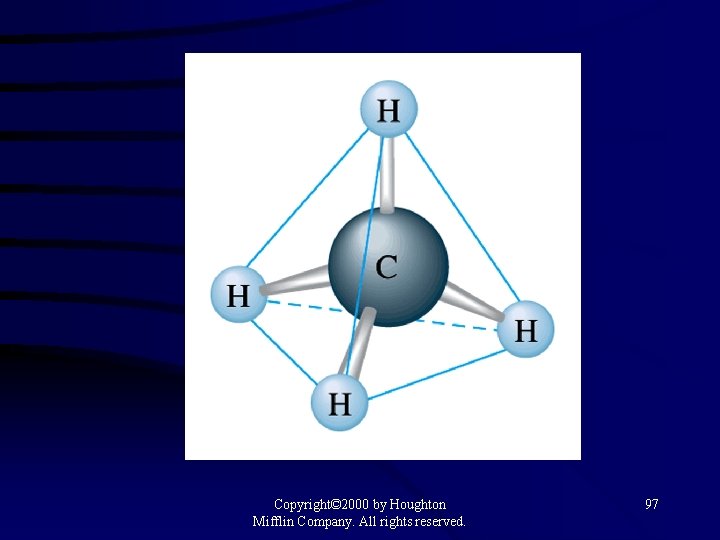
VSEPR Class # of atoms bonded to central atom # lone pairs on central atom Arrangement of electron pairs Molecular Geometry AB 2 2 0 linear trigonal planar tetrahedral AB 3 3 0 trigonal planar AB 4 4 0 tetrahedral Copyright© 2000 by Houghton Mifflin Company. All rights reserved. 95
Copyright© 2000 by Houghton Mifflin Company. All rights reserved. 96
Copyright© 2000 by Houghton Mifflin Company. All rights reserved. 97
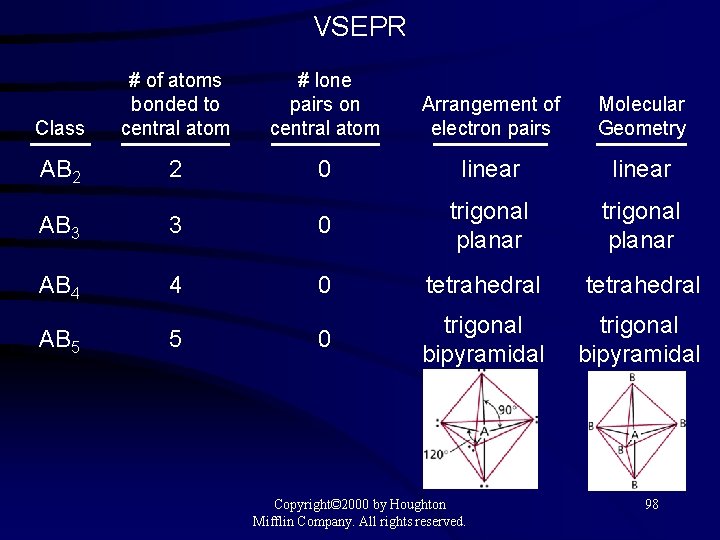
VSEPR Class # of atoms bonded to central atom # lone pairs on central atom Arrangement of electron pairs Molecular Geometry AB 2 2 0 linear trigonal planar AB 3 3 0 trigonal planar AB 4 4 0 tetrahedral AB 5 5 0 trigonal bipyramidal Copyright© 2000 by Houghton Mifflin Company. All rights reserved. 98
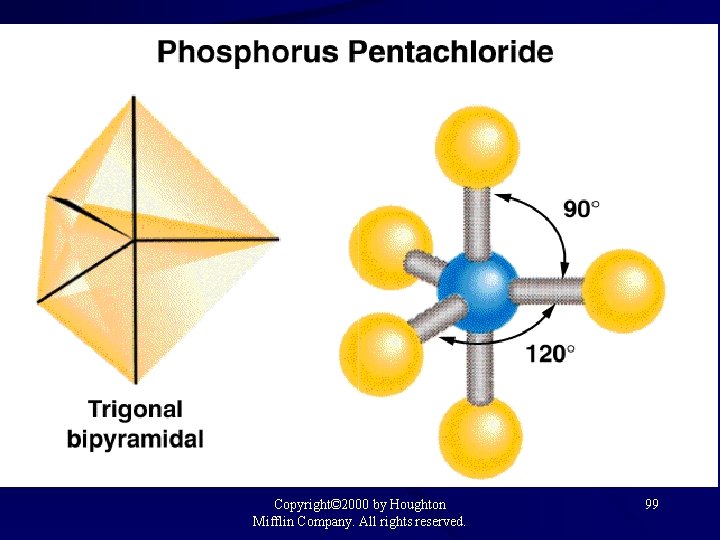
Copyright© 2000 by Houghton Mifflin Company. All rights reserved. 99
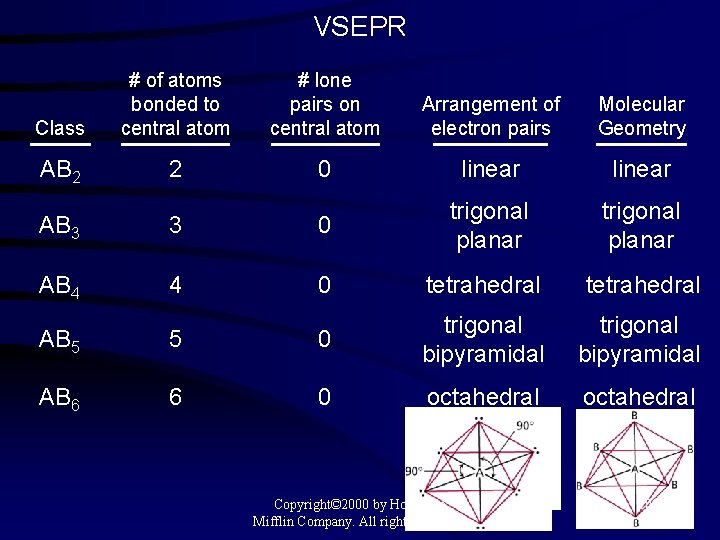
VSEPR Class # of atoms bonded to central atom # lone pairs on central atom Arrangement of electron pairs Molecular Geometry AB 2 2 0 linear trigonal planar AB 3 3 0 trigonal planar AB 4 4 0 tetrahedral AB 5 5 0 trigonal bipyramidal AB 6 6 0 octahedral Copyright© 2000 by Houghton Mifflin Company. All rights reserved. 100
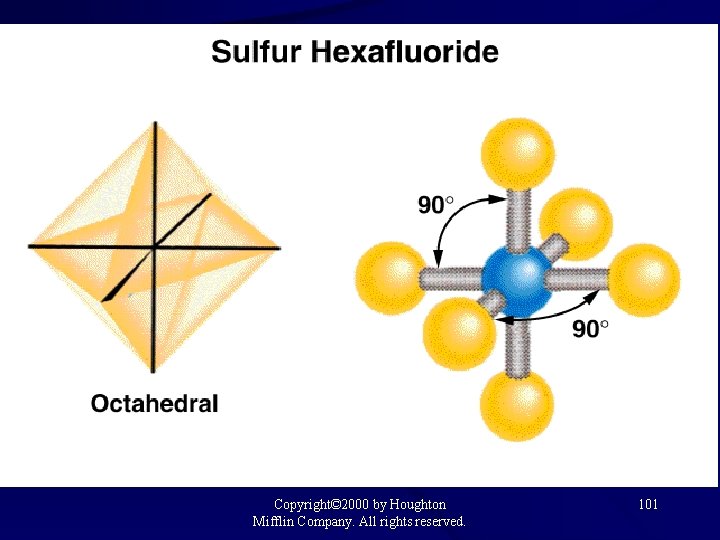
Copyright© 2000 by Houghton Mifflin Company. All rights reserved. 101
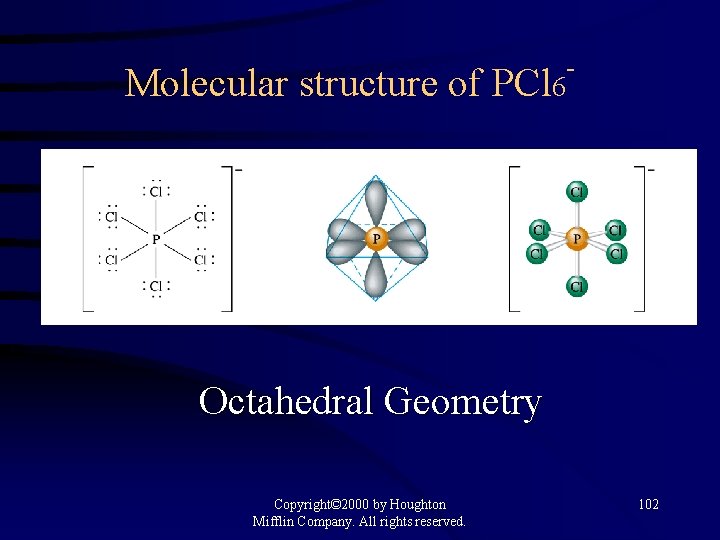
- Molecular structure of PCl 6 Octahedral Geometry Copyright© 2000 by Houghton Mifflin Company. All rights reserved. 102
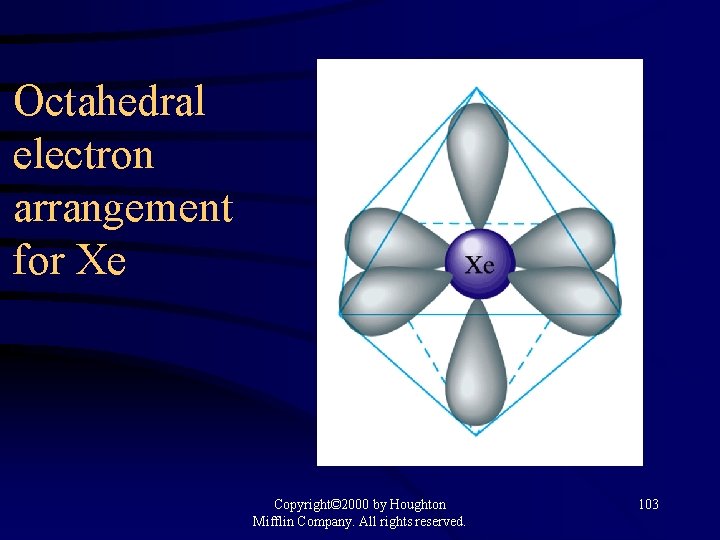
Octahedral electron arrangement for Xe Copyright© 2000 by Houghton Mifflin Company. All rights reserved. 103
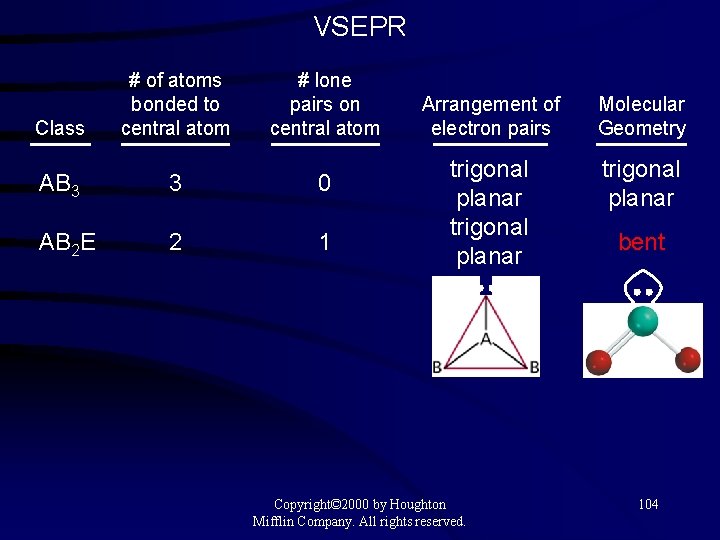
VSEPR Class # of atoms bonded to central atom # lone pairs on central atom AB 3 3 0 AB 2 E 2 1 Arrangement of electron pairs Molecular Geometry trigonal planar Copyright© 2000 by Houghton Mifflin Company. All rights reserved. bent 104
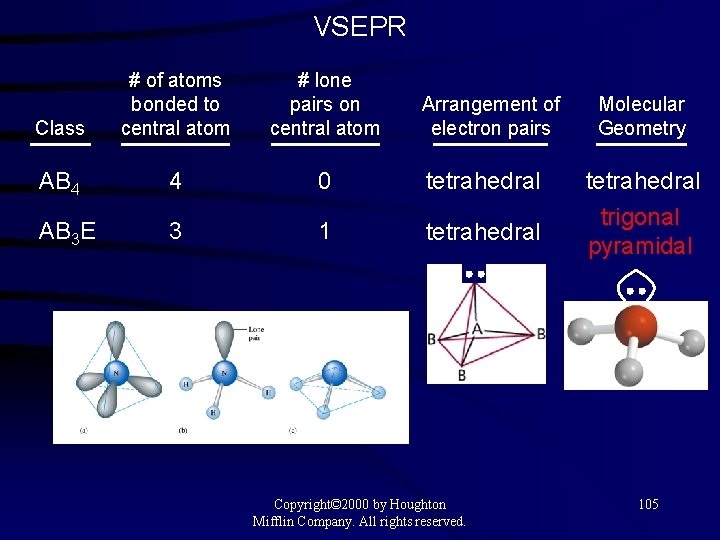
VSEPR Class # of atoms bonded to central atom # lone pairs on central atom AB 4 4 0 AB 3 E 3 1 Arrangement of electron pairs Molecular Geometry tetrahedral trigonal pyramidal Copyright© 2000 by Houghton Mifflin Company. All rights reserved. 105
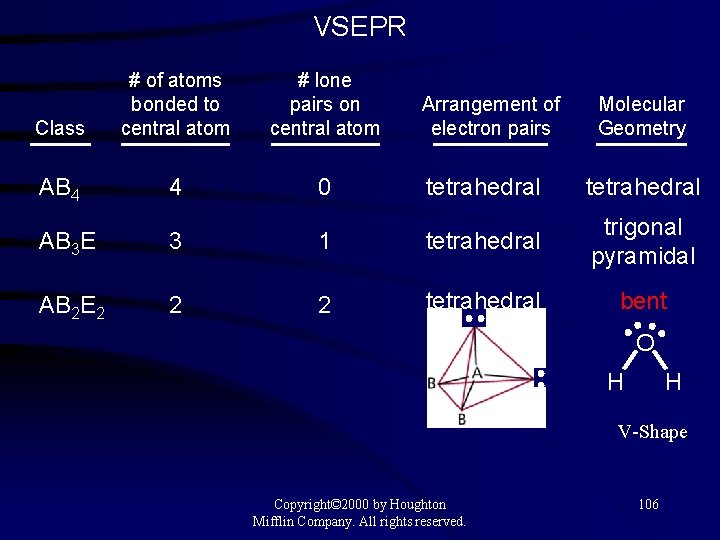
VSEPR Class # of atoms bonded to central atom # lone pairs on central atom AB 4 4 0 Arrangement of electron pairs Molecular Geometry tetrahedral AB 3 E 3 1 tetrahedral trigonal pyramidal AB 2 E 2 2 2 tetrahedral bent O H H V-Shape Copyright© 2000 by Houghton Mifflin Company. All rights reserved. 106
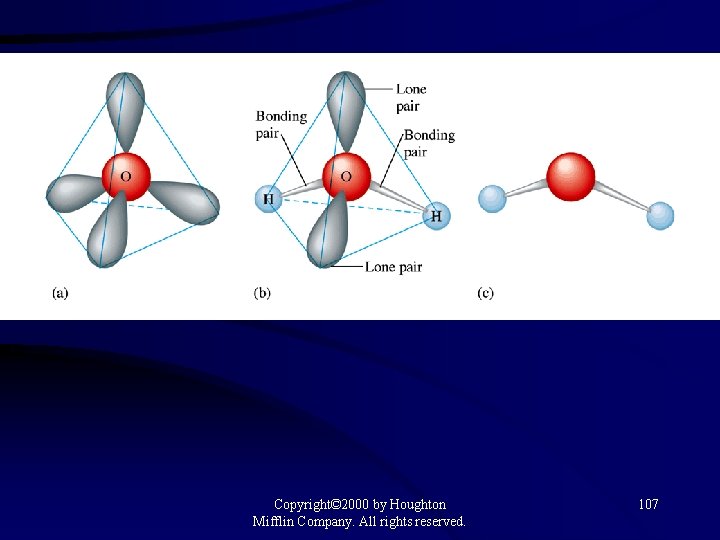
Copyright© 2000 by Houghton Mifflin Company. All rights reserved. 107
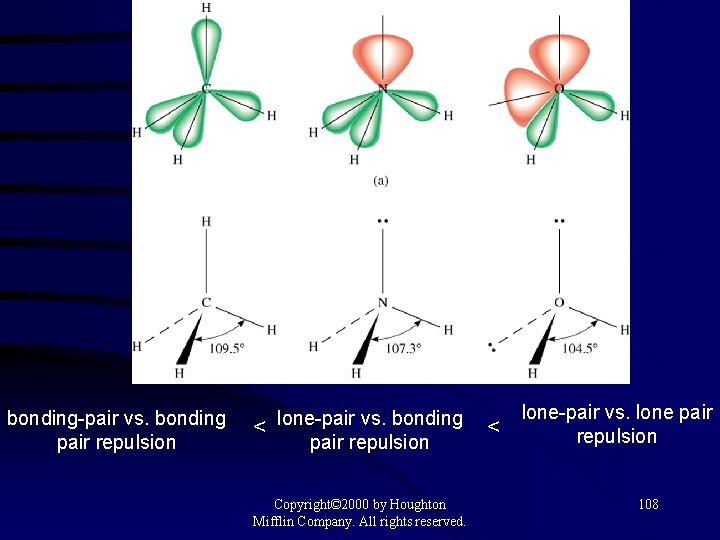
bonding-pair vs. bonding pair repulsion < lone-pair vs. bonding pair repulsion Copyright© 2000 by Houghton Mifflin Company. All rights reserved. < lone-pair vs. lone pair repulsion 108
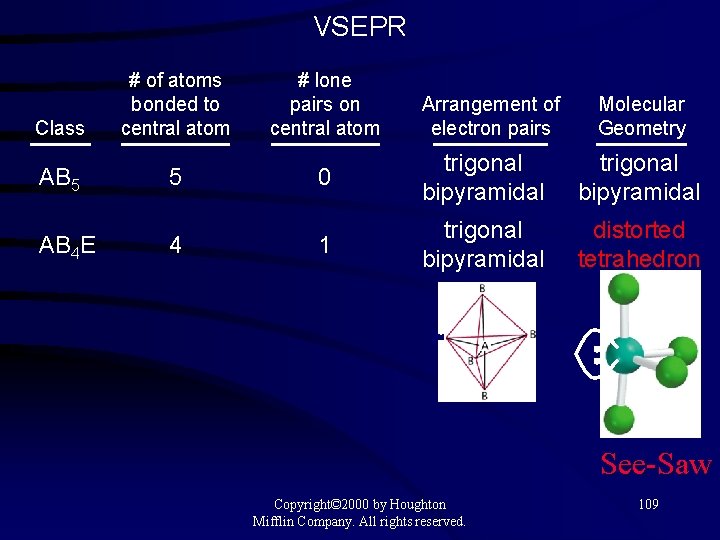
VSEPR Class AB 5 AB 4 E # of atoms bonded to central atom 5 4 # lone pairs on central atom Arrangement of electron pairs Molecular Geometry 0 trigonal bipyramidal 1 trigonal bipyramidal distorted tetrahedron See-Saw Copyright© 2000 by Houghton Mifflin Company. All rights reserved. 109
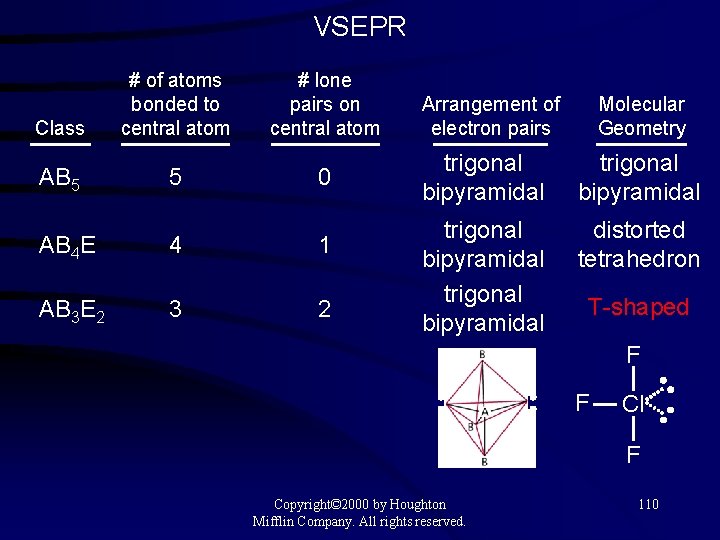
VSEPR Class AB 5 # of atoms bonded to central atom 5 # lone pairs on central atom 0 AB 4 E 4 1 AB 3 E 2 3 2 Arrangement of electron pairs Molecular Geometry trigonal bipyramidal distorted tetrahedron T-shaped F F Cl F Copyright© 2000 by Houghton Mifflin Company. All rights reserved. 110
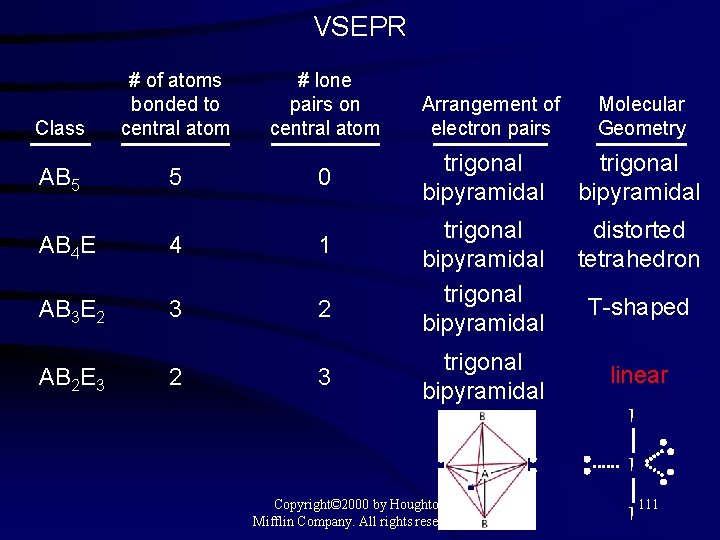
VSEPR Class AB 5 # of atoms bonded to central atom 5 # lone pairs on central atom 0 AB 4 E 4 1 AB 3 E 2 3 2 AB 2 E 3 2 3 Arrangement of electron pairs Molecular Geometry trigonal bipyramidal distorted tetrahedron trigonal bipyramidal T-shaped linear I I Copyright© 2000 by Houghton Mifflin Company. All rights reserved. I 111
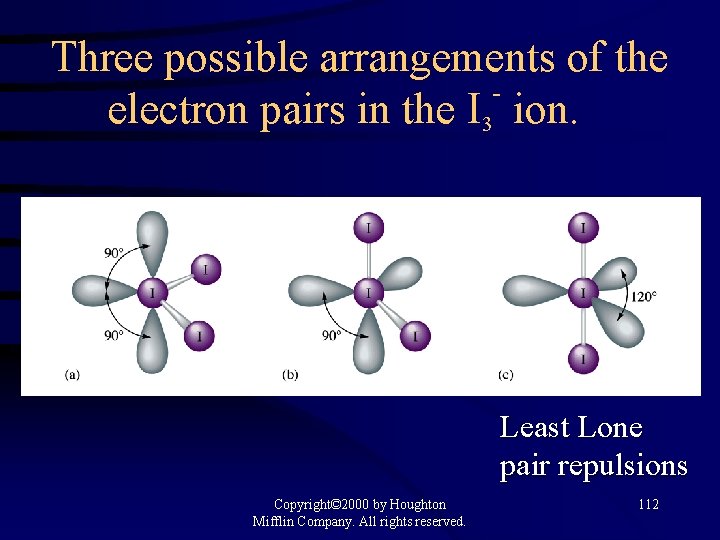
Three possible arrangements of the electron pairs in the I 3 ion. Least Lone pair repulsions Copyright© 2000 by Houghton Mifflin Company. All rights reserved. 112
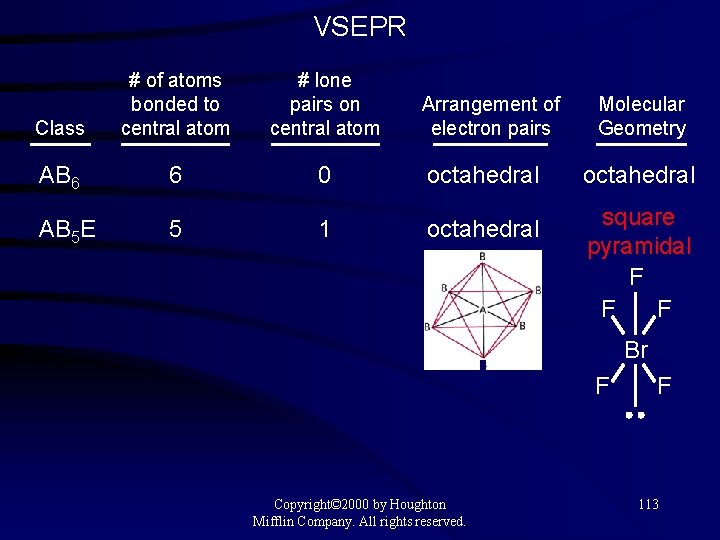
VSEPR Class # of atoms bonded to central atom # lone pairs on central atom AB 6 6 0 octahedral AB 5 E 5 1 octahedral square pyramidal F F F Arrangement of electron pairs Molecular Geometry Br F Copyright© 2000 by Houghton Mifflin Company. All rights reserved. F 113
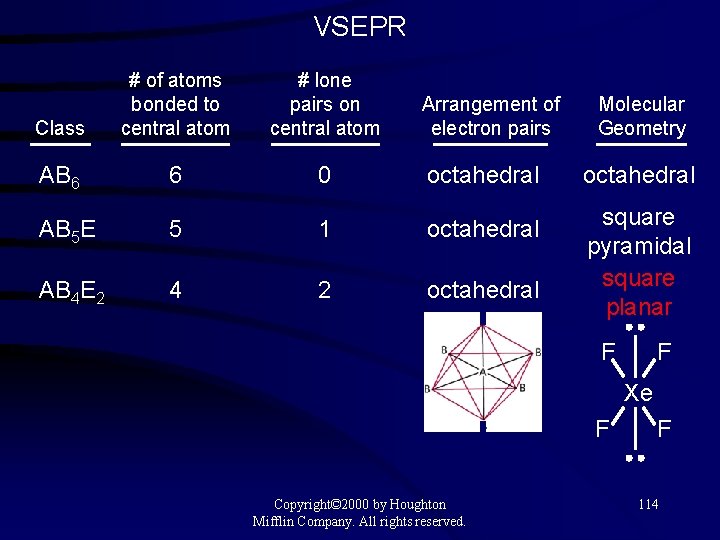
VSEPR Class # of atoms bonded to central atom # lone pairs on central atom AB 6 6 0 octahedral AB 5 E 5 1 octahedral AB 4 E 2 4 2 octahedral square pyramidal square planar Arrangement of electron pairs Molecular Geometry F F Xe F Copyright© 2000 by Houghton Mifflin Company. All rights reserved. F 114
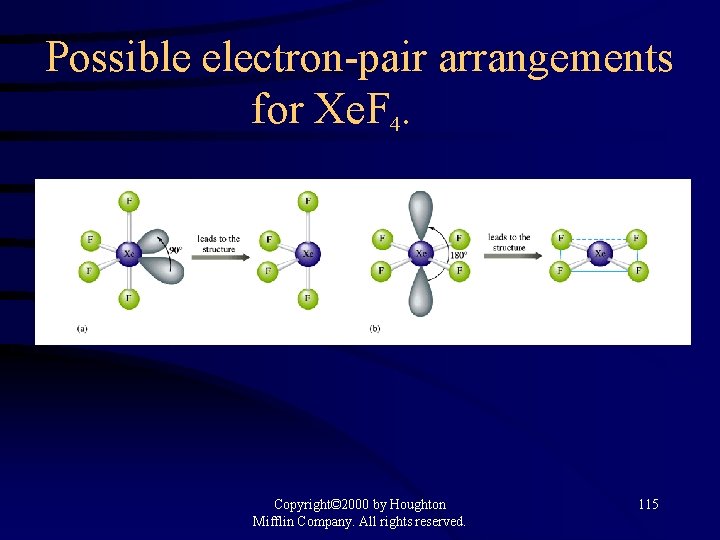
Possible electron-pair arrangements for Xe. F 4. Copyright© 2000 by Houghton Mifflin Company. All rights reserved. 115
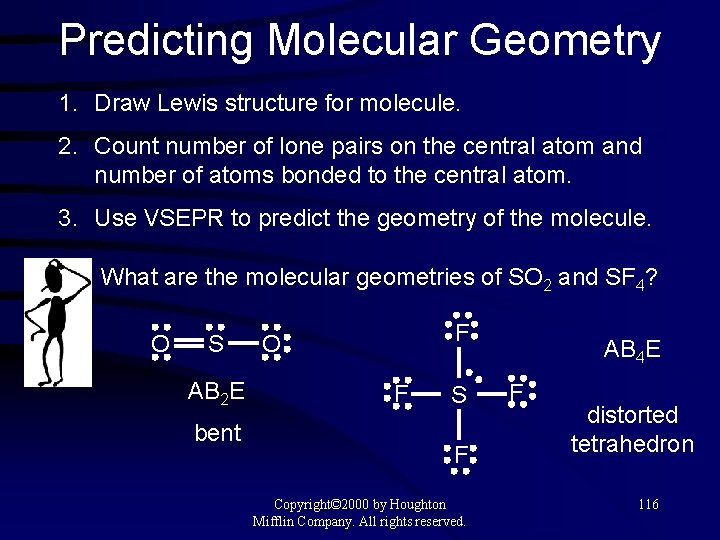
Predicting Molecular Geometry 1. Draw Lewis structure for molecule. 2. Count number of lone pairs on the central atom and number of atoms bonded to the central atom. 3. Use VSEPR to predict the geometry of the molecule. What are the molecular geometries of SO 2 and SF 4? O S AB 2 E bent F O F S F Copyright© 2000 by Houghton Mifflin Company. All rights reserved. AB 4 E F distorted tetrahedron 116
Multiple bonds NO 3 - ion Copyright© 2000 by Houghton Mifflin Company. All rights reserved. 117
SO 2 Copyright© 2000 by Houghton Mifflin Company. All rights reserved. 118
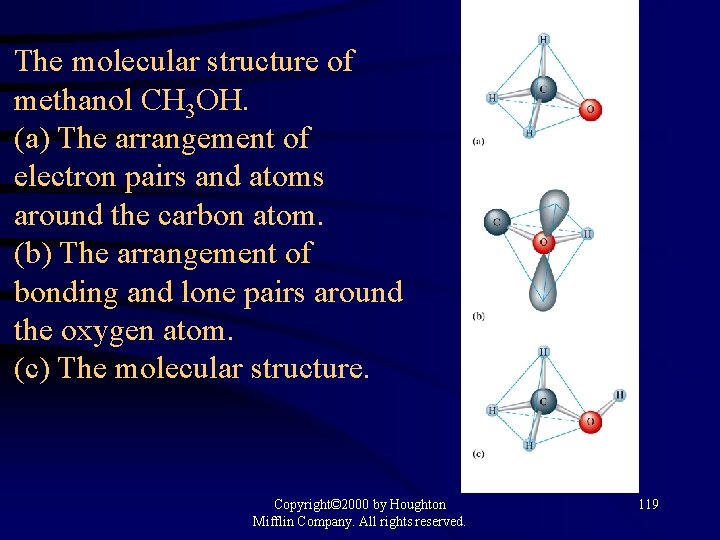
The molecular structure of methanol CH 3 OH. (a) The arrangement of electron pairs and atoms around the carbon atom. (b) The arrangement of bonding and lone pairs around the oxygen atom. (c) The molecular structure. Copyright© 2000 by Houghton Mifflin Company. All rights reserved. 119
- Slides: 119