
Bonding Chapters 8 9 Bonds l Ionic l
Bonding Chapters 8 & 9
Bonds l Ionic l l Covalent l l Electrostatic attraction between oppositely charged ions Shared valence electrons Metallic l Pooled electrons around a positive core
Octet Rule l Atoms will gain, lose, or share electrons to achieve a full valence shell l l First energy level is limited to 2 electrons d & f sublevels allow for more than 8
Ionic Bonding l Electrostatic attraction due to oppositely charged ions l Lattice Energy l Energy released when gaseous ions form 1 mole of ionic solid l l Usually reported as exothermic process Energy required to separate 1 mole of ionic solid into gaseous ions
Lattice Energy l Depends directly on magnitude of charges and inversely on size of ions l Larger charges means more coulombic attraction l Larger ion size means less coulombic attraction
Ionic Compounds l l l Metal and nonmetal High Melting and Boiling Points Hard Crystalline solids l l Brittle Break when struck (Cleave) Soluble in water Conduct electricity when melted or dissolved l Do not conduct as solids
Covalent Bonding l Sharing of valence electrons due to equal or near equal electronegativity of 2 nonmetals
Bond Enthalpy l Amount of energy required to break a bond Amount of energy released when a bond forms l Larger energy = stronger bond l ΔH = Σreactants - Σproducts l
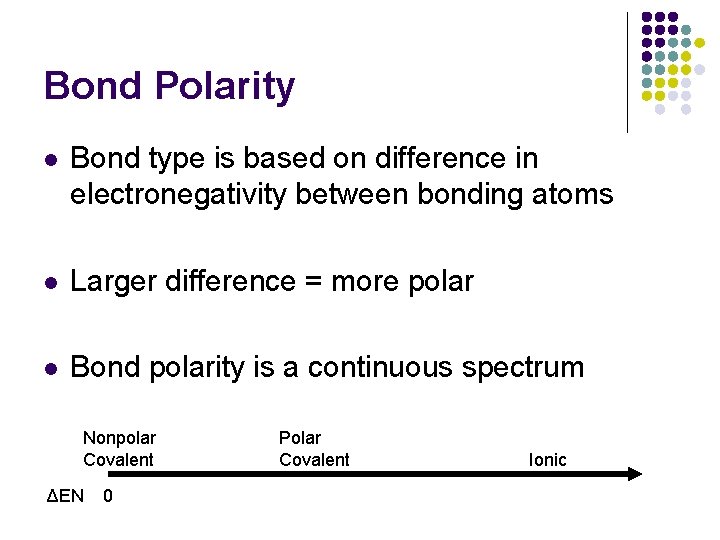
Bond Polarity l Bond type is based on difference in electronegativity between bonding atoms l Larger difference = more polar l Bond polarity is a continuous spectrum Nonpolar Covalent ΔEN 0 Polar Covalent Ionic
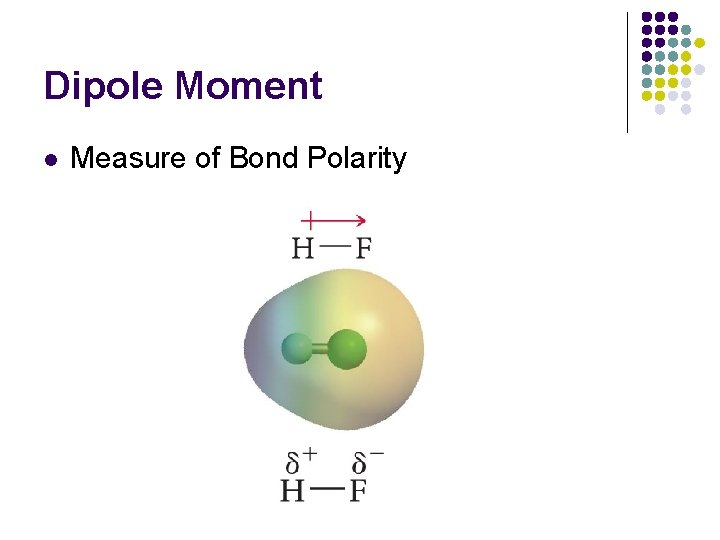
Dipole Moment l Measure of Bond Polarity
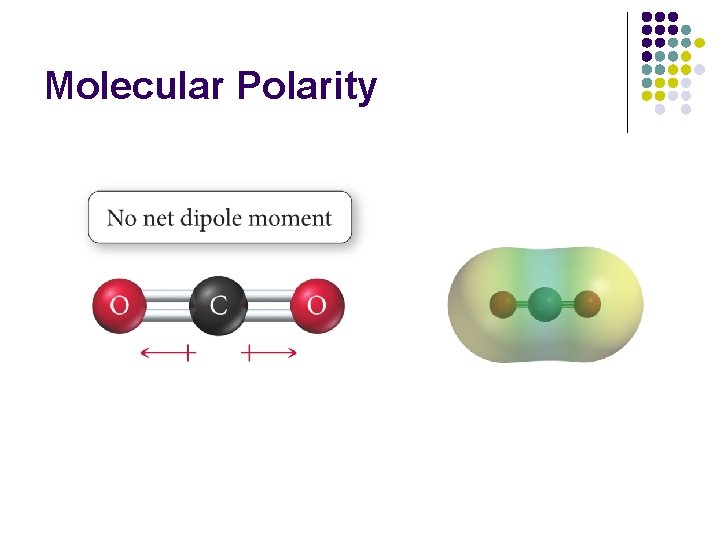
Molecular Polarity

Molecular Polarity

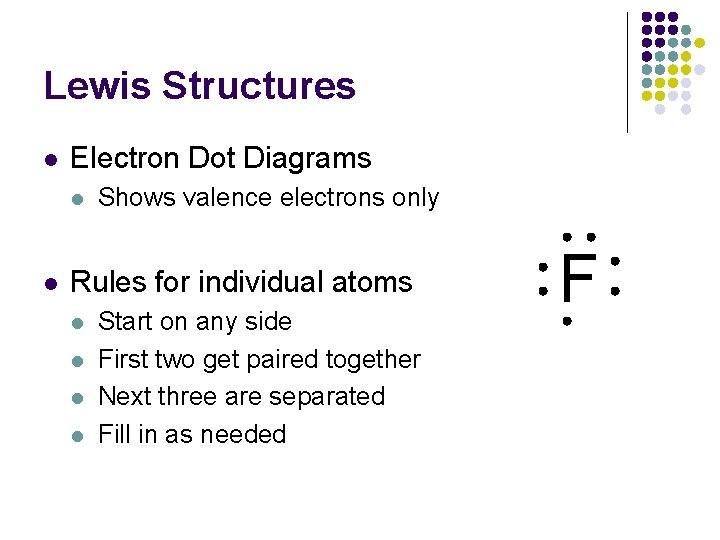
Lewis Structures l Electron Dot Diagrams l l Shows valence electrons only Rules for individual atoms l l Start on any side First two get paired together Next three are separated Fill in as needed F
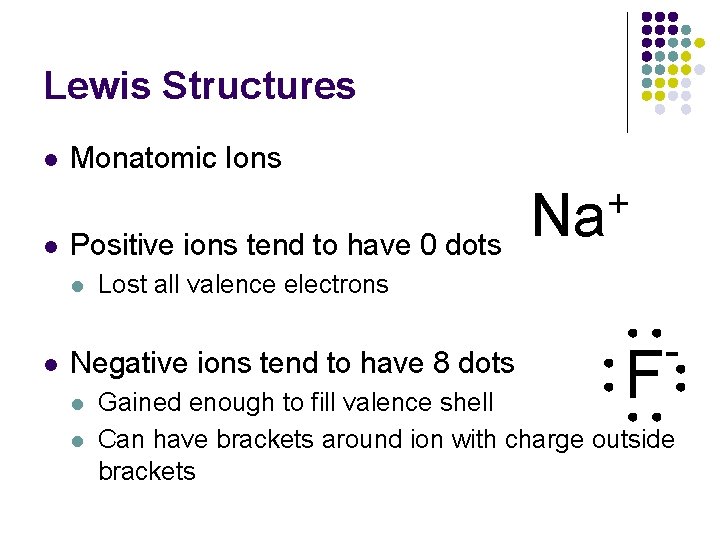
Lewis Structures l l Monatomic Ions Positive ions tend to have 0 dots l l Lost all valence electrons Negative ions tend to have 8 dots l l + Na F - Gained enough to fill valence shell Can have brackets around ion with charge outside brackets
![Lewis Structures l l Ionic Compounds Na. Cl Na + [ Cl ] -](http://slidetodoc.com/presentation_image_h2/33bdfe0e30bf05a554714b80763fe05c/image-16.jpg "Lewis Structures l l Ionic Compounds Na. Cl Na + [ Cl ] -")
Lewis Structures l l Ionic Compounds Na. Cl Na + [ Cl ] -
Lewis Structures l Covalent Compounds l Line for bonding electrons l l 1 line = single bond 2 lines = double bond 3 lines = triple bond Dots for nonbonding electrons
Lewis Structures l l Determine number valence electrons Arrange atoms around a central atom with single bonds l l l Usually least electronegative element excluding H Fill in octet for outer atoms Fill in octet for central atom If not enough to fill central atom’s octet, make multiple bonds to central atom
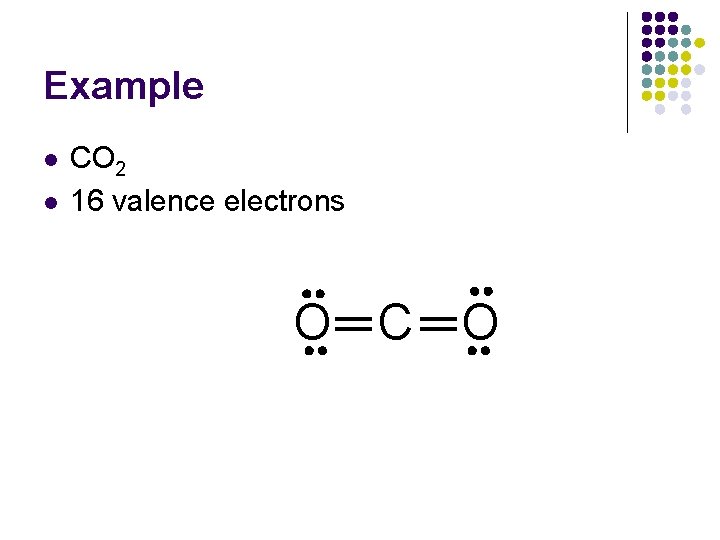
Example l l CO 2 16 valence electrons O C O
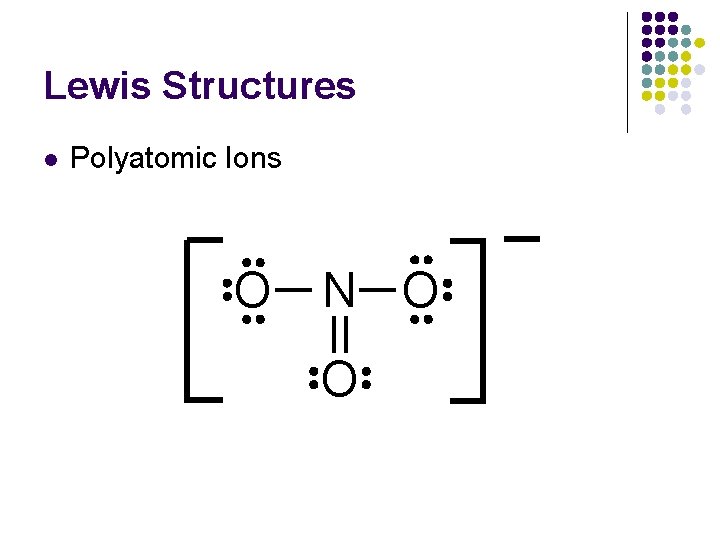
Lewis Structures l Polyatomic Ions O N O O
Lewis Structures l Exceptions to Octet Rule l l l More than octet Less than octet Odd number of electrons
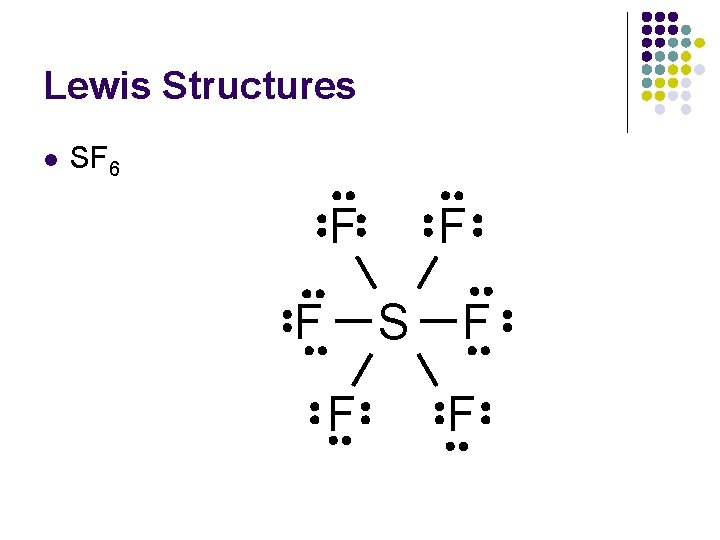
Lewis Structures l SF 6 F F F S F F F
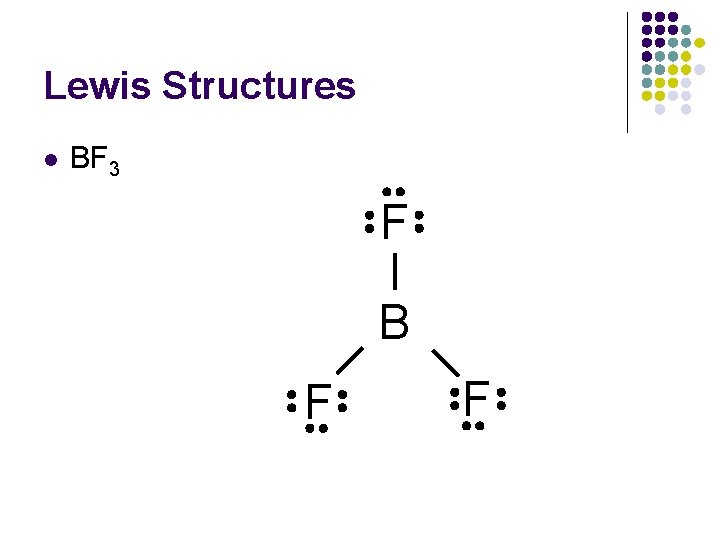
Lewis Structures l BF 3 F B F F
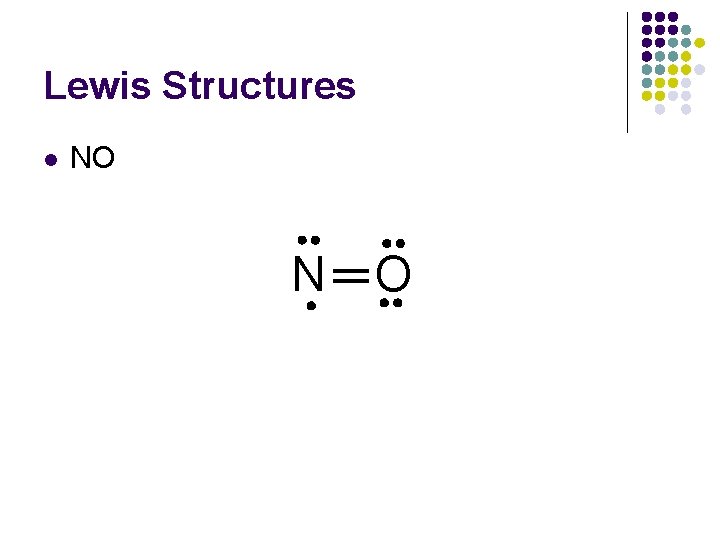
Lewis Structures l NO N O

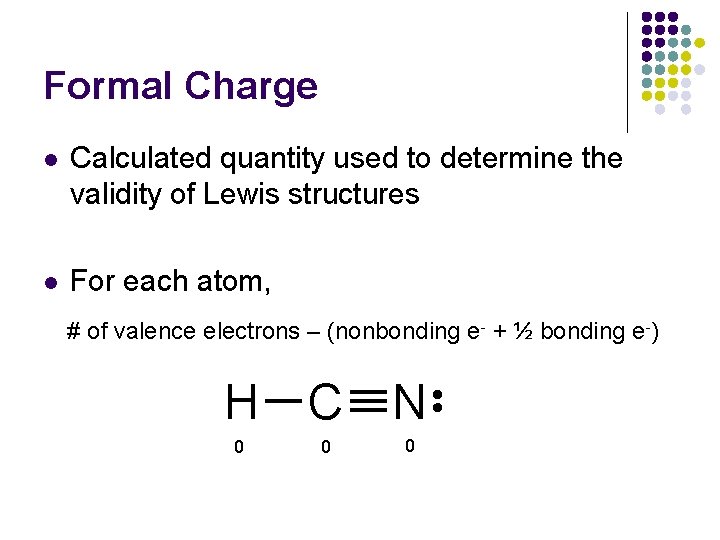
Formal Charge l Calculated quantity used to determine the validity of Lewis structures l For each atom, # of valence electrons – (nonbonding e- + ½ bonding e-) H C N 0 0 0
Formal Charge l Best Lewis Structures l l Have fewest and/or smallest charges Negative charge on most electronegative element
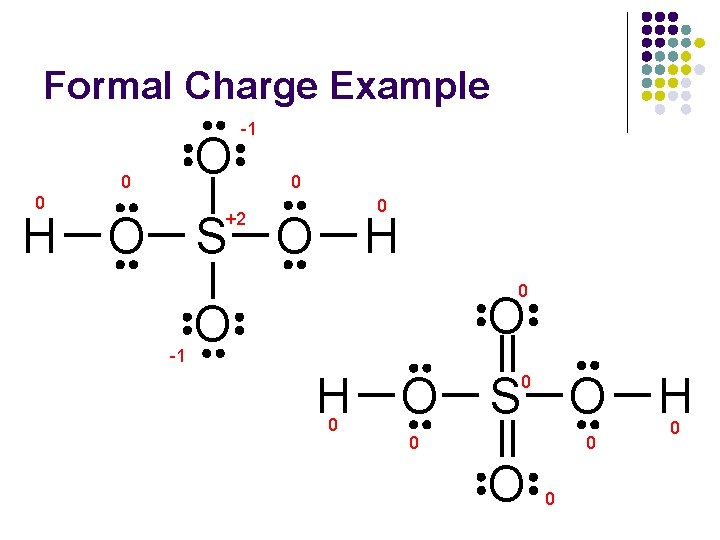
Formal Charge Example O 0 0 H -1 +2 O S -1 0 0 O H 0 O S O 0 0 0 O 0 H 0
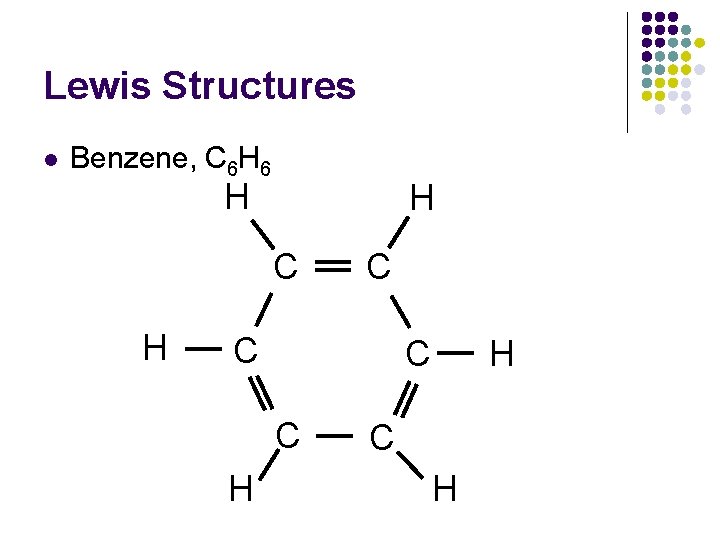
Lewis Structures l Benzene, C 6 H 6 H H C C C C H H C H
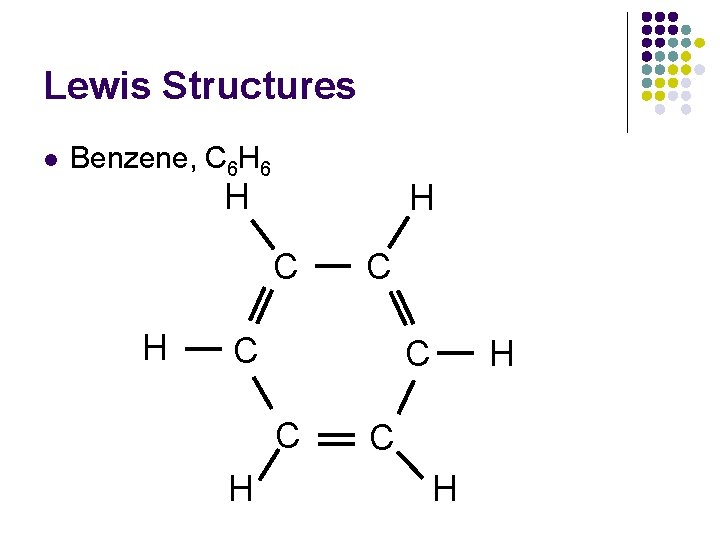
Lewis Structures l Benzene, C 6 H 6 H H C C C C H H C H
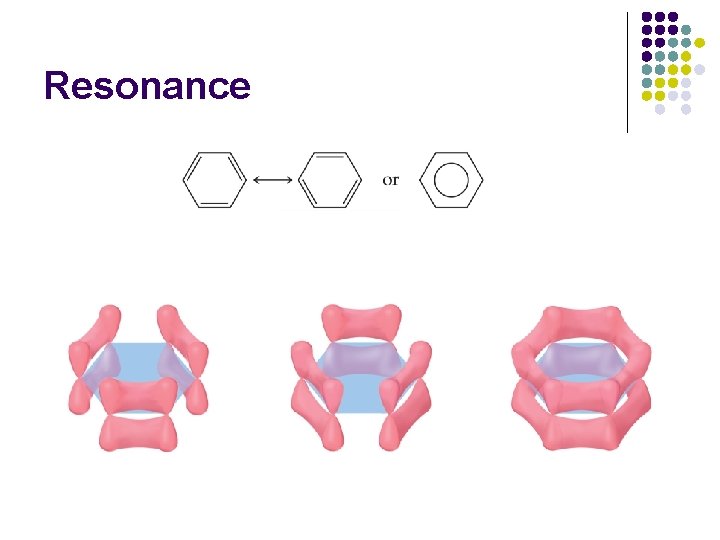
Resonance l Two or more equally valid, but different Lewis Structures l l Differ only in the position of the electrons Use double headed arrow between resonance structures
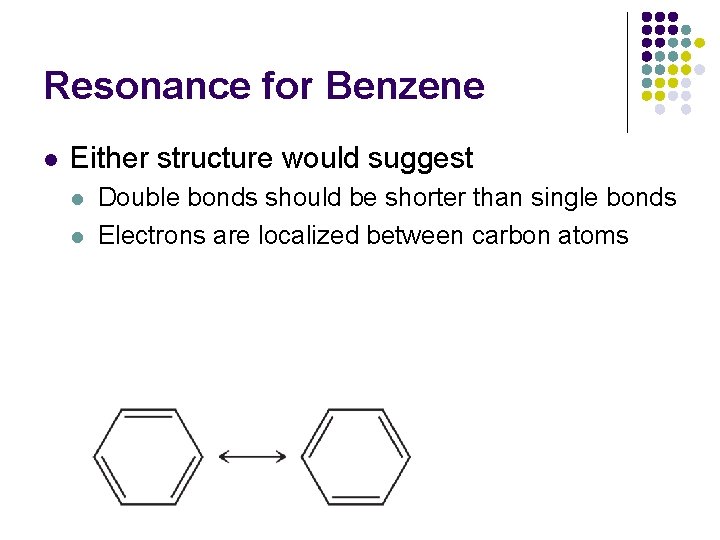
Resonance for Benzene l Either structure would suggest l l Double bonds should be shorter than single bonds Electrons are localized between carbon atoms
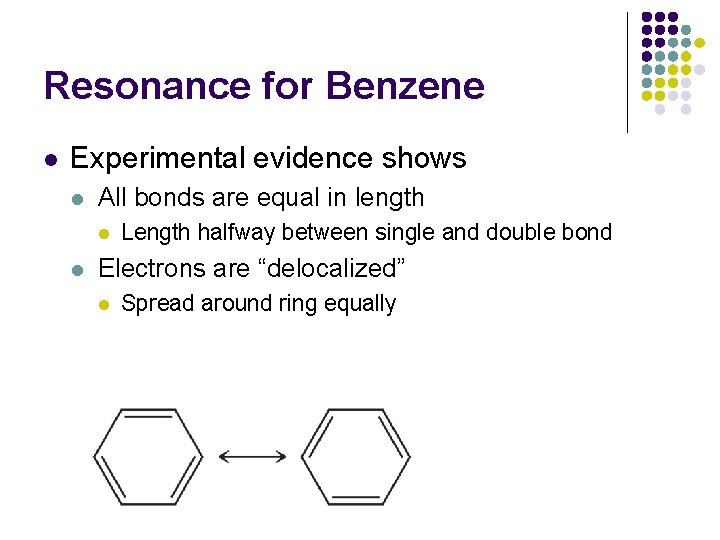
Resonance for Benzene l Experimental evidence shows l All bonds are equal in length l l Length halfway between single and double bond Electrons are “delocalized” l Spread around ring equally

VSEPR Theory l Valence Shell Electron Pair Repulsion l Model accounts for the shape of the molecule l l Lewis Structures don’t always show proper shape Electron groups repel each other and try to spread as far apart as possible l Electron groups (domains) are lone pairs, single bonds, double bonds, and triple bonds
Electron Geometry l There are 5 different possible arrangements around a central atom l 2 electron groups up to 6 electron groups
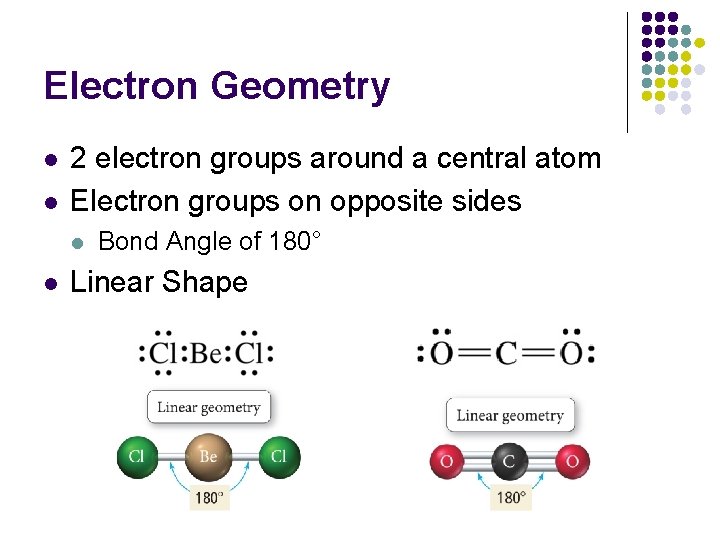
Electron Geometry l l 2 electron groups around a central atom Electron groups on opposite sides l l Bond Angle of 180° Linear Shape
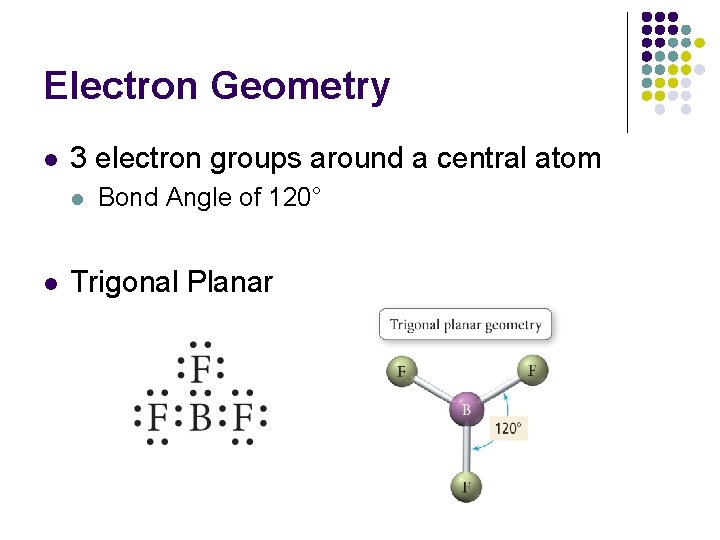
Electron Geometry l 3 electron groups around a central atom l l Bond Angle of 120° Trigonal Planar
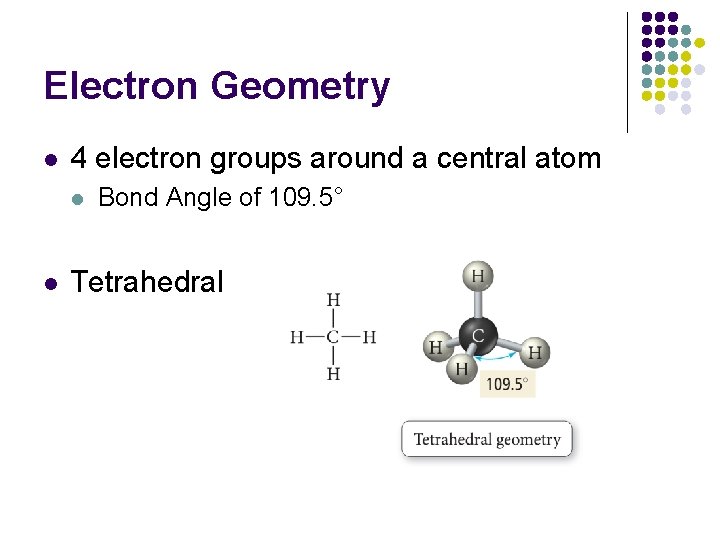
Electron Geometry l 4 electron groups around a central atom l l Bond Angle of 109. 5° Tetrahedral
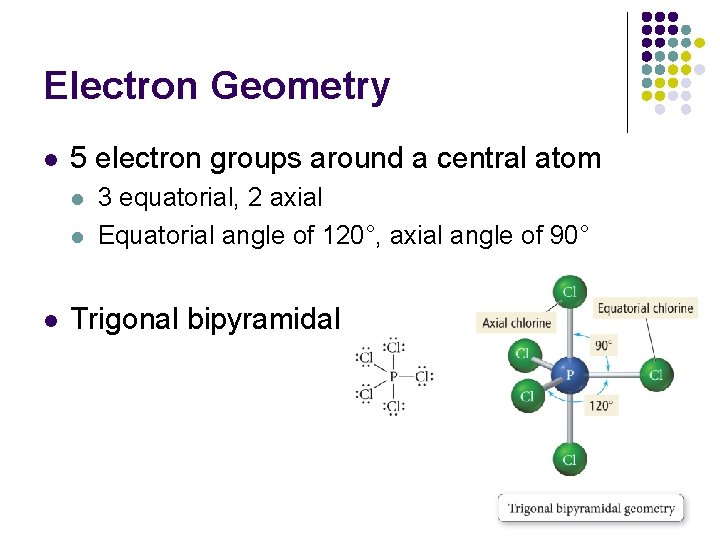
Electron Geometry l 5 electron groups around a central atom l l l 3 equatorial, 2 axial Equatorial angle of 120°, axial angle of 90° Trigonal bipyramidal
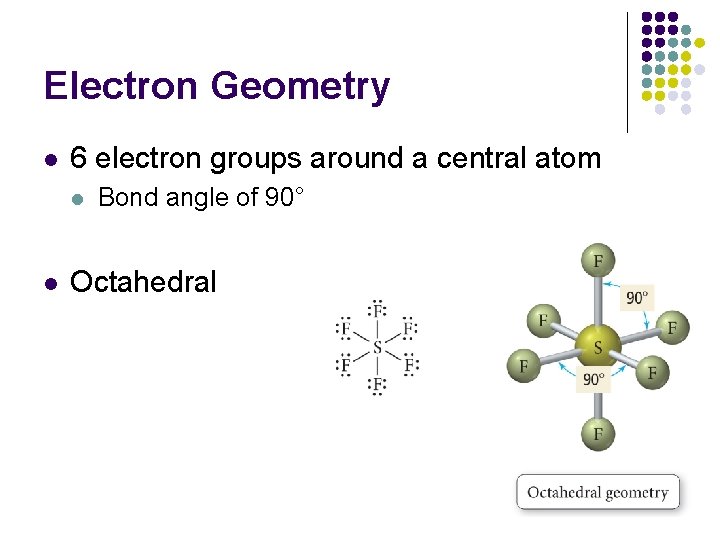
Electron Geometry l 6 electron groups around a central atom l l Bond angle of 90° Octahedral
Molecular Geometry l Molecular Geometry is defined by the position of the bonded atoms in the molecule, not the lone pairs l l All binary molecules are linear Lone pairs still impact the shape due to their repulsion l Same electron geometries may have different molecular geometries
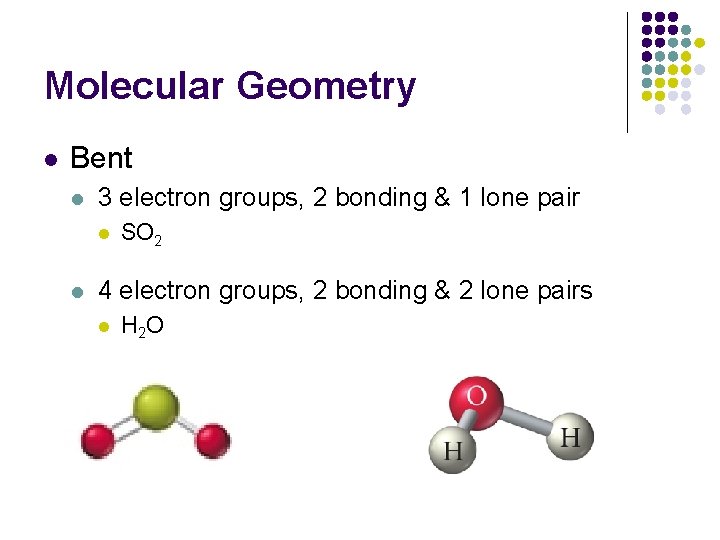
Molecular Geometry l Bent l 3 electron groups, 2 bonding & 1 lone pair l l SO 2 4 electron groups, 2 bonding & 2 lone pairs l H 2 O
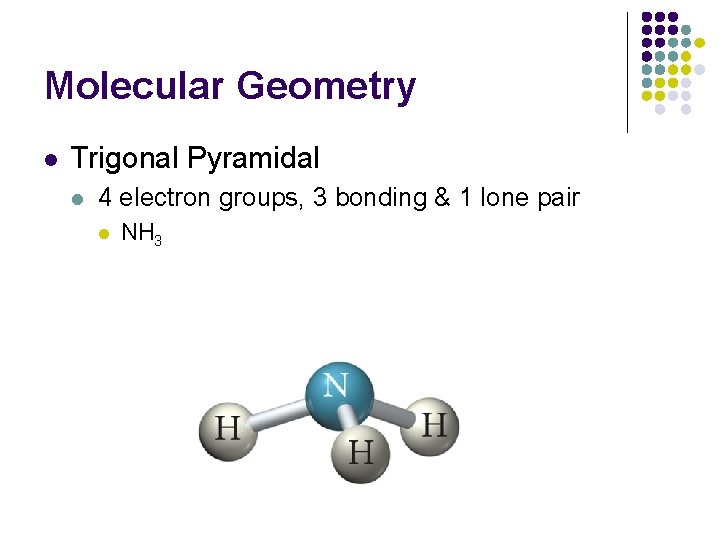
Molecular Geometry l Trigonal Pyramidal l 4 electron groups, 3 bonding & 1 lone pair l NH 3
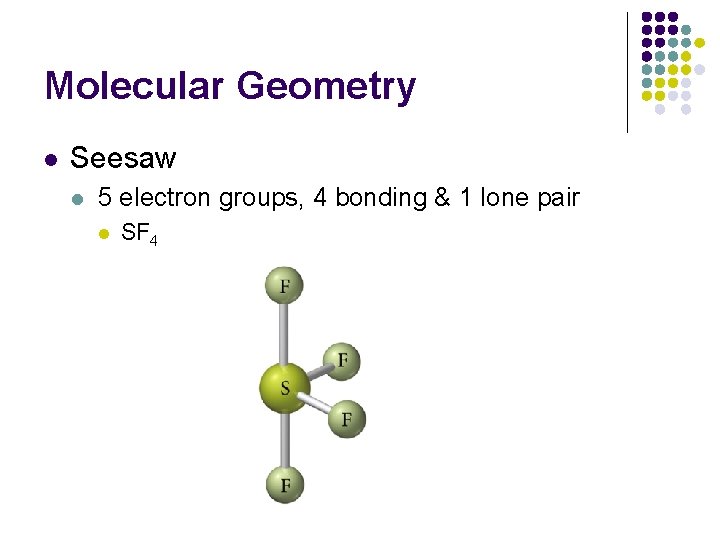
Molecular Geometry l Seesaw l 5 electron groups, 4 bonding & 1 lone pair l SF 4
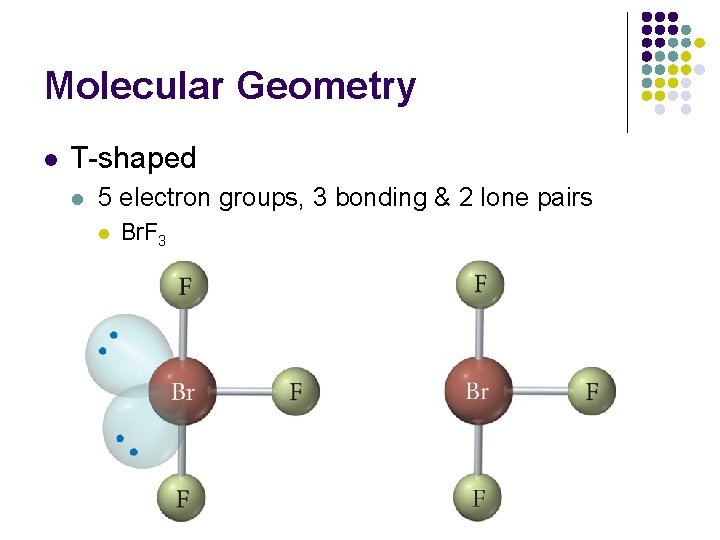
Molecular Geometry l T-shaped l 5 electron groups, 3 bonding & 2 lone pairs l Br. F 3
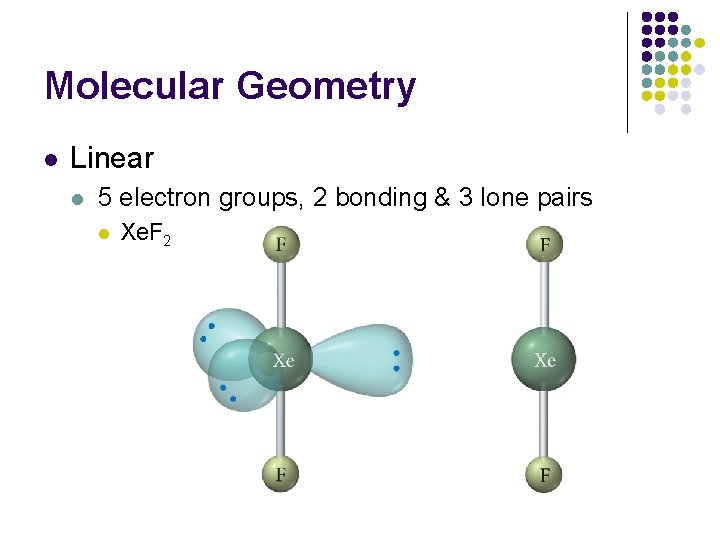
Molecular Geometry l Linear l 5 electron groups, 2 bonding & 3 lone pairs l Xe. F 2
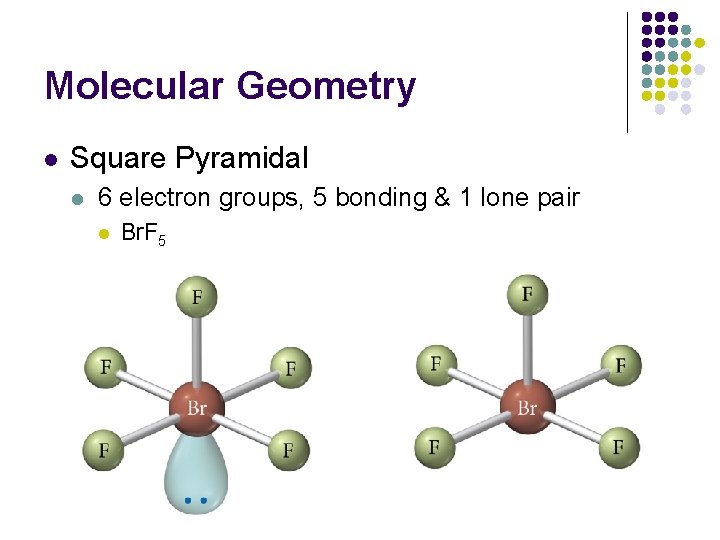
Molecular Geometry l Square Pyramidal l 6 electron groups, 5 bonding & 1 lone pair l Br. F 5
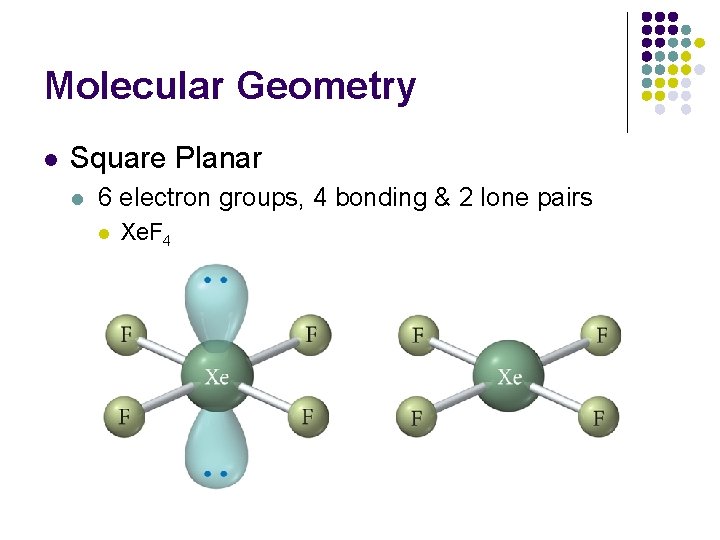
Molecular Geometry l Square Planar l 6 electron groups, 4 bonding & 2 lone pairs l Xe. F 4
Bond Angles l Angle between 2 atoms bonded to a central atom l Other bonds and/or lone pairs in the molecule affect bond angle
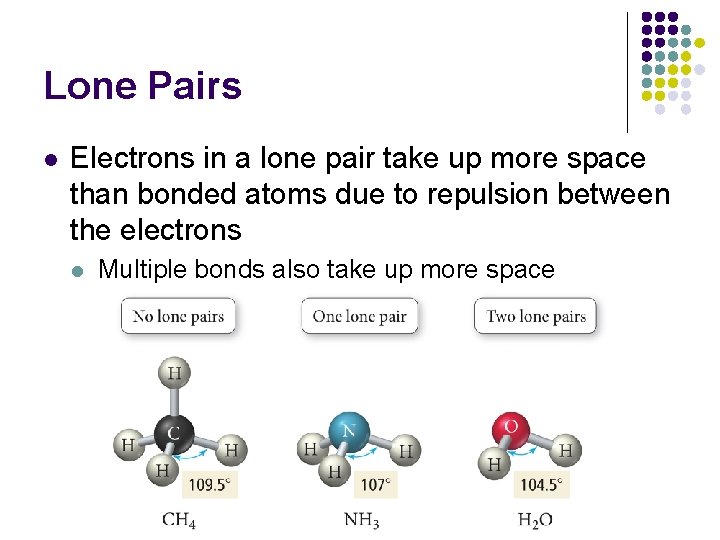
Lone Pairs l Electrons in a lone pair take up more space than bonded atoms due to repulsion between the electrons l Multiple bonds also take up more space
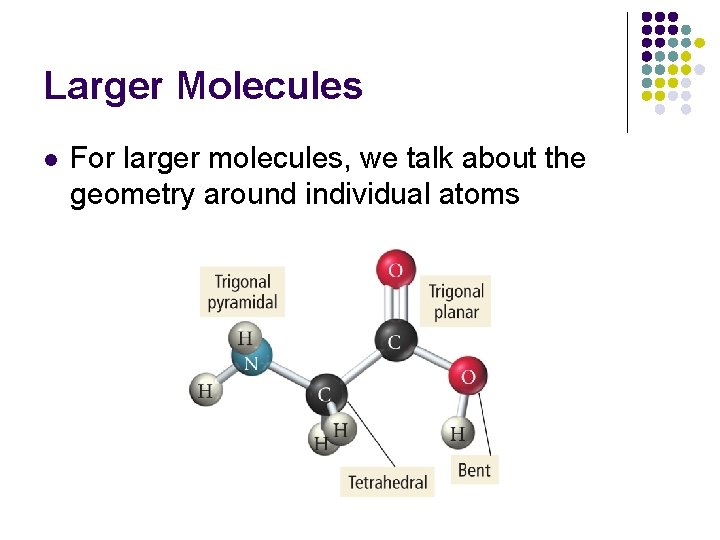
Larger Molecules l For larger molecules, we talk about the geometry around individual atoms

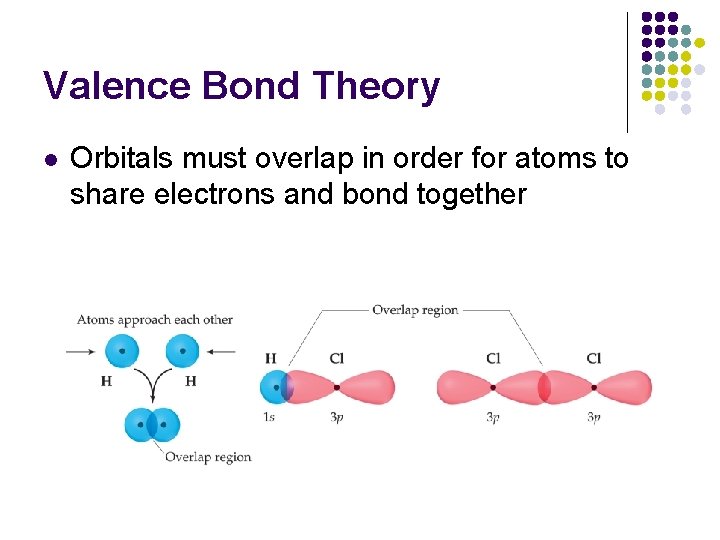
Valence Bond Theory l Orbitals must overlap in order for atoms to share electrons and bond together
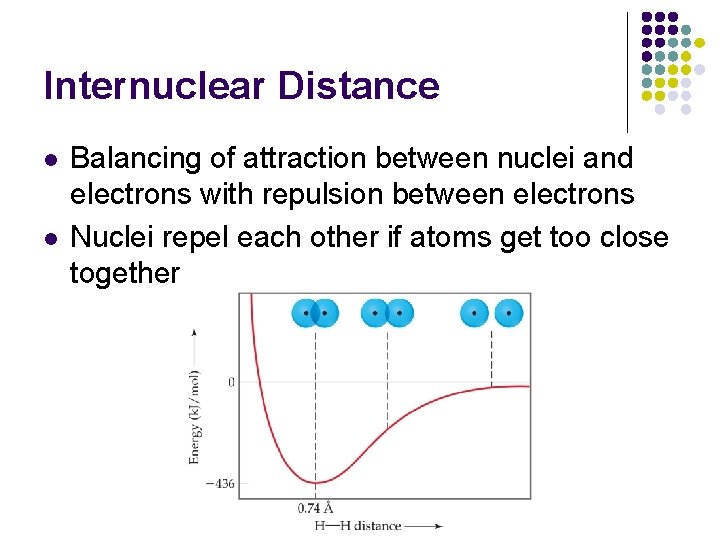
Internuclear Distance l l Balancing of attraction between nuclei and electrons with repulsion between electrons Nuclei repel each other if atoms get too close together
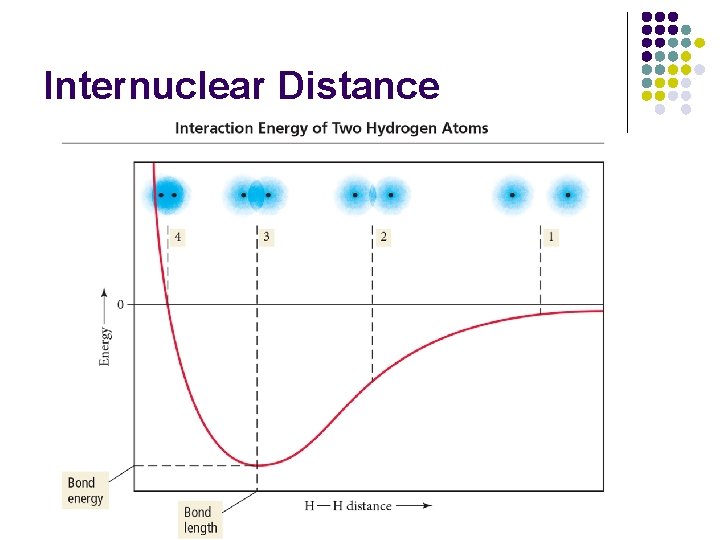
Internuclear Distance
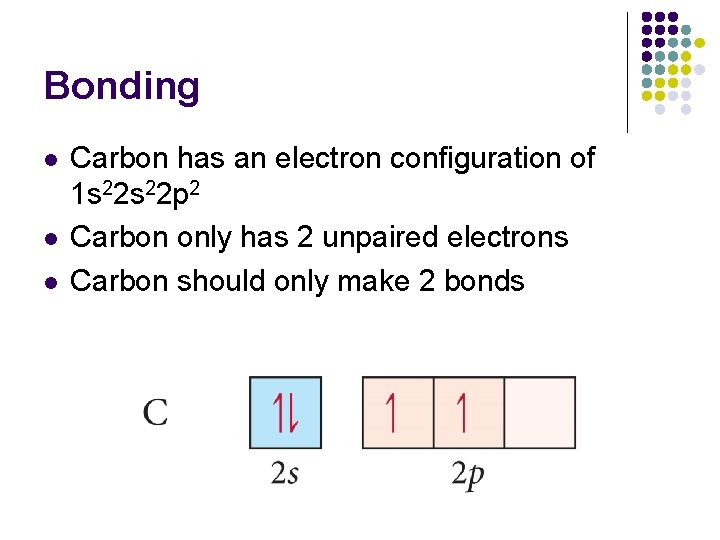
Bonding l l l Carbon has an electron configuration of 1 s 22 p 2 Carbon only has 2 unpaired electrons Carbon should only make 2 bonds
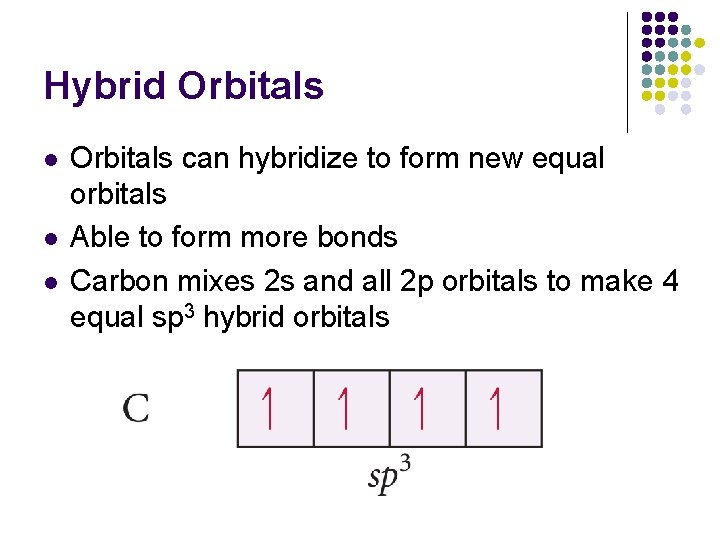
Hybrid Orbitals l l l Orbitals can hybridize to form new equal orbitals Able to form more bonds Carbon mixes 2 s and all 2 p orbitals to make 4 equal sp 3 hybrid orbitals

Hybrid Orbitals
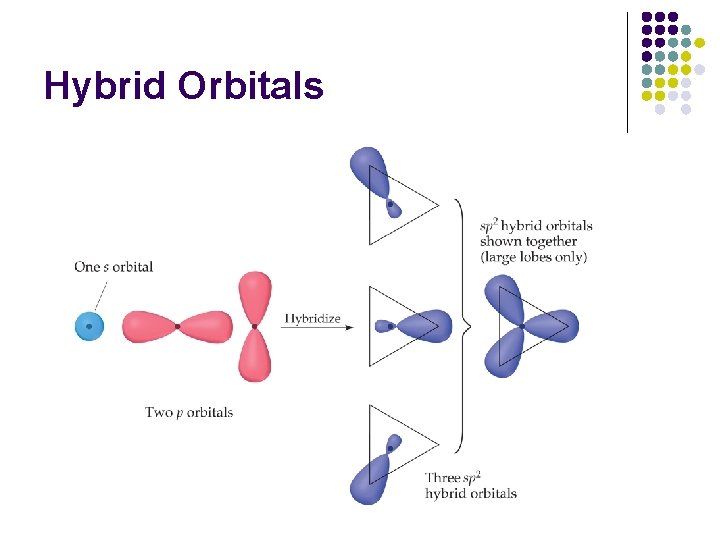
Hybrid Orbitals
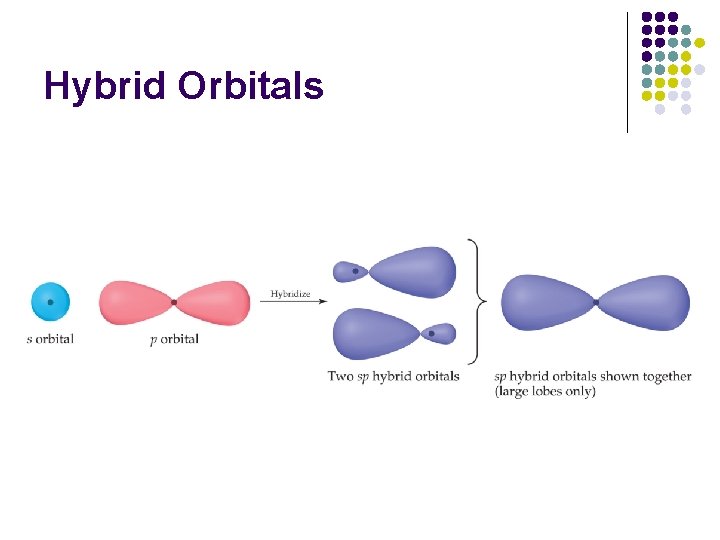
Hybrid Orbitals
Sigma and Pi Bonds l There are 2 ways that orbitals can overlap to form bonds l l Sigma bonds Pi bonds
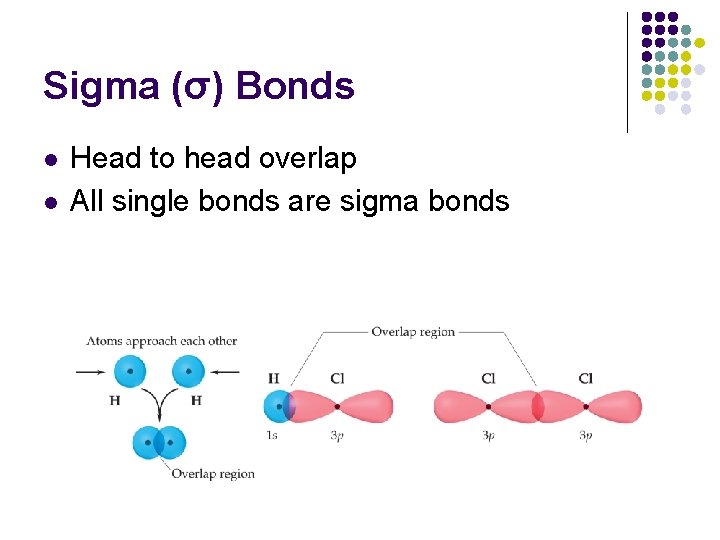
Sigma (σ) Bonds l l Head to head overlap All single bonds are sigma bonds
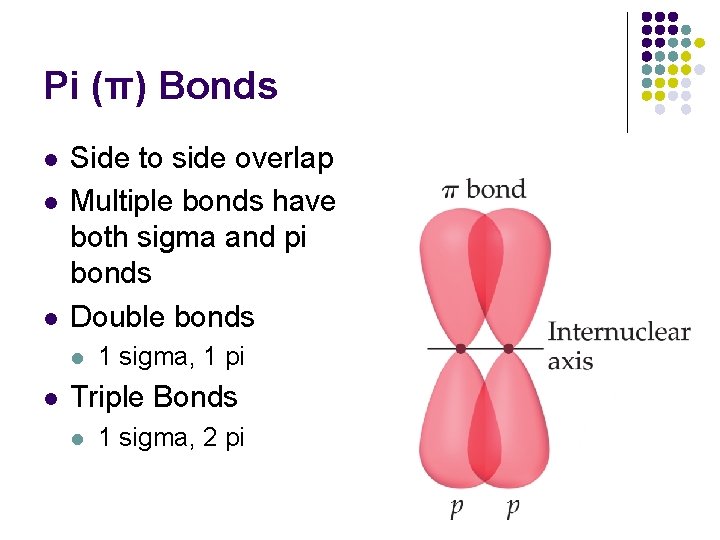
Pi (π) Bonds l l l Side to side overlap Multiple bonds have both sigma and pi bonds Double bonds l l 1 sigma, 1 pi Triple Bonds l 1 sigma, 2 pi
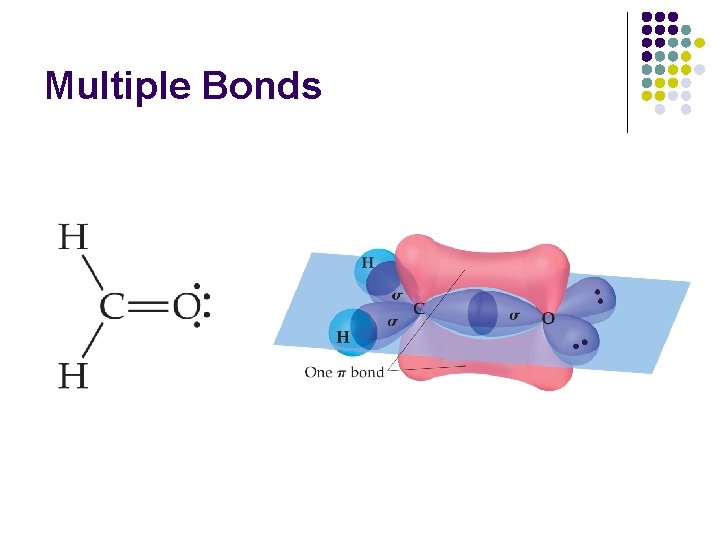
Multiple Bonds
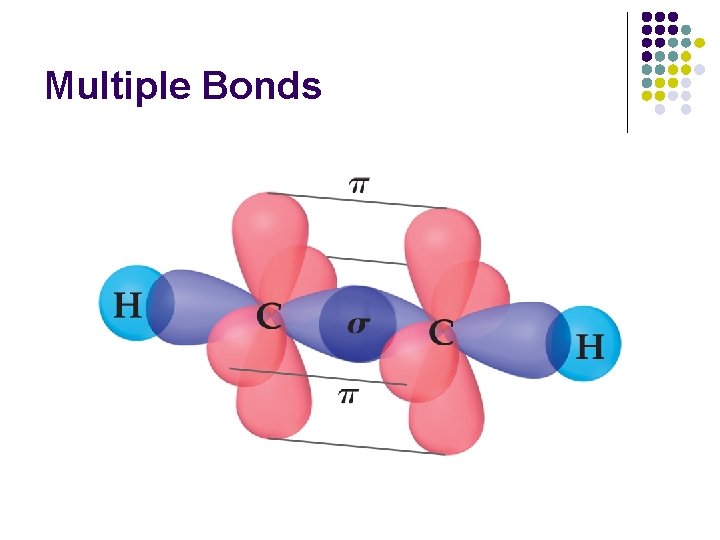
Multiple Bonds
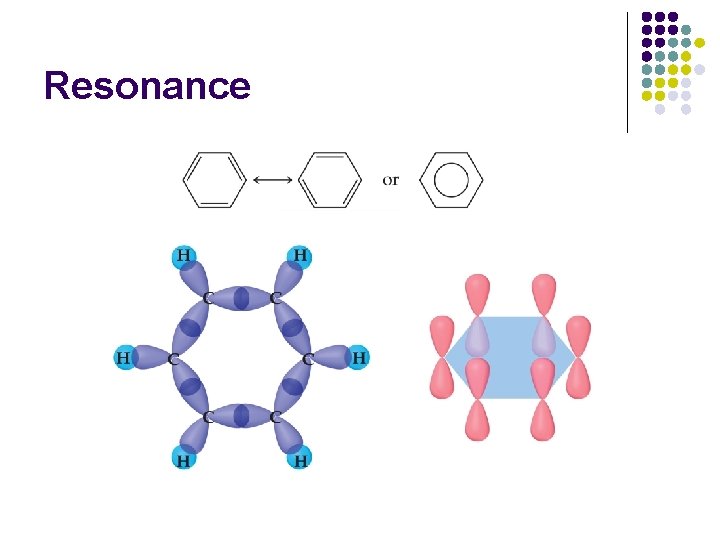
Resonance
Resonance

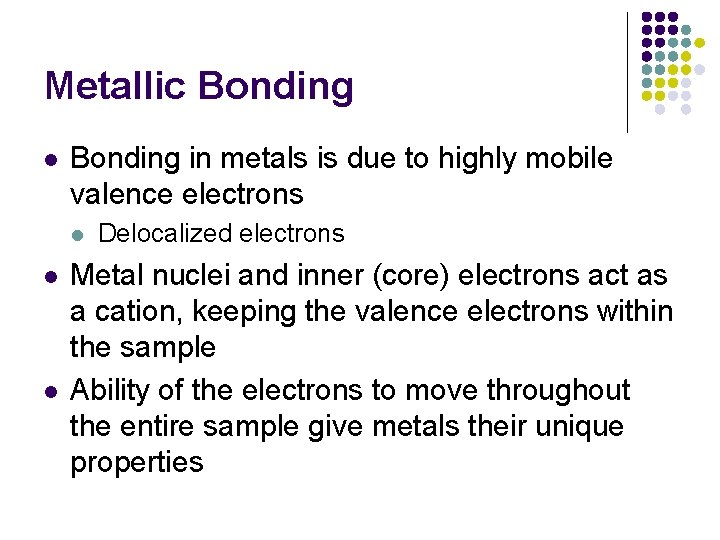
Metallic Bonding l Bonding in metals is due to highly mobile valence electrons l l l Delocalized electrons Metal nuclei and inner (core) electrons act as a cation, keeping the valence electrons within the sample Ability of the electrons to move throughout the entire sample give metals their unique properties
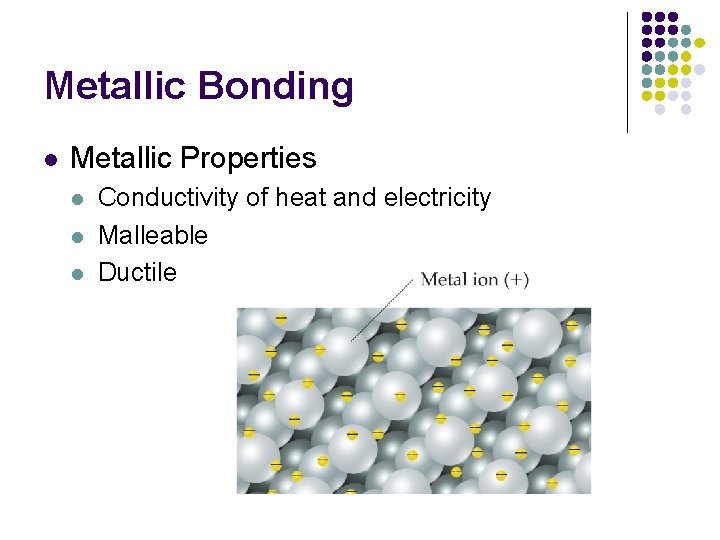
Metallic Bonding l Metallic Properties l l l Conductivity of heat and electricity Malleable Ductile
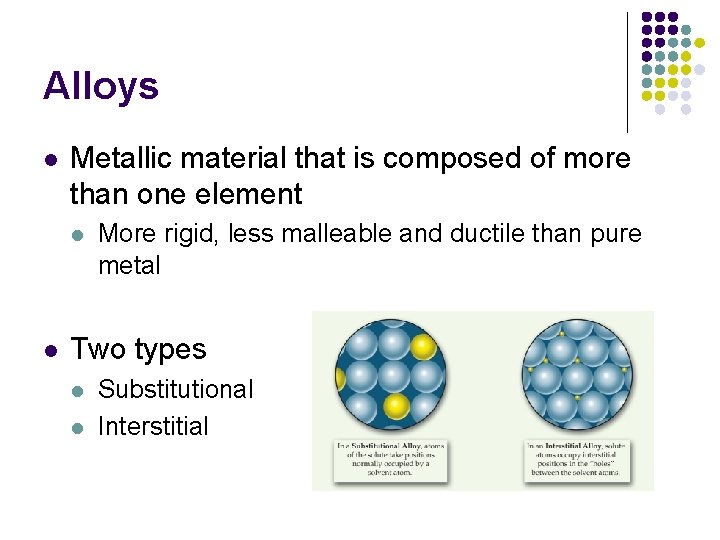
Alloys l Metallic material that is composed of more than one element l l More rigid, less malleable and ductile than pure metal Two types l l Substitutional Interstitial
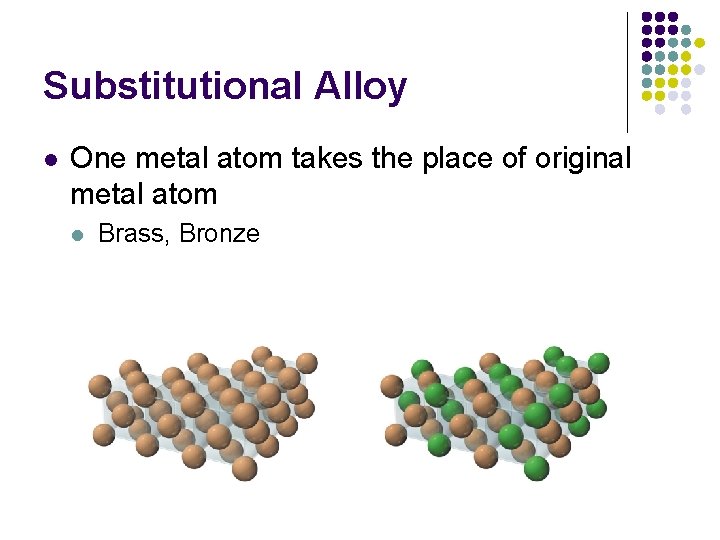
Substitutional Alloy l One metal atom takes the place of original metal atom l Brass, Bronze
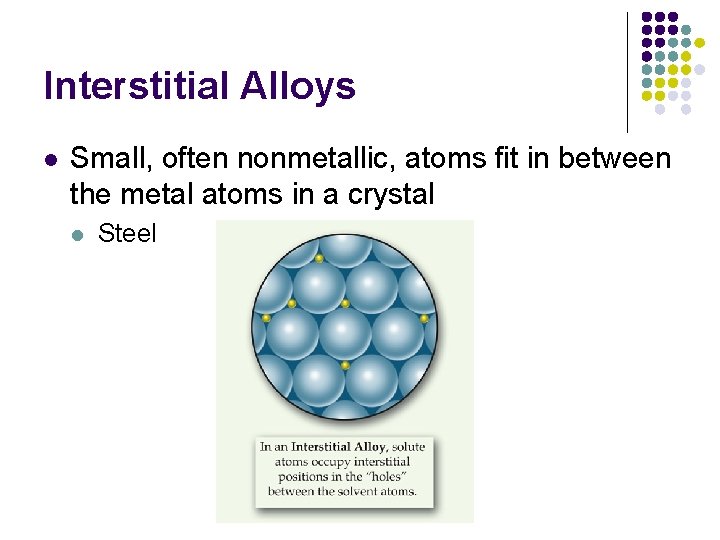
Interstitial Alloys l Small, often nonmetallic, atoms fit in between the metal atoms in a crystal l Steel
- Slides: 74