
BONDING AND IMPRINTING ED 1 D Emma Delaney
BONDING AND IMPRINTING ED 1 D Emma Delaney
LET’S WARM UP THAT GREY MATTER. . . QUICK QUIZ ➤ What is ethology? ➤ What do we mean by the term interspecific? ➤ What do we mean by the term intraspecific? ➤ What is allogrooming? ➤ Which Nobel Peace Prize winner carried out work on imprinting? ➤ Extension: What do the terms ‘Precocial’ and ‘Altricial’ mean?
LESSON OBJECTIVES ➤ Define the terms Bonding and Imprinting ➤ Understand the importance of bonding and imprinting to survival ➤ Apply these terms to specific animal species
BONDING ‘The process by which a close emotional relationship is developed' (Cambridge dictionary). Bonding in animal behaviour is a biological process in which individuals of the same or different species develop a connection. The function of bonding is to promote cooperation. Parents and offspring develop strong bonds—the former takes care of the latter, and the latter trusts the teachings of the former (ethology. eu).
OVER TO YOU…. . ➤ Spend one minute coming up with an example of intraspecific bonding, name the species and how the bonding occurs. ➤ Spend two minutes coming up with an example of interspecific bonding, name the species involved and how the bonding occurs. ➤ Spend three minutes sharing your ideas as a table and agreeing on the examples that you wish to share with the group. . .
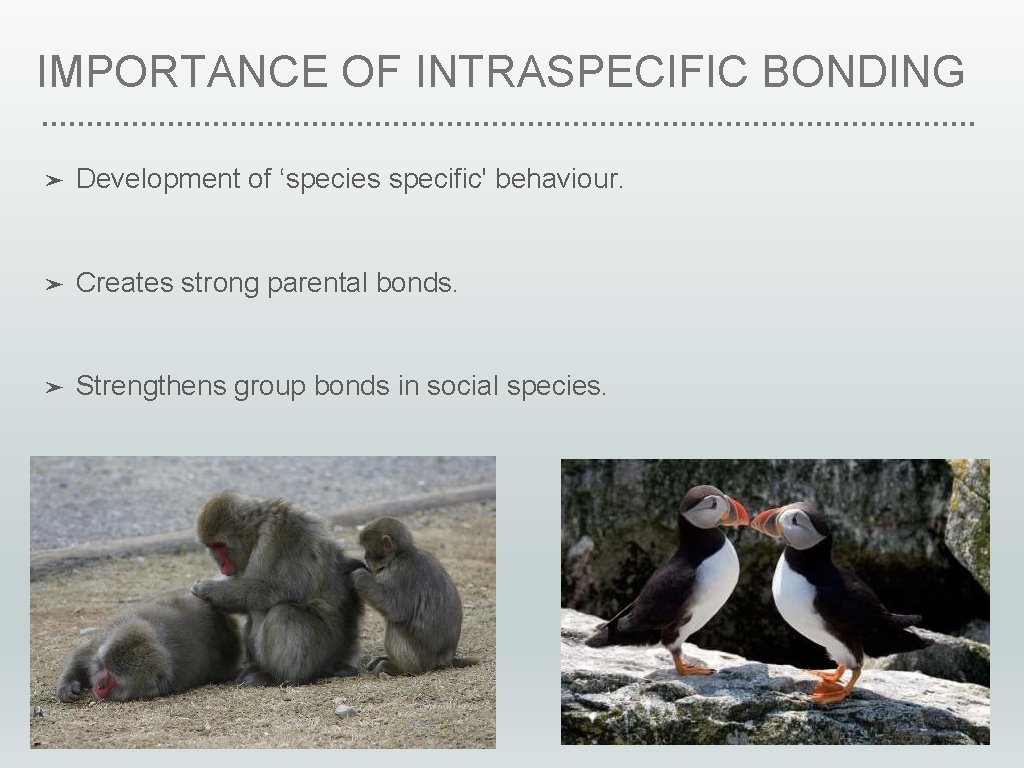
IMPORTANCE OF INTRASPECIFIC BONDING ➤ Development of ‘species specific' behaviour. ➤ Creates strong parental bonds. ➤ Strengthens group bonds in social species.
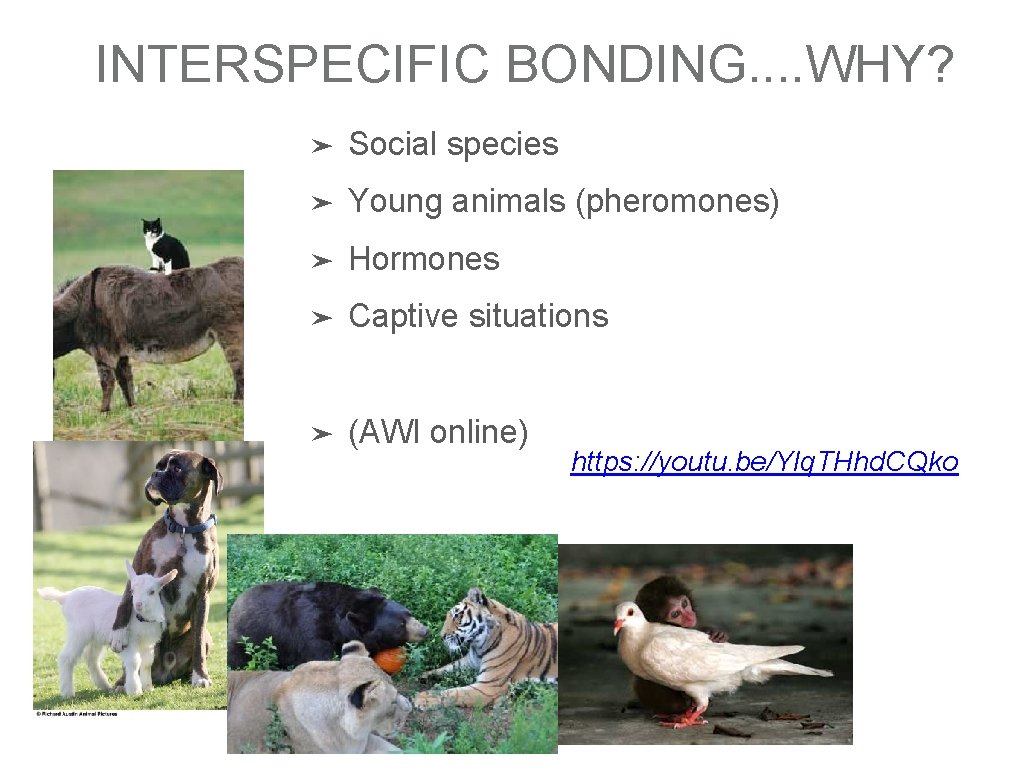
INTERSPECIFIC BONDING. . WHY? ➤ Social species ➤ Young animals (pheromones) ➤ Hormones ➤ Captive situations ➤ (AWI online) https: //youtu. be/Ylq. THhd. CQko
IMPRINTING In psychology and ethology, imprinting is any kind of phase-sensitive learning that is rapid and apparently independent of the consequences of behaviour. Filial imprinting: Is believed to have a critical period and is most obvious in young birds. It relies on the body producing chemicals which effect the brain directly such as Thyroxine. It requires the presence of the hyperstriatal ventrale in the brain to take place Animals impacted by filial imprinting are often in an advanced stage (precocial) when born and can immediately feed themselves (Chemistry is life). Sexual imprinting: This helps to determine sexual preferences in adults with regards to finding a partner, showing them the characteristics to search for in a potential mate.
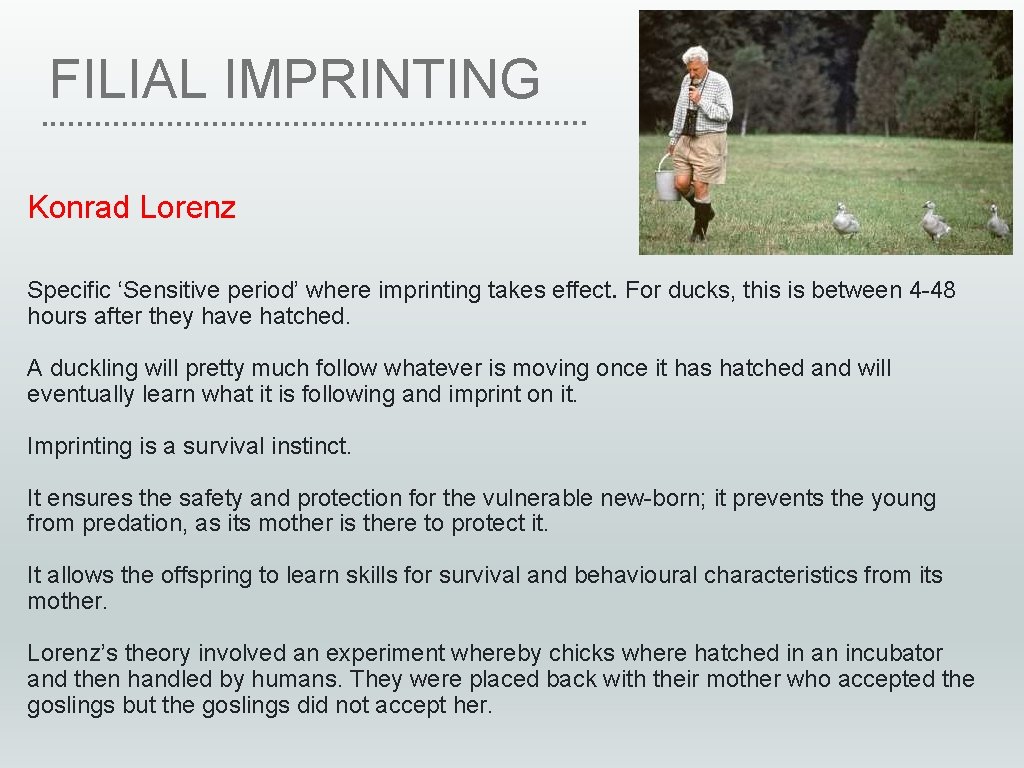
FILIAL IMPRINTING Konrad Lorenz Specific ‘Sensitive period’ where imprinting takes effect. For ducks, this is between 4 -48 hours after they have hatched. A duckling will pretty much follow whatever is moving once it has hatched and will eventually learn what it is following and imprint on it. Imprinting is a survival instinct. It ensures the safety and protection for the vulnerable new-born; it prevents the young from predation, as its mother is there to protect it. It allows the offspring to learn skills for survival and behavioural characteristics from its mother. Lorenz’s theory involved an experiment whereby chicks where hatched in an incubator and then handled by humans. They were placed back with their mother who accepted the goslings but the goslings did not accept her.
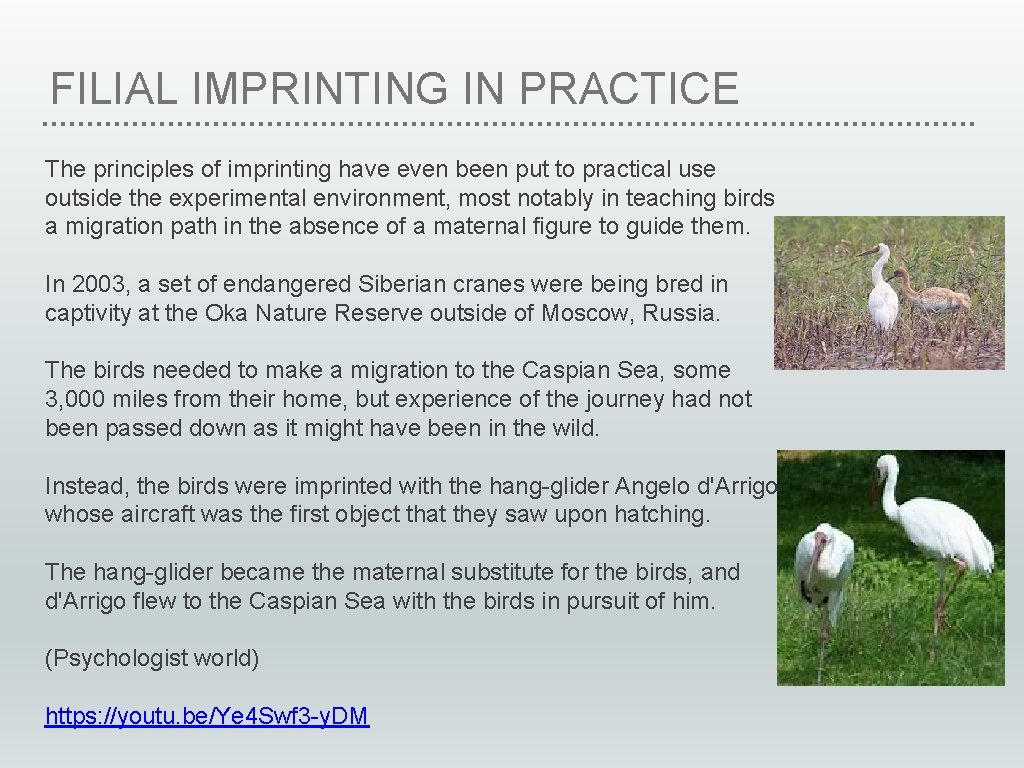
FILIAL IMPRINTING IN PRACTICE The principles of imprinting have even been put to practical use outside the experimental environment, most notably in teaching birds a migration path in the absence of a maternal figure to guide them. In 2003, a set of endangered Siberian cranes were being bred in captivity at the Oka Nature Reserve outside of Moscow, Russia. The birds needed to make a migration to the Caspian Sea, some 3, 000 miles from their home, but experience of the journey had not been passed down as it might have been in the wild. Instead, the birds were imprinted with the hang-glider Angelo d'Arrigo, whose aircraft was the first object that they saw upon hatching. The hang-glider became the maternal substitute for the birds, and d'Arrigo flew to the Caspian Sea with the birds in pursuit of him. (Psychologist world) https: //youtu. be/Ye 4 Swf 3 -y. DM
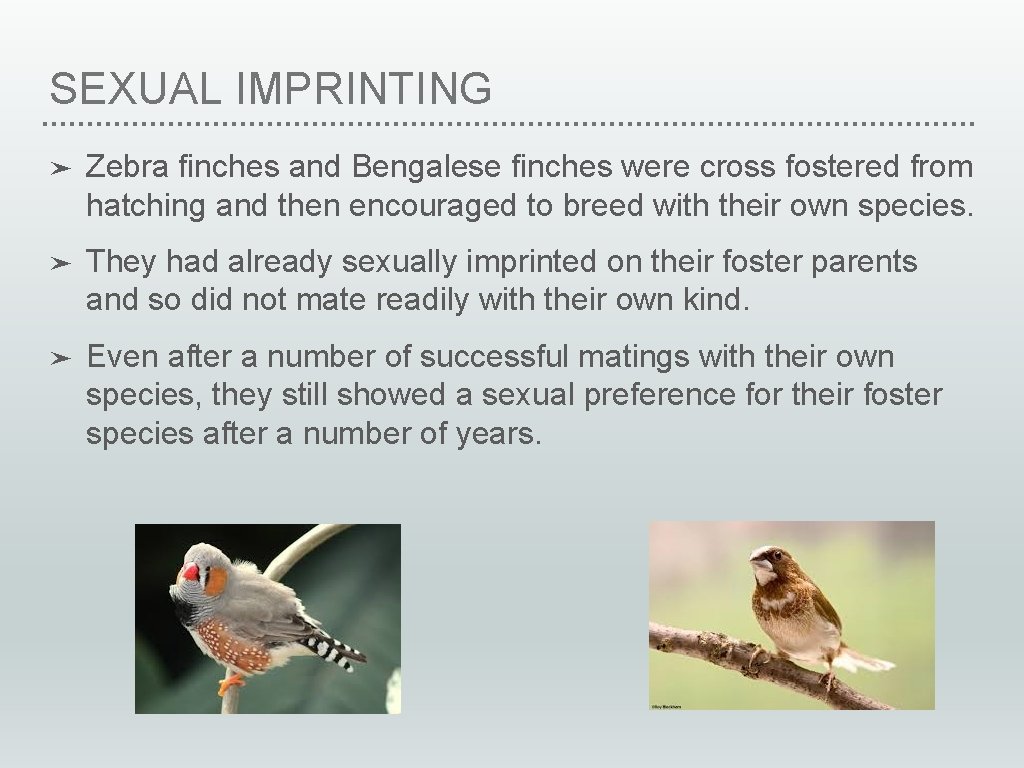
SEXUAL IMPRINTING ➤ Zebra finches and Bengalese finches were cross fostered from hatching and then encouraged to breed with their own species. ➤ They had already sexually imprinted on their foster parents and so did not mate readily with their own kind. ➤ Even after a number of successful matings with their own species, they still showed a sexual preference for their foster species after a number of years.

RESEARCH AND ETHICS HOMEWORK ➤ Read the handout given to you and underline/ highlight the main points before next week. ➤ Are there any ethical issues with any research undertaken?
- Slides: 13