
BOMBAY Blood Group DR MOHAMMED H SAIEMALDAHR BB
BOMBAY Blood Group DR. MOHAMMED H SAIEMALDAHR BB Faculty of Applied Medical Science MED TECH DEP. drmsaiem
The Bombay Phenotypes (Oh) l The H gene appears to be necessary for the formation of A and B Ags. It is very common 99. 9% of all individuals have an HH or Hh genotype. l The allele h is very rare and does not produce the LFucose transferase necessary formation of the HStructure. l The genotype (hh) or H null is extremely rare and is known as the Bombay Phenotype or Oh. drmsaiem
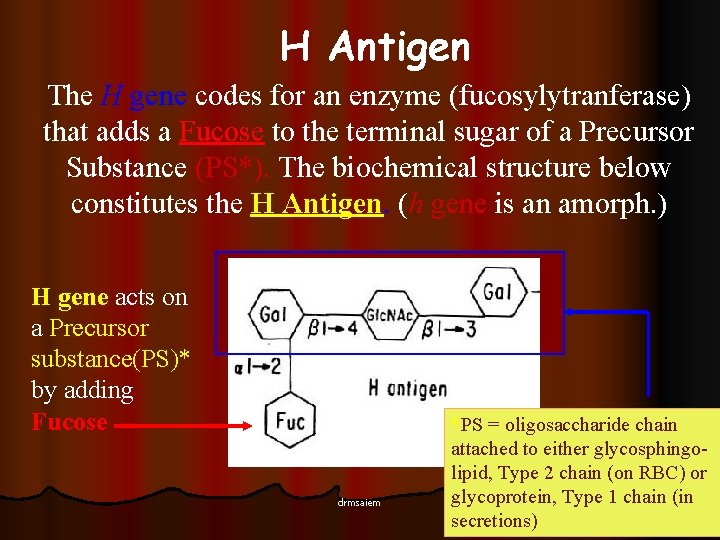
H Antigen The H gene codes for an enzyme (fucosylytranferase) that adds a Fucose to the terminal sugar of a Precursor Substance (PS*). The biochemical structure below constitutes the H Antigen. (h gene is an amorph. ) H gene acts on a Precursor substance(PS)* by adding Fucose drmsaiem *PS = oligosaccharide chain attached to either glycosphingolipid, Type 2 chain (on RBC) or glycoprotein, Type 1 chain (in secretions)
H antigen is the foundation upon which A and B antigens are built. A and B genes code for enzymes that add an immunodominant sugar to the H antigen. O allele does not code a functional enzyme Greatest amount of H Least O > A 2 > B > A 2 B > A 1 B amount of H drmsaiem

The Bombay Phenotypes (Oh) l The Bombay Phenotype was first reported by Bhende 1952 in Bombay, India. l Bombay cells can not be converted to group A or B by the specific transferases. l This support the concept that the H structure serves as the acceptor molecule or precursor substance for the product of the A or B gene -specified tranferases. drmsaiem
The Bombay Phenotypes (Oh) l Bombay individuals lack all normal expression of the A, B, or O genes they inherited. l The Bombay Phenotype Red Cells are devoid of normal A B, H Ags. l Fail to react with anti- A, anti -B , and anti -A, B and anti H. l Bombay Serum contains anti-A, -B and anti-H. drmsaiem
The Bombay Phenotypes (Oh) l The Bombay anti-H is active over a wide thermal range. It is an Ig. M antibody that can bind complement and cause red cell lysis. l Because the H Ag is common to all ABO blood group, Bombay blood is incompatible with all ABO donors. l In routine forward grouping, using anti-A, anti-B, and anti-AB. The Bombay would phenotype as an O blood group. However, transfusing normal group O would cause immediate cell lysis by the potent anti-H of the Bombay individuals. l Thus, only blood from another Bombay individual can be transfused to a Bombay recipient. drmsaiem
The Bombay Phenotypes (Oh) l Oh (hh) individuals are all non-secretors of ABH substances, because both the H gene and the Se gene must be inherited for the ABH antigens to be found in secretions. drmsaiem
The Bombay Phenotypes (Oh) l Proof that individual lacks the H antigen may be accomplished by typing the Bombay phenotype red cells with a products of the plant Ulex Europacus or with sera containing Anti-H activity from which all anti-A, anti-AB activity has been adsorbed (Removal of Abs) l This plant lectin provide a much simple and more readily available source of anti-H like activity. Thus this plant must used to determine the presence or absence of the H antigen on the surface of RBCs drmsaiem
The Bombay Phenotypes (Oh) l General Characteristics of Bombay Oh (Hnull Phenotypes) 1. Absence of H, A, and B antigens; NO agglutination with anti-A, anti-B, or anti-H lectin 2. Presence of anti-A, anti-B, anti-A, B and a potent wide thermal range of anti-H in the serum 3. A, B, H non-secretor (no A, B, or H substances present in saliva) 4. Absence of α-2 -L-fucosyltransferase (H enzyme) in serum and H antigen on red cells drmsaiem

The Bombay Phenotypes (Oh) 5 - Presence of A or B enzymes in serum 6 - Strong reactivity with anti-I reagents (possibly owing to an increase in number of I receptors) 7. A recessive mode of inheritance. 8. Red cells of the Bombay phenotype (Oh will not react with the anti-H lectin (Ulex europaeus) 9. Red cells of the Bombay phenotype (Oh are compatible only with the serum from another Bombay individual. drmsaiem
The Bombay Phenotypes (Oh) l The Bombay phenotype can been divided into four different categories that depend on the inheritance of the alleles of H (hh) are responsible for the variable expression of H and in turn A and B antigens. Category I: Classic Bombay l This group arises from the inheritance of the hh genotypes. These cells lack all H antigen and react stronger with examples of anti-I. l drmsaiem
The Bombay Phenotypes (Oh) l Category 2: Deficient Bombay Non –Secretors The red cells of these individuals have a slight amount of ABH antigens that are primarily detected by adsorption and elution (removal of Ab) studies. l Category 3: H-Deficient Bombay Secretor Recessive Inheritance These Bombay secretors arise out of the inheritance of a double dose of the recessive gene. drmsaiem
The Bombay Phenotypes (Oh) l Category 4: H-Deficient Bombay Secretors Dominant Inheritance These persons inherit H-deficient red cells via a dominant gene; however, they contain normal ABH substance if they are secretors. drmsaiem
- Slides: 14