
BOLT Optimizing Open MP Parallel Regions with UserLevel

BOLT: Optimizing Open. MP Parallel Regions with User-Level Threads Shintaro Iwasaki†, Abdelhalim Amer‡, Kenjiro Taura†, Sangmin Seo‡, Pavan Balaji‡ †The University of Tokyo ‡Argonne National Laboratory Email: iwasaki@eidos. ic. i. u-Tokyo. ac. jp, siwasaki@anl. gov
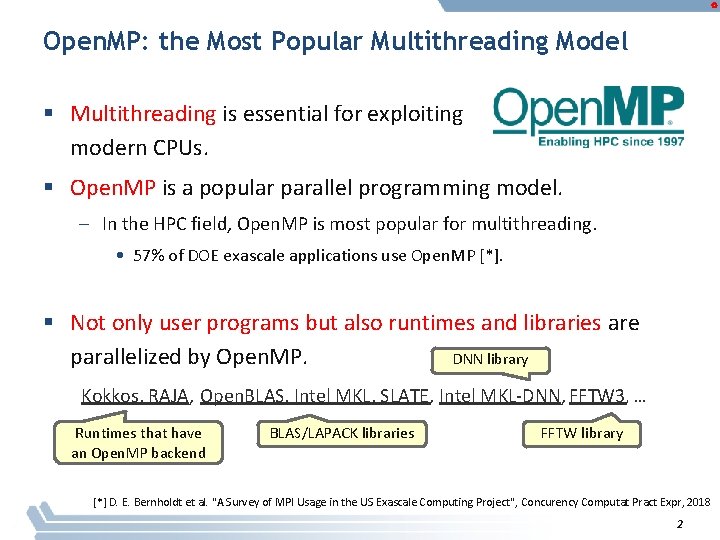
Open. MP: the Most Popular Multithreading Model § Multithreading is essential for exploiting modern CPUs. § Open. MP is a popular parallel programming model. – In the HPC field, Open. MP is most popular for multithreading. • 57% of DOE exascale applications use Open. MP [*]. § Not only user programs but also runtimes and libraries are DNN library parallelized by Open. MP. Kokkos, RAJA, Open. BLAS, Intel MKL, SLATE, Intel MKL-DNN, FFTW 3, … Runtimes that have an Open. MP backend BLAS/LAPACK libraries FFTW library [*] D. E. Bernholdt et al. "A Survey of MPI Usage in the US Exascale Computing Project", Concurency Computat Pract Expr, 2018 2
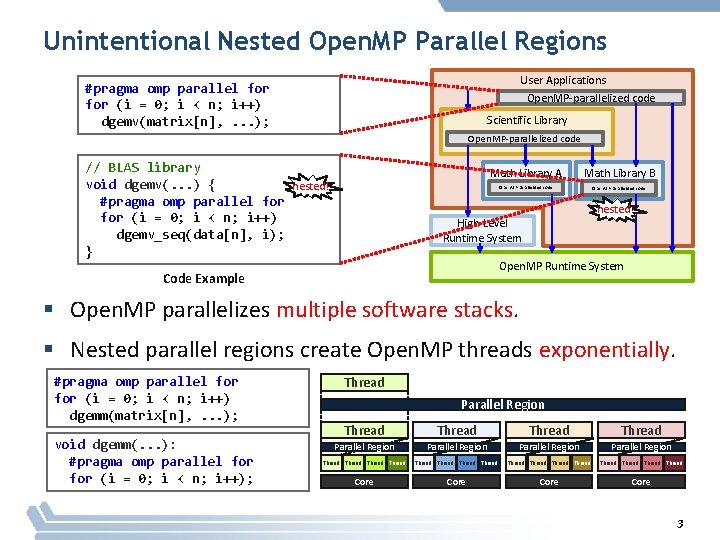
Unintentional Nested Open. MP Parallel Regions User Applications Open. MP-parallelized code #pragma omp parallel for (i = 0; i < n; i++) dgemv(matrix[n], . . . ); Scientific Library Open. MP-parallelized code // BLAS library void dgemv(. . . ) { nested! #pragma omp parallel for (i = 0; i < n; i++) dgemv_seq(data[n], i); } Math Library A Math Library B Open. MP-parallelized code nested! High-Level Runtime System Open. MP Runtime System Code Example § Open. MP parallelizes multiple software stacks. § Nested parallel regions create Open. MP threads exponentially. #pragma omp parallel for (i = 0; i < n; i++) dgemm(matrix[n], . . . ); void dgemm(. . . ): #pragma omp parallel for (i = 0; i < n; i++); Thread Parallel Region Thread Parallel Region Thread Thread Thread Thread Core 3
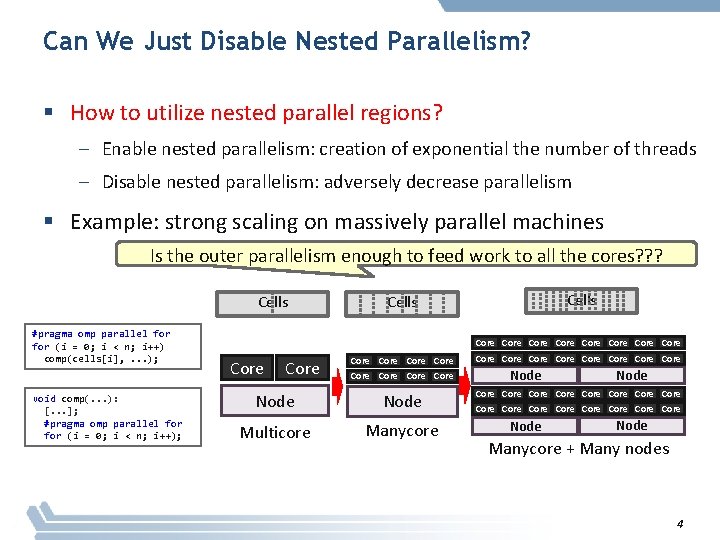
Can We Just Disable Nested Parallelism? § How to utilize nested parallel regions? – Enable nested parallelism: creation of exponential the number of threads – Disable nested parallelism: adversely decrease parallelism § Example: strong scaling on massively parallel machines Is the outer parallelism enough to feed work to all the cores? ? ? Cells #pragma omp parallel for (i = 0; i < n; i++) comp(cells[i], . . . ); void comp(. . . ): [. . . ]; #pragma omp parallel for (i = 0; i < n; i++); Cells Core Core Core Core Core Node Multicore Manycore Core Core Node Core Core Core Core Node Manycore + Many nodes 4
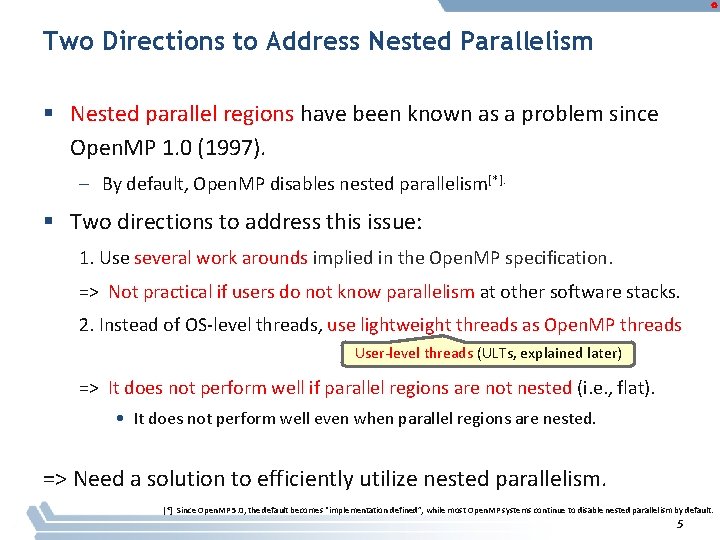
Two Directions to Address Nested Parallelism § Nested parallel regions have been known as a problem since Open. MP 1. 0 (1997). – By default, Open. MP disables nested parallelism[*]. § Two directions to address this issue: 1. Use several work arounds implied in the Open. MP specification. => Not practical if users do not know parallelism at other software stacks. 2. Instead of OS-level threads, use lightweight threads as Open. MP threads User-level threads (ULTs, explained later) => It does not perform well if parallel regions are not nested (i. e. , flat). • It does not perform well even when parallel regions are nested. => Need a solution to efficiently utilize nested parallelism. [*] Since Open. MP 5. 0, the default becomes “implementation defined”, while most Open. MP systems continue to disable nested parallelism by default. 5
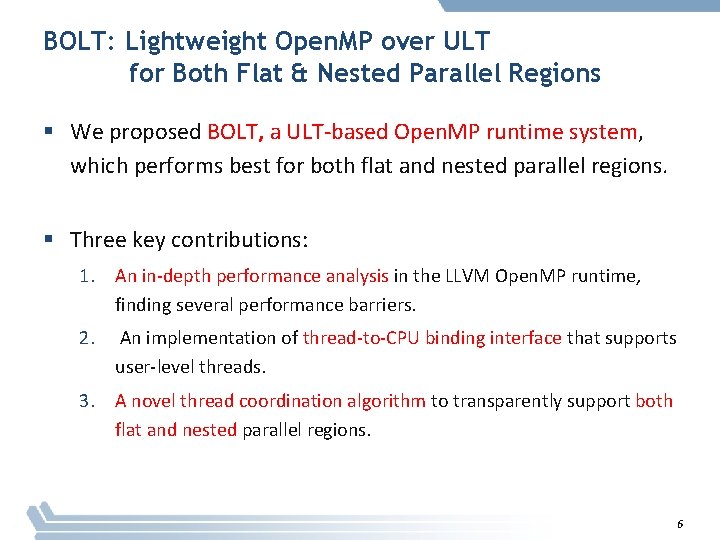
BOLT: Lightweight Open. MP over ULT for Both Flat & Nested Parallel Regions § We proposed BOLT, a ULT-based Open. MP runtime system, which performs best for both flat and nested parallel regions. § Three key contributions: 1. An in-depth performance analysis in the LLVM Open. MP runtime, finding several performance barriers. 2. An implementation of thread-to-CPU binding interface that supports user-level threads. 3. A novel thread coordination algorithm to transparently support both flat and nested parallel regions. 6
Index 1. Introduction 2. Existing Approaches – OS-level thread-based approach – User-level thread-based approach • What is a user-level thread (ULT)? 3. BOLT for both Nested and Flat Parallelism – Scalability optimizations – ULT-aware affinity (proc_bind) – Thread coordination (wait_policy) 4. Evaluation 5. Conclusion 7

Direction 1: Work around with OS-Level Threads (1/2) #pragma omp parallel for (i = 0; i < n; i++) dgemv(matrix[n], . . . ); Thread // BLAS library void dgemv(. . . ) { #pragma omp parallel for (i = 0; i < n; i++) dgemv_seq(data[n], i); } Thread Parallel Region Parallel Region Thread Thread Thread Thread § Several workarounds 1. Disable nested parallel regions (OMP_NESTED=false, OMP_ACTIVE_LEVELS=. . . ) • Parallelism is lost. 2. Finely tune numbers of threads (OMP_NUM_THREADS=nth 1, nth 2, nth 3, . . . ) • Parallelism is lost. Difficult to tune parameters. Thread Parallel Region Thread Parallel Region Thread Thread Thread Thread 1. OMP_NESTED=false Thread Parallel Region Thread Parallel Region Thread Thread Thread 2. OMP_NUM_THREADS=3, 3 8
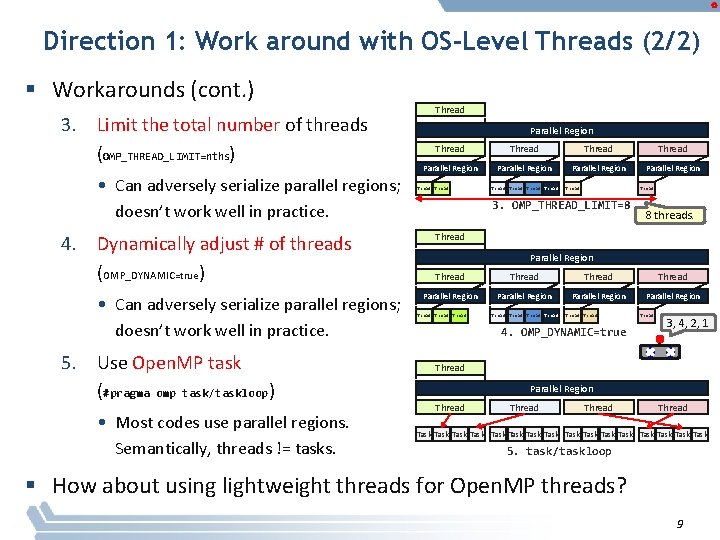
Direction 1: Work around with OS-Level Threads (2/2) § Workarounds (cont. ) 3. Limit the total number of threads (OMP_THREAD_LIMIT=nths) • Can adversely serialize parallel regions; doesn’t work well in practice. 4. Dynamically adjust # of threads (OMP_DYNAMIC=true) • Can adversely serialize parallel regions; doesn’t work well in practice. 5. Use Open. MP task (#pragma omp task/taskloop ) • Most codes use parallel regions. Semantically, threads != tasks. Thread Parallel Region Thread Parallel Region Thread Thread 3. OMP_THREAD_LIMIT=8 8 threads. Thread Parallel Region Thread Parallel Region Thread Thread Thread 4. OMP_DYNAMIC=true Thread 3, 4, 2, 1 Thread Parallel Region Thread Task Task Task Task 5. task/taskloop § How about using lightweight threads for Open. MP threads? 9
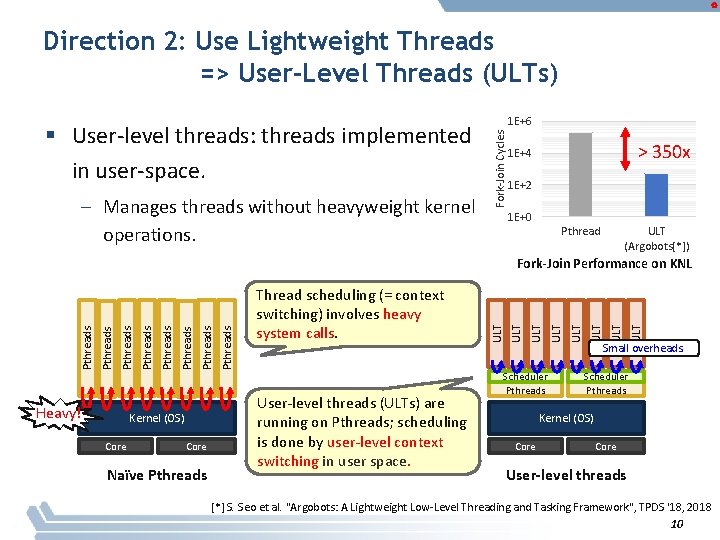
Direction 2: Use Lightweight Threads => User-Level Threads (ULTs) – Manages threads without heavyweight kernel operations. Fork-Join Cycles § User-level threads: threads implemented in user-space. 1 E+6 > 350 x 1 E+4 1 E+2 1 E+0 Pthread ULT (Argobots[*]) Heavy! Kernel (OS) Core Naïve Pthreads User-level threads (ULTs) are running on Pthreads; scheduling is done by user-level context switching in user space. Scheduler Pthreads ULT ULT Thread scheduling (= context switching) involves heavy system calls. ULT Pthreads Pthreads Fork-Join Performance on KNL Small overheads. Scheduler Pthreads Kernel (OS) Core User-level threads [*] S. Seo et al. "Argobots: A Lightweight Low-Level Threading and Tasking Framework", TPDS '18, 2018 10
Solution 2: User-Level Threads § The idea of ULTs is not new (back to <90 s). and more. § Several ULT-based Open. MP systems have been proposed. – Nanos. Compiler [1], Omni/ST [2], OMPi [3], MPC [4], Forest. GOMP [5], Omp. Ss (Open. MP compatible mode) [6], Lib. KOMP [7] … [1] Marc et al. , Nanos. Compiler: Supporting Flexible Multilevel Parallelism Exploitation in Open. MP. 2000 [2] Tanaka et al. , Performance Evaluation of Open. MP Applications with Nested Parallelism. 2000 [3] Hadjidoukas et al. , Support and Efficiency of Nested Parallelism in Open. MP Implementations. 2008 [4] Pérache et al. , MPC: A Unified Parallel Runtime for Clusters of NUMA Machines. 2008 [5] Broquedis et al. , Forest. GOMP: An Efficient Open. MP Environment for NUMA Architectures. 2010 [6] Duran et al. , A Proposal for Programming Heterogeneous Multi-Core Architectures. 2011 [7] Broquedis et al. , lib. KOMP, an Efficient Open. MP Runtime System for Both Fork-Join and Data Flow Paradigms. 2012 § However, these runtimes do not perform well for several reasons. – Lack of Open. MP specification-aware optimizations – Lack of general optimizations For apples-to-apples comparison, we will focus on the ULT-based LLVM Open. MP. 11
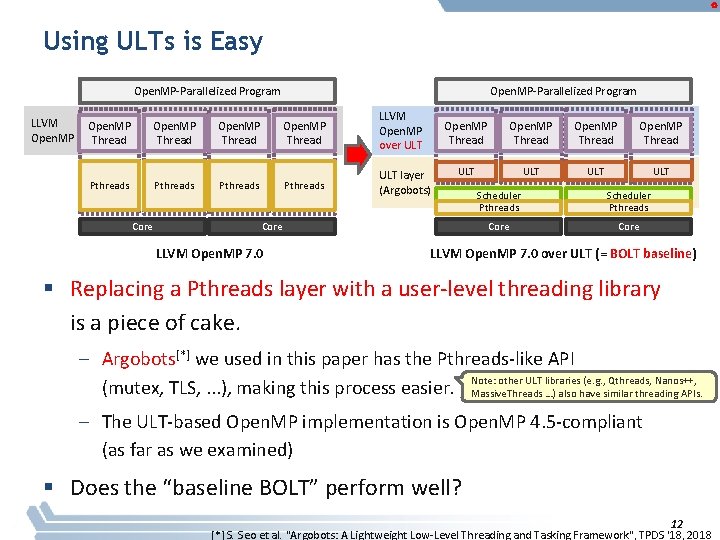
Using ULTs is Easy Open. MP-Parallelized Program LLVM Open. MP Thread Pthreads Core Open. MP Thread Pthreads Open. MP-Parallelized Program Open. MP Thread LLVM Open. MP over ULT Pthreads ULT layer (Argobots) Open. MP Thread ULT ULT Core LLVM Open. MP 7. 0 Scheduler Pthreads Core LLVM Open. MP 7. 0 over ULT (= BOLT baseline) § Replacing a Pthreads layer with a user-level threading library is a piece of cake. – Argobots[*] we used in this paper has the Pthreads-like API Note: other ULT libraries (e. g. , Qthreads, Nanos++, (mutex, TLS, . . . ), making this process easier. Massive. Threads …) also have similar threading APIs. – The ULT-based Open. MP implementation is Open. MP 4. 5 -compliant (as far as we examined) § Does the “baseline BOLT” perform well? 12 [*] S. Seo et al. "Argobots: A Lightweight Low-Level Threading and Tasking Framework", TPDS '18, 2018
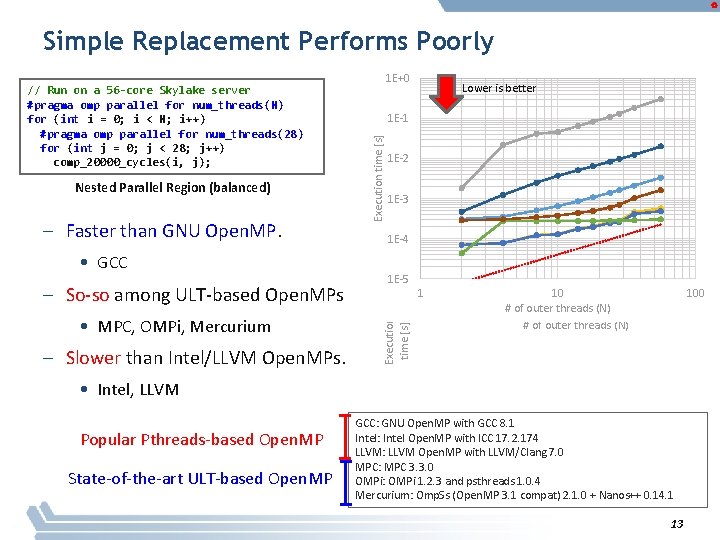
Simple Replacement Performs Poorly – Faster than GNU Open. MP. • GCC – So-so among ULT-based Open. MPs • MPC, OMPi, Mercurium – Slower than Intel/LLVM Open. MPs. Lower is better 1 E-1 Execution time [s] Nested Parallel Region (balanced) 1 E+0 1 E-2 1 E-3 1 E-4 1 E-5 1 Execution time [s] // Run on a 56 -core Skylake server #pragma omp parallel for num_threads(N) for (int i = 0; i < N; i++) #pragma omp parallel for num_threads(28) for (int j = 0; j < 28; j++) comp_20000_cycles(i, j); 10 # of outer threads (N) 100 • Intel, LLVM Popular Pthreads-based Open. MP State-of-the-art ULT-based Open. MP GCC: GNU Open. MP with GCC 8. 1 Intel: Intel Open. MP with ICC 17. 2. 174 LLVM: LLVM Open. MP with LLVM/Clang 7. 0 MPC: MPC 3. 3. 0 OMPi: OMPi 1. 2. 3 and psthreads 1. 0. 4 Mercurium: Omp. Ss (Open. MP 3. 1 compat) 2. 1. 0 + Nanos++ 0. 14. 1 13
Index 1. Introduction 2. Existing Approaches – OS-level thread-based approach – User-level thread-based approach • What is a user-level thread (ULT)? 3. BOLT for both Nested and Flat Parallelism – Scalability optimizations – ULT-aware affinity (proc_bind) – Thread coordination (wait_policy) 4. Evaluation 5. Conclusion 14
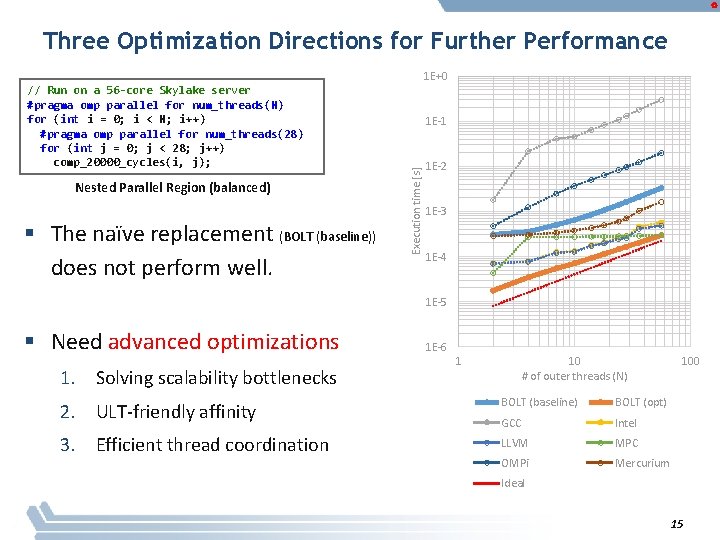
Three Optimization Directions for Further Performance Nested Parallel Region (balanced) § The naïve replacement (BOLT (baseline)) does not perform well. 1 E+0 1 E-1 Execution time [s] // Run on a 56 -core Skylake server #pragma omp parallel for num_threads(N) for (int i = 0; i < N; i++) #pragma omp parallel for num_threads(28) for (int j = 0; j < 28; j++) comp_20000_cycles(i, j); 1 E-2 1 E-3 1 E-4 1 E-5 § Need advanced optimizations 1. Solving scalability bottlenecks 1 E-6 1 10 # of outer threads (N) 2. ULT-friendly affinity BOLT (baseline) GOMP BOLT (opt) IOMP GCC LOMP Intel 3. Efficient thread coordination MPC LLVM OMPi MPC Mercurium OMPi Ideal Mercurium 100 BOLT Ideal (opt) 15
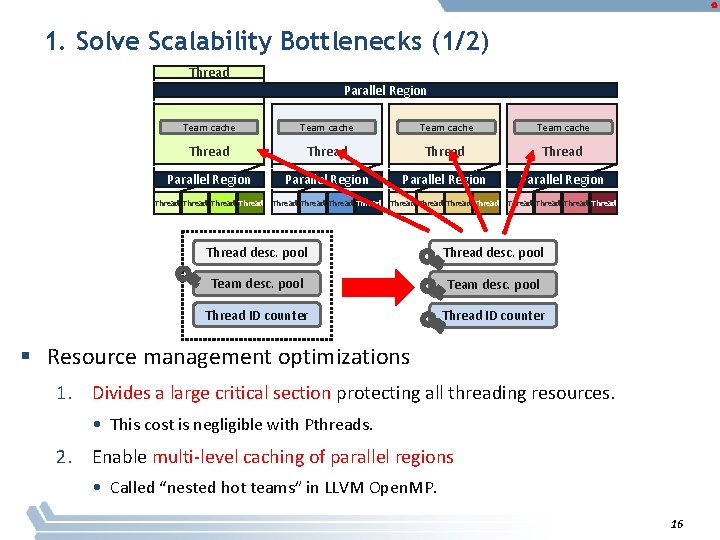
1. Solve Scalability Bottlenecks (1/2) Thread Parallel Region Team cache Thread Parallel Region Thread Thread Thread Thread Thread desc. pool Team desc. pool Thread ID counter § Resource management optimizations 1. Divides a large critical section protecting all threading resources. • This cost is negligible with Pthreads. 2. Enable multi-level caching of parallel regions • Called “nested hot teams” in LLVM Open. MP. 16
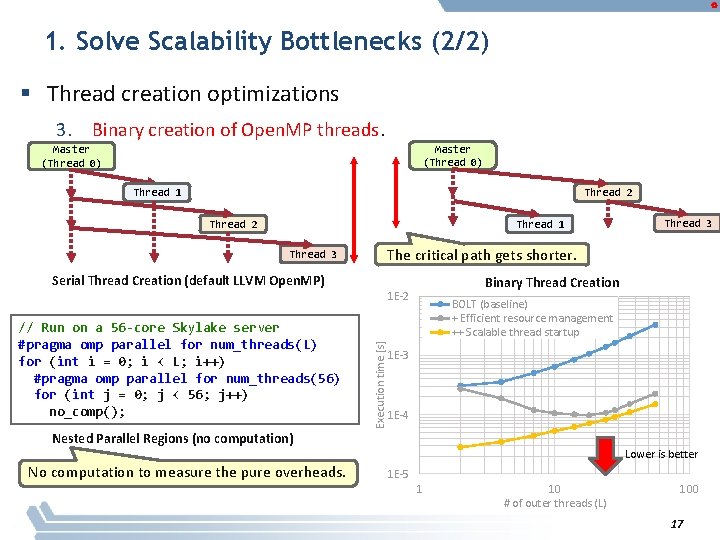
1. Solve Scalability Bottlenecks (2/2) § Thread creation optimizations 3. Binary creation of Open. MP threads. Master (Thread 0) Thread 1 Thread 2 Thread 1 Thread 3 The critical path gets shorter. Serial Thread Creation (default LLVM Open. MP) Binary Thread Creation 1 E-2 Execution time [s] // Run on a 56 -core Skylake server #pragma omp parallel for num_threads(L) for (int i = 0; i < L; i++) #pragma omp parallel for num_threads(56) for (int j = 0; j < 56; j++) no_comp(); BOLT (baseline) + Efficient resource management ++ Scalable thread startup 1 E-3 1 E-4 Nested Parallel Regions (no computation) No computation to measure the pure overheads. Thread 3 Lower is better 1 E-5 1 10 # of outer threads (L) 100 17
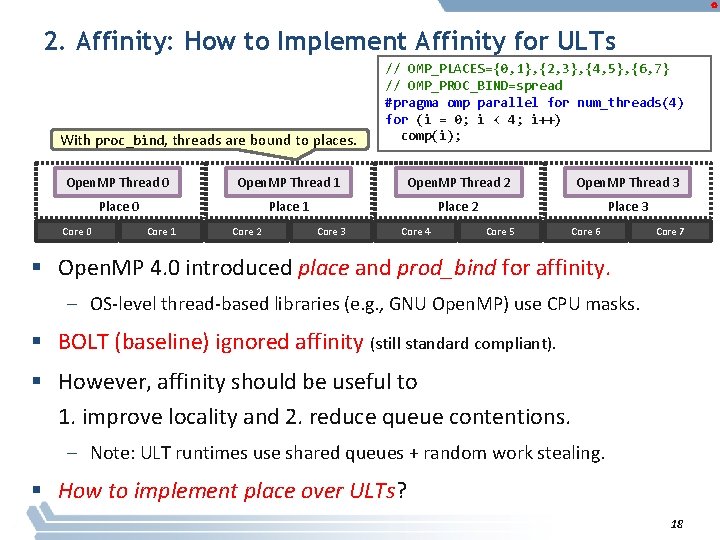
2. Affinity: How to Implement Affinity for ULTs With proc_bind, threads are bound to places. // OMP_PLACES={0, 1}, {2, 3}, {4, 5}, {6, 7} // OMP_PROC_BIND=spread #pragma omp parallel for num_threads(4) for (i = 0; i < 4; i++) comp(i); Open. MP Thread 0 Open. MP Thread 1 Open. MP Thread 2 Open. MP Thread 3 Place 0 Place 1 Place 2 Place 3 Core 0 Core 1 Core 2 Core 3 Core 4 Core 5 Core 6 Core 7 § Open. MP 4. 0 introduced place and prod_bind for affinity. – OS-level thread-based libraries (e. g. , GNU Open. MP) use CPU masks. § BOLT (baseline) ignored affinity (still standard compliant). § However, affinity should be useful to 1. improve locality and 2. reduce queue contentions. – Note: ULT runtimes use shared queues + random work stealing. § How to implement place over ULTs? 18
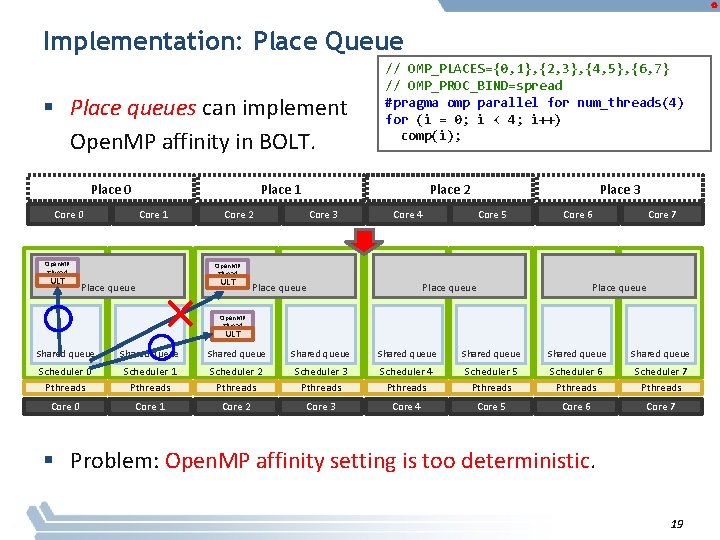
Implementation: Place Queue § Place queues can implement Open. MP affinity in BOLT. Place 0 Core 0 Place 1 Core 1 Open. MP Thread ULT // OMP_PLACES={0, 1}, {2, 3}, {4, 5}, {6, 7} // OMP_PROC_BIND=spread #pragma omp parallel for num_threads(4) for (i = 0; i < 4; i++) comp(i); Core 2 Place 2 Core 3 Core 4 Place 3 Core 5 Core 6 Core 7 Open. MP Thread ULT Place queue Open. MP Thread ULT Shared queue Shared queue Scheduler 0 Pthreads Scheduler 1 Pthreads Scheduler 2 Pthreads Scheduler 3 Pthreads Scheduler 4 Pthreads Scheduler 5 Pthreads Scheduler 6 Pthreads Scheduler 7 Pthreads Core 0 Core 1 Core 2 Core 3 Core 4 Core 5 Core 6 Core 7 § Problem: Open. MP affinity setting is too deterministic. 19
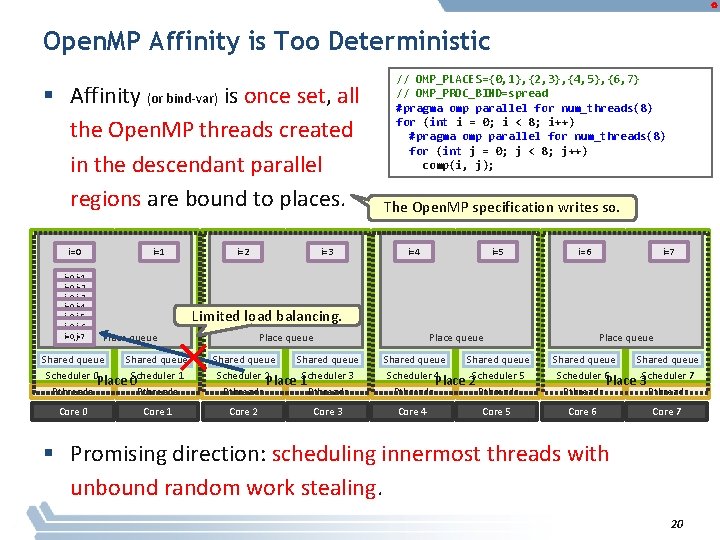
Open. MP Affinity is Too Deterministic § Affinity (or bind-var) is once set, all the Open. MP threads created in the descendant parallel regions are bound to places. i=0, j=1 i=0, j=2 i=0, j=3 i=0, j=4 i=0, j=5 i=0, j=6 i=0, j=7 i=1 i=3 The Open. MP specification writes so. i=4 i=5 i=6 i=7 Limited load balancing. Place queue Shared queue Scheduler 0 Place 0 Scheduler 1 Pthreads Core 0 i=2 // OMP_PLACES={0, 1}, {2, 3}, {4, 5}, {6, 7} // OMP_PROC_BIND=spread #pragma omp parallel for num_threads(8) for (int i = 0; i < 8; i++) #pragma omp parallel for num_threads(8) for (int j = 0; j < 8; j++) comp(i, j); Core 1 Place queue Shared queue Scheduler 2 Place 1 Scheduler 3 Pthreads Shared queue Scheduler 4 Place 2 Scheduler 5 Pthreads Shared queue Scheduler 6 Place 3 Scheduler 7 Pthreads Core 2 Core 3 Core 4 Core 5 Core 6 Core 7 § Promising direction: scheduling innermost threads with unbound random work stealing. 20
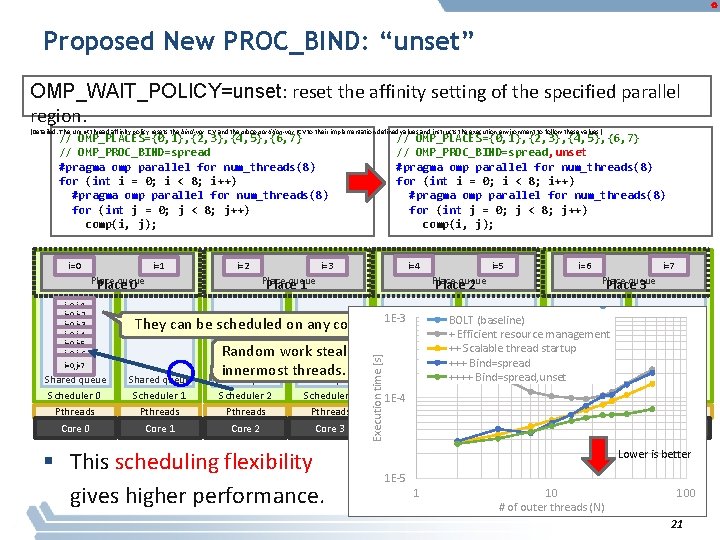
Proposed New PROC_BIND: “unset” OMP_WAIT_POLICY=unset: reset the affinity setting of the specified parallel region. (Detailed: The unset thread affinity policy resets the bind-var ICV and the place-partition-var ICV to their implementation defined values and instructs the execution environment to follow these values. ) // OMP_PLACES={0, 1}, {2, 3}, {4, 5}, {6, 7} // OMP_PROC_BIND=spread #pragma omp parallel for num_threads(8) for (int i = 0; i < 8; i++) #pragma omp parallel for num_threads(8) for (int j = 0; j < 8; j++) comp(i, j); i=0 i=1 i=2 Place queue Place 0 i=4 i=3 Place queue Place 1 i=0, j=7 Shared queue Scheduler 1 Pthreads Core 0 Core 1 i=6 i=7 Place queue Place 3 1 E-3 BOLT (baseline) + Efficient resource management ++ Scalable thread startup Random work stealing for +++ Bind=spread innermost threads. Bind=spread, unset Shared queue ++++Shared queue They can be scheduled on any cores. Shared queue Scheduler 0 Pthreads i=5 Place queue Place 2 Scheduler 2 Pthreads Scheduler 3 Pthreads Core 2 Core 3 § This scheduling flexibility gives higher performance. Execution time [s] i=0, j=1 i=0, j=2 i=0, j=3 i=0, j=4 i=0, j=5 i=0, j=6 // OMP_PLACES={0, 1}, {2, 3}, {4, 5}, {6, 7} // OMP_PROC_BIND=spread, unset #pragma omp parallel for num_threads(8) for (int i = 0; i < 8; i++) #pragma omp parallel for num_threads(8) for (int j = 0; j < 8; j++) comp(i, j); Scheduler 4 1 E-4 Pthreads Scheduler 5 Pthreads Scheduler 6 Pthreads Shared queue Scheduler 7 Pthreads Core 4 Core 5 Core 6 Core 7 Lower is better 1 E-5 1 10 # of outer threads (N) 100 21
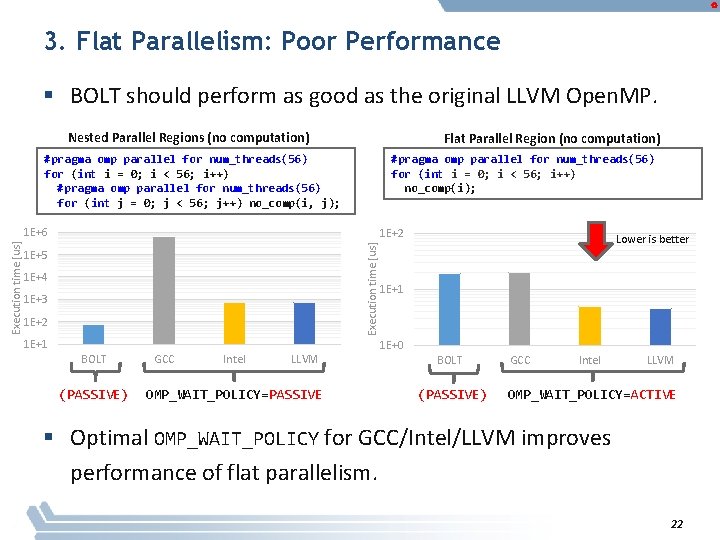
3. Flat Parallelism: Poor Performance § BOLT should perform as good as the original LLVM Open. MP. Nested Parallel Regions (no computation) Flat Parallel Region (no computation) #pragma omp parallel for num_threads(56) for (int i = 0; i < 56; i++) #pragma omp parallel for num_threads(56) for (int j = 0; j < 56; j++) no_comp(i, j); #pragma omp parallel for num_threads(56) for (int i = 0; i < 56; i++) no_comp(i); 1 E+2 Execution time [us] 1 E+6 1 E+5 1 E+4 1 E+3 1 E+2 1 E+1 BOLT (PASSIVE) GCC Intel LLVM OMP_WAIT_POLICY=PASSIVE Lower is better 1 E+1 1 E+0 BOLT (PASSIVE) GCC Intel LLVM OMP_WAIT_POLICY=ACTIVE § Optimal OMP_WAIT_POLICY for GCC/Intel/LLVM improves performance of flat parallelism. 22
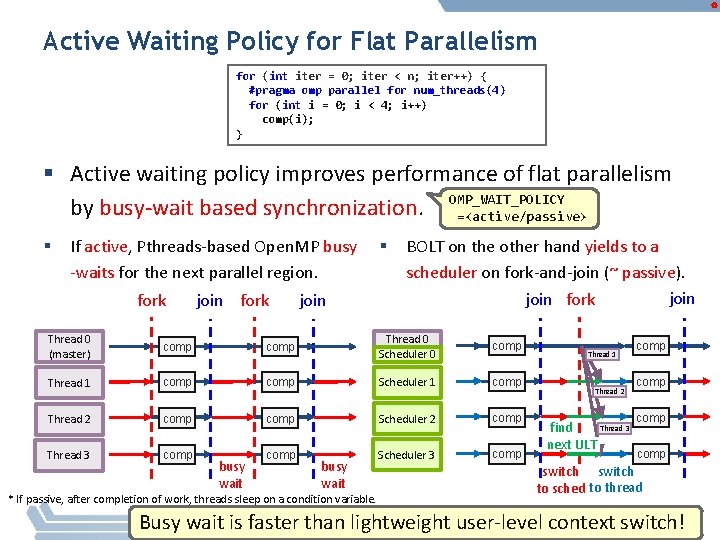
Active Waiting Policy for Flat Parallelism for (int iter = 0; iter < n; iter++) { #pragma omp parallel for num_threads(4) for (int i = 0; i < 4; i++) comp(i); } § Active waiting policy improves performance of flat parallelism by busy-wait based synchronization. OMP_WAIT_POLICY =<active/passive> § If active, Pthreads-based Open. MP busy -waits for the next parallel region. fork join § BOLT on the other hand yields to a scheduler on fork-and-join (~ passive). join fork Thread 0 (master) comp Thread 0 Scheduler 0 comp Thread 1 comp Scheduler 1 comp Thread 2 comp Scheduler 2 comp Thread 3 comp Scheduler 3 comp busy wait * If passive, after completion of work, threads sleep on a condition variable. Thread 1 Thread 2 Thread 3 find next ULT comp switch to sched to thread Busy wait is faster than lightweight user-level context switch! 23
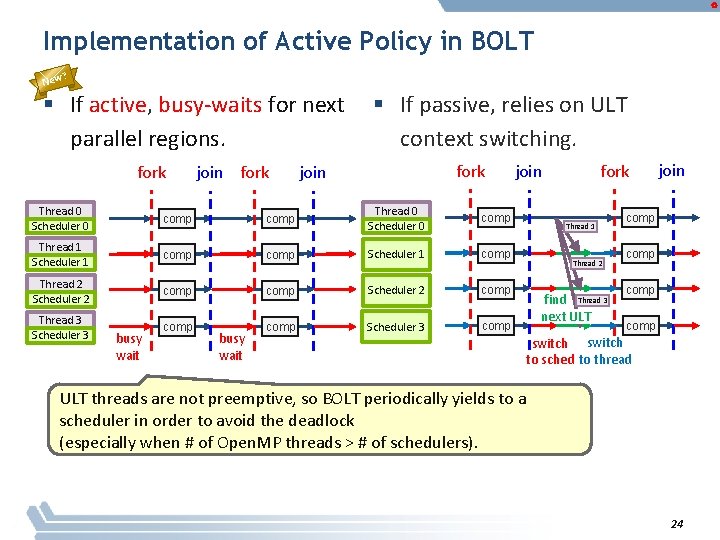
Implementation of Active Policy in BOLT New? § If active, busy-waits for next parallel regions. fork join fork § If passive, relies on ULT context switching. fork join Thread 0 Scheduler 0 comp Thread 1 Scheduler 1 comp Thread 2 Scheduler 2 comp Scheduler 3 comp Thread 3 Scheduler 3 busy wait comp busy wait fork join Thread 1 Thread 2 find Thread 3 next ULT join comp switch to sched to thread ULT threads are not preemptive, so BOLT periodically yields to a scheduler in order to avoid the deadlock (especially when # of Open. MP threads > # of schedulers). 24
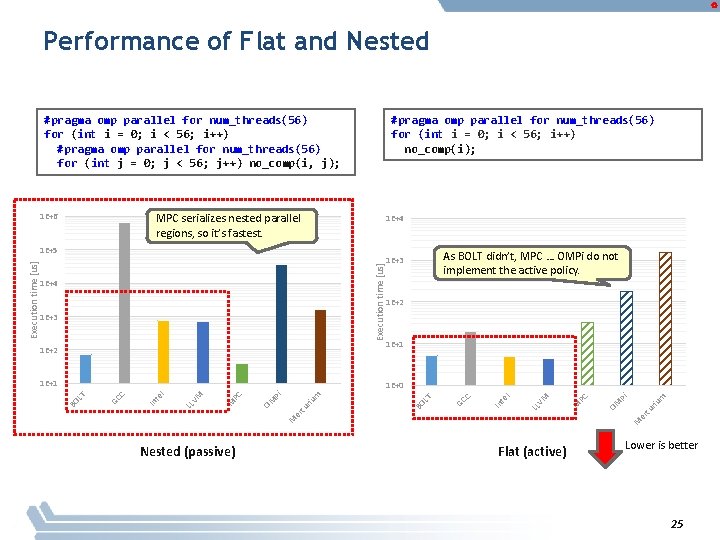
Performance of Flat and Nested #pragma omp parallel for num_threads(56) for (int i = 0; i < 56; i++) no_comp(i); #pragma omp parallel for num_threads(56) for (int i = 0; i < 56; i++) #pragma omp parallel for num_threads(56) for (int j = 0; j < 56; j++) no_comp(i, j); 1 E+6 MPC serializes nested parallel regions, so it’s fastest. 1 E+4 Execution time [us] 1 E+4 1 E+3 1 E+2 1 E+1 As BOLT didn’t, MPC … OMPi do not implement the active policy. 1 E+3 1 E+2 1 E+1 er cu r iu m Pi OM PC M M Nested (passive) M VM LL l te In C GC LT BO er cu r iu m Pi OM PC M VM LL l te In C GC LT 1 E+0 BO Execution time [us] 1 E+5 Flat (active) Lower is better 25
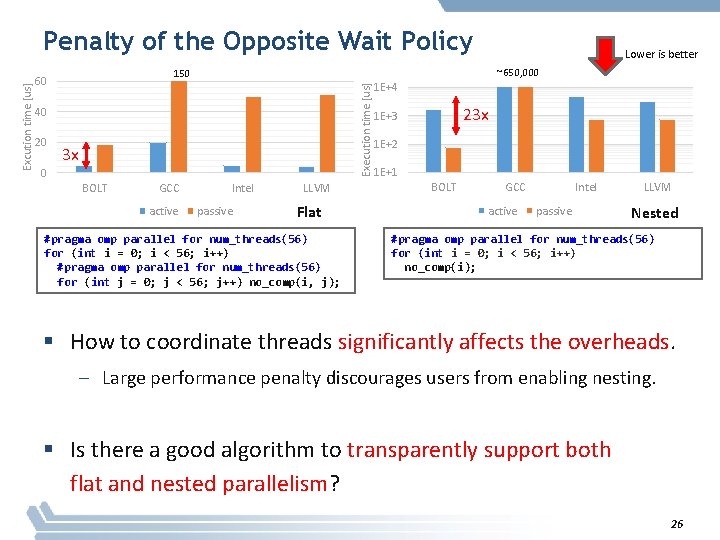
40 20 3 x 0 BOLT GCC active Lower is better ~650, 000 150 60 Execution time [us] Excution time [us] Penalty of the Opposite Wait Policy Intel passive LLVM Flat #pragma omp parallel for num_threads(56) for (int i = 0; i < 56; i++) #pragma omp parallel for num_threads(56) for (int j = 0; j < 56; j++) no_comp(i, j); 1 E+4 23 x 1 E+3 1 E+2 1 E+1 BOLT GCC active Intel passive LLVM Nested #pragma omp parallel for num_threads(56) for (int i = 0; i < 56; i++) no_comp(i); § How to coordinate threads significantly affects the overheads. – Large performance penalty discourages users from enabling nesting. § Is there a good algorithm to transparently support both flat and nested parallelism? 26
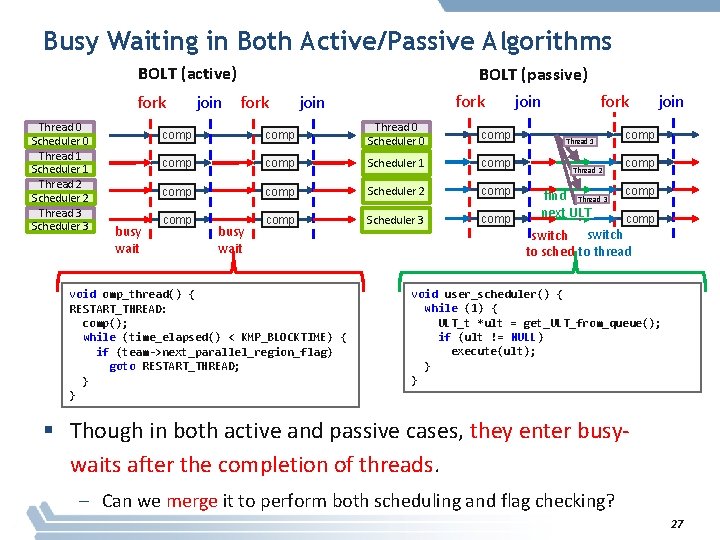
Busy Waiting in Both Active/Passive Algorithms BOLT (active) fork Thread 0 Scheduler 0 Thread 1 Scheduler 1 Thread 2 Scheduler 2 Thread 3 Scheduler 3 busy wait join fork BOLT (passive) fork join comp Thread 0 Scheduler 0 comp Scheduler 1 comp Scheduler 2 comp Scheduler 3 comp busy wait void omp_thread() { RESTART_THREAD: comp(); while (time_elapsed() < KMP_BLOCKTIME) { if (team->next_parallel_region_flag) goto RESTART_THREAD; } } Thread 1 Thread 2 find Thread 3 next ULT join comp switch to sched to thread void user_scheduler() { while (1) { ULT_t *ult = get_ULT_from_queue(); if (ult != NULL) execute(ult); } } § Though in both active and passive cases, they enter busywaits after the completion of threads. – Can we merge it to perform both scheduling and flag checking? 27
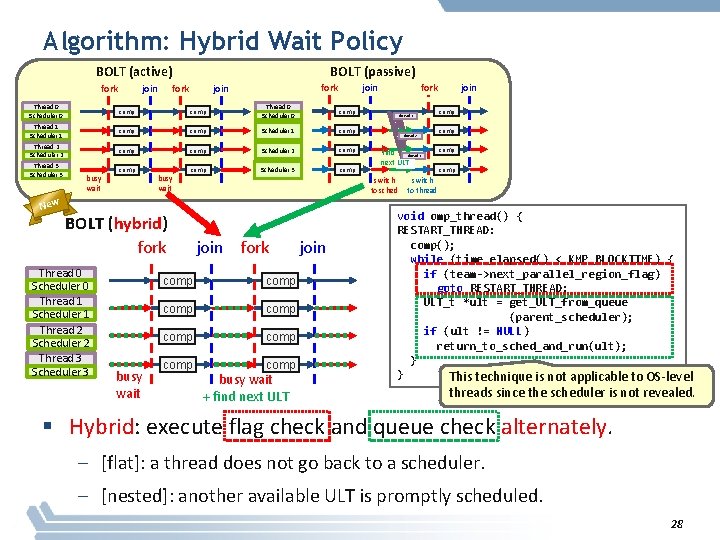
Algorithm: Hybrid Wait Policy BOLT (active) fork BOLT (passive) fork join Thread 0 Scheduler 0 comp Thread 1 Scheduler 1 comp Thread 2 Scheduler 2 comp Scheduler 3 comp Thread 3 Scheduler 3 New busy wait comp busy wait BOLT (hybrid) fork Thread 0 Scheduler 0 Thread 1 Scheduler 1 Thread 2 Scheduler 2 Thread 3 Scheduler 3 busy wait comp comp Thread 1 Thread 2 find Thread 3 next ULT switch to sched join fork comp busy wait + find next ULT join fork join comp switch to thread void omp_thread() { RESTART_THREAD: comp(); while (time_elapsed() < KMP_BLOCKTIME) { if (team->next_parallel_region_flag) goto RESTART_THREAD; ULT_t *ult = get_ULT_from_queue (parent_scheduler); if (ult != NULL) return_to_sched_and_run(ult); } } This technique is not applicable to OS-level threads since the scheduler is not revealed. § Hybrid: execute flag check and queue check alternately. – [flat]: a thread does not go back to a scheduler. – [nested]: another available ULT is promptly scheduled. 28
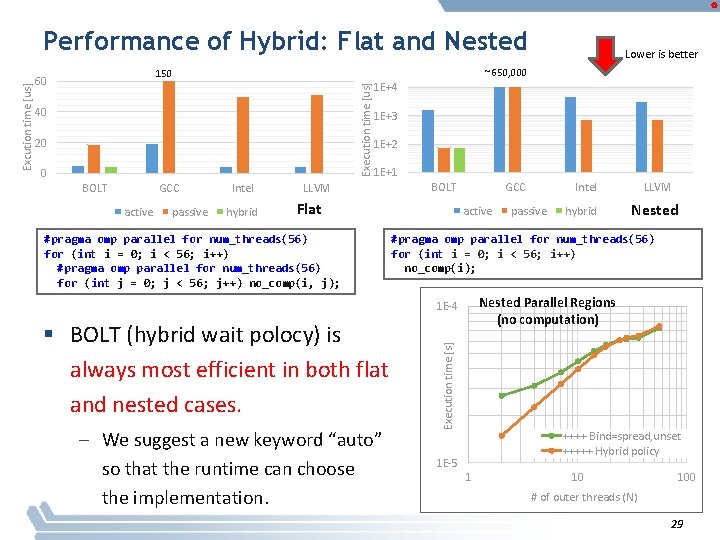
40 20 0 BOLT GCC active Lower is better ~650, 000 150 60 Execution time [us] passive Intel hybrid 1 E+4 1 E+3 1 E+2 1 E+1 LLVM BOLT Flat #pragma omp parallel for num_threads(56) for (int i = 0; i < 56; i++) #pragma omp parallel for num_threads(56) for (int j = 0; j < 56; j++) no_comp(i, j); GCC active – We suggest a new keyword “auto” so that the runtime can choose the implementation. passive hybrid LLVM Nested Parallel Regions (no computation) 1 E-4 § BOLT (hybrid wait polocy) is always most efficient in both flat and nested cases. Intel #pragma omp parallel for num_threads(56) for (int i = 0; i < 56; i++) no_comp(i); Execution time [s] Excution time [us] Performance of Hybrid: Flat and Nested ++++ Bind=spread, unset +++++ Hybrid policy 1 E-5 1 10 100 # of outer threads (N) 29
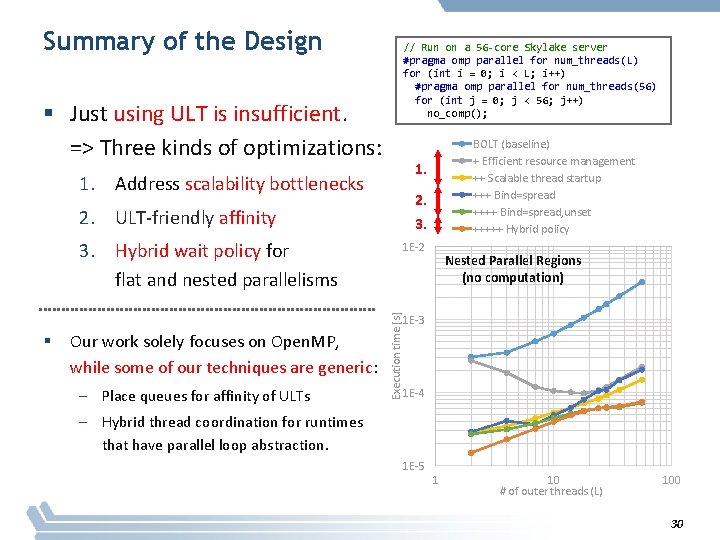
Summary of the Design // Run on a 56 -core Skylake server #pragma omp parallel for num_threads(L) for (int i = 0; i < L; i++) #pragma omp parallel for num_threads(56) for (int j = 0; j < 56; j++) no_comp(); § Just using ULT is insufficient. => Three kinds of optimizations: 1. Address scalability bottlenecks 2. ULT-friendly affinity 3. Hybrid wait policy for flat and nested parallelisms Our work solely focuses on Open. MP, while some of our techniques are generic: – Place queues for affinity of ULTs 1 E-2 Execution time [s] § BOLT (baseline) + Efficient resource management ++ Scalable thread startup +++ Bind=spread ++++ Bind=spread, unset +++++ Hybrid policy Nested Parallel Regions (no computation) 1 E-3 1 E-4 – Hybrid thread coordination for runtimes that have parallel loop abstraction. 1 E-5 1 10 # of outer threads (L) 100 30
Index 1. Introduction 2. Existing Approaches – OS-level thread-based approach – User-level thread-based approach • What is a user-level thread (ULT)? 3. BOLT for both Nested and Flat Parallelism – Scalability optimizations – ULT-aware affinity (proc_bind) – Thread coordination (wait_policy) 4. Evaluation 5. Conclusion 31
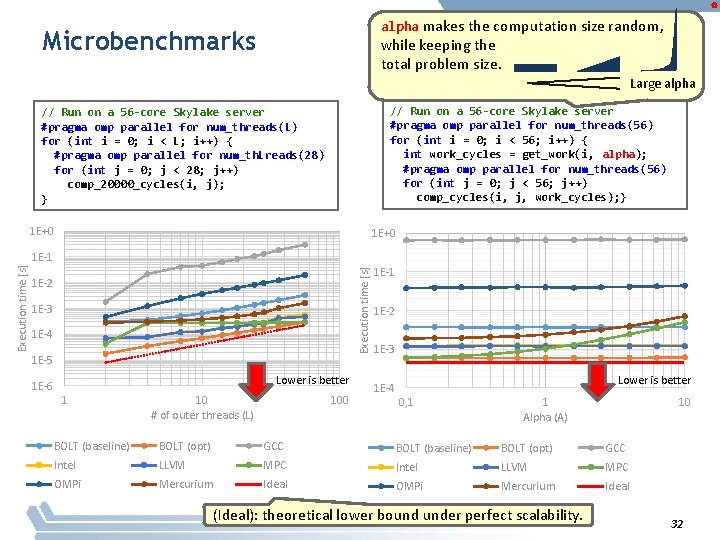
alpha makes the computation size random, Microbenchmarks while keeping the total problem size. Large alpha // Run on a 56 -core Skylake server #pragma omp parallel for num_threads(56) for (int i = 0; i < 56; i++) { int work_cycles = get_work(i, alpha); #pragma omp parallel for num_threads(56) for (int j = 0; j < 56; j++) comp_cycles(i, j, work_cycles); } // Run on a 56 -core Skylake server #pragma omp parallel for num_threads(L) for (int i = 0; i < L; i++) { #pragma omp parallel for num_th. Lreads(28) for (int j = 0; j < 28; j++) comp_20000_cycles(i, j); } 1 E+0 Execution time [s] 1 E-1 1 E-2 1 E-3 1 E-4 1 E-5 Lower is better 1 E-6 1 10 # of outer threads (L) 100 1 E-1 1 E-2 1 E-3 Lower is better 1 E-4 0, 1 1 Alpha (A) 10 BOLT (baseline) BOLT (opt) GCC Intel LLVM MPC OMPi Mercurium Ideal (Ideal): theoretical lower bound under perfect scalability. 32
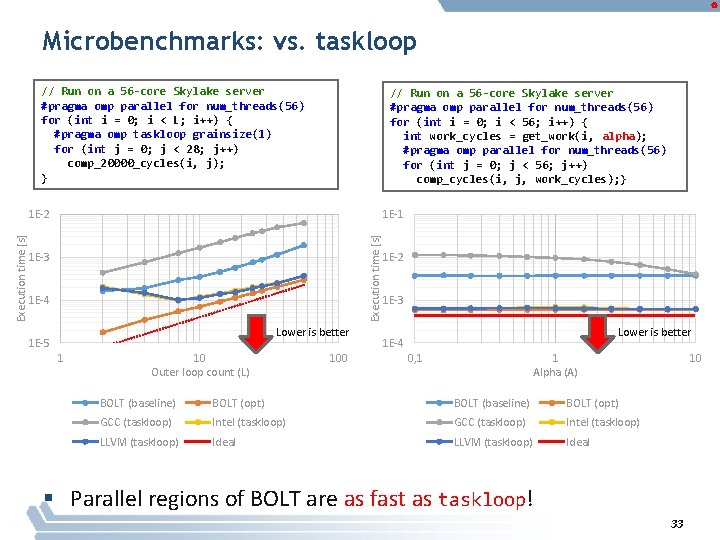
Microbenchmarks: vs. taskloop // Run on a 56 -core Skylake server #pragma omp parallel for num_threads(56) for (int i = 0; i < L; i++) { #pragma omp taskloop grainsize(1) for (int j = 0; j < 28; j++) comp_20000_cycles(i, j); } // Run on a 56 -core Skylake server #pragma omp parallel for num_threads(56) for (int i = 0; i < 56; i++) { int work_cycles = get_work(i, alpha); #pragma omp parallel for num_threads(56) for (int j = 0; j < 56; j++) comp_cycles(i, j, work_cycles); } 1 E-1 Execution time [s] 1 E-2 1 E-3 1 E-4 Lower is better 1 E-5 1 10 Outer loop count (L) 100 1 E-2 1 E-3 Lower is better 1 E-4 0, 1 1 Alpha (A) BOLT (baseline) BOLT (opt) GCC (taskloop) Intel (taskloop) LLVM (taskloop) Ideal 10 § Parallel regions of BOLT are as fast as taskloop! 33
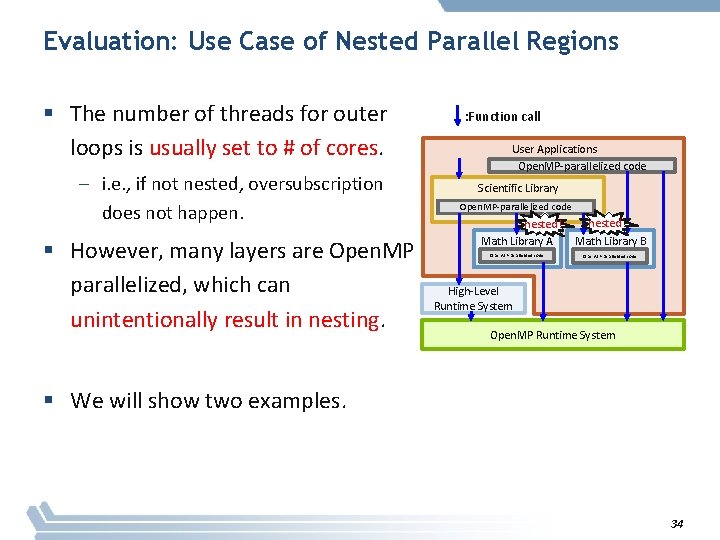
Evaluation: Use Case of Nested Parallel Regions § The number of threads for outer loops is usually set to # of cores. – i. e. , if not nested, oversubscription does not happen. § However, many layers are Open. MP parallelized, which can unintentionally result in nesting. : Function call User Applications Open. MP-parallelized code Scientific Library Open. MP-parallelized code nested! Math Library A Open. MP-parallelized code nested! Math Library B Open. MP-parallelized code High-Level Runtime System Open. MP Runtime System § We will show two examples. 34
![Evaluation 1: KIFMM § KIFMM[*]: highly optimized N-body solver – N-body solver is one](http://slidetodoc.com/presentation_image_h2/a4dee1a1ac3bd818debe4894c9fc457b/image-35.jpg "Evaluation 1: KIFMM § KIFMM[*]: highly optimized N-body solver – N-body solver is one")
Evaluation 1: KIFMM § KIFMM[*]: highly optimized N-body solver – N-body solver is one of the heaviest kernels in astronomy simulations. § Multiple layers are parallelized by Open. MP. – BLAS and FFT. § We focus on the upward phase in KIFMM. for (int i = 0; i < max_levels; i++) #pragma omp parallel for (int j = 0; j < nodecounts[i]; j++) { [. . . ]; dgemv(. . . ); // dgemv() creates a parallel region. } KIFMM Open. MP parallelized code BLAS FFTW 3 Open. MP parallelized code Open. MP Runtime System [*] A. Chandramowlishwaran et al. , "Brief Announcement: Towards a Communication Optimal Fast Multipole Method and Its Implications at Exascale", SPAA '12, 2012 35
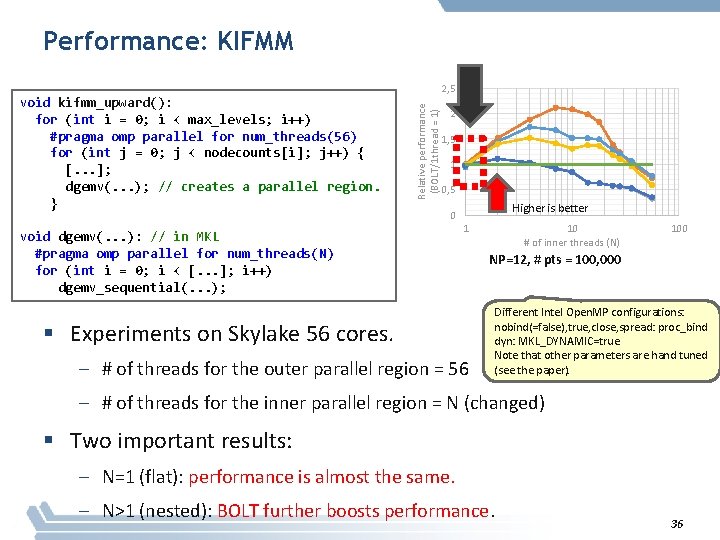
Performance: KIFMM Relative performance (BOLT/1 thread = 1) void kifmm_upward(): for (int i = 0; i < max_levels; i++) #pragma omp parallel for num_threads(56) for (int j = 0; j < nodecounts[i]; j++) { [. . . ]; dgemv(. . . ); // creates a parallel region. } 2, 5 2 1, 5 1 0, 5 Higher is better 0 void dgemv(. . . ): // in MKL #pragma omp parallel for num_threads(N) for (int i = 0; i < [. . . ]; i++) dgemv_sequential(. . . ); 1 § Experiments on Skylake 56 cores. – # of threads for the outer parallel region = 56 10 # of inner threads (N) 100 NP=12, # pts = 100, 000 Different Intel Open. MP configurations: nobind(=false), true, close, spread: proc_bind dyn: MKL_DYNAMIC=true Note that other parameters are hand tuned (see the paper). – # of threads for the inner parallel region = N (changed) § Two important results: – N=1 (flat): performance is almost the same. – N>1 (nested): BOLT further boosts performance. 36
![Evaluation 2: FFT in QBox § Qbox[*]: first-principles molecular dynamics code. § We focus](http://slidetodoc.com/presentation_image_h2/a4dee1a1ac3bd818debe4894c9fc457b/image-37.jpg "Evaluation 2: FFT in QBox § Qbox[*]: first-principles molecular dynamics code. § We focus")
Evaluation 2: FFT in QBox § Qbox[*]: first-principles molecular dynamics code. § We focus on the FFT computation part. Qbox Open. MP parallelized code LAPACK/Sca. LAPACK BLAS Open. MP parallelized code FFTW 3 Open. MP parallelized code Open. MP Runtime System // FFT backward #pragma omp parallel for (int i = 0; i < num / nprocs; i++) fftw_execute(plan_2 d, . . . ); void fftw_execute(. . . ): // in FFTW 3 [. . . ]; #pragma omp parallel for num_threads(N) for (int i = 0; i < [. . . ]; i++) fftw_sequential(. . . ); MPI § We extracted this FFT kernel and change the parameters based on the gold benchmark. [*] F. Gygi, “Architecture of Qbox: A scalable first-principles molecular dynamics code, ” IBM Journal of Research and Development, vol. 52, no. 1. 2, pp. 137– 144, Jan. 2008. 37
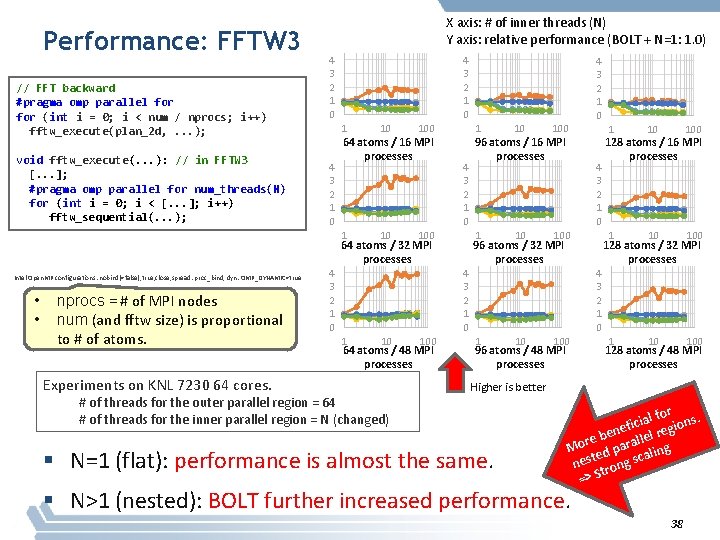
Performance: FFTW 3 // FFT backward #pragma omp parallel for (int i = 0; i < num / nprocs; i++) fftw_execute(plan_2 d, . . . ); void fftw_execute(. . . ): // in FFTW 3 [. . . ]; #pragma omp parallel for num_threads(N) for (int i = 0; i < [. . . ]; i++) fftw_sequential(. . . ); X axis: # of inner threads (N) Y axis: relative performance (BOLT + N=1: 1. 0) 4 3 2 1 0 1 4 3 2 1 0 • • nprocs = # of MPI nodes num (and fftw size) is proportional to # of atoms. Experiments on KNL 7230 64 cores. 4 3 2 1 0 100 64 atoms / 16 MPI processes 1 Intel Open. MP configurations: nobind(=false), true, close, spread: proc_bind, dyn: OMP_DYNAMIC=true 10 100 64 atoms / 48 MPI processes # of threads for the outer parallel region = 64 # of threads for the inner parallel region = N (changed) 4 3 2 1 0 100 64 atoms / 32 MPI processes 1 1 100 96 atoms / 16 MPI processes 1 4 3 2 1 0 10 10 4 3 2 1 0 100 96 atoms / 32 MPI processes 1 10 4 3 2 1 0 100 96 atoms / 48 MPI processes 1 10 100 128 atoms / 16 MPI processes 128 atoms / 32 MPI processes 128 atoms / 48 MPI processes Higher is better § N=1 (flat): performance is almost the same. for s. l a i efic l region n e eb lle Mor d para ling e a nest rong sc t => S § N>1 (nested): BOLT further increased performance. 38
Index 1. Introduction 2. Existing Approaches – OS-level thread-based approach – User-level thread-based approach • What is a user-level thread (ULT)? 3. BOLT for both Nested and Flat Parallelism – Scalability optimizations – ULT-aware affinity (proc_bind) – Thread coordination (wait_policy) 4. Evaluation 5. Conclusion 39
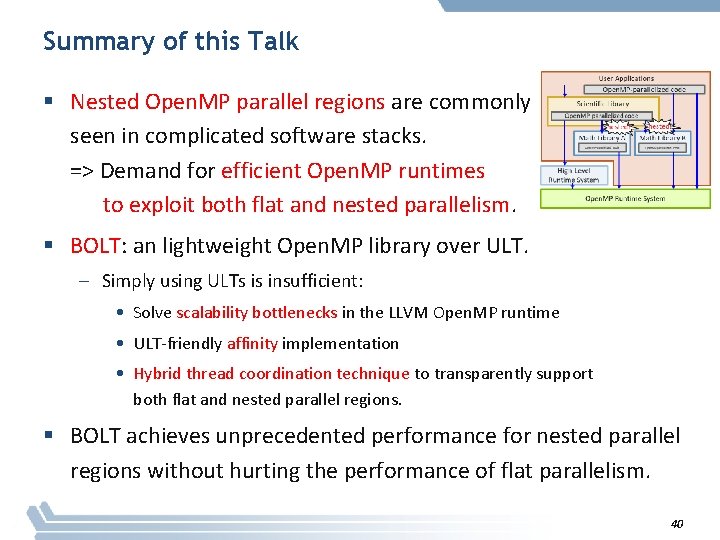
Summary of this Talk § Nested Open. MP parallel regions are commonly seen in complicated software stacks. => Demand for efficient Open. MP runtimes to exploit both flat and nested parallelism. § BOLT: an lightweight Open. MP library over ULT. – Simply using ULTs is insufficient: • Solve scalability bottlenecks in the LLVM Open. MP runtime • ULT-friendly affinity implementation • Hybrid thread coordination technique to transparently support both flat and nested parallel regions. § BOLT achieves unprecedented performance for nested parallel regions without hurting the performance of flat parallelism. 40
Thank you for listening! Artifact: https: //zenodo. org/record/3372716 (DOI: 10. 5281/zenodo. 3372716) § BOLT: http: //www. bolt-omp. org § Q&A (as a software): – What is the goal of the BOLT project? • Improve Open. MP by ULTs: – 1. enrich Open. MP tasking features with least overheads, – 2. minimizing overheads of Open. MP threads, and 3. more. – How to use it? • BOLT is a runtime library: no special compiler is required. GCC/ICC/Clang + LD_LIBRARY_PATH+=${BOLT_INSTALL_PATH} works. – Is BOLT stable? Much engineering efforts for ABI compatibility and stability. • Regularly checked with LLVM Open. MP tests (GCC 8. x, ICC 19. x, and Clang 10. x) – What Open. MP features are supported? • Open. MP 4. 5 including task, task depend, and offloading. Future work: • Enhance task scheduling • MPI+Open. MP interoperability Acknowledgment This research was supported by the Exascale Computing Project (17 -SC-20 -SC), a joint project of the U. S. Department of Energy’s Office of Science and National Nuclear Security Administration, responsible for delivering a capable exascale ecosystem, including software, applications, and hardware technology, to support the nation’s exascale computing imperative. This research is in particular its subproject on Scaling Open. MP with LLVm for Exascale performance and portability (SOLLVE). BOLT is part of the ECP SOLLVE project: https: //www. bnl. gov/compsci/projects/SOLLVE/ 41
- Slides: 41