
Bolsheviks In Power Vladimir Lenin lead the Bolshevik
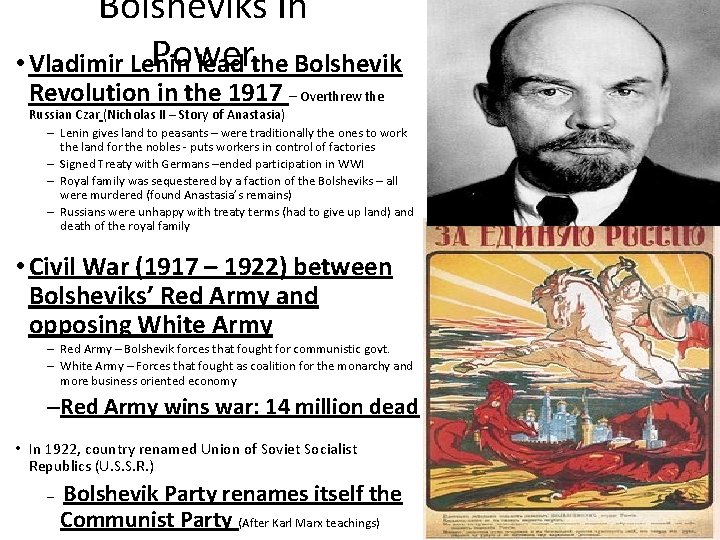
Bolsheviks In Power • Vladimir Lenin lead the Bolshevik Revolution in the 1917 – Overthrew the Russian Czar (Nicholas II – Story of Anastasia) – Lenin gives land to peasants – were traditionally the ones to work the land for the nobles - puts workers in control of factories – Signed Treaty with Germans –ended participation in WWI – Royal family was sequestered by a faction of the Bolsheviks – all were murdered (found Anastasia’s remains) – Russians were unhappy with treaty terms (had to give up land) and death of the royal family • Civil War (1917 – 1922) between Bolsheviks’ Red Army and opposing White Army – Red Army – Bolshevik forces that fought for communistic govt. – White Army – Forces that fought as coalition for the monarchy and more business oriented economy –Red Army wins war: 14 million dead • In 1922, country renamed Union of Soviet Socialist Republics (U. S. S. R. ) – Bolshevik Party renames itself the Communist Party (After Karl Marx teachings)

A New Leader • 1924 - Lenin dies after suffering three strokes at age 53 – Third stroke he couldn’t move/speak – asked that poison be administered to end his life (Brain is preserved) • Leon Trotsky (Thinker) and Joseph Stalin (General Secretary) compete to replace Lenin when he dies – Both were high ranking members of Lenin’s party – reports were that he preferred Trotsky’s intellectual ability – Trotsky wanted to spread the communist revolution/ideas outside of Russia and focus Russia’s government on bettering the common people – Stalin wanted to protect the USSR from outside forces (keep communism inside Russia); not afraid to use the common people to achieve goals • Stalin gains complete control of the Communist Party in 1948; Trotsky forced into exile – Trotsky fled to Mexico city, where he even stayed with Frida Khalo and husband Diego Rivera – Later hunted down by a USSR agent sent by Stalin in 1940 – killed via icepick • *Story of Animal Farm by George Orwell*

Totalitarianism – Stalinist Russia
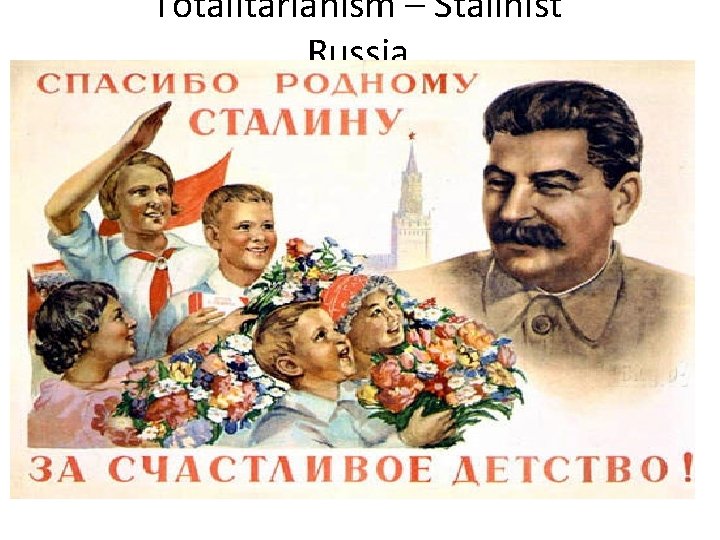
– With Lenin and Trotsky gone, the two did/wanted before Stalin centralized government more then either of • Totalitarianism—government that dominates every aspect of life • Totalitarian leaders are often dynamic, persuasive (charismatic) – others are reluctant to speak out against them for various reasons • Government Uses police to spy on/intimidate people – not afraid to use tanks to stop riots in the 1930 s • Government Shapes minds through education – youth groups were formed in schools where party propaganda was read – children regularly practiced drills/marches with pictures of Stalin in the background – Government Controls all mass media via censorship – had officers monitor radio programs, phone lines, etc. – Crushes opposing views (people are assassinated or they “disappear” – – killed and buried in unmarked graves (people dreaded the knock in the early hours of the morning) Leaders brand religious, ethnic minorities “enemies of the state” – officials/leaders of these groups had the power to call for uprisings against Stalin’s regime
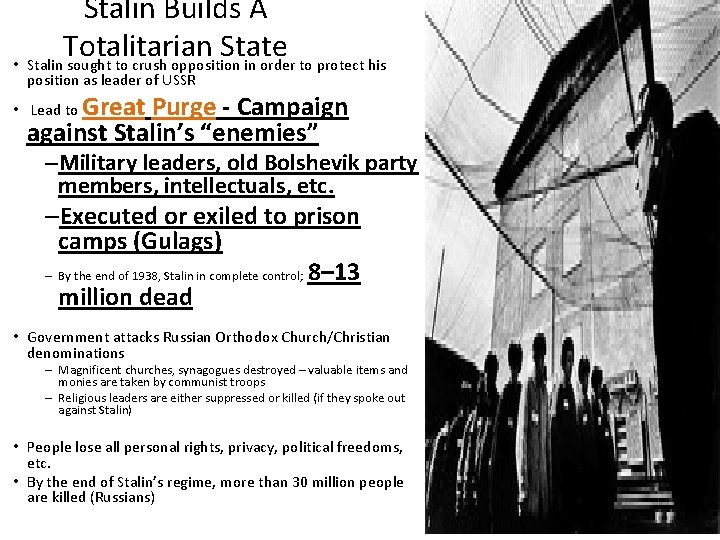
Stalin Builds A Totalitarian State • Stalin sought to crush opposition in order to protect his position as leader of USSR Great Purge - Campaign against Stalin’s “enemies” • Lead to –Military leaders, old Bolshevik party members, intellectuals, etc. –Executed or exiled to prison camps (Gulags) – By the end of 1938, Stalin in complete control; 8– 13 million dead • Government attacks Russian Orthodox Church/Christian denominations – Magnificent churches, synagogues destroyed – valuable items and monies are taken by communist troops – Religious leaders are either suppressed or killed (if they spoke out against Stalin) • People lose all personal rights, privacy, political freedoms, etc. • By the end of Stalin’s regime, more than 30 million people are killed (Russians)
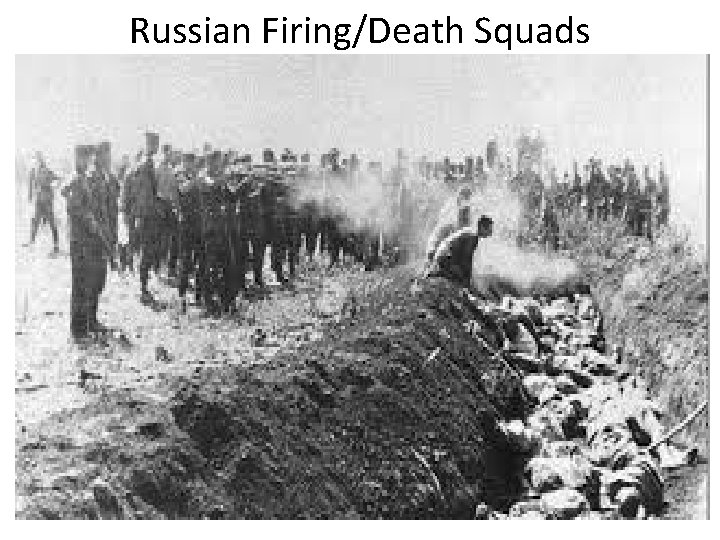
Russian Firing/Death Squads
– Stalin Takes Control Of The Economy Russia has Command economy—government makes all economic decisions • Since Stalin is in power, he reviewed the economic centers in Russia and determined how to improve them • Five-Year Plans—Stalin’s plans for improving Russia’s economy based on industry sectors – Set high quotas to increase output of steel, coal, oil and electricity – match productivity of Western nations – Government limited production of consumer goods – people faced severe shortages of housing, food, clothing and other necessities – Industrial output increased by 25 percent by 1933 – particularly with steel • 1928 – Government seized 25 million privately owned farms –Combined them to produce larger collective farms Collectivization –Hundreds of peasant families worked on the farms – often didn’t have a choice – Those who tried to resist were forcefully made to work – “escorted” by soldiers – Result: large growth in industrial power; shortage of consumer goods and famines • In the 1930 s, wealthy peasant Kulaks (farm owners) of Ukraine rebelled against the government; Stalin led a mass genocide of the Kulaks; 5– 10 million died as a result (Stalin went after them because they were prosperous and didn’t need the government; non-conformity is a danger)
Life Under Stalin • People better educated – taught new trades and gain more skills (technicians, doctors, construction, etc. ) • There are limited personal freedoms; little to no democratic processes, and few consumer goods are sold in USSR (everything made to wear/eat/etc. was made by Russians) – foreign imports were not encouraged • Communists say women are equal to men – Bolshevik Revolution of 1917 declared men and women to be equal – Women forced to join the labor force to meet Stalin’s Five Year Plan quotas – start to pursue degrees in science and math – Many Women receive advanced educations - become professionals • Engineers, electricians, doctors, lawyers, military personnel, etc. – by 1950, 75 percent of doctors in Russia are women – Women suffer from demands of work (completing labor quota) and devoting time to family – it was their patriotic duty • By mid-1930 s, Stalin has transformed Soviet Union • Into totalitarian regime; industrial, political power • Unopposed as dictator of USSR and leader of the Communist Party (everyone is dead/exiled) • Ruled by terror and fear instead of constitutional government - Demanded conformity, obedience, etc
- Slides: 9