
Bois Noir BwahNwarh Candidatus Phytoplasma solani North American
Bois Noir (Bwah-Nwarh) Candidatus Phytoplasma solani

North American Grapevine Yellows
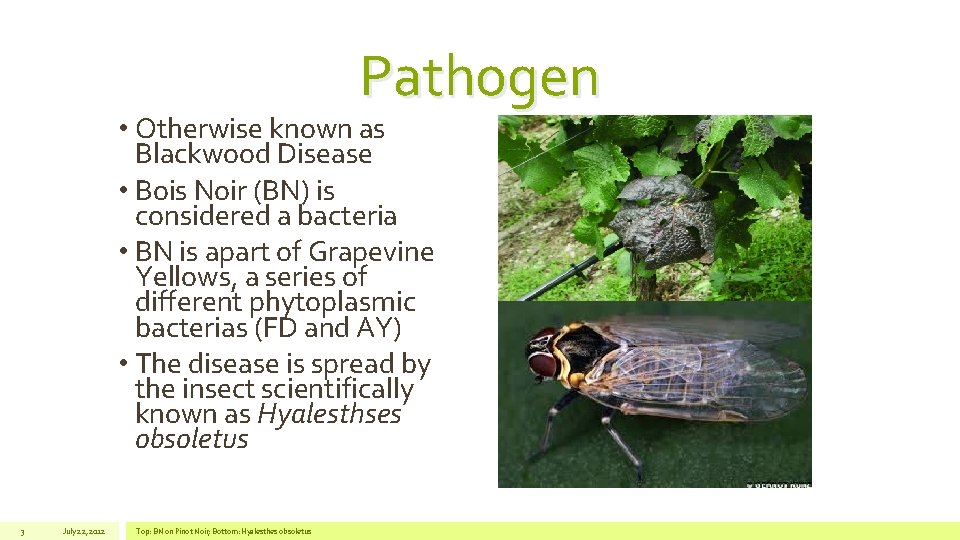
Pathogen • Otherwise known as Blackwood Disease • Bois Noir (BN) is considered a bacteria • BN is apart of Grapevine Yellows, a series of different phytoplasmic bacterias (FD and AY) • The disease is spread by the insect scientifically known as Hyalesthses obsoletus 3 July 22, 2012 Top: BN on Pinot Noir; Bottom: Hyalesthes obsoletus
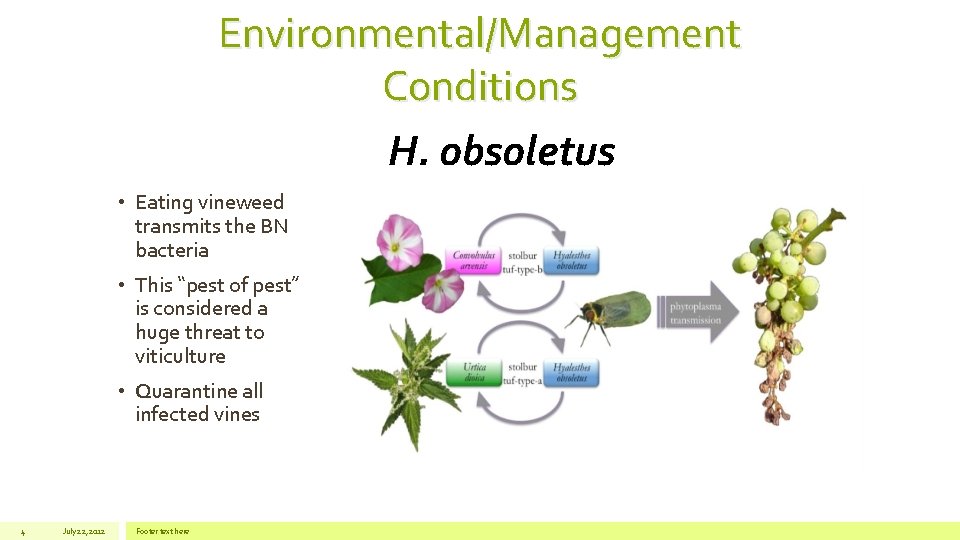
Environmental/Management Conditions H. obsoletus • Eating vineweed transmits the BN bacteria • This “pest of pest” is considered a huge threat to viticulture • Quarantine all infected vines 4 July 22, 2012 Footer text here
• North American Grapevine Yellows is a co -dependency between Aster Yellows (AY) and X-Disease phytoplasmas • Many cultivars of weeds carry the XDisease phytoplasma such as dandelions, clovers, and Rosacea family plant species • The disease can spread in a variety of ways: propagation of plants (although rare), infectious cultivars or susceptible cultivars, contaminated materials, or the H. obsoletus pest • However, BN was first found and eradicated in B. C. Due to favorable conditions and susceptibility, BN has become more prevalent in the European Countries 5 July 22, 2012 Footer text here Environmental and Management Conditions
IPM Tactics • Cultural: Bois Noir is prevalent in excessively pruned vines, however pruning is essential to grape vines. • Biological: using “clean” and certified rootstock • Genetic: one of the oldest techniques, raising disease resistant plants • Physical: Weeding but after the flight period of the H. obsoletus, and uprooting infected plants • Chemical: Due to the location of Bois Noir (Europe), such applicators, like in Switzerland, chose Glyphosate. 6 July 22, 2012 Footer text here Additional Information • The easiest and most preventative way to reduce the spread of Bois Noir is destroying contaminated vineyards. Many vineyards that have failed due to Bois Noir are abandoned. • Educated farmers in this field differentiates mediocre and proper land management techniques to eliminate and prevent the disease spreading.
Why? § There are series of reasons as to why I chose this specific pest. The most important pertaining to my goal: owning a vineyard. Once I begin and am in the business for awhile, I will also operate my own winery. § That being said, I chose Bois Noir because it is important to know what diseases and pests wine grapes are susceptible too. Regardless of how prevalent they are in our country, if at all. § Learning something new about my field of work helps me become more interested and informed. § Bois Noir caught my attention because the of the name. It sounds so classy, and yet it’s a disease. 7 July 22, 2012 Footer text here
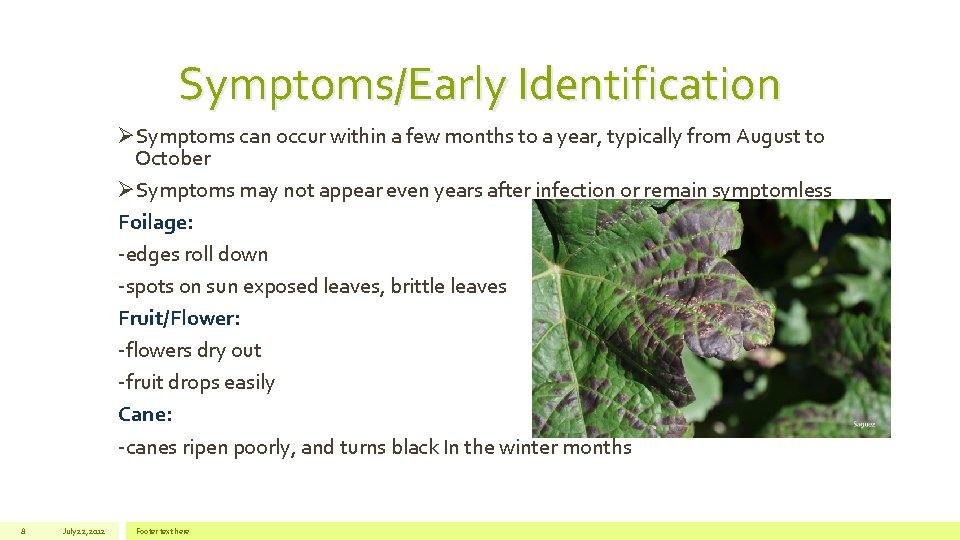
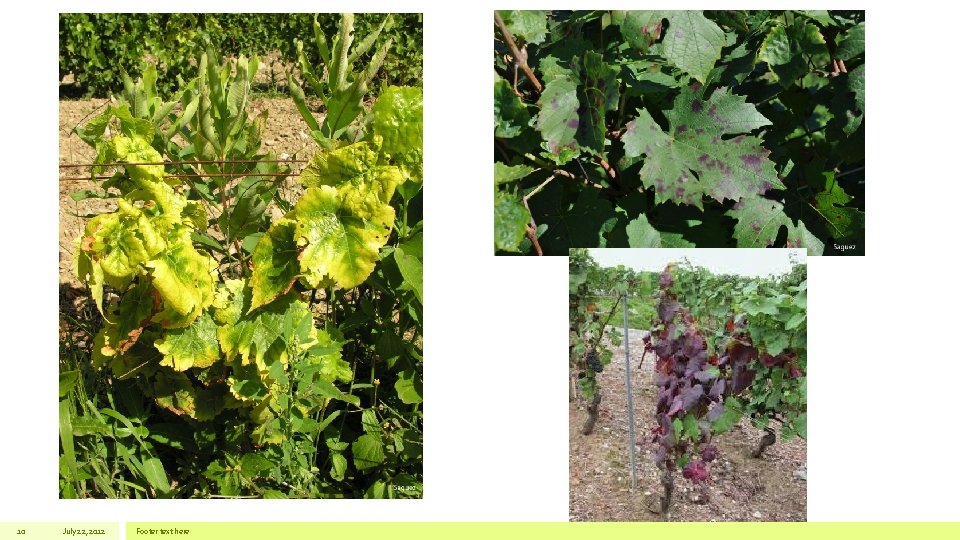
Symptoms/Early Identification ØSymptoms can occur within a few months to a year, typically from August to October ØSymptoms may not appear even years after infection or remain symptomless Foilage: -edges roll down -spots on sun exposed leaves, brittle leaves Fruit/Flower: -flowers dry out -fruit drops easily Cane: -canes ripen poorly, and turns black In the winter months 8 July 22, 2012 Footer text here
Symptoms and Diagnostics Symptoms Continued • Symptoms are more noticeable before the leaves change in the fall • BN is highly recommended to be quarantined • There is not a damage boundary per say because the disease is incredibly infectious • Treatment is effective immediately 9 July 22, 2012 Footer text here Diagnosis • The best diagnosis technique is extracting leaf parts or veins by tissue culture • Professional consultants and specialists are considered the best diagnosis and detection • BN is often confused with Grapevine Leaf Roll Virus, or Potato Leafhopper infection • Also, the changing leaves are often confused with an element deficiency (potassium, phosphorus, etc). • Only when the grapevine remains symptomless for three consecutive years will the vine be considered healthy
10 July 22, 2012 Footer text here
Experiment One: “Field Treatment with Resistance Inducers for the Control of Grapevine Bois Noir” ØThis article contains experiments regarding chemical inducers that eliminate the BN virus from the Chardonnay cultivar. ØThese ‘sub-experiments’ took place in the summers of 2007, and then in 2008. ØThe experiment also analyzes whether or not the inducers had a significant impact on the recovering aspect of the BN bacteria, as well as creating or establishing a resistance factor in the grapevine from the BN bacteria. ØThe goal of this experiment is to reduce the symptomatic plants. Therefore, generating a resistance in the grapevines as a defense from the bacteria through weekly canopy sprays. 11 July 22, 2012 Footer text here
• 744 vines accounted for • 10% of symptomatic vines (20 samples) represent the sanitary status of the field • 12 samples of symptomatic weeds to analyze phytoplasmic activity • 5 commercial products tested, (Aliette, Kendal, Chito Plant, Bion, and Olivis) diluted, and sprayed on the canopy of BN infected grapevines • Plants showing symptoms in 2006 were divided into three blocks • 2007 treatments: weekly, from June to mid. July (7 applications) • 2008 treatments: weekly, from May to the beginning of August (13 applications) • A volume of 1000 l/ha sprayed using a backpack sprayer 12 July 22, 2012 Footer text here Experiment One: “Field Treatment with Resistance Inducers for the Control of Grapevine Bois Noir” How was the experiment done? Three random blocks consisting of 12 plants each in 2007, and five plants in 2008. In 2008, inducers were applied to treated vines from 2007 that also showed disease symptoms in August that same year. Those plants equal to the sprayed plants were used as untreated controls to gain information regarding natural recovery. Disease symptoms were found at the end of July and August 2007 and 2008.
Experiment One: “Field Treatment with Resistance Inducers for the Control of Grapevine Bois Noir” Results 2006: 214/744 plants showed symptoms of grapevine yellows 2007: treatments increase recovered plants. The highest percentages were higher than the control (t 2). All treatments increased percentages from 29. 5% (Chito Plant) to 112. 0% (Bion). 13 July 22, 2012 Footer text here 2008: Kendal, Bion, and Olivis (t 2) increased recovery significantly. Natural recovery rate: 23. 1% Chemical recovery rate: 23. 8% (Aliette) to 147. 2% (Kendal) Recovery increased in symptomatic plants in the two years of treatment. In 2008, 71 of the 214 symptomatic plants showed grapevine yellows. And again in 2008, only 20 newly infected plants were identified.
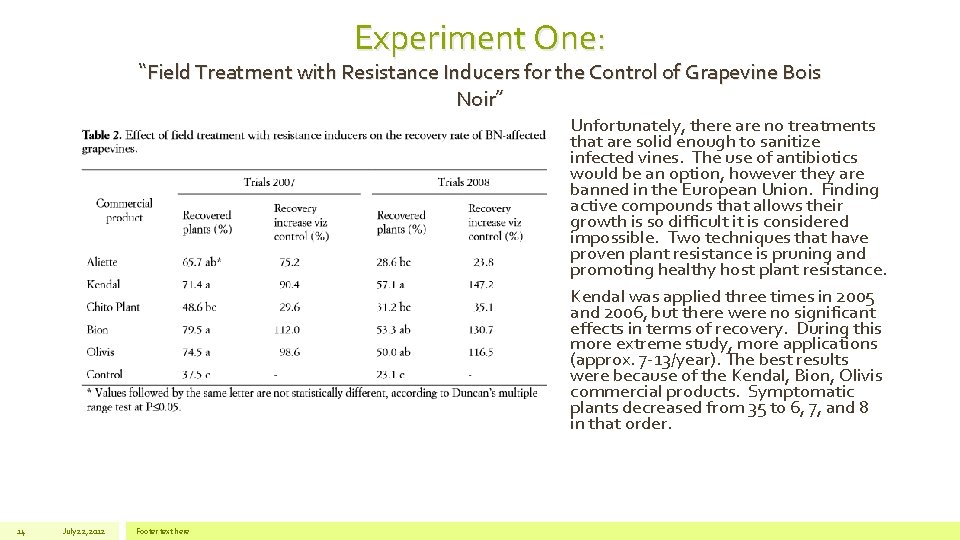
Experiment One: “Field Treatment with Resistance Inducers for the Control of Grapevine Bois Noir” Unfortunately, there are no treatments that are solid enough to sanitize infected vines. The use of antibiotics would be an option, however they are banned in the European Union. Finding active compounds that allows their growth is so difficult it is considered impossible. Two techniques that have proven plant resistance is pruning and promoting healthy host plant resistance. Kendal was applied three times in 2005 and 2006, but there were no significant effects in terms of recovery. During this more extreme study, more applications (approx. 7 -13/year). The best results were because of the Kendal, Bion, Olivis commercial products. Symptomatic plants decreased from 35 to 6, 7, and 8 in that order. 14 July 22, 2012 Footer text here
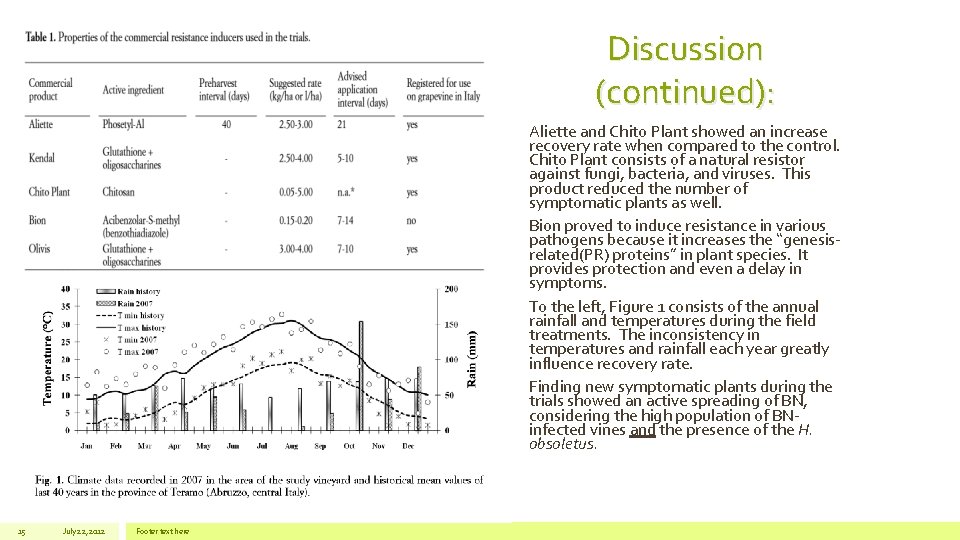
Discussion (continued): Aliette and Chito Plant showed an increase recovery rate when compared to the control. Chito Plant consists of a natural resistor against fungi, bacteria, and viruses. This product reduced the number of symptomatic plants as well. Bion proved to induce resistance in various pathogens because it increases the “genesisrelated(PR) proteins” in plant species. It provides protection and even a delay in symptoms. To the left, Figure 1 consists of the annual rainfall and temperatures during the field treatments. The inconsistency in temperatures and rainfall each year greatly influence recovery rate. Finding new symptomatic plants during the trials showed an active spreading of BN, considering the high population of BNinfected vines and the presence of the H. obsoletus. 15 July 22, 2012 Footer text here
Experiment Two: “Controlling ‘bois noir’ disease on grapevine: does the timing of herbicide application affect vector emergence? ØThis article contains information regarding seasonal herbicides applications ØThese applications were used to control the viticultural weeds that attract the H. obsoletus pest ØIn this case, stinging nettle Ø This article attempts to prove that spraying should also occur in the Spring, like in the Fall, in order to regulate/destroy stinging nettle like other weeds Ø Direct measures to control BN, much less H. obsoletus are highly ineffective Ø BN is entirely too contagious and easily spread Ø H. obsoletus populations are so abundant Ø The attempt of several applications are used to destroy the “reservoir and source of both the pathogen and it’s vector. ” 16 July 22, 2012 Footer text here
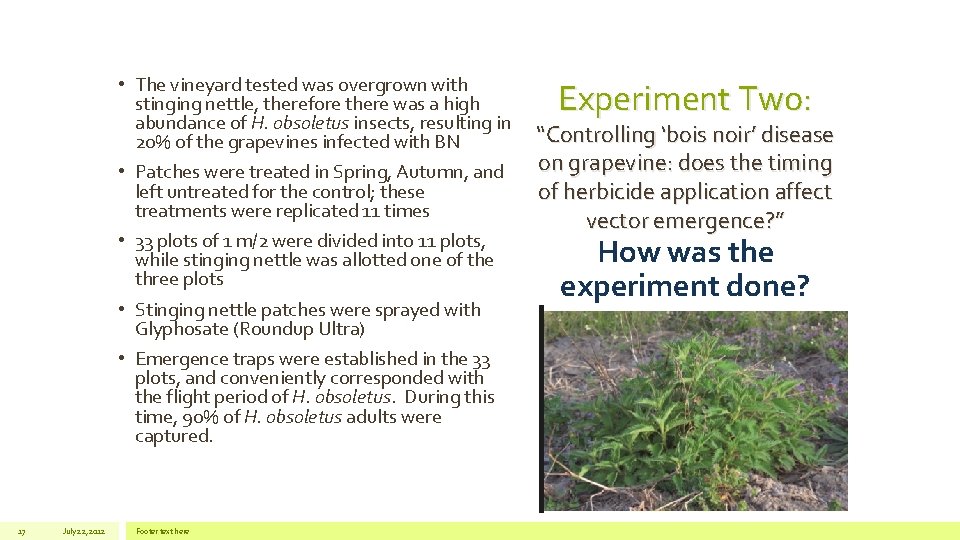
• The vineyard tested was overgrown with stinging nettle, therefore there was a high abundance of H. obsoletus insects, resulting in 20% of the grapevines infected with BN • Patches were treated in Spring, Autumn, and left untreated for the control; these treatments were replicated 11 times • 33 plots of 1 m/2 were divided into 11 plots, while stinging nettle was allotted one of the three plots • Stinging nettle patches were sprayed with Glyphosate (Roundup Ultra) • Emergence traps were established in the 33 plots, and conveniently corresponded with the flight period of H. obsoletus. During this time, 90% of H. obsoletus adults were captured. 17 July 22, 2012 Footer text here Experiment Two: “Controlling ‘bois noir’ disease on grapevine: does the timing of herbicide application affect vector emergence? ” How was the experiment done?
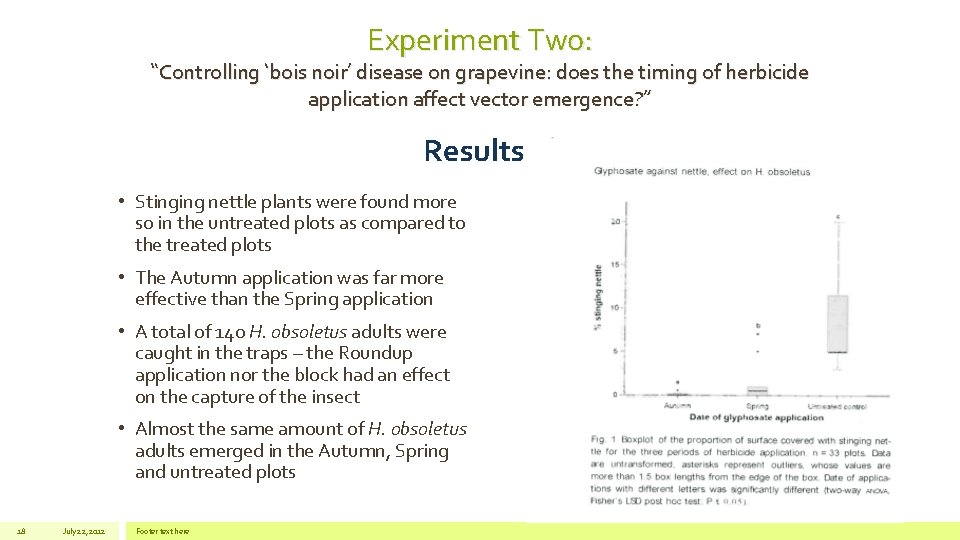
Experiment Two: “Controlling ‘bois noir’ disease on grapevine: does the timing of herbicide application affect vector emergence? ” Results • Stinging nettle plants were found more so in the untreated plots as compared to the treated plots • The Autumn application was far more effective than the Spring application • A total of 140 H. obsoletus adults were caught in the traps – the Roundup application nor the block had an effect on the capture of the insect • Almost the same amount of H. obsoletus adults emerged in the Autumn, Spring and untreated plots 18 July 22, 2012 Footer text here
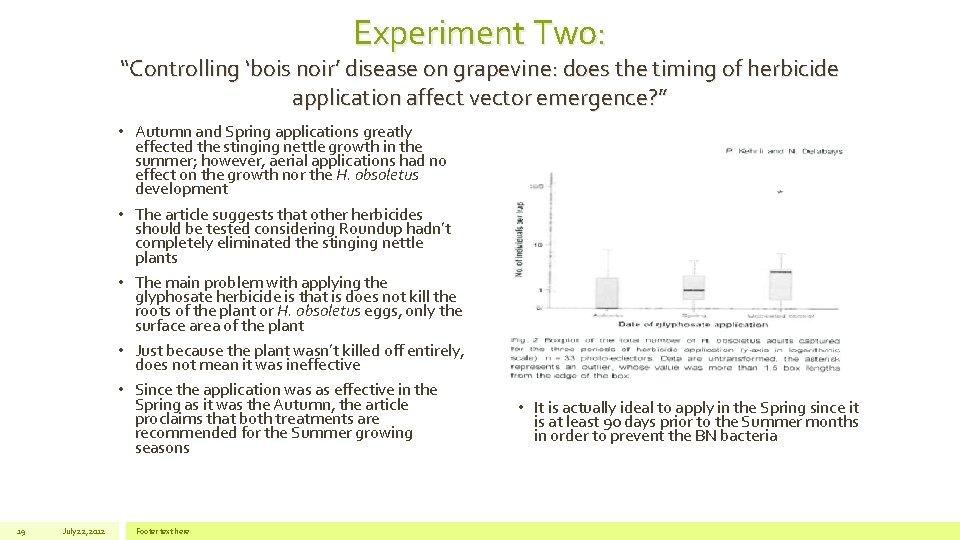
Experiment Two: “Controlling ‘bois noir’ disease on grapevine: does the timing of herbicide application affect vector emergence? ” • Autumn and Spring applications greatly effected the stinging nettle growth in the summer; however, aerial applications had no effect on the growth nor the H. obsoletus development • The article suggests that other herbicides should be tested considering Roundup hadn’t completely eliminated the stinging nettle plants • The main problem with applying the glyphosate herbicide is that is does not kill the roots of the plant or H. obsoletus eggs, only the surface area of the plant • Just because the plant wasn’t killed off entirely, does not mean it was ineffective • Since the application was as effective in the Spring as it was the Autumn, the article proclaims that both treatments are recommended for the Summer growing seasons 19 July 22, 2012 Footer text here • It is actually ideal to apply in the Spring since it is at least 90 days prior to the Summer months in order to prevent the BN bacteria
References D’Ascenzo, D. , Romanazzi, G. , and Murolo, S. (2009). Field Treatment with Resistance Inducers for the Control of Grapevine Bois Noir. Journal of Plant Pathology, 91, 677 -682. Delabays, N. and Kehril, P. (2011). Controlling ‘bois noir’ disease on grapevine: does the timing of herbicide application affect vector emergence? Journal of Applied Entomology, 136, 234 -237. doi: 10. 1111 • http: //www. inspection. gc. ca/plants/plant-pests-invasivespecies/diseases/grapevine-yellows/identificationguide/eng/1326143947606/1326144092300 • www. omafra. gov 20 July 22, 2012 Footer text here
- Slides: 20