
Bohr Model of the Atom Outline Emission spectrum
Bohr Model of the Atom Outline – Emission spectrum of atomic hydrogen. – The Bohr model. – Extension to higher atomic number.
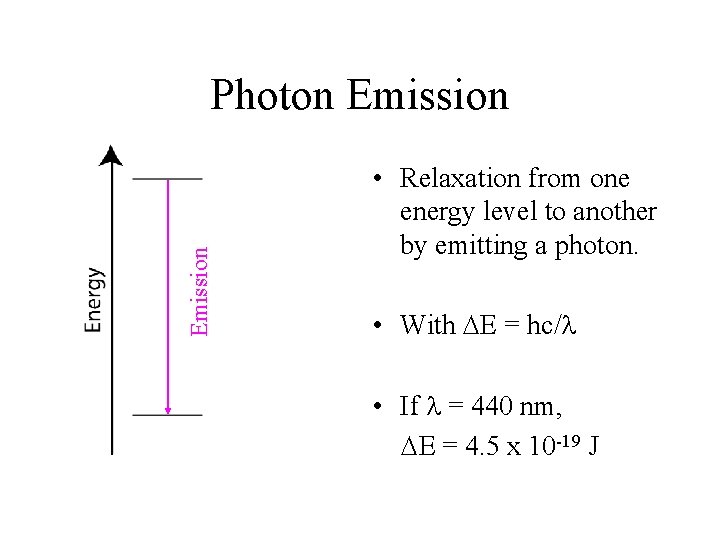
Emission Photon Emission • Relaxation from one energy level to another by emitting a photon. • With DE = hc/l • If l = 440 nm, DE = 4. 5 x 10 -19 J
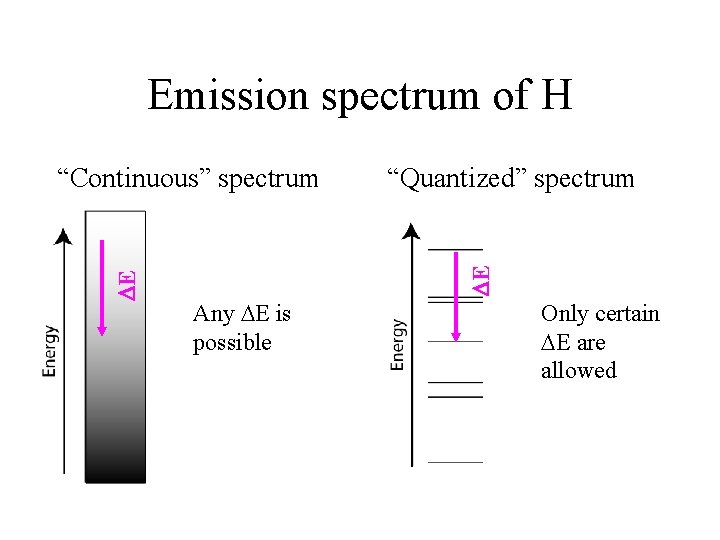
Emission spectrum of H “Quantized” spectrum DE DE “Continuous” spectrum Any DE is possible Only certain DE are allowed
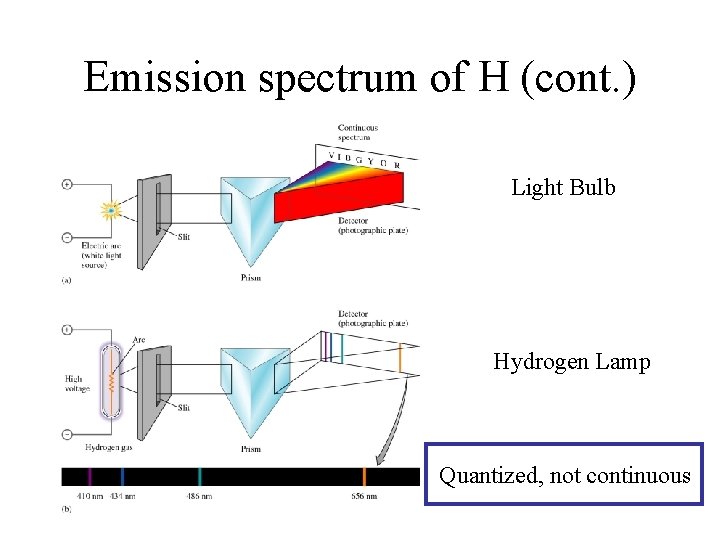
Emission spectrum of H (cont. ) Light Bulb Hydrogen Lamp Quantized, not continuous
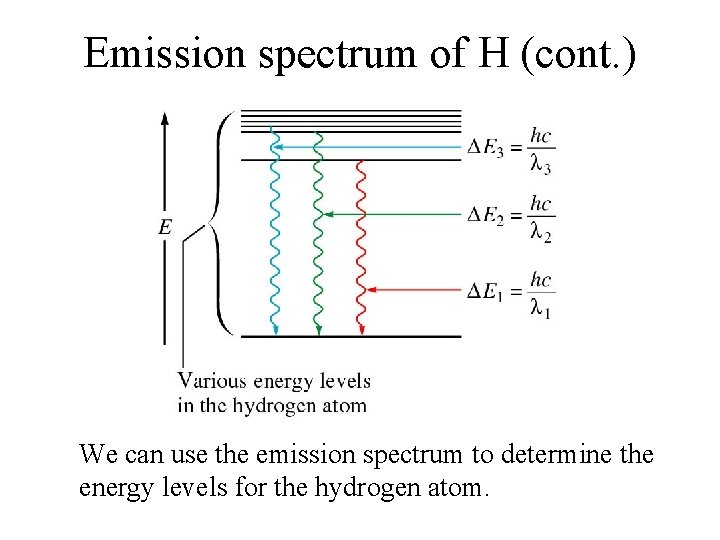
Emission spectrum of H (cont. ) We can use the emission spectrum to determine the energy levels for the hydrogen atom.
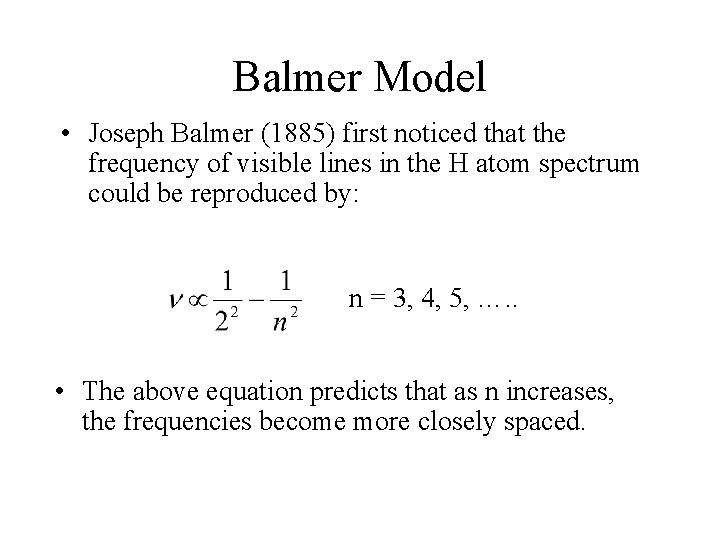
Balmer Model • Joseph Balmer (1885) first noticed that the frequency of visible lines in the H atom spectrum could be reproduced by: n = 3, 4, 5, …. . • The above equation predicts that as n increases, the frequencies become more closely spaced.
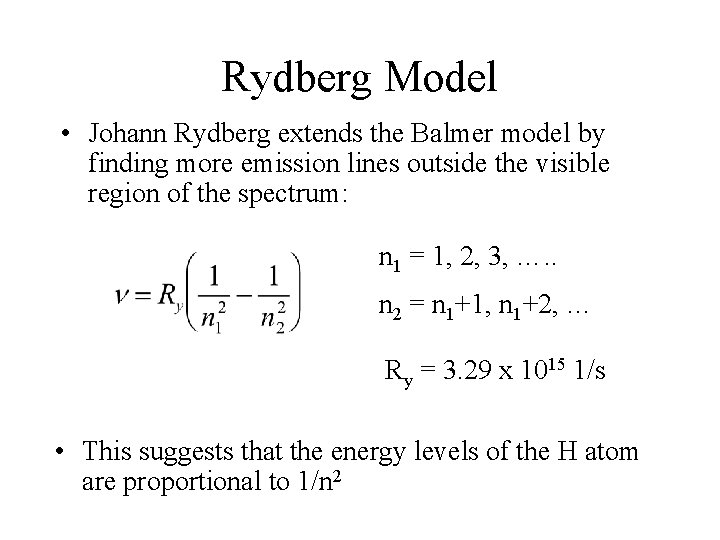
Rydberg Model • Johann Rydberg extends the Balmer model by finding more emission lines outside the visible region of the spectrum: n 1 = 1, 2, 3, …. . n 2 = n 1+1, n 1+2, … Ry = 3. 29 x 1015 1/s • This suggests that the energy levels of the H atom are proportional to 1/n 2
The Bohr Model • Niels Bohr uses the emission spectrum of hydrogen to develop a quantum model for H. • Central idea: electron circles the “nucleus” in only certain allowed circular orbits. • Bohr postulates that there is Coulomb attraction between e- and nucleus. However, classical physics is unable to explain why an H atom doesn’t simply collapse.

The Bohr Model (cont. ) • Bohr model for the H atom is capable of reproducing the energy levels given by the empirical formulas of Balmer and Rydberg. Z = atomic number (1 for H) n = integer (1, 2, …. ) • Ry x h = -2. 178 x 10 -18 J (!)
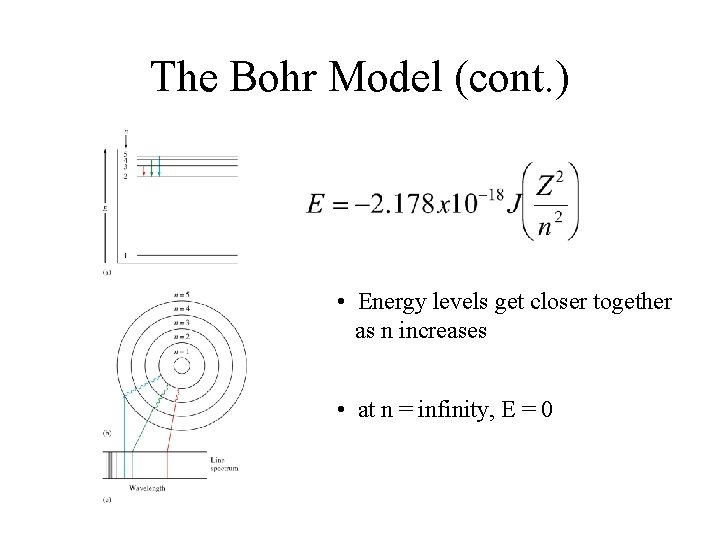
The Bohr Model (cont. ) • Energy levels get closer together as n increases • at n = infinity, E = 0
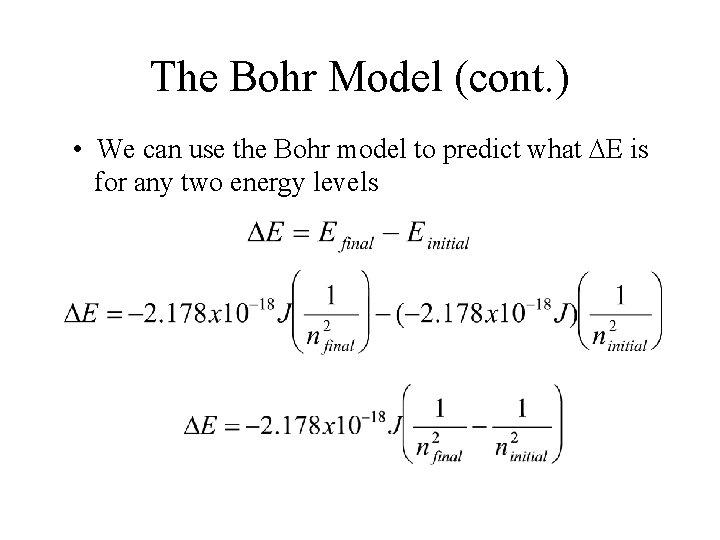
The Bohr Model (cont. ) • We can use the Bohr model to predict what DE is for any two energy levels
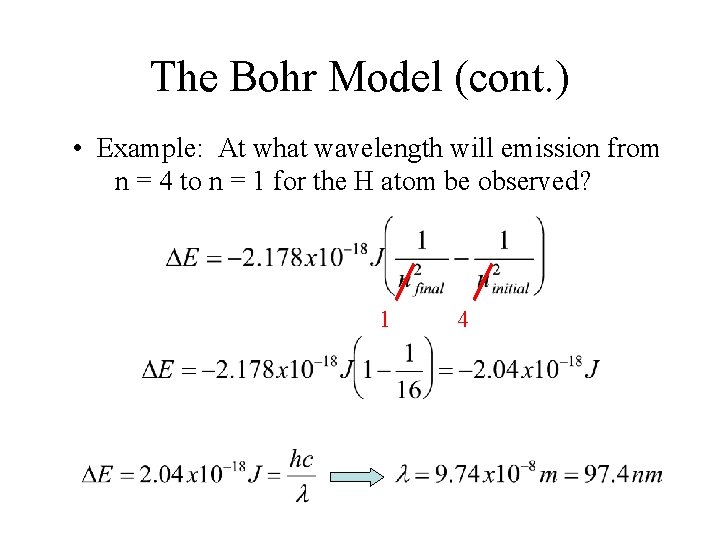
The Bohr Model (cont. ) • Example: At what wavelength will emission from n = 4 to n = 1 for the H atom be observed? 1 4
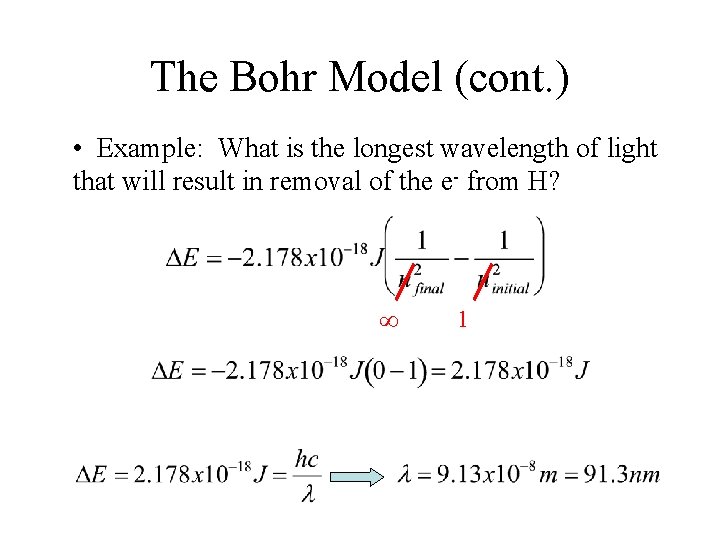
The Bohr Model (cont. ) • Example: What is the longest wavelength of light that will result in removal of the e- from H? 1
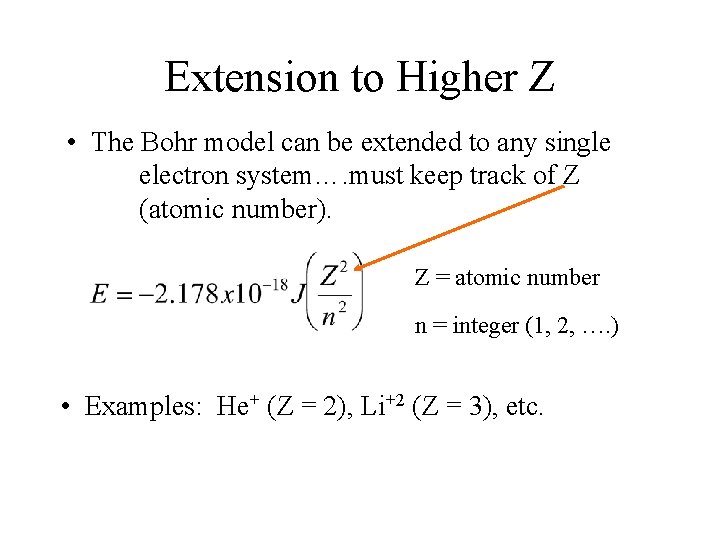
Extension to Higher Z • The Bohr model can be extended to any single electron system…. must keep track of Z (atomic number). Z = atomic number n = integer (1, 2, …. ) • Examples: He+ (Z = 2), Li+2 (Z = 3), etc.
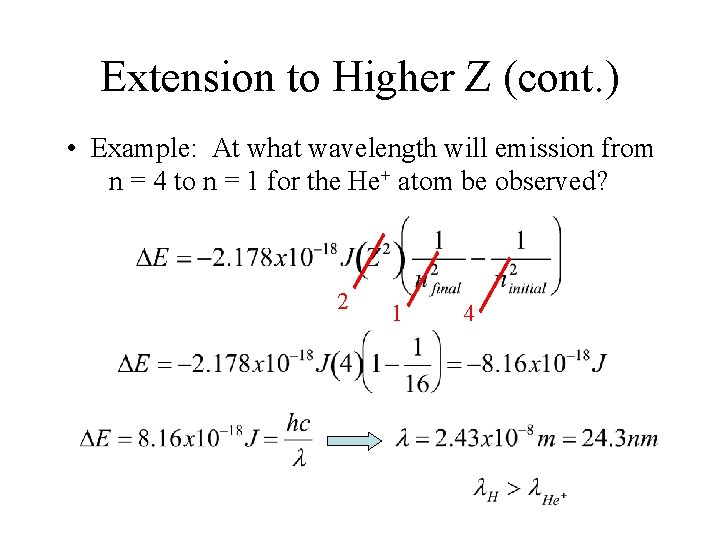
Extension to Higher Z (cont. ) • Example: At what wavelength will emission from n = 4 to n = 1 for the He+ atom be observed? 2 1 4
Where does this go wrong? • The Bohr model’s successes are limited: • Doesn’t work for multi-electron atoms. • The “electron racetrack” picture is incorrect. • That said, the Bohr model was a pioneering, “quantized” picture of atomic energy levels.
- Slides: 16