
Bohr and Lewis Diagrams 1 PROPERLY DRAWING ATOMS
Bohr and Lewis Diagrams 1 PROPERLY DRAWING ATOMS!

What is a Bohr Diagram? 2 • Niels Bohr (1885 -1962) discovered that electrons were arranged in energy levels/specific patterns (aka: energy shells!) • Bohr Diagram = a diagram that shows how many e - are in each shell surrounding the nucleus
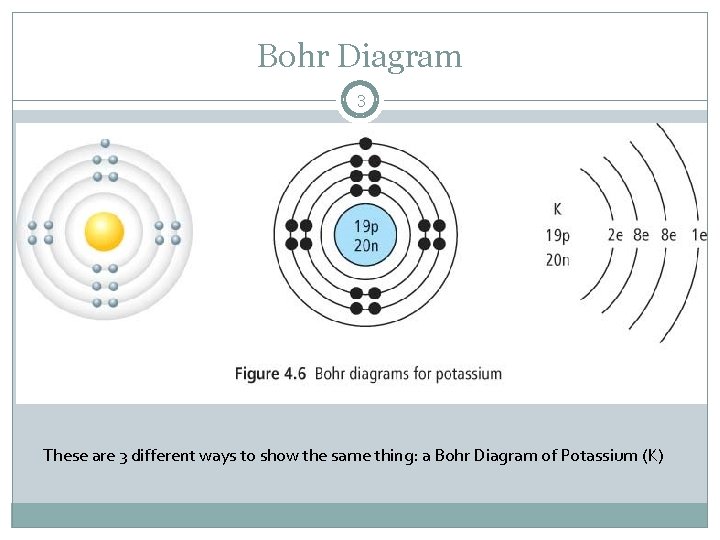
Bohr Diagram 3 These are 3 different ways to show the same thing: a Bohr Diagram of Potassium (K)
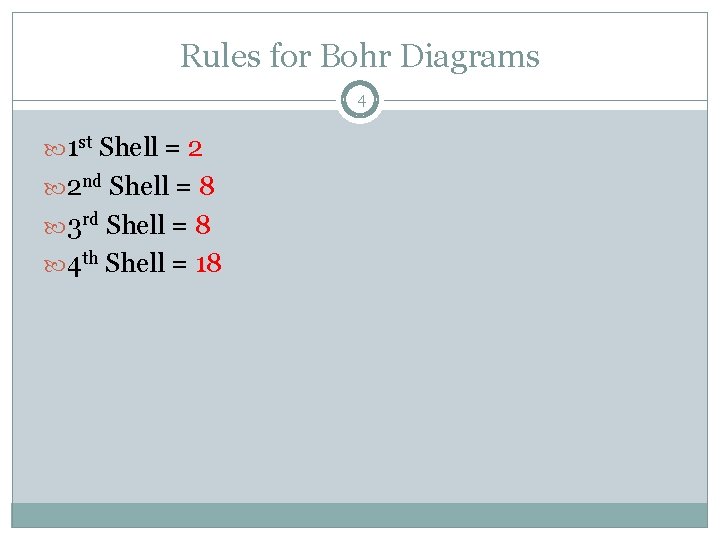
Rules for Bohr Diagrams 4 1 st Shell = 2 2 nd Shell = 8 3 rd Shell = 8 4 th Shell = 18
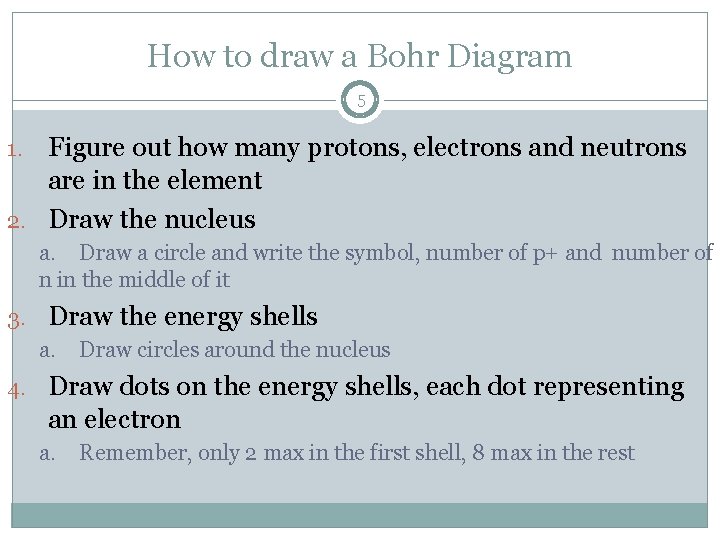
How to draw a Bohr Diagram 5 Figure out how many protons, electrons and neutrons are in the element 2. Draw the nucleus 1. a. Draw a circle and write the symbol, number of p+ and number of n in the middle of it 3. Draw the energy shells a. Draw circles around the nucleus 4. Draw dots on the energy shells, each dot representing an electron a. Remember, only 2 max in the first shell, 8 max in the rest

Vocab 6 • Valence Shell = the outermost shell that contains electrons • Valence Electron = the electrons in the outermost shell – These are the e- involved in chemical bonding • Stable Octet = an element with a full outer shell (8 electrons in its valence shell)
Patterns in Electron Arrangements 7 • The period number of an element = the number of shells involved with it – Ex: Be is in period 2, so it has 2 occupied shells • (Except for the transition elements), the last digit of the group number = the number of e- in the valence shell – Ex: Chlorine is in group 17, so it has 7 e- in its valence shell
Ions 8 Atoms can gain or lose electrons This causes them to become electrically charged IONS = electrically charged atoms that have gained or lost electrons
Ions 9 Atoms will either lose some electrons or gain some electrons to become more stable The most stable state for an atom is with a full octet (8 electrons in its valence shell) The Noble Gases are all stable octets. Other atoms will gain or lose electrons to be stable like their nearest noble gas is
Cat. IONS 10 Metal atoms lose e- to form positively charged cations Example: Na loses 1 electron to become the ion Na +
An. IONS 11 Non-metal atoms gain e- to form negatively charged anions Example: Cl loses 1 picks up 1 electron to become the ion Cl -
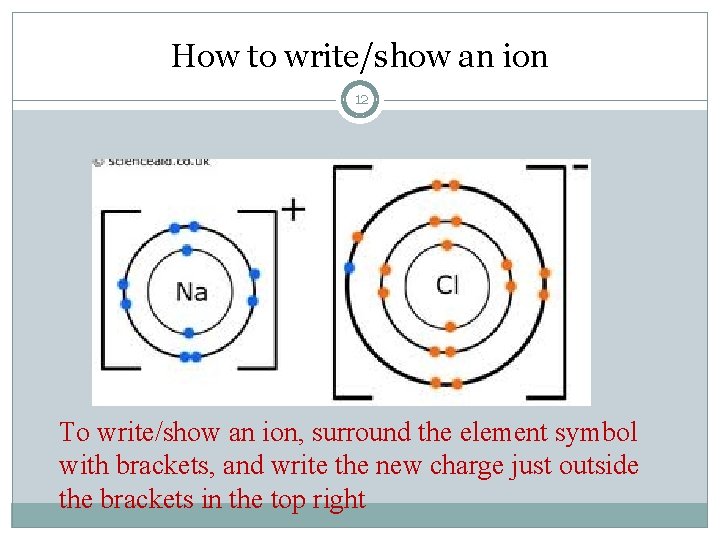
How to write/show an ion 12 To write/show an ion, surround the element symbol with brackets, and write the new charge just outside the brackets in the top right
What are Lewis Diagrams? 13 Gilbert Lewis (1875 -1946) invented an easier method of showing chemical bonding Lewis Diagrams = only show an atom’s VALENCE SHELL and its ELECTRONS Why do you need to know this method too? It is an easy method of showing/seeing chemical bonding
How do you draw a Lewis Diagram? 14 1. Figure out an element’s symbol and the number of protons and neutrons 2. Draw the nucleus 3. (Ignore all the completely filled inner electron energy shells) 4. Draw dots representing each valence electron in the valence shell a. Draw the dots SINGLY until the 5 th electron, then start pairing them up
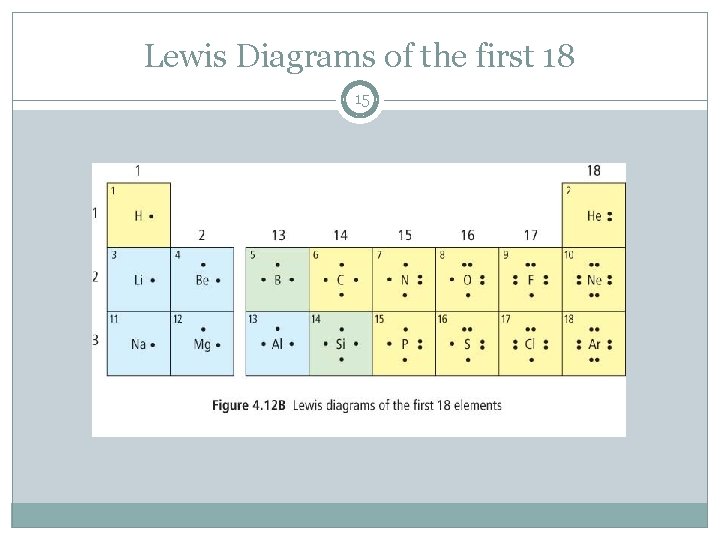
Lewis Diagrams of the first 18 15
Things to notice: 16 The number of dots (valence electrons) = the last digit of the group number The number of dots (valence electrons) increases from L R
Now Practice! 17 Try drawing a Lewis Diagram for the following elements: Li Carbon F Argon Compare your work with your table partner’s
- Slides: 17