
Boethius on eternity The Christian belief that God
Boethius on eternity The Christian belief that God is eternal was influenced by the philosophy of Boethius
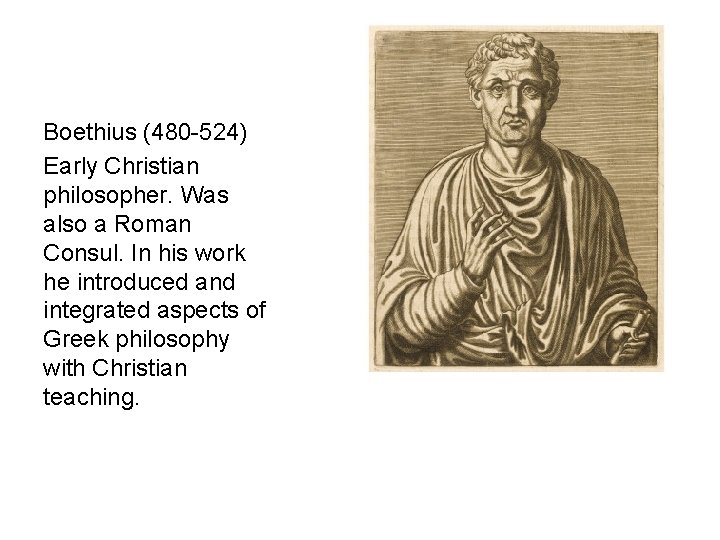
Boethius (480 -524) Early Christian philosopher. Was also a Roman Consul. In his work he introduced and integrated aspects of Greek philosophy with Christian teaching.
Boethius argued that God is changeless & does not exist in time • Boethius says that eternity is ‘the whole, simultaneous and perfect possession of unending life’. • He is saying that life is not only endless but that it is not like physical life, because it does not involve change (or experiencing life as a series of events – one following another [linear])
So for God there is no past, present & future • God exists eternally. All of time is present to God at the same time. • Imagine a film you know well: it has beginning; middle; end – it flows. God would, however, take in the film in one glance – opening titles through to end credits.
Why does Boethius believe God is eternal • Because God is • Thomas Aquinas simple & pure: does agrees with Boethius not learn new things & & says that time does not pass for involves living life God. successively (linear). God exists outside • God must exist time & the nature of outside time because God is to exist. time is not simple – consists of parts & involves beginnings & ends.

CRITICISMS of Boethius & God’s eternity • Anthony Kenny argued that the notion of all time being simultaneously present to God is incoherent. If all time is simultaneously present to God then that means all time is happening at the same moment, which is not logical.
SOLUTION TO THIS PROBLEM • We can say that God is EVERLASTING (rather than Boethius’ definition of eternal) • By everlasting, theologians mean that God always exists & will exist without end – but, time passes for God. • God cannot see the future (that is illogical)
Supporting the view that God is everlasting • Richard Swinburne • Swinburne suggests supports it & argues that belief in an that the idea of events everlasting God fits occurring more satisfactorily simultaneously to God with God as revealed cannot be made in the Bible (in the sense of. Bible God does act in time: ten plagues [Old Testament]; birth of Jesus [New Testament])
GOD AS EVERLASTING • God can act in response to human behaviour • Future cannot be known if it does not yet exist • God’s knowledge increases as the future happens
- Slides: 9