
Boeing Technology Phantom Works High Temperature Materials Vehicle

Boeing Technology | Phantom Works High Temperature Materials Vehicle Performance Goals and Implications on Materials John Davis, Dan Driemeyer, Stan Lawton and Laura Riegel Presented at the Workshop on Modeling Materials in Extreme Environments Sept 24 and 25, 2005
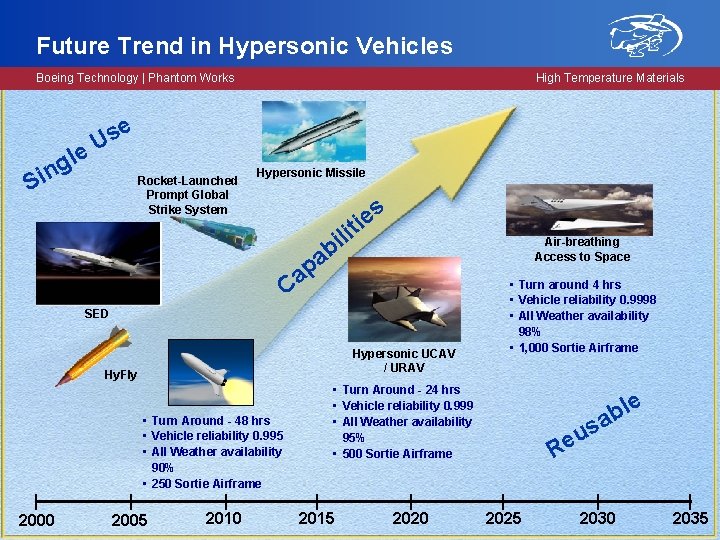
Future Trend in Hypersonic Vehicles Boeing Technology | Phantom Works e s e. U l g in S Rocket-Launched Prompt Global Strike System High Temperature Materials Hypersonic Missile s e i li it Air-breathing Access to Space ab p a C SED Hypersonic UCAV / URAV Hy. Fly • Turn Around - 48 hrs • Vehicle reliability 0. 995 • All Weather availability 90% • 250 Sortie Airframe 2000 2005 2010 • Turn around 4 hrs • Vehicle reliability 0. 9998 • All Weather availability 98% • 1, 000 Sortie Airframe • Turn Around - 24 hrs • Vehicle reliability 0. 999 • All Weather availability 95% • 500 Sortie Airframe 2015 2020 le b a R 2025 s u e 2030 2035
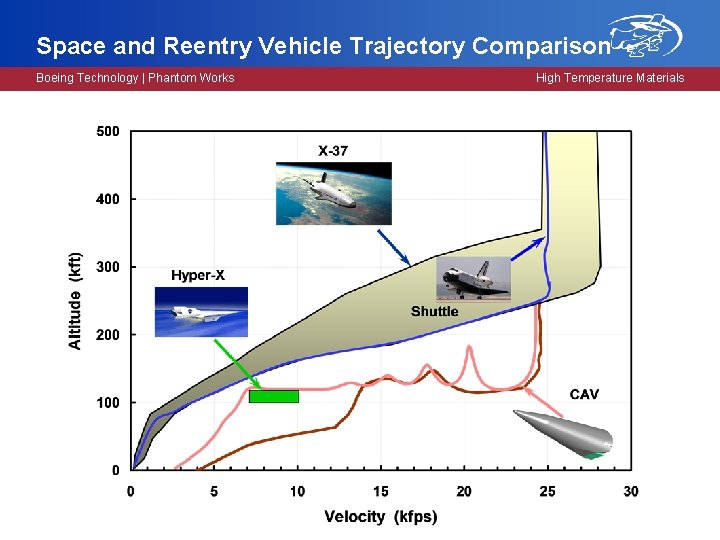
Space and Reentry Vehicle Trajectory Comparison Boeing Technology | Phantom Works High Temperature Materials
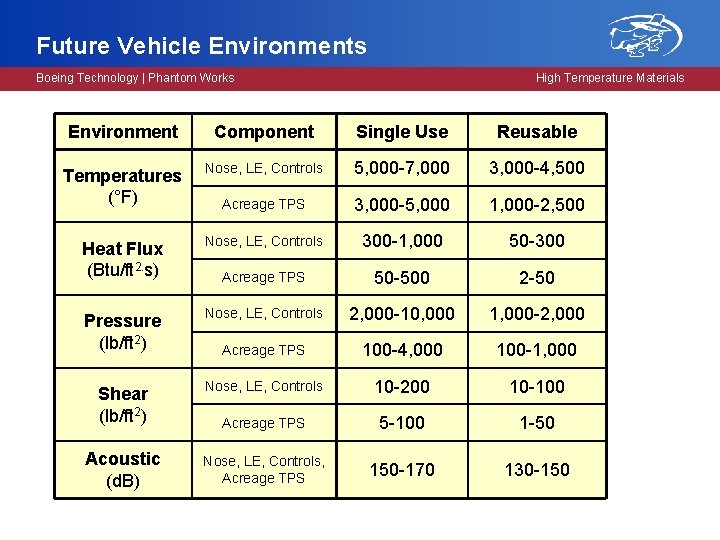
Future Vehicle Environments Boeing Technology | Phantom Works High Temperature Materials Environment Component Single Use Reusable Temperatures (°F) Nose, LE, Controls 5, 000 -7, 000 3, 000 -4, 500 Acreage TPS 3, 000 -5, 000 1, 000 -2, 500 Heat Flux (Btu/ft 2. s) Nose, LE, Controls 300 -1, 000 50 -300 Acreage TPS 50 -500 2 -50 Pressure (lb/ft 2) Nose, LE, Controls 2, 000 -10, 000 1, 000 -2, 000 Acreage TPS 100 -4, 000 100 -1, 000 Shear (lb/ft 2) Nose, LE, Controls 10 -200 10 -100 Acreage TPS 5 -100 1 -50 Acoustic (d. B) Nose, LE, Controls, Acreage TPS 150 -170 130 -150
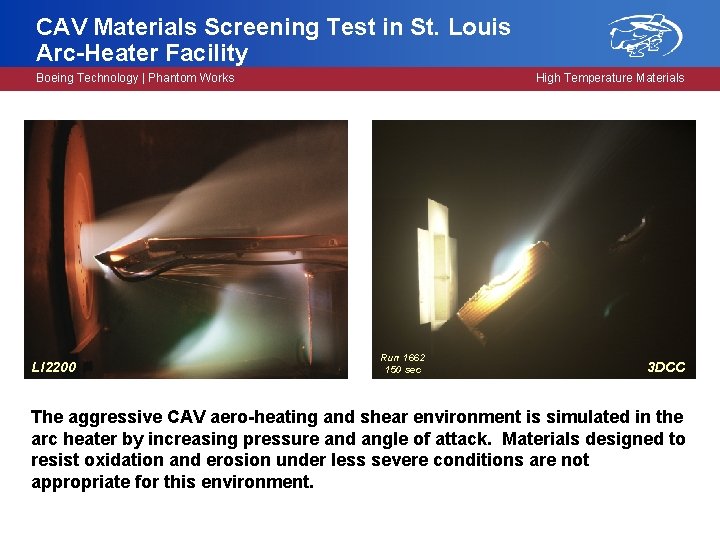
CAV Materials Screening Test in St. Louis Arc-Heater Facility Boeing Technology | Phantom Works LI 2200 High Temperature Materials Run 1662 150 sec 3 DCC The aggressive CAV aero-heating and shear environment is simulated in the arc heater by increasing pressure and angle of attack. Materials designed to resist oxidation and erosion under less severe conditions are not appropriate for this environment.
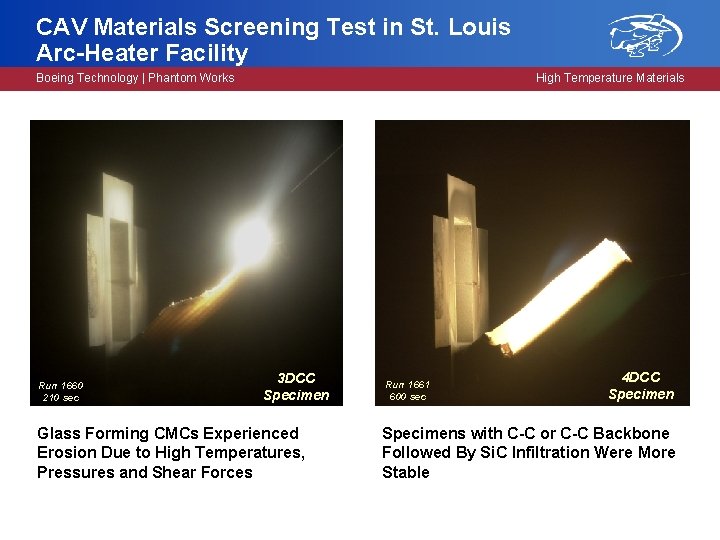
CAV Materials Screening Test in St. Louis Arc-Heater Facility Boeing Technology | Phantom Works Run 1660 210 sec High Temperature Materials 3 DCC Specimen Glass Forming CMCs Experienced Erosion Due to High Temperatures, Pressures and Shear Forces Run 1661 600 sec 4 DCC Specimens with C-C or C-C Backbone Followed By Si. C Infiltration Were More Stable
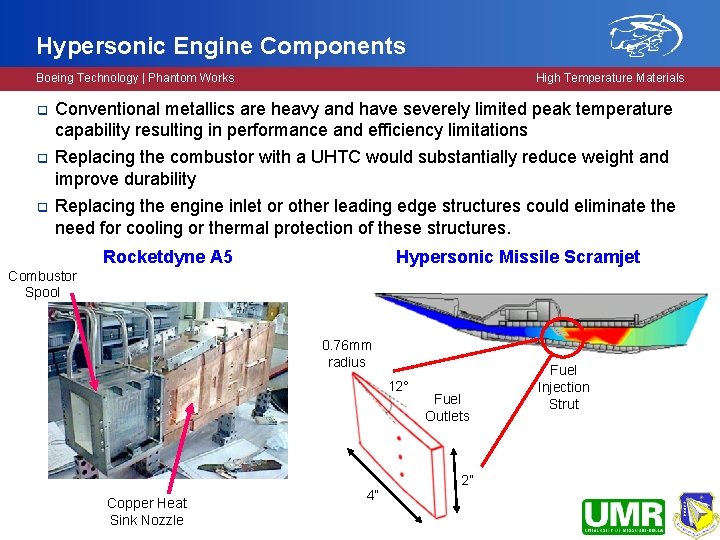
Hypersonic Engine Components Boeing Technology | Phantom Works q q q High Temperature Materials Conventional metallics are heavy and have severely limited peak temperature capability resulting in performance and efficiency limitations Replacing the combustor with a UHTC would substantially reduce weight and improve durability Replacing the engine inlet or other leading edge structures could eliminate the need for cooling or thermal protection of these structures. Rocketdyne A 5 Hypersonic Missile Scramjet Combustor Spool 0. 76 mm radius 12° Copper Heat Sink Nozzle 4” Fuel Outlets 2” Fuel Injection Strut
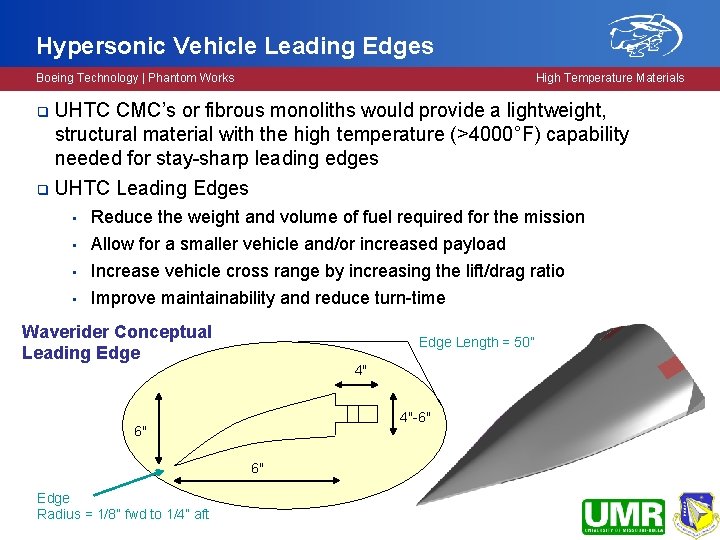
Hypersonic Vehicle Leading Edges Boeing Technology | Phantom Works High Temperature Materials UHTC CMC’s or fibrous monoliths would provide a lightweight, structural material with the high temperature (>4000°F) capability needed for stay-sharp leading edges q UHTC Leading Edges q • • Reduce the weight and volume of fuel required for the mission Allow for a smaller vehicle and/or increased payload Increase vehicle cross range by increasing the lift/drag ratio Improve maintainability and reduce turn-time Waverider Conceptual Leading Edge Length = 50” 4" 4"-6" 6" 6" Edge Radius = 1/8” fwd to 1/4” aft
Other Concerns for UHTC’s Boeing Technology | Phantom Works q Reinforcement / UHTC Composites • q Hypersonic vehicle leading edges and engine components will require UHTC composites for strength, toughness, and impact resistance. Processability • q High Temperature Materials Forming, sintering, and machining UHTC composites is difficult and expensive. Optimization of Properties • Changing the material chemistry to improve oxidation resistance or sinterability could adversely affect other properties.
- Slides: 9