
BODY TYPES A classification of body types or
BODY TYPES -A classification of body types or physique has been thought of to distinguish certain physiological and personality traits.
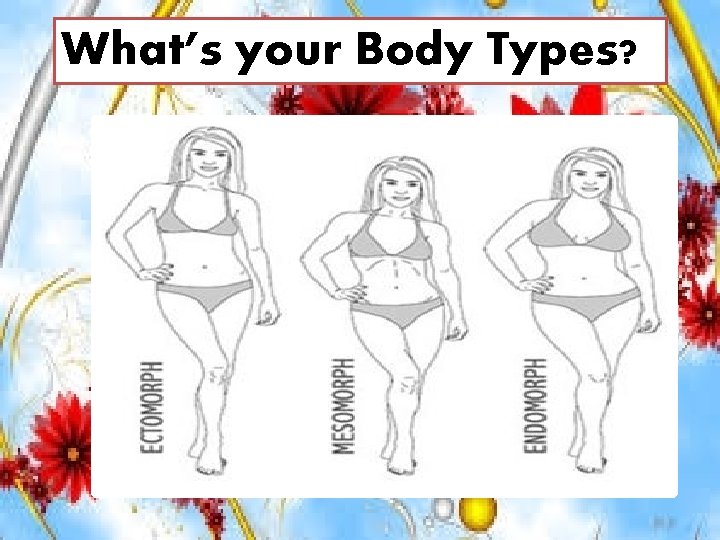
What’s your Body Types?
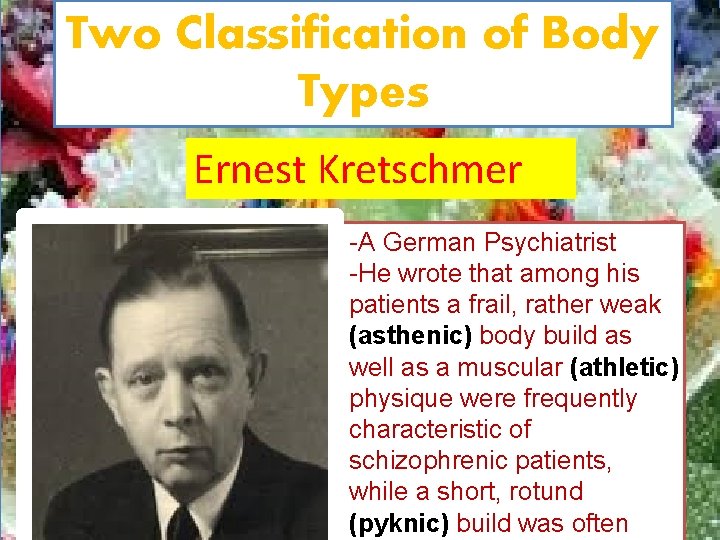
Two Classification of Body Types Ernest Kretschmer -A German Psychiatrist -He wrote that among his patients a frail, rather weak (asthenic) body build as well as a muscular (athletic) physique were frequently characteristic of schizophrenic patients, while a short, rotund (pyknic) build was often
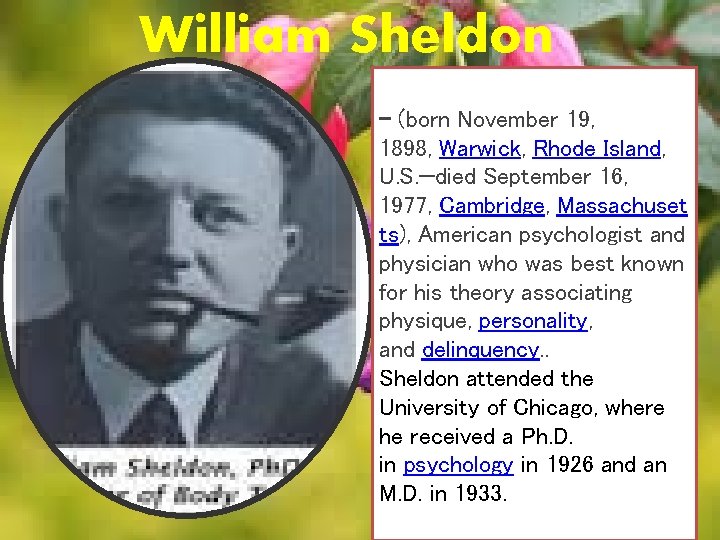
William Sheldon - (born November 19, 1898, Warwick, Rhode Island, U. S. —died September 16, 1977, Cambridge, Massachuset ts), American psychologist and physician who was best known for his theory associating physique, personality, and delinquency. . Sheldon attended the University of Chicago, where he received a Ph. D. in psychology in 1926 and an M. D. in 1933.
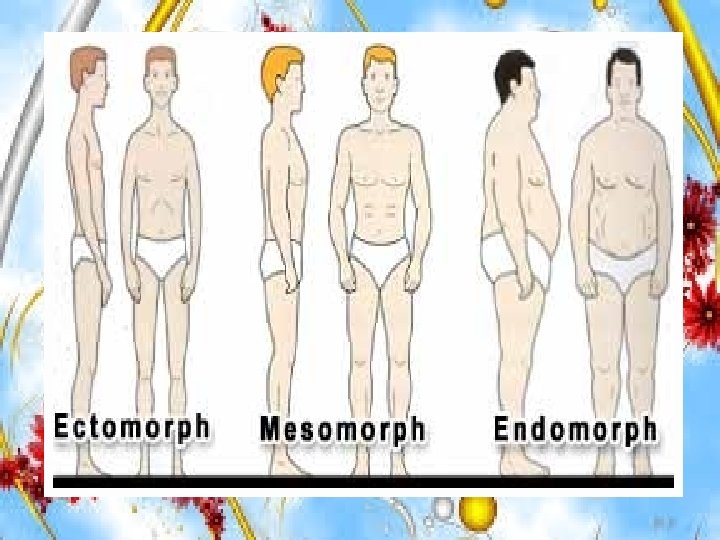
-Sheldon became convinced that the psychological makeup of humans had biological foundations. He constructed a classification system that associated physiology and psychology, which he outlined in The Varieties of Human Physique (1940) and The Varieties of Temperament (1942). -Sheldon classified people according to three body types: 1. endomorphs, who are rounded and soft, were said to have a tendency toward a “viscerotonic” personality (i. e. , relaxed, comfortable, extroverted) 2. mesomorphs, who are square and muscular, were said to have a tendency toward a “somotonic” personality (i. e. , active, dynamic, assertive, aggressive) 3. ectomorphs, who are thin and fine-boned, were said to have a tendency toward a “cerebrotonic” personality (i. e. , introverted, thoughtful, inhibited, sensitive).

Kretschmer’s Body Types Asthenic
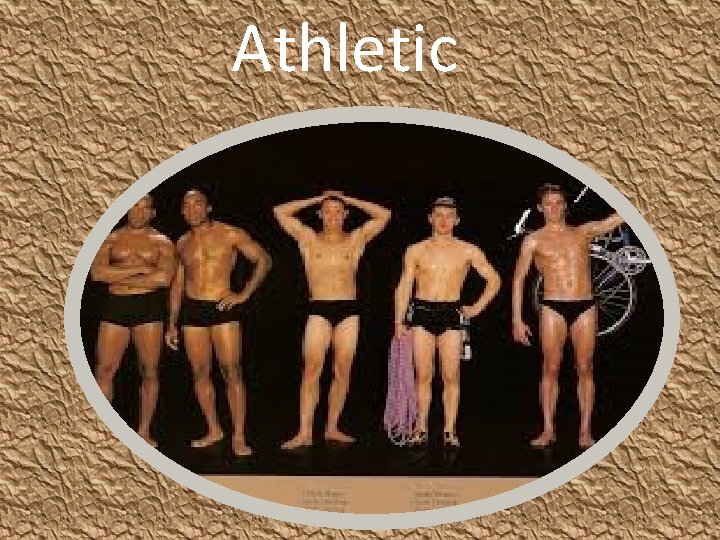
Athletic

Kretschmer’s Body Types Sheldon’s Body Types Characteristics 1. Asthenic Ectomorph Lean, slim, shallowchested, and tall in proportion to their weight. 2. Athletic Mesomorph Muscular individual with broad shoulders, welldeveloped chest, robust and strong. 3. Pyknic Endomorph Broad, rounded figure, large head, heavy neck, and rudy face 4. Dysplastic ______ Abnormal bodies/ abnormal builds

Ectomorph Mesomorph Endomorph Skinny, linear/ ruler appearance Naturally lean Smooth, round body Lightly muscled Naturally muscular Gains muscle easily, but tends to be underdeveloped Small joints/ boned Medium size joints/ bones Medium/ large joints/ bones Low body fat (without Naturally strong exercising or following low calorie diets) High levels of body fat (may be overweight) Small shoulders, chest and buttocks Small shoulders, high waist and large hips Broad/ square shoulders
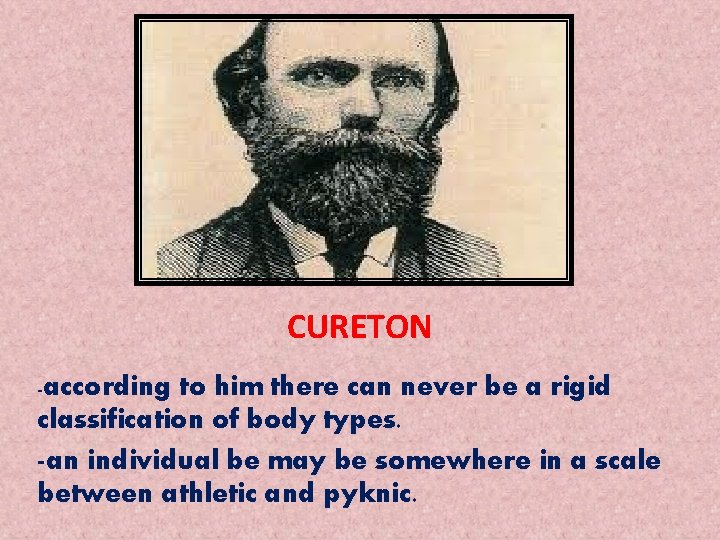
CURETON -according to him there can never be a rigid classification of body types. -an individual be may be somewhere in a scale between athletic and pyknic.
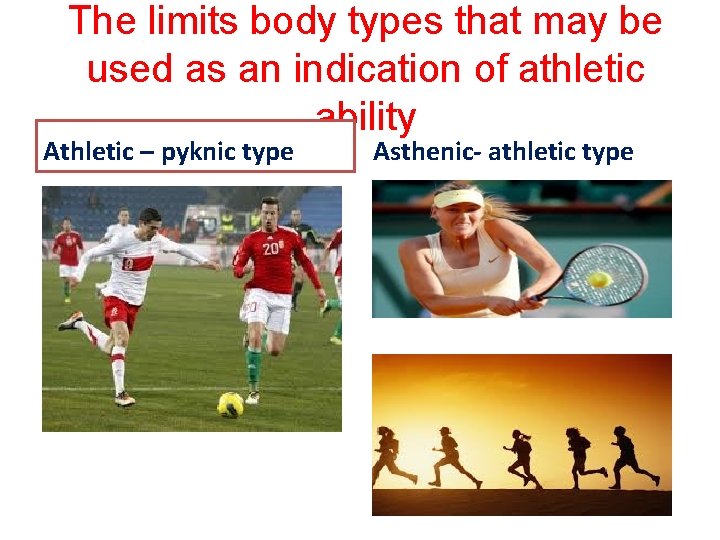
The limits body types that may be used as an indication of athletic ability Athletic – pyknic type Asthenic- athletic type
Somatotyping or body classification -may not be reliable in selection of athletes, yet we can use them as basis in spotting of potential athletes or for classifying for physical education activities.
THANK YOU FOR LISTENING…. . GOD BLESS US ALL……. .
- Slides: 15