
Body Tube Nosepiece Objectives Ocular lens Eyepiece Arm
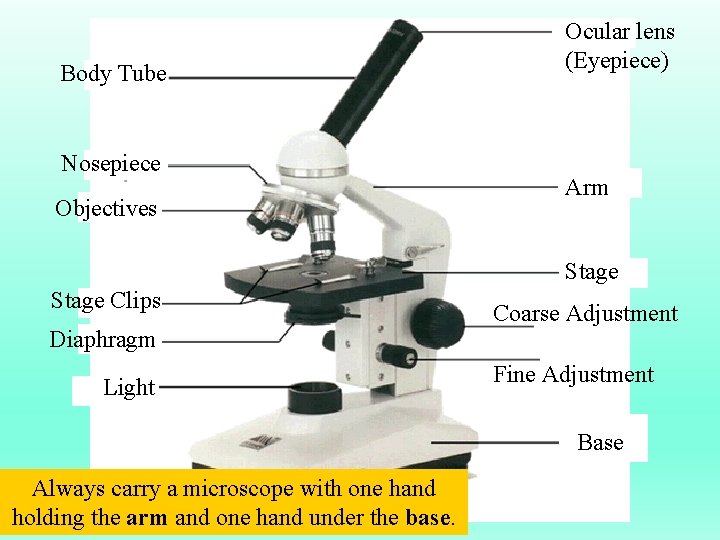
Body Tube Nosepiece Objectives Ocular lens (Eyepiece) Arm Stage Clips Diaphragm Light Coarse Adjustment Fine Adjustment Base Always carry a microscope with one hand holding the arm and one hand under the base.
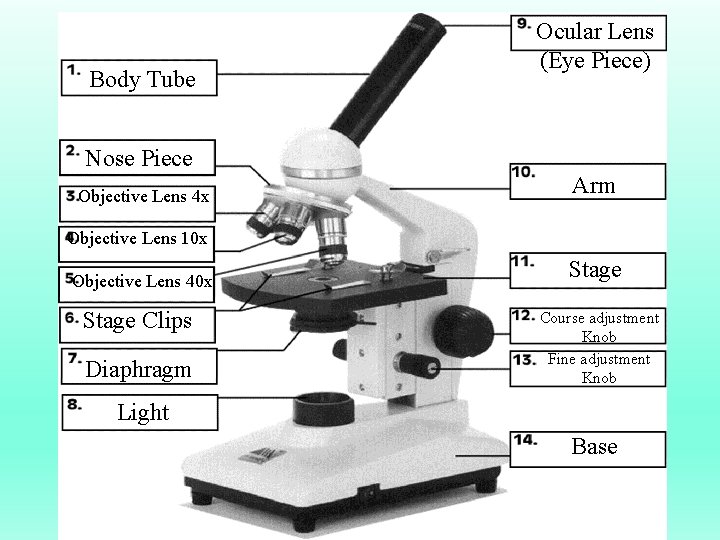
Body Tube Ocular Lens (Eye Piece) Nose Piece Objective Lens 4 x Arm Objective Lens 10 x Objective Lens 40 x Stage Clips Diaphragm Stage Course adjustment Knob Fine adjustment Knob Light Base
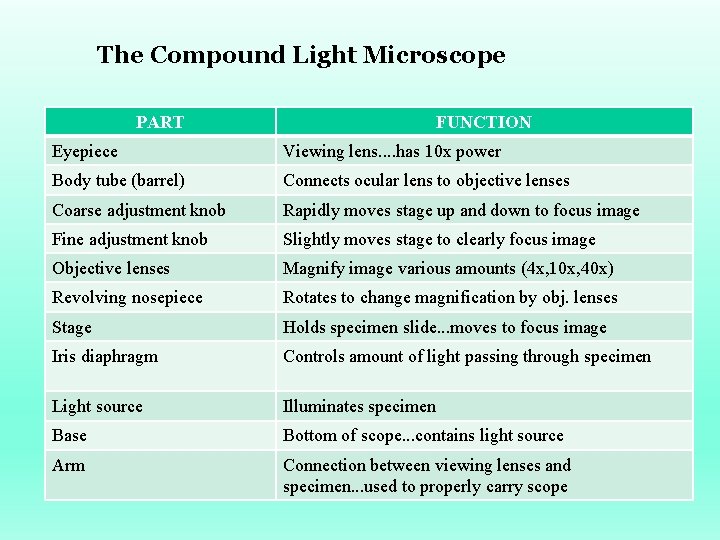
The Compound Light Microscope PART FUNCTION Eyepiece Viewing lens. . has 10 x power Body tube (barrel) Connects ocular lens to objective lenses Coarse adjustment knob Rapidly moves stage up and down to focus image Fine adjustment knob Slightly moves stage to clearly focus image Objective lenses Magnify image various amounts (4 x, 10 x, 40 x) Revolving nosepiece Rotates to change magnification by obj. lenses Stage Holds specimen slide. . . moves to focus image Iris diaphragm Controls amount of light passing through specimen Light source Illuminates specimen Base Bottom of scope. . . contains light source Arm Connection between viewing lenses and specimen. . . used to properly carry scope
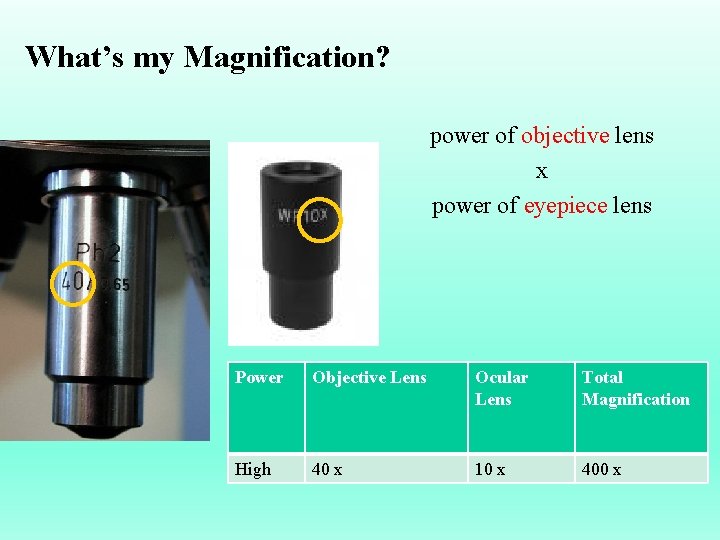
What’s my Magnification? power of objective lens x power of eyepiece lens Power Objective Lens Ocular Lens Total Magnification High 40 x 10 x 400 x

Comparing Powers of Magnification We can see better details with higher the powers of magnification, but we cannot see as much of the image. Which of these images would be viewed at a higher power of magnification?
Procedure…. . . 1 – Turn on the microscope and then rotate the nosepiece to click the red-banded objective (lowest) into place. 2 – Place a slide on the stage and secure it using the stage clips. Use the coarse adjustment knob (large knob) to get it the image into view and then use the fine adjustment knob (small knob) to make it clearer. 3 – Once you have the image in view, rotate the nosepiece to view it under different powers. Be careful with the largest objective! Sometimes there is not enough room and you will not be able to use it! 4 – When you are done, turn off the microscope and put up the slides you used.
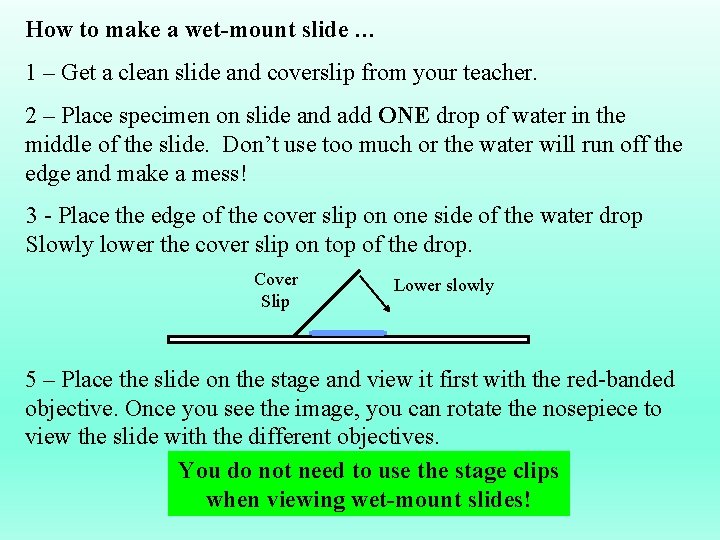
How to make a wet-mount slide … 1 – Get a clean slide and coverslip from your teacher. 2 – Place specimen on slide and add ONE drop of water in the middle of the slide. Don’t use too much or the water will run off the edge and make a mess! 3 - Place the edge of the cover slip on one side of the water drop Slowly lower the cover slip on top of the drop. Cover Slip Lower slowly 5 – Place the slide on the stage and view it first with the red-banded objective. Once you see the image, you can rotate the nosepiece to view the slide with the different objectives. You do not need to use the stage clips when viewing wet-mount slides!
- Slides: 8