
Body Structure The morphology of multicellular fungi Enhances
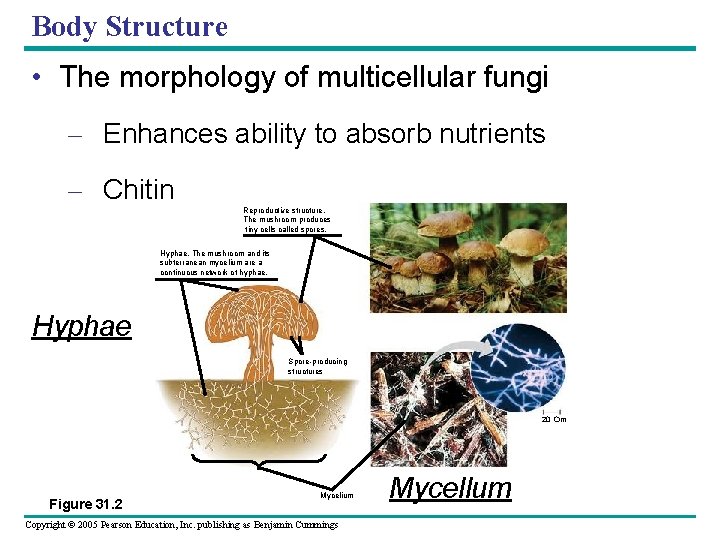
Body Structure • The morphology of multicellular fungi – Enhances ability to absorb nutrients – Chitin Reproductive structure. The mushroom produces tiny cells called spores. Hyphae. The mushroom and its subterranean mycelium are a continuous network of hyphae. Hyphae Spore-producing structures 20 m Figure 31. 2 Mycelium Copyright © 2005 Pearson Education, Inc. publishing as Benjamin Cummings Mycellum
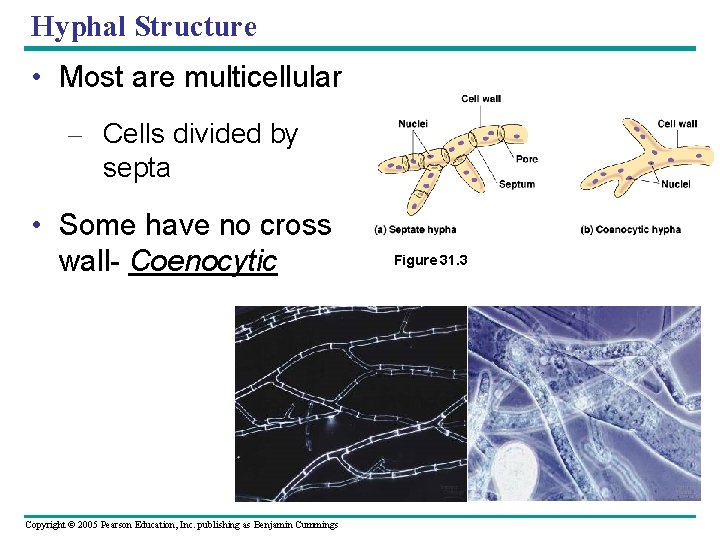
Hyphal Structure • Most are multicellular – Cells divided by septa • Some have no cross wall- Coenocytic Copyright © 2005 Pearson Education, Inc. publishing as Benjamin Cummings Figure 31. 3
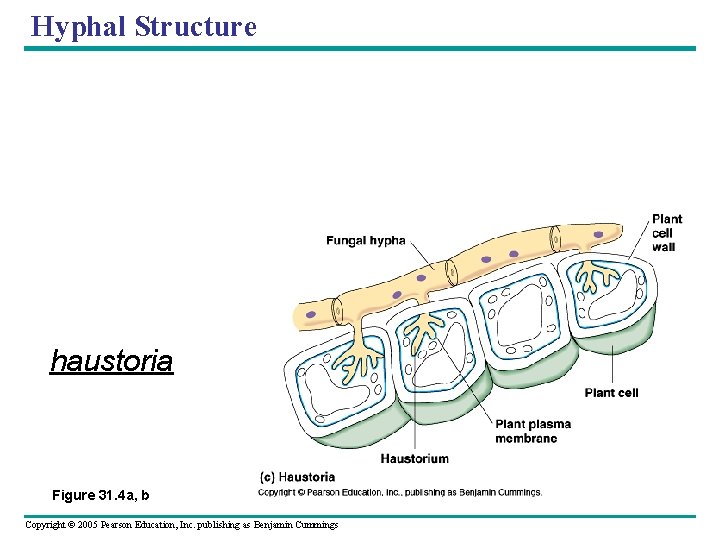
Hyphal Structure haustoria Figure 31. 4 a, b Copyright © 2005 Pearson Education, Inc. publishing as Benjamin Cummings
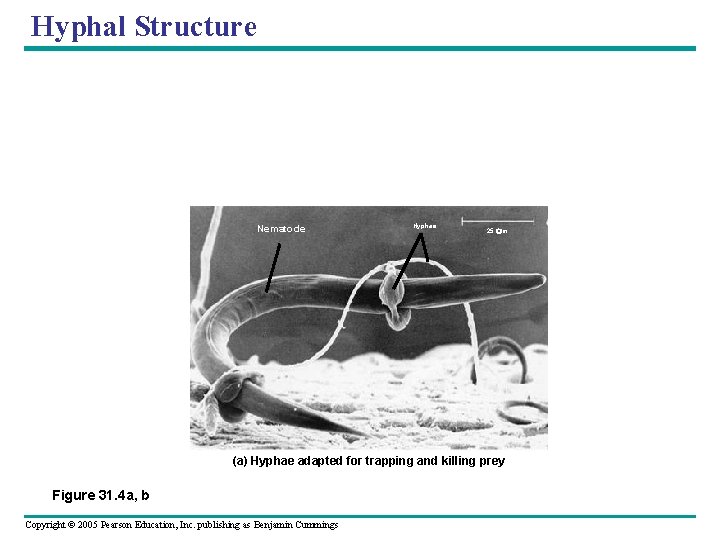
Hyphal Structure Nematode Hyphae 25 m (a) Hyphae adapted for trapping and killing prey Figure 31. 4 a, b Copyright © 2005 Pearson Education, Inc. publishing as Benjamin Cummings
Mycorrhizae • Are mutually beneficial relationships between fungi and plant roots – Mycorrhizae “fungus roots” • Delivers minerals and receives organic nutrients – Ectomycorrhizal fungi: Grow in extracellular spaces of roots – Endomycorrhizal fungi: Hyphae go through cell wall to plasmamembrane Copyright © 2005 Pearson Education, Inc. publishing as Benjamin Cummings
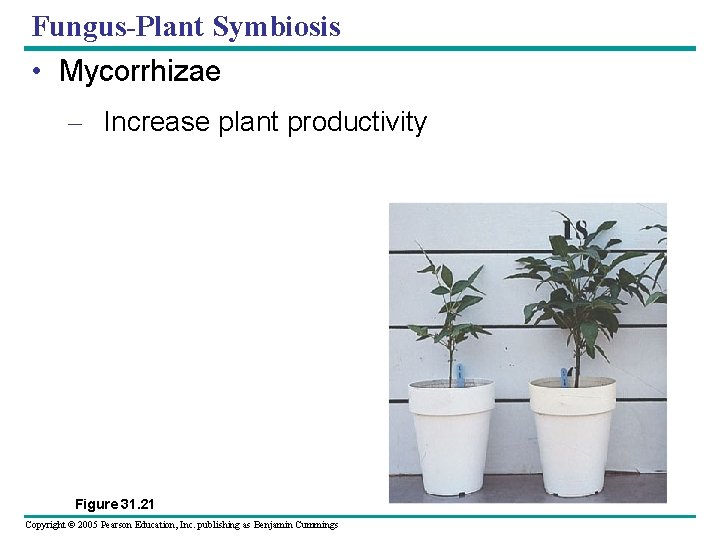
Fungus-Plant Symbiosis • Mycorrhizae – Increase plant productivity RESULTS Figure 31. 21 Copyright © 2005 Pearson Education, Inc. publishing as Benjamin Cummings
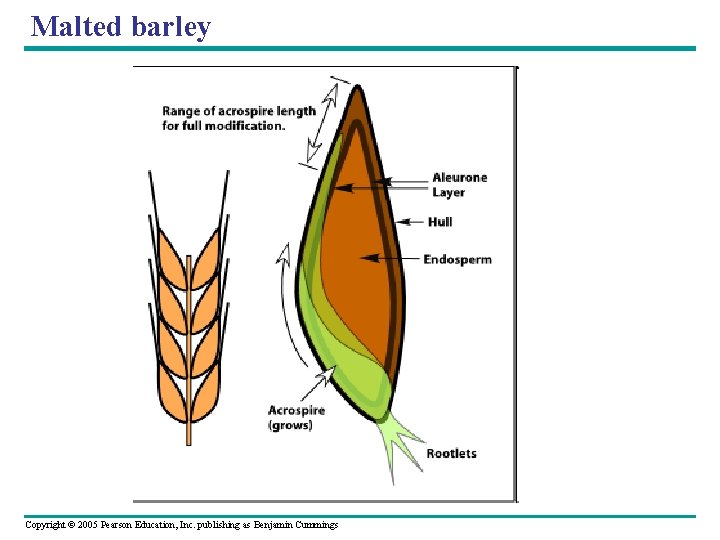
Malted barley Copyright © 2005 Pearson Education, Inc. publishing as Benjamin Cummings
Copyright © 2005 Pearson Education, Inc. publishing as Benjamin Cummings

Copyright © 2005 Pearson Education, Inc. publishing as Benjamin Cummings
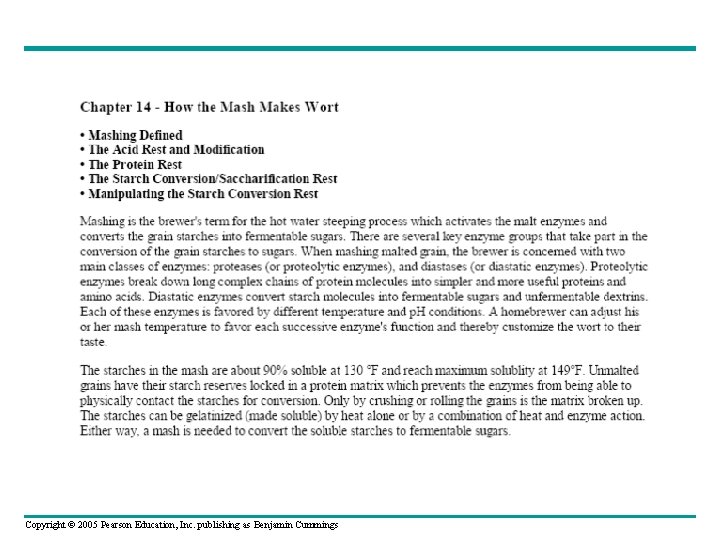
Copyright © 2005 Pearson Education, Inc. publishing as Benjamin Cummings
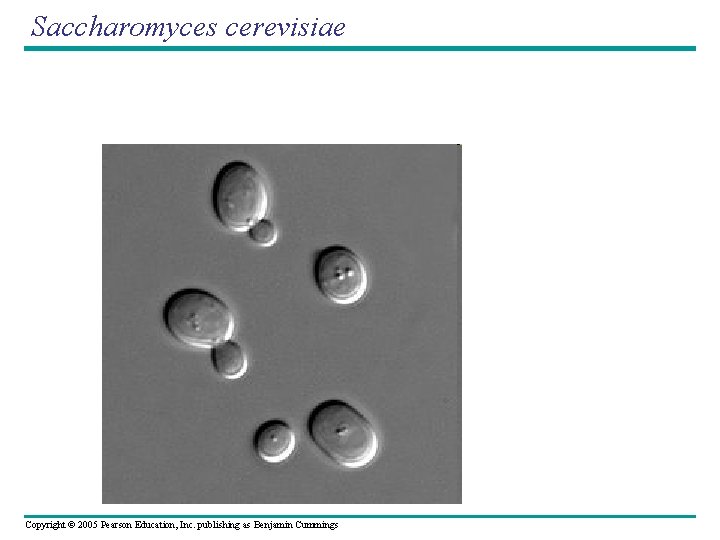
Saccharomyces cerevisiae Copyright © 2005 Pearson Education, Inc. publishing as Benjamin Cummings
• Brewer's yeast tolerate up to about 5% alcohol. Beyond this alcohol level the yeast cannot continue fermentation. Wine yeast on the other hand tolerates up to about 12% alcohol. The level of alcohol tolerance by yeast varies from 5% to about 21% depending on yeast strain. • Part 1 Aerobic (Oxygen is present) This is the initial rapid process where the yeast is doubling its colony size every 4 hours. (Usually 24 -48 hours) • Part 2 Anaerobic. (No oxygen present) Slower activity and the yeast focuses on converting sugar to alcohol rather that increasing the number of yeast cells. (This process can take from days to weeks depending on the yeast and the recipe) Copyright © 2005 Pearson Education, Inc. publishing as Benjamin Cummings
• The overall process of fermentation is to convert glucose sugar (C 6 H 12 O 6) to alcohol (CH 3 CH 2 OH) and carbon dioxide gas (CO 2). The reactions within the yeast to make this happen are very complex but the overall process is as follows: • C 6 H 12 O 6 ====> 2(CH 3 CH 2 OH) + 2(CO 2) Sugar ====> Alcohol + Carbon dioxide gas (Glucose) (Ethyl alcohol) • Note: The sugars used can be a range of fermentable sugars. These sugars are converted by enzymes to glucose which is then convered to alcohol and CO 2 Copyright © 2005 Pearson Education, Inc. publishing as Benjamin Cummings
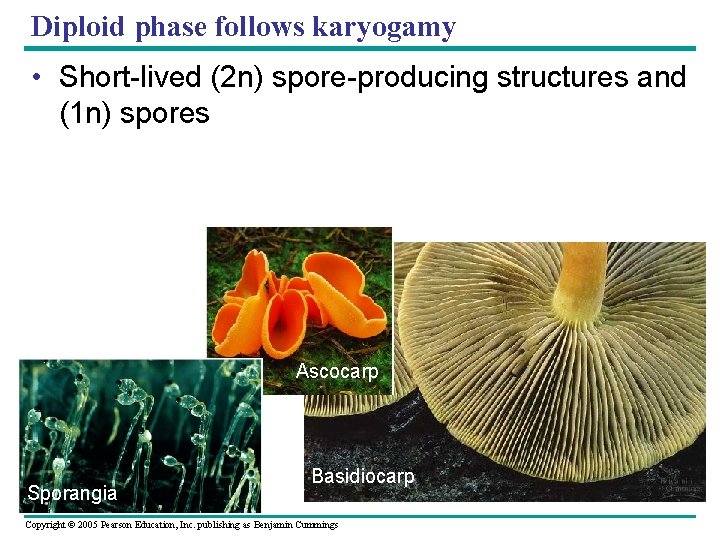
Diploid phase follows karyogamy • Short-lived (2 n) spore-producing structures and (1 n) spores Ascocarp Sporangia Basidiocarp Copyright © 2005 Pearson Education, Inc. publishing as Benjamin Cummings
• Concept 31. 3: Fungi descended from an aquatic, single-celled, flagellated protist • Fungi and Animalia as sister kingdoms • Fungi early colonizers of land, probably as symbionts with plants. Copyright © 2005 Pearson Education, Inc. publishing as Benjamin Cummings
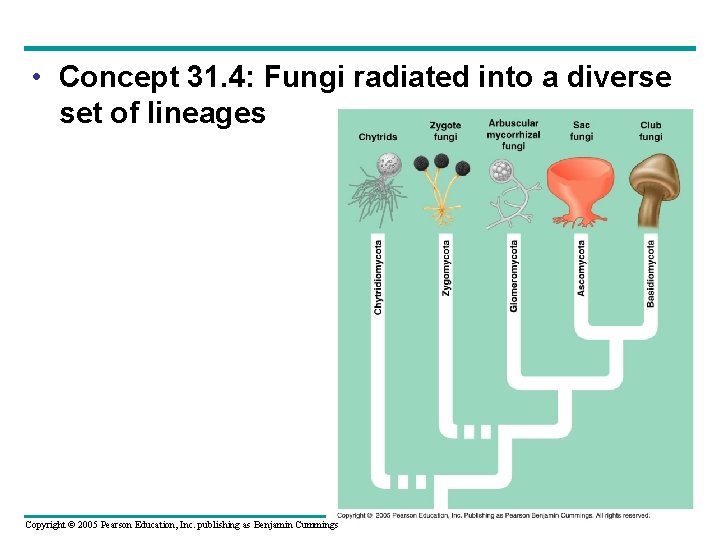
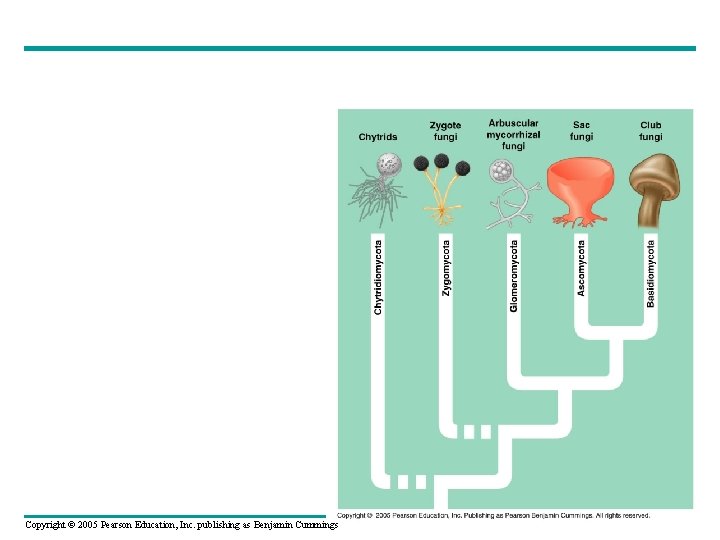
• Concept 31. 4: Fungi radiated into a diverse set of lineages Copyright © 2005 Pearson Education, Inc. publishing as Benjamin Cummings
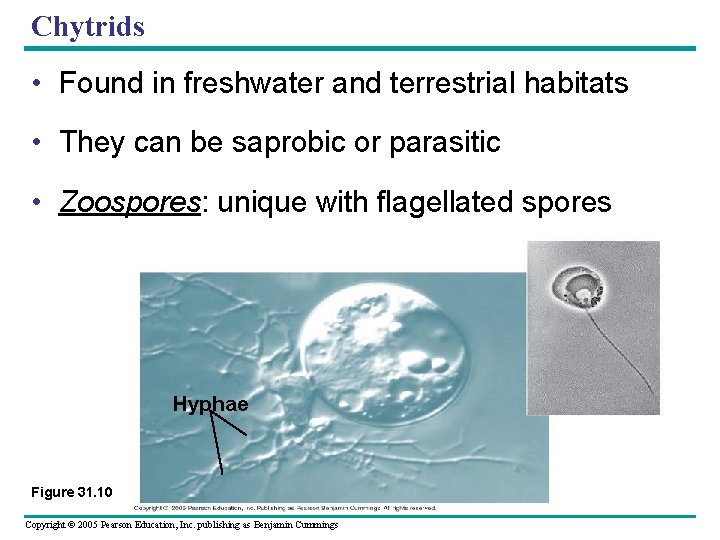
Chytrids • Found in freshwater and terrestrial habitats • They can be saprobic or parasitic • Zoospores: unique with flagellated spores Hyphae Figure 31. 10 Copyright © 2005 Pearson Education, Inc. publishing as Benjamin Cummings
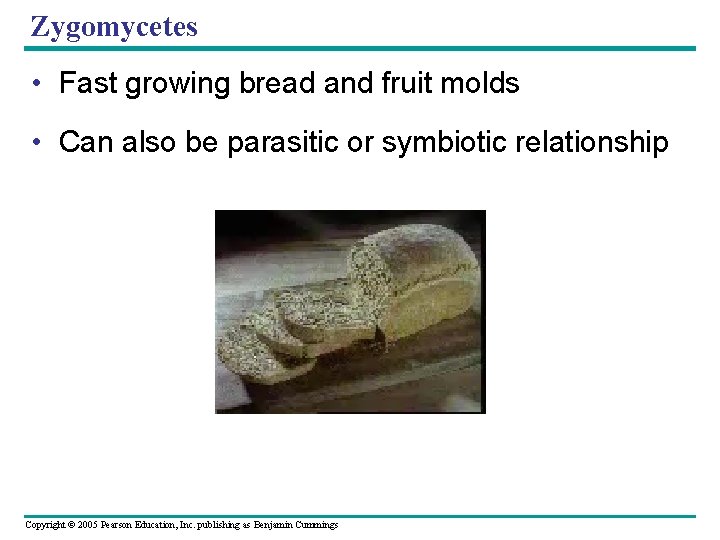
Zygomycetes • Fast growing bread and fruit molds • Can also be parasitic or symbiotic relationship Copyright © 2005 Pearson Education, Inc. publishing as Benjamin Cummings
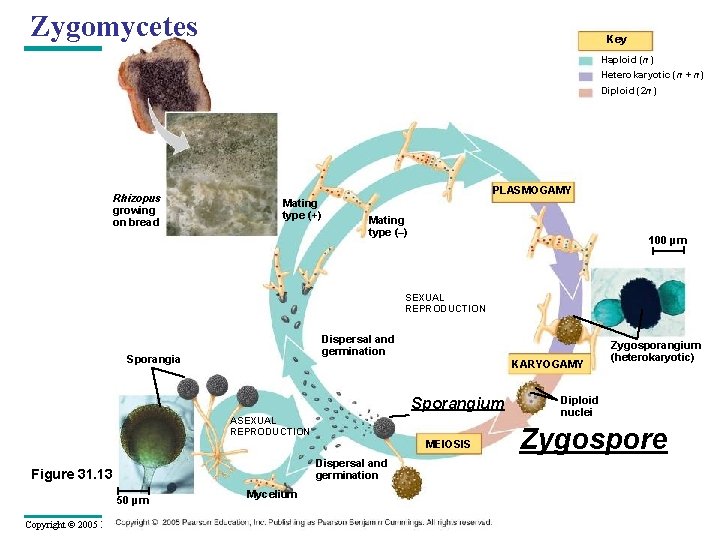
Zygomycetes Key Haploid (n) Heterokaryotic (n + n) Diploid (2 n) Rhizopus growing on bread PLASMOGAMY Mating type (+) Mating type (–) 100 µm SEXUAL REPRODUCTION Dispersal and germination Sporangia KARYOGAMY Sporangium ASEXUAL REPRODUCTION MEIOSIS Dispersal and germination Figure 31. 13 50 µm Mycelium Copyright © 2005 Pearson Education, Inc. publishing as Benjamin Cummings Zygosporangium (heterokaryotic) Diploid nuclei Zygospore
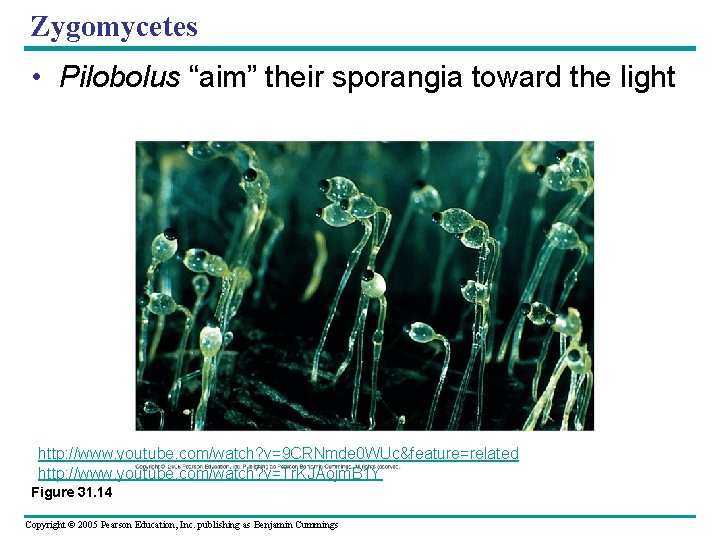
Zygomycetes • Pilobolus “aim” their sporangia toward the light http: //www. youtube. com/watch? v=9 CRNmde 0 WUc&feature=related http: //www. youtube. com/watch? v=Tr. KJAojm. B 1 Y Figure 31. 14 Copyright © 2005 Pearson Education, Inc. publishing as Benjamin Cummings
Zygomycetes • Pilobolus “aim” their sporangia toward the light Copyright © 2005 Pearson Education, Inc. publishing as Benjamin Cummings
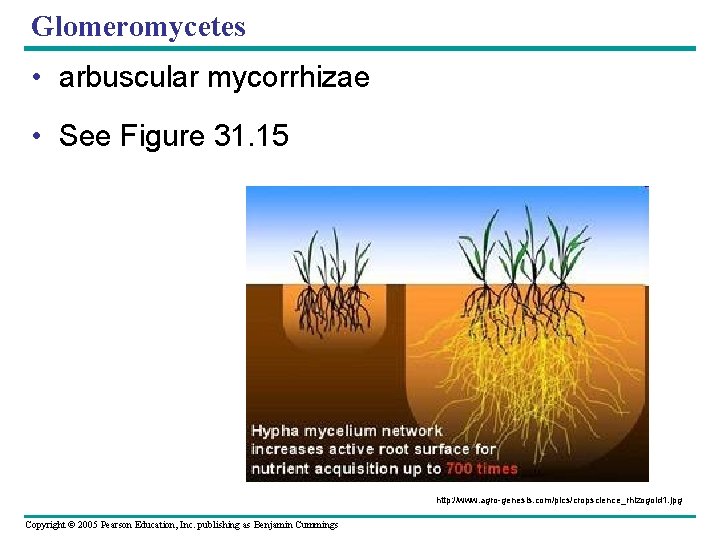
Glomeromycetes • arbuscular mycorrhizae • See Figure 31. 15 http: //www. agro-genesis. com/pics/cropscience_rhizogold 1. jpg Copyright © 2005 Pearson Education, Inc. publishing as Benjamin Cummings
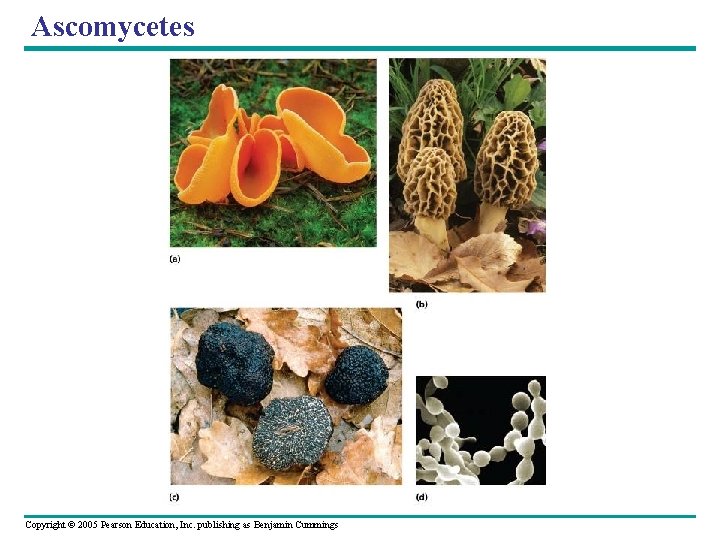
Ascomycetes Copyright © 2005 Pearson Education, Inc. publishing as Benjamin Cummings
Glomeromycetes • Spores produced in a saclike asci “sac fungi” • Asci are within the ascocarp Copyright © 2005 Pearson Education, Inc. publishing as Benjamin Cummings
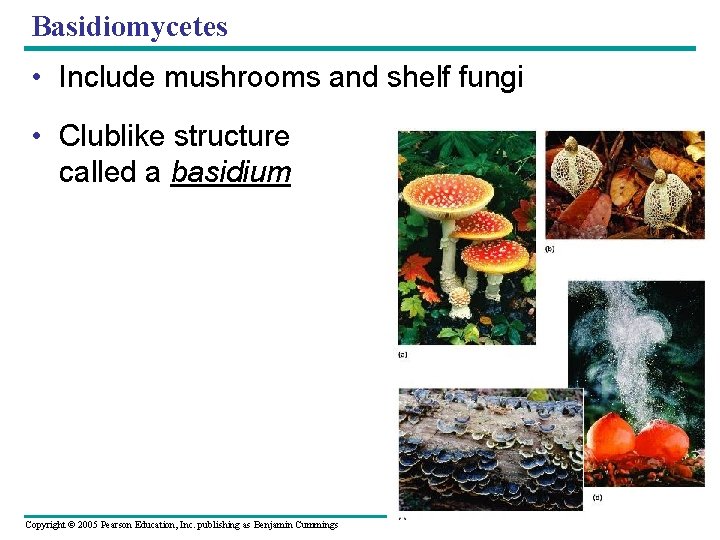
Basidiomycetes • Include mushrooms and shelf fungi • Clublike structure called a basidium Copyright © 2005 Pearson Education, Inc. publishing as Benjamin Cummings
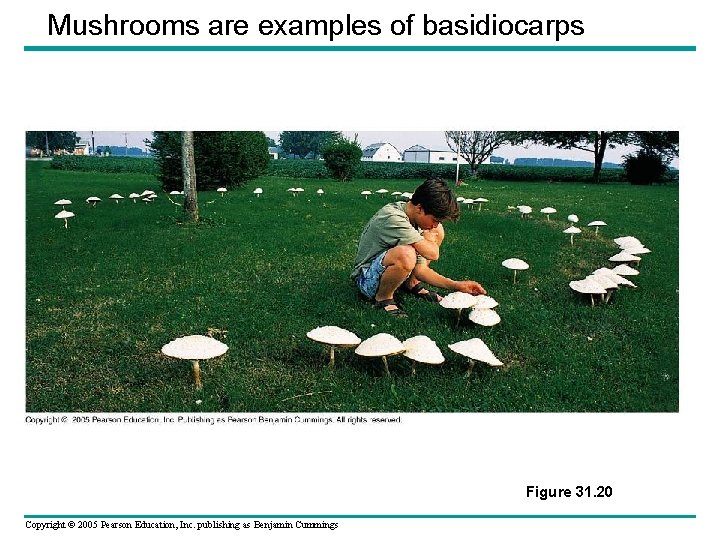
Mushrooms are examples of basidiocarps Figure 31. 20 Copyright © 2005 Pearson Education, Inc. publishing as Benjamin Cummings
Copyright © 2005 Pearson Education, Inc. publishing as Benjamin Cummings
• Concept 31. 5: Fungi have a powerful impact on ecosystems and human welfare Copyright © 2005 Pearson Education, Inc. publishing as Benjamin Cummings
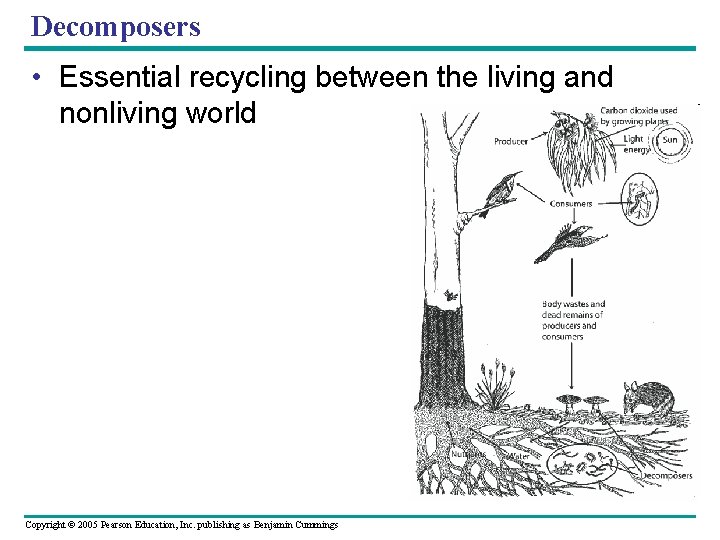
Decomposers • Essential recycling between the living and nonliving world Copyright © 2005 Pearson Education, Inc. publishing as Benjamin Cummings
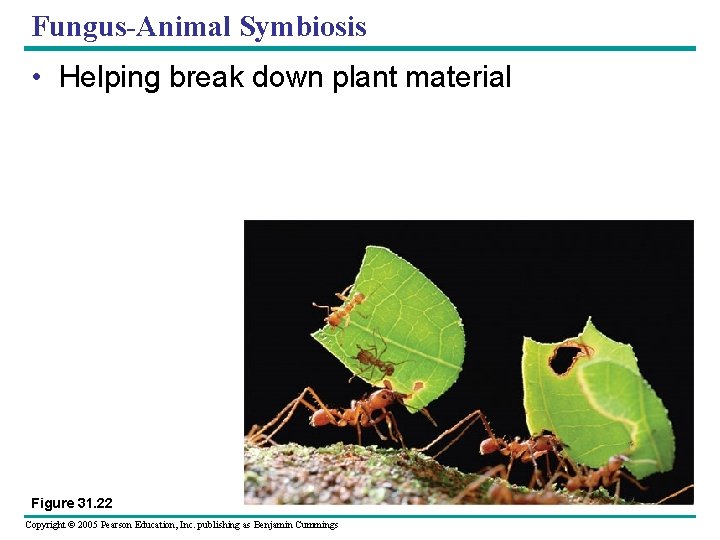
Fungus-Animal Symbiosis • Helping break down plant material Figure 31. 22 Copyright © 2005 Pearson Education, Inc. publishing as Benjamin Cummings
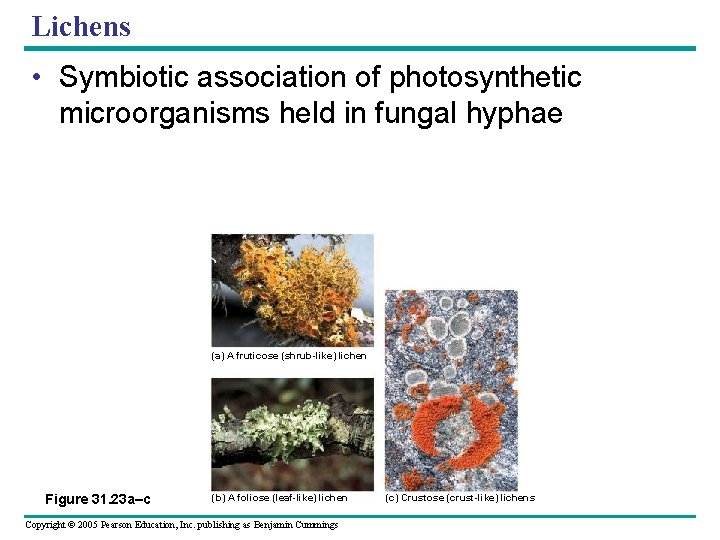
Lichens • Symbiotic association of photosynthetic microorganisms held in fungal hyphae (a) A fruticose (shrub-like) lichen Figure 31. 23 a–c (b) A foliose (leaf-like) lichen Copyright © 2005 Pearson Education, Inc. publishing as Benjamin Cummings (c) Crustose (crust-like) lichens
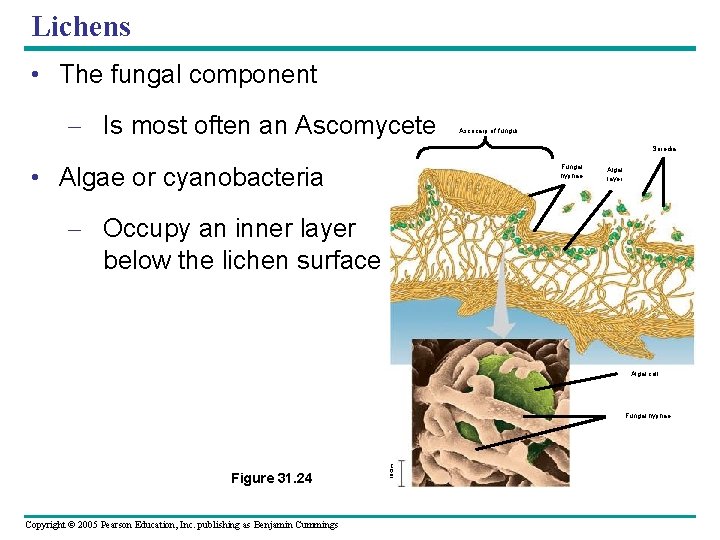
Lichens • The fungal component – Is most often an Ascomycete Ascocarp of fungus Soredia • Algae or cyanobacteria Fungal hyphae Algal layer – Occupy an inner layer below the lichen surface Algal cell Figure 31. 24 Copyright © 2005 Pearson Education, Inc. publishing as Benjamin Cummings 10 m Fungal hyphae
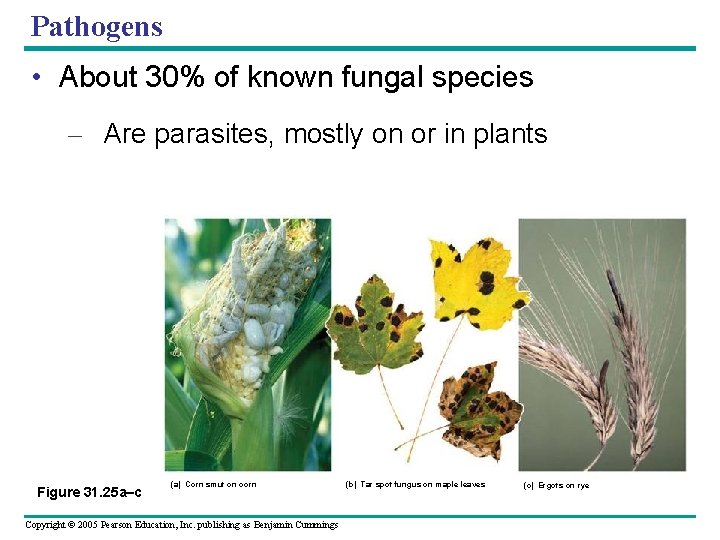
Pathogens • About 30% of known fungal species – Are parasites, mostly on or in plants Figure 31. 25 a–c (a) Corn smut on corn Copyright © 2005 Pearson Education, Inc. publishing as Benjamin Cummings (b) Tar spot fungus on maple leaves (c) Ergots on rye
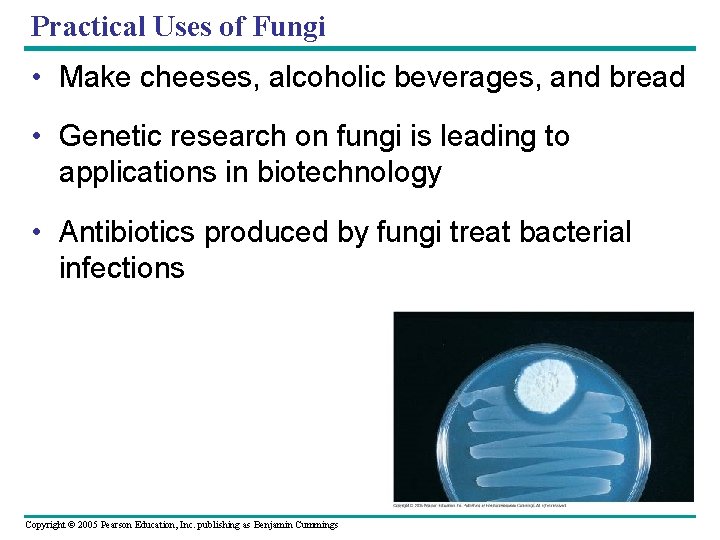
Practical Uses of Fungi • Make cheeses, alcoholic beverages, and bread • Genetic research on fungi is leading to applications in biotechnology • Antibiotics produced by fungi treat bacterial infections Copyright © 2005 Pearson Education, Inc. publishing as Benjamin Cummings
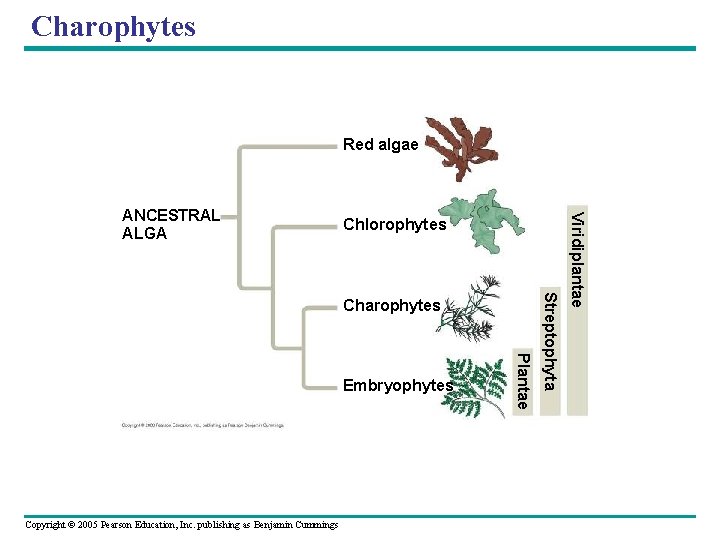
Charophytes Red algae Chlorophytes Copyright © 2005 Pearson Education, Inc. publishing as Benjamin Cummings Plantae Embryophytes Streptophyta Charophytes Viridiplantae ANCESTRAL ALGA
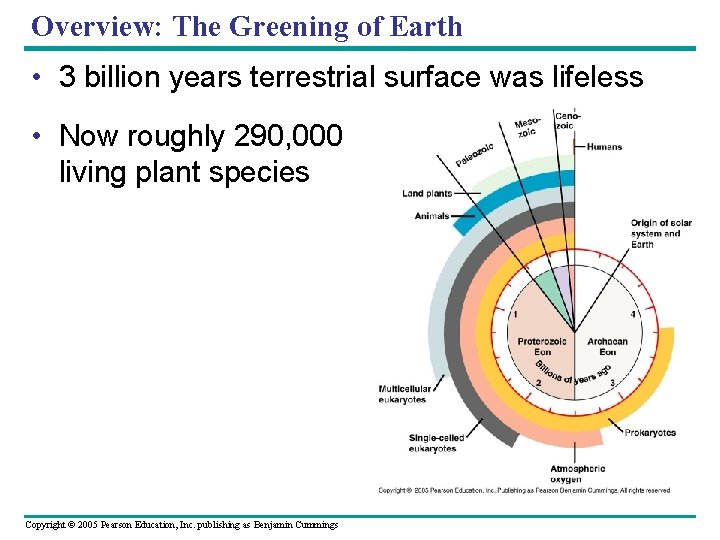
Overview: The Greening of Earth • 3 billion years terrestrial surface was lifeless • Now roughly 290, 000 living plant species Copyright © 2005 Pearson Education, Inc. publishing as Benjamin Cummings
- Slides: 36