
Body Paragraphs Critical Theory Research Essay Importance of
Body Paragraphs Critical Theory Research Essay
Importance of Body Paragraphs Supports thesis statement by: Explaining your ideas Providing evidence from the text Using research
Components Topic sentence Three pieces of support Concluding sentence connecting to thesis
Topic Sentence Each paragraph in your essay should contain a topic sentence. It is usually the first sentence. It should be an idea that supports your thesis statement. It should transition smoothly from the previous paragraph. Ultimately, the topic sentence should tie the details of the paragraph to your thesis statement and tie the details of the paragraph together.
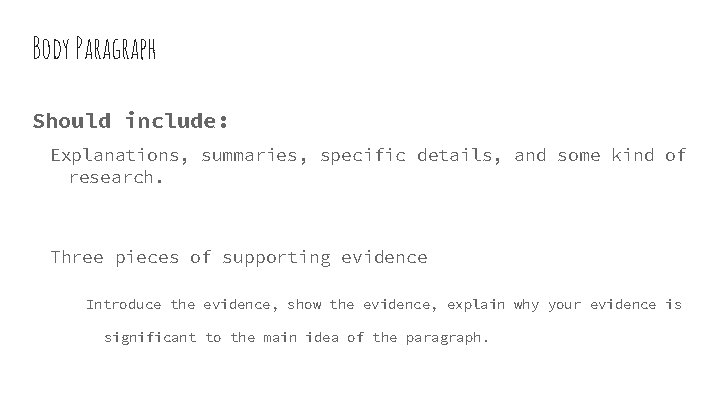
Body Paragraph Should include: Explanations, summaries, specific details, and some kind of research. Three pieces of supporting evidence Introduce the evidence, show the evidence, explain why your evidence is significant to the main idea of the paragraph.

Concluding Sentence One sentence at the end of each paragraph that summarizes what you have said in the paragraph. It should tie all of the ideas back to thesis statement. It may provide a transition to the next body paragraph.
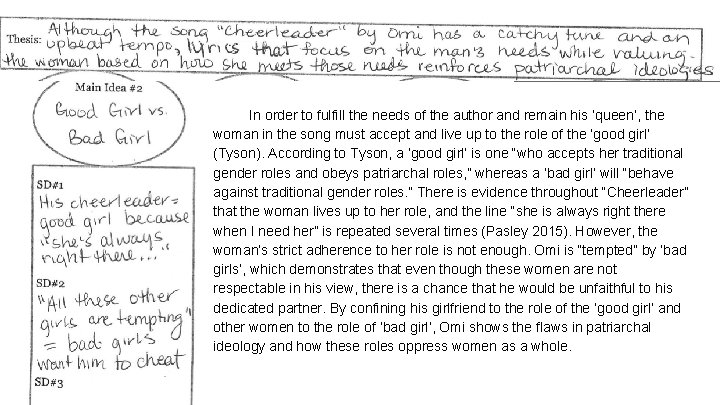
In order to fulfill the needs of the author and remain his ‘queen’, the woman in the song must accept and live up to the role of the ‘good girl’ (Tyson). According to Tyson, a ‘good girl’ is one “who accepts her traditional gender roles and obeys patriarchal roles, ” whereas a ‘bad girl’ will “behave against traditional gender roles. ” There is evidence throughout “Cheerleader” that the woman lives up to her role, and the line “she is always right there when I need her” is repeated several times (Pasley 2015). However, the woman’s strict adherence to her role is not enough. Omi is “tempted” by ‘bad girls’, which demonstrates that even though these women are not respectable in his view, there is a chance that he would be unfaithful to his dedicated partner. By confining his girlfriend to the role of the ‘good girl’ and other women to the role of ‘bad girl’, Omi shows the flaws in patriarchal ideology and how these roles oppress women as a whole.
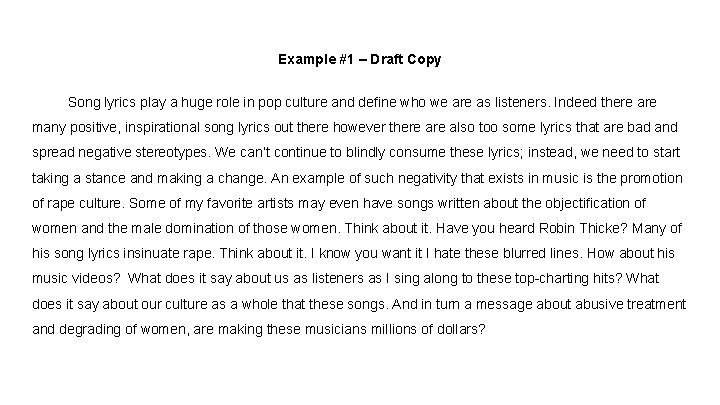
Example #1 – Draft Copy Song lyrics play a huge role in pop culture and define who we are as listeners. Indeed there are many positive, inspirational song lyrics out there however there also too some lyrics that are bad and spread negative stereotypes. We can’t continue to blindly consume these lyrics; instead, we need to start taking a stance and making a change. An example of such negativity that exists in music is the promotion of rape culture. Some of my favorite artists may even have songs written about the objectification of women and the male domination of those women. Think about it. Have you heard Robin Thicke? Many of his song lyrics insinuate rape. Think about it. I know you want it I hate these blurred lines. How about his music videos? What does it say about us as listeners as I sing along to these top-charting hits? What does it say about our culture as a whole that these songs. And in turn a message about abusive treatment and degrading of women, are making these musicians millions of dollars?
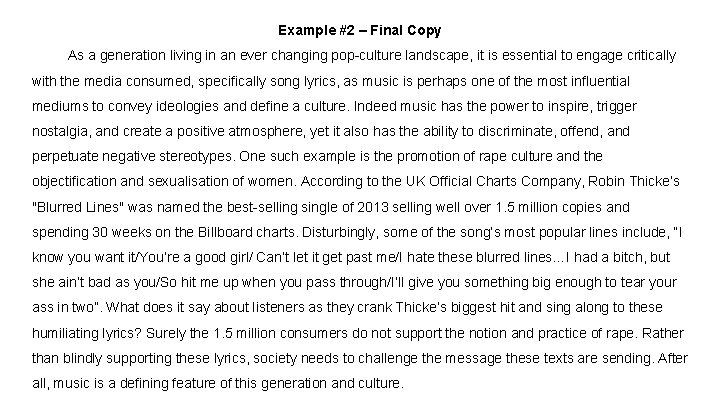
Example #2 – Final Copy As a generation living in an ever changing pop-culture landscape, it is essential to engage critically with the media consumed, specifically song lyrics, as music is perhaps one of the most influential mediums to convey ideologies and define a culture. Indeed music has the power to inspire, trigger nostalgia, and create a positive atmosphere, yet it also has the ability to discriminate, offend, and perpetuate negative stereotypes. One such example is the promotion of rape culture and the objectification and sexualisation of women. According to the UK Official Charts Company, Robin Thicke’s "Blurred Lines" was named the best-selling single of 2013 selling well over 1. 5 million copies and spending 30 weeks on the Billboard charts. Disturbingly, some of the song’s most popular lines include, “I know you want it/You’re a good girl/ Can’t let it get past me/I hate these blurred lines…I had a bitch, but she ain’t bad as you/So hit me up when you pass through/I’ll give you something big enough to tear your ass in two”. What does it say about listeners as they crank Thicke’s biggest hit and sing along to these humiliating lyrics? Surely the 1. 5 million consumers do not support the notion and practice of rape. Rather than blindly supporting these lyrics, society needs to challenge the message these texts are sending. After all, music is a defining feature of this generation and culture.
- Slides: 9