
Body Paragraphs and Counterclaim 6 th and 7
Body Paragraphs and Counterclaim 6 th and 7 th Grade Text-based Writing
What are body paragraphs? Body paragraphs are where you explain your points and give evidence from the articles to prove what you are writing.

How do I set up my body paragraphs? The order of your body paragraphs is determined by the order or your introduction. Counterclaim should be written after you have made all your points, but before the conclusion.
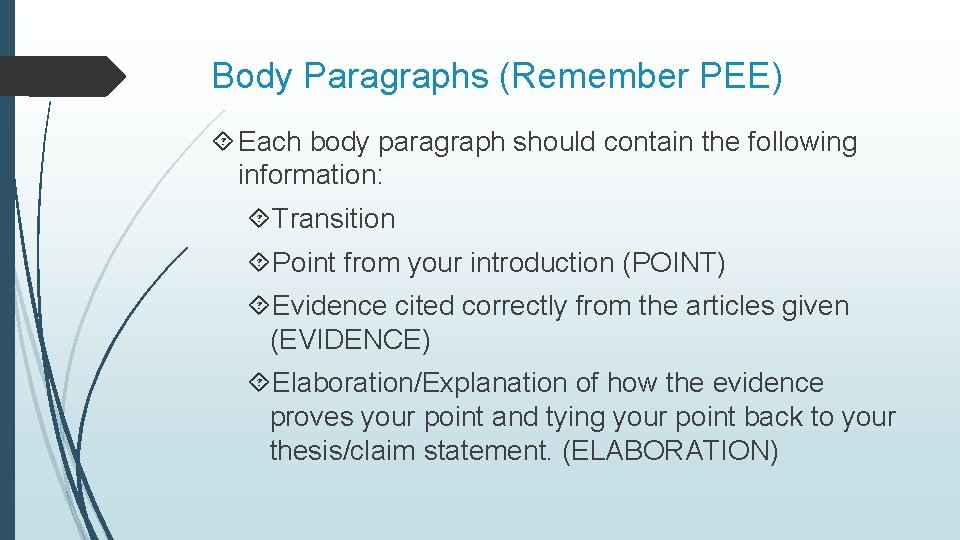
Body Paragraphs (Remember PEE) Each body paragraph should contain the following information: Transition Point from your introduction (POINT) Evidence cited correctly from the articles given (EVIDENCE) Elaboration/Explanation of how the evidence proves your point and tying your point back to your thesis/claim statement. (ELABORATION)
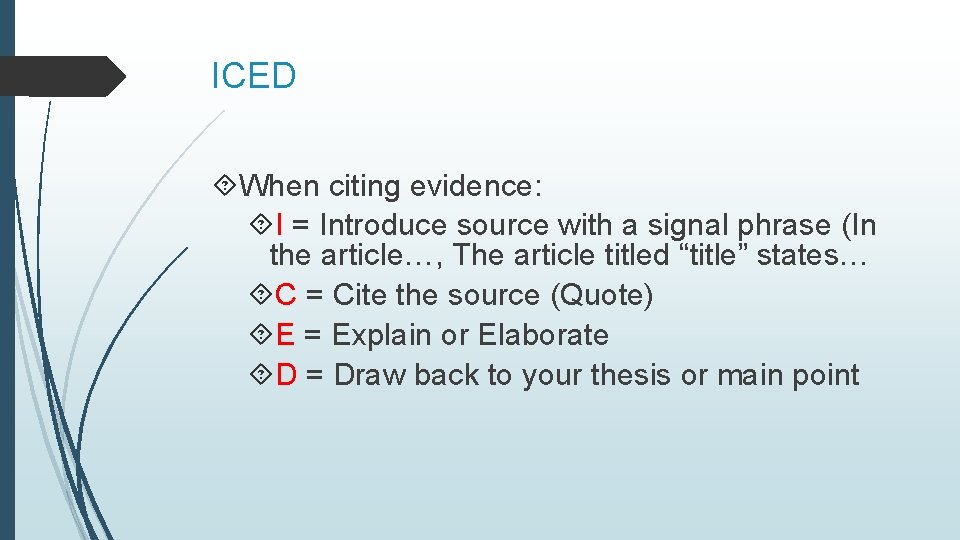
ICED When citing evidence: I = Introduce source with a signal phrase (In the article…, The article titled “title” states… C = Cite the source (Quote) E = Explain or Elaborate D = Draw back to your thesis or main point
Body Paragraphs 1, 2 and possibly 3 Each body paragraph must follow the point, evidence, and elaboration format using ICED to cite your evidence.
Body Killers Using first person Not including evidence for each point. Not explaining how your evidence proves your point and ties back to thesis. Quote bombing Using evidence but forgetting to cite it. Paraphrasing from the article but not citing it. Quoting entire paragraphs with no independent thought.
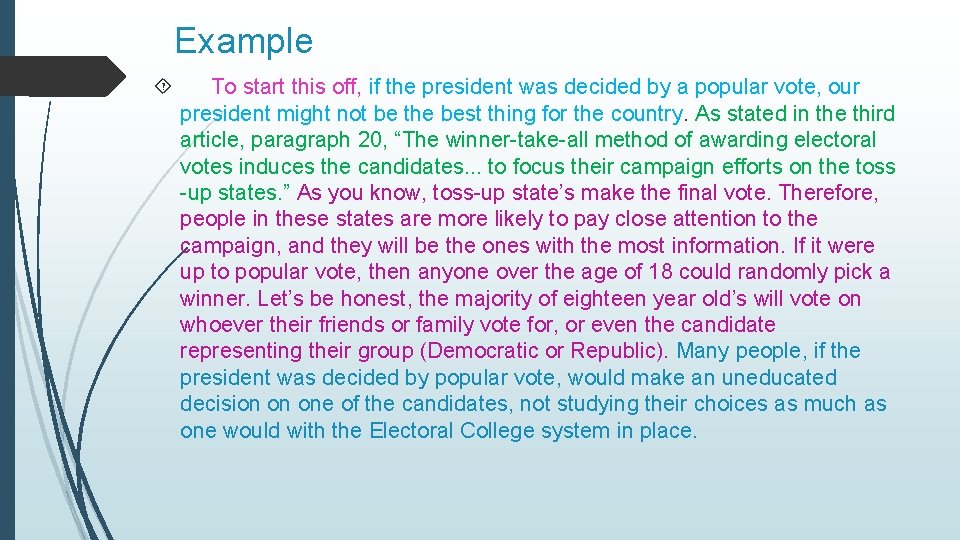
Example To start this off, if the president was decided by a popular vote, our president might not be the best thing for the country. As stated in the third article, paragraph 20, “The winner-take-all method of awarding electoral votes induces the candidates. . . to focus their campaign efforts on the toss -up states. ” As you know, toss-up state’s make the final vote. Therefore, people in these states are more likely to pay close attention to the campaign, and they will be the ones with the most information. If it were up to popular vote, then anyone over the age of 18 could randomly pick a winner. Let’s be honest, the majority of eighteen year old’s will vote on whoever their friends or family vote for, or even the candidate representing their group (Democratic or Republic). Many people, if the president was decided by popular vote, would make an uneducated decision on one of the candidates, not studying their choices as much as one would with the Electoral College system in place.
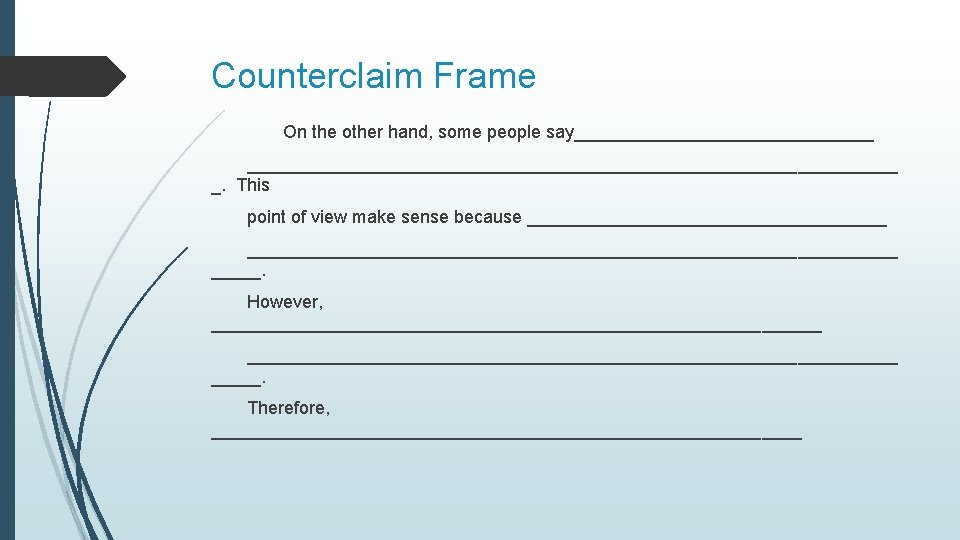
Counterclaim A counterclaim is where you talk about the other side. You give information with evidence then explain how it is not the correct side. Refute – to prove wrong by argument or evidence.
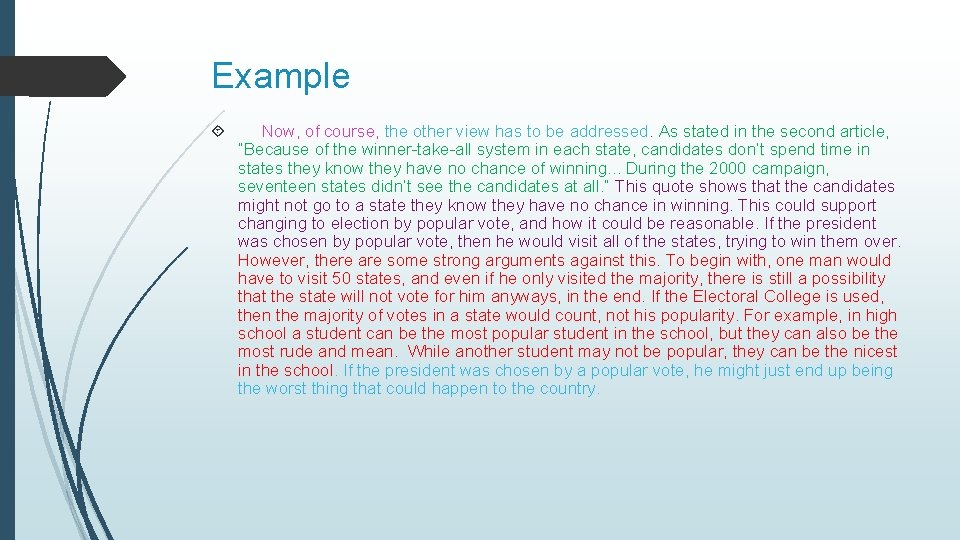
Example Now, of course, the other view has to be addressed. As stated in the second article, “Because of the winner-take-all system in each state, candidates don’t spend time in states they know they have no chance of winning. . . During the 2000 campaign, seventeen states didn’t see the candidates at all. ” This quote shows that the candidates might not go to a state they know they have no chance in winning. This could support changing to election by popular vote, and how it could be reasonable. If the president was chosen by popular vote, then he would visit all of the states, trying to win them over. However, there are some strong arguments against this. To begin with, one man would have to visit 50 states, and even if he only visited the majority, there is still a possibility that the state will not vote for him anyways, in the end. If the Electoral College is used, then the majority of votes in a state would count, not his popularity. For example, in high school a student can be the most popular student in the school, but they can also be the most rude and mean. While another student may not be popular, they can be the nicest in the school. If the president was chosen by a popular vote, he might just end up being the worst thing that could happen to the country.
- Slides: 11