
Body Paragraph Argumentative FORMAT Topic SentenceClaim Evidence 1
Body Paragraph Argumentative
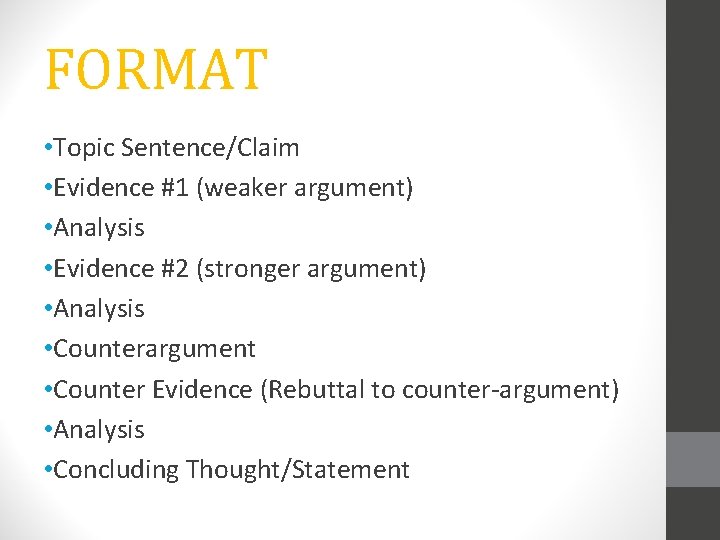
FORMAT • Topic Sentence/Claim • Evidence #1 (weaker argument) • Analysis • Evidence #2 (stronger argument) • Analysis • Counterargument • Counter Evidence (Rebuttal to counter-argument) • Analysis • Concluding Thought/Statement
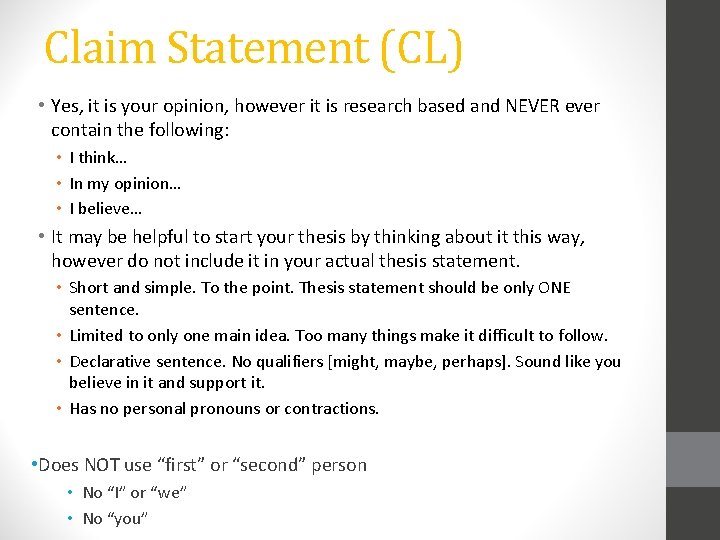
Claim Statement (CL) • Yes, it is your opinion, however it is research based and NEVER ever contain the following: • I think… • In my opinion… • I believe… • It may be helpful to start your thesis by thinking about it this way, however do not include it in your actual thesis statement. • Short and simple. To the point. Thesis statement should be only ONE sentence. • Limited to only one main idea. Too many things make it difficult to follow. • Declarative sentence. No qualifiers [might, maybe, perhaps]. Sound like you believe in it and support it. • Has no personal pronouns or contractions. • Does NOT use “first” or “second” person • No “I” or “we” • No “you”
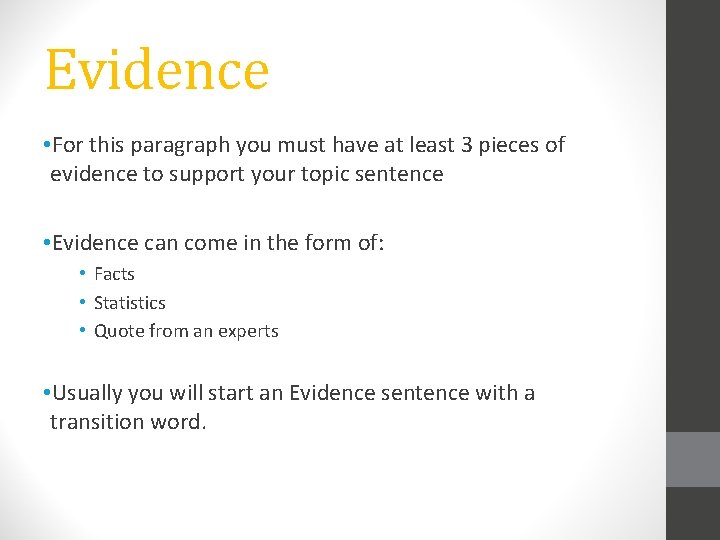
Evidence • For this paragraph you must have at least 3 pieces of evidence to support your topic sentence • Evidence can come in the form of: • Facts • Statistics • Quote from an experts • Usually you will start an Evidence sentence with a transition word.
Transition • Transitions are words and phrases that take your reader smoothly from one idea to another. • Transitions connect your topic sentence to your evidence. • See handout for various types of transition words
Lead-Ins • A lead-in often come between the transition and the evidence. • Lead-in’s set up your evidence in a smooth fashion: • For example, “many students do not want to come to school. ”(Smith) • For example, according the National Center For Teen Bullying the pressure to dress a certain way leads, “many students [to] not want to come to school” (Smith).
ANALYSIS • Elaboration shows HOW and WHY your Evidence supports your topic sentence and claim. • Synonyms for elaboration include back up, insight, analysis, interpretation, inference, evaluation, or reflection. • Elaboration never uses the term “I think”
COUNTERAGRUMENT • After your second fact, transition into what the other side says about the issue. • Your elaboration sentence would then explain how that goes against your claim.
CONCLUDING SENTENCE • The last sentence in a body paragraph. • It does not repeat key words from the topic sentence • This is where you “wrap-up” what you have been saying already. AND, if you have more than one paragraph it sets the reader up for what the next paragraph will be about.
IN-TEXT CITATIONS • You have to credit each source you use at the end of the sentence of sentences in which it appears. • Because this information appears in parentheses, it is called parenthetical documentation. • It usually consists of the author’s last name and a page number (Murphy, 8). • Here are some exceptions: • Website: Because a website has no page number, use only the author’s name (Murphy). If the site does not credit an author, use the short form of the title, (“Bullying”) • • Author named in sentence: Use only the page number. More than one source for a single idea: List both sources and separate them with a semicolon. (“Shiloh”; Murphy, 8)
- Slides: 10