
BODY MOVEMENT NOTES NAMING OF SKELETAL MUSCLE Direction

BODY MOVEMENT NOTES
NAMING OF SKELETAL MUSCLE • Direction of muscle fibers – Example: rectus (straight) • Relative size of the muscle – Example: maximus (largest) • Shape of the muscle – Example: deltoid (triangular)
• Location of the muscle – Example: many muscles are named for bones (e. g. , temporalis) • Number of origins – Example: triceps (three heads) • Location of the muscles origin and insertion – Example: sterno (on the sternum)
• Action of the muscle – Example: flexor and extensor (flexes or extends a bone)
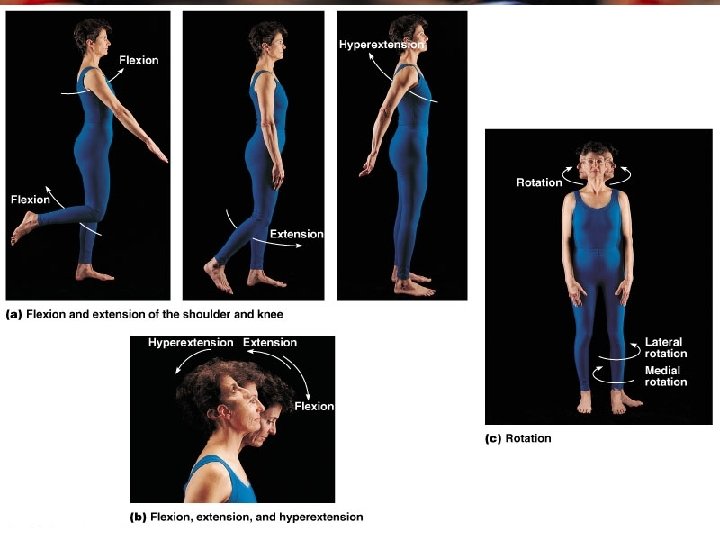
TYPES OF BODY MOVEMENT • Flexion – movement that decreases angle of joint • Extension – movement that increases angle of joint – Hyperextension – extension beyond 180°
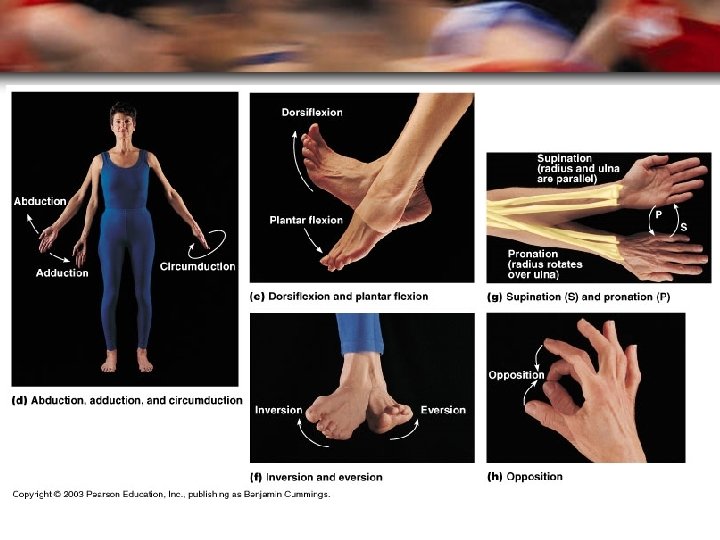
• Rotation – movement of a bone around a longitudinal axis • Abduction – movement of limb away from midline • Adduction – movement of limb toward the midline • Circumduction – proximal end of a limb is stationary and the distal end moves in circle
• Dorsiflexion – lifting the superior surface of foot towards shin • Plantar flexion – pointing toe • Inversion – turn sole of foot medially • Eversion – turn sole of foot laterally
• Supination – forearm rotates laterally so palm faces anteriorly • Pronation - forearm rotates medially so palm faces posteriorly • Opposition – movement of thumb to touch tips of other fingers
- Slides: 10