
Body Language Key Stage 3 July 2015 What
Body Language Key Stage 3 July 2015
What is Body Language? Body Language is more of an umbrella term to describe how you are using you body to communicate an emotion to an audience. It is part of characterisation, which is about the ways in which you interpret a character through the way you use your body and voice.
What words contribute to body language • • • Gestures Facial Expressions Stance Posture Movement Eye Contact • Legs / Torso / Arms / Head / Feet etc…
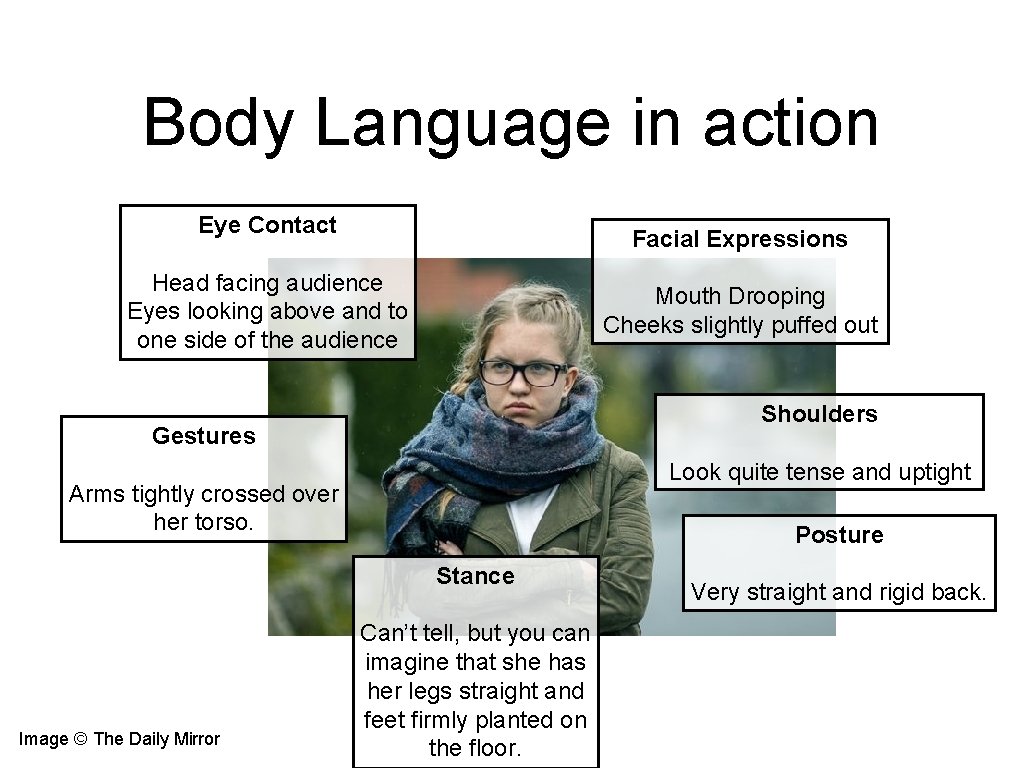
Body Language in action Eye Contact Facial Expressions Head facing audience Eyes looking above and to one side of the audience Mouth Drooping Cheeks slightly puffed out Shoulders Gestures Look quite tense and uptight Arms tightly crossed over her torso. Posture Stance Image © The Daily Mirror Can’t tell, but you can imagine that she has her legs straight and feet firmly planted on the floor. Very straight and rigid back.

Writing about Body Language • Rule 1: Begin by talking about what you did personally in the performance (e. g. in the still image I played…) • Rule 2: Add a describing word to the character or role you played (e. g. not a king but an angry king). • Rule 3: Use the connective “and” along with one of the following phrases: “to communicate”, “to convey”, “to get across”, “to show” or “to express” • Rule 4: Use at least 2 key terms and as many describing words as you can (e. g. I puffed up my chest to show I had angry body language. )

Writing about Body Language Rule 1 Rule 3 Rule 2 In the performance I performed an annoyed and moody teenage girl and to communicate that I was annoyed I faced the audience but didn’t make direct eye contact with them, I also narrowed my eyes, I had my arms crossed, shoulders tight and my back straight. Rule 4
- Slides: 6