
Body Language Definition Nonverbal communication Body Language may

Body Language
Definition • Non-verbal communication
Body Language may be the most powerful and honest type of communication. Some research suggests we send 93% of our messages nonverbally
Body Language is used to help send a message and needs to coordinate with how we are speaking or listening. Your body language should be chosen as carefully as you choose your words.
Body Language has two forms: 1. Positive messages 2. Negative messages
Seven Types of Body Language 1. How you sit or stand (posture) 2. Facial Expressions
3. Clothing and Grooming 4. Gestures (hand, foot, eye movements) 5. Eye Contact
6. Voice Tone, Inflection, and Volume (38%) 7. Personal Space The human brain processes nonverbal messages faster than verbal at a rate of 240 non-verbal messages per minute.
Body Language Messages: Eye Contact Good eye contact can tell a listener that the speaker is: honest, dependable, interested, confident Poor eye contact can tell a listener that the speaker is: dishonest, undependable, disinterested, nervous, embarrassed, fearful, shy Eye contact that is too long can tell a listener that the speaker is: disapproving, hostile, wishing for greater intimacy, challenging a supervisor’s authority *uncomfortable and inappropriate within a classroom environment
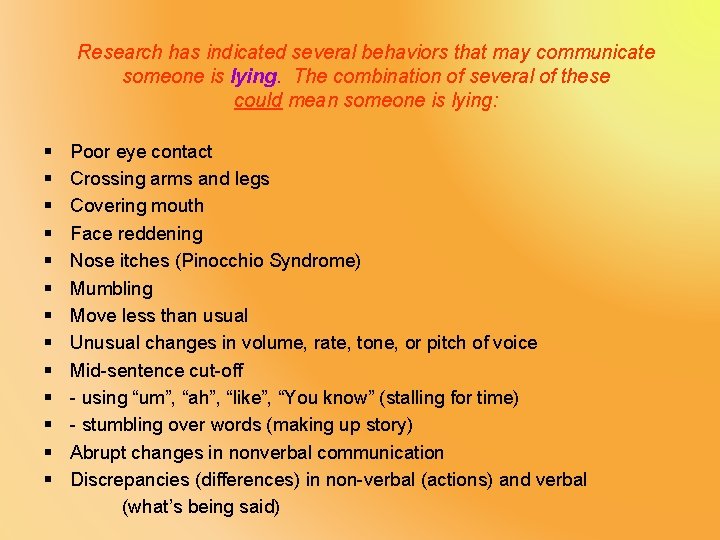
Research has indicated several behaviors that may communicate someone is lying. The combination of several of these could mean someone is lying: § § § § Poor eye contact Crossing arms and legs Covering mouth Face reddening Nose itches (Pinocchio Syndrome) Mumbling Move less than usual Unusual changes in volume, rate, tone, or pitch of voice Mid-sentence cut-off - using “um”, “ah”, “like”, “You know” (stalling for time) - stumbling over words (making up story) Abrupt changes in nonverbal communication Discrepancies (differences) in non-verbal (actions) and verbal (what’s being said)
- Slides: 10