
Body Image How Is It Portrayed In The
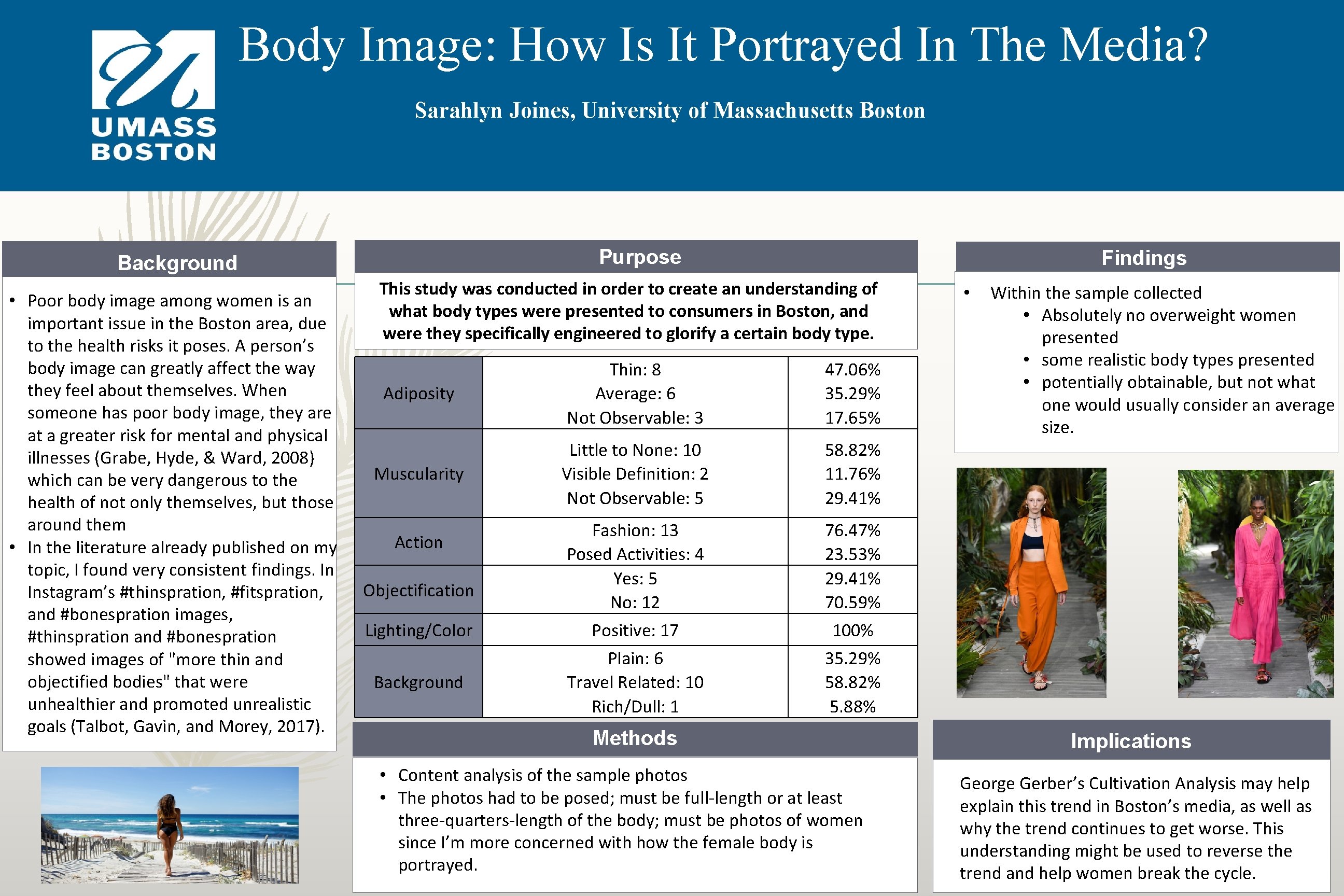
Body Image: How Is It Portrayed In The Media? Sarahlyn Joines, University of Massachusetts Boston Purpose Background • Poor body image among women is an important issue in the Boston area, due to the health risks it poses. A person’s body image can greatly affect the way they feel about themselves. When someone has poor body image, they are at a greater risk for mental and physical illnesses (Grabe, Hyde, & Ward, 2008) which can be very dangerous to the health of not only themselves, but those around them • In the literature already published on my topic, I found very consistent findings. In Instagram’s #thinspration, #fitspration, and #bonespration images, #thinspration and #bonespration showed images of "more thin and objectified bodies" that were unhealthier and promoted unrealistic goals (Talbot, Gavin, and Morey, 2017). ) Findings This study was conducted in order to create an understanding of what body types were presented to consumers in Boston, and were they specifically engineered to glorify a certain body type. Adiposity Thin: 8 Average: 6 Not Observable: 3 47. 06% 35. 29% 17. 65% Muscularity Little to None: 10 Visible Definition: 2 Not Observable: 5 58. 82% 11. 76% 29. 41% Fashion: 13 Posed Activities: 4 Yes: 5 No: 12 76. 47% 23. 53% 29. 41% 70. 59% Lighting/Color Positive: 17 100% Background Plain: 6 Travel Related: 10 Rich/Dull: 1 35. 29% 58. 82% 5. 88% Action Objectification Methods • Content analysis of the sample photos • The photos had to be posed; must be full-length or at least three-quarters-length of the body; must be photos of women since I’m more concerned with how the female body is portrayed. • Within the sample collected • Absolutely no overweight women presented • some realistic body types presented • potentially obtainable, but not what one would usually consider an average size. Implications George Gerber’s Cultivation Analysis may help explain this trend in Boston’s media, as well as why the trend continues to get worse. This understanding might be used to reverse the trend and help women break the cycle. jhkjg
- Slides: 1