
body image and eating disorders Discuss a variety
body image and eating disorders
• Discuss a variety of different eating disorders • Review body image and what it means to us • Examine how to get yourself or someone else help for an eating disorder • Create a Venn Diagram using what we know about eating disorders and body image Today we will…
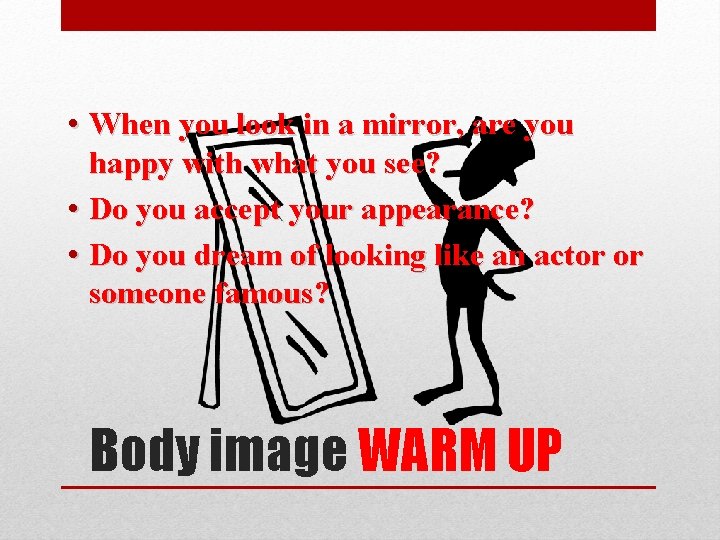
• When you look in a mirror, are you happy with what you see? • Do you accept your appearance? • Do you dream of looking like an actor or someone famous? Body image WARM UP
• Do you often compare yourself to models or athletes? • Do you worry a great deal about being too fat, too thin, or not muscular enough? • Do you think of yourself as fat even though your weight is within the normal limits? • Are you always on a diet? • Is it difficult for you to accept the body changes of puberty? • If you answered yes to any of these questions, you need to work on developing a more positive body image. Negative body image indicators
• Discuss your feelings with an adult • Remember that models and actors are not typical • Focus on what you like about your body, not what you dislike • Exercise regularly so you can feel confident • Do NOT compare yourself to others + body image suggestions
• HAVING A NEGATIVE BODY IMAGE CAN CONTRIBUTE TO THE DEVELOPMENT OF EATING DISORDERS Eating Disorders
• Eating disorder- a food related illness in which a person changes eating habits in a way that is harmful to the body and mind. • Eating disorders affect both males and females • Eating disorders can be life threatening EATING DISORDERS
• Anorexia- an eating disorder characterized by self starvation. • It can affect males, but approx. 9 out 10 cases involve females • The person is intensely afraid of gaining weight • May skip meals • Refuse to eat certain foods • Avoid eating all together • May use laxatives, enemas, or diuretics or force themselves to vomit ANOREXIA NERVOSA
• Damage to the heart, kidneys, bones and muscles • Malnutrition- condition where the body does not get the nutrients it needs • Dehydration- the body does not have enough fluid to function well • Estimated that 10 – 20 % of people who have anorexia die as a result of the disorder Anorexia and the body
• Seek medical attention from a physician • Possible psychiatric (mental) help to deal with emotions and underlying problem • Talk to a family member, adult or friend Get help for anorexia!!
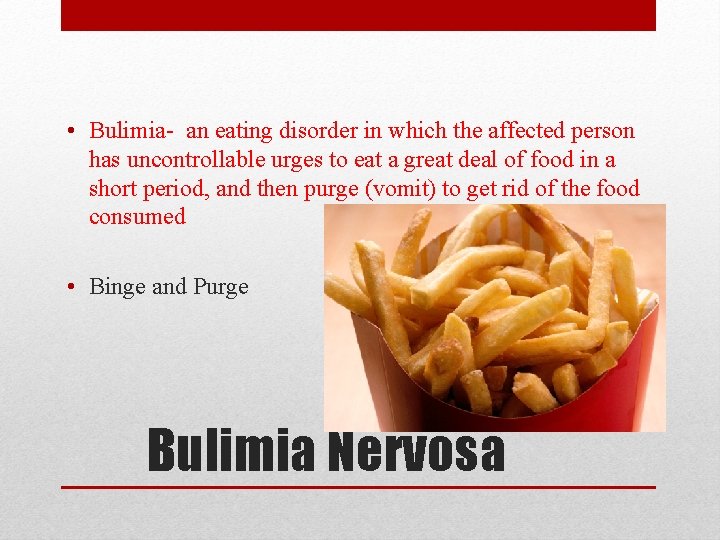
• Bulimia- an eating disorder in which the affected person has uncontrollable urges to eat a great deal of food in a short period, and then purge (vomit) to get rid of the food consumed • Binge and Purge Bulimia Nervosa
• People will eat, followed by vomiting, using laxatives or diuretics • Person may fast or engage in excessive exercise habits • Frequently feel ashamed of what they are doing • Usually keep their behavior a secret • About 80% of people with bulimia are female Bulimia
• Harms digestive system • Cause chemical imbalances that disrupt heart function • Harm to the esophagus due to vomiting • Wearing away of tooth enamel Bulimia and the body
• Seek assistance from a health professional • Possible psychiatric evaluation and help • Often need help for physical problems • Talk to an adult, family member or friend Get help for bulimia!!!
• LIST THE SIMILARITIES OF ANOREXIA AND BULIMIA ON A VENN DIAGRAM. CLASS ACTIVITY
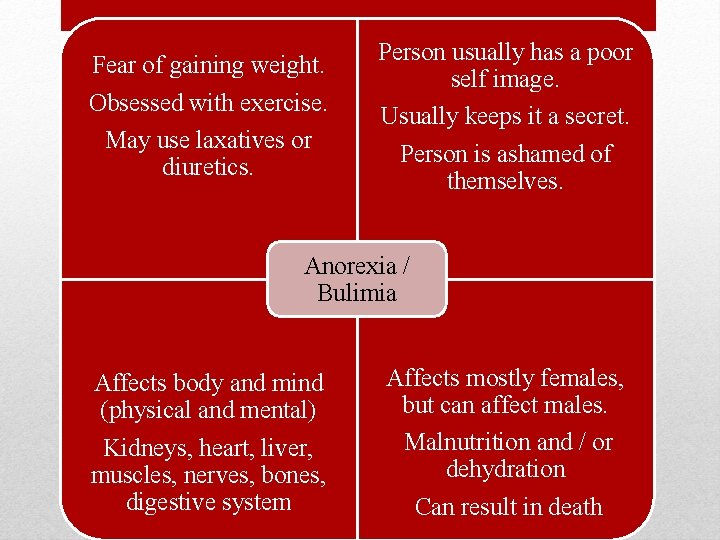
Fear of gaining weight. Obsessed with exercise. May use laxatives or diuretics. Person usually has a poor self image. Usually keeps it a secret. Person is ashamed of themselves. Anorexia / Bulimia Affects body and mind (physical and mental) Kidneys, heart, liver, muscles, nerves, bones, digestive system Affects mostly females, but can affect males. Malnutrition and / or dehydration Can result in death
• https: //www. youtube. com/watch? v=E 5 q. ZPe 8 Hux. I Video clips
- Slides: 17