
Body Defenses Nonspecific 12 b Think pair share
Body Defenses: Nonspecific 12 b
Think, pair, share • What parts of your body help you keep germs out? • Can you think of any body processes that help fight germs and disease?

Body Defenses · The body is constantly in contact with bacteria, fungi, and viruses · 1) The body has two defense systems foreign materials · Nonspecific defense system · Mechanisms protect against a variety of invaders · Responds immediately to protect body from foreign materials Copyright © 2003 Pearson Education, Inc. publishing as Benjamin Cummings Slide 12. 15 a
Body Defenses · 2) Specific defense system · Specific defense is required for each type of invader · Also known as the immune system Copyright © 2003 Pearson Education, Inc. publishing as Benjamin Cummings Slide 12. 15 b
Quick Quiz • Explain the difference between nonspecific and specific body defenses.

Nonspecific Body Defenses · Body surface coverings · Intact skin · Mucous membranes · Specialized human cells · Chemicals produced by the body Copyright © 2003 Pearson Education, Inc. publishing as Benjamin Cummings Slide 12. 16
First Line of Defense
Surface Membrane Barriers · The skin · Physical barrier to foreign materials · p. H of the skin is acidic to inhibit bacterial growth · Sebum (sweat) is toxic to bacteria · Vaginal secretions are very acidic Copyright © 2003 Pearson Education, Inc. publishing as Benjamin Cummings Slide 12. 17 a
Surface Membrane Barriers · Stomach mucosa · Secretes hydrochloric acid · Has protein-digesting enzymes · Saliva and lacrimal fluid contain lysozyme · Mucus traps microogranisms in digestive and respiratory pathways Copyright © 2003 Pearson Education, Inc. publishing as Benjamin Cummings Slide 12. 17 b
Quick Quiz • Which of the First Line of Defenses do you think is the most important any why?
Second Line of Defense
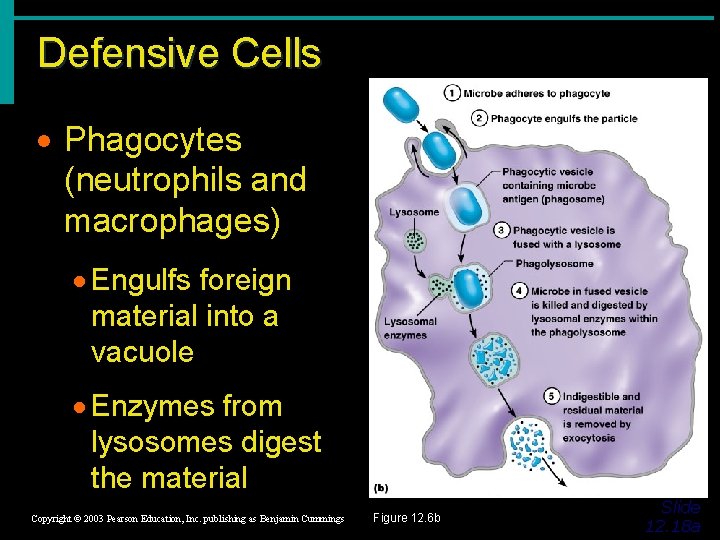
Defensive Cells · Phagocytes (neutrophils and macrophages) · Engulfs foreign material into a vacuole · Enzymes from lysosomes digest the material Copyright © 2003 Pearson Education, Inc. publishing as Benjamin Cummings Figure 12. 6 b Slide 12. 18 a
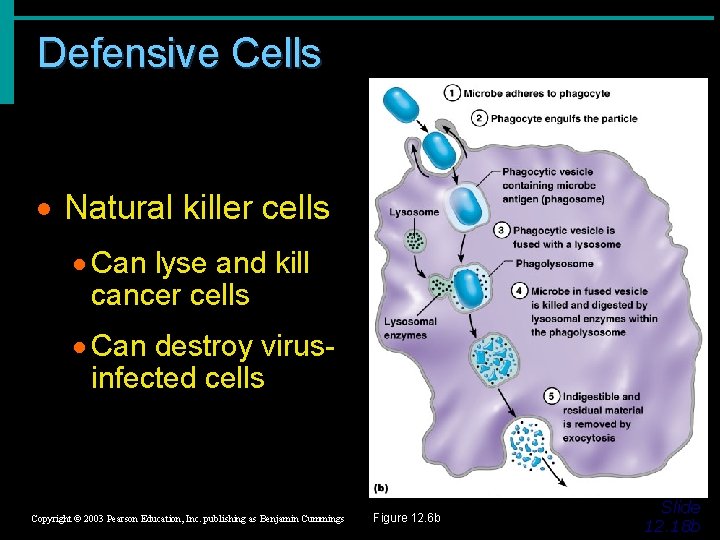
Defensive Cells · Natural killer cells · Can lyse and kill cancer cells · Can destroy virusinfected cells Copyright © 2003 Pearson Education, Inc. publishing as Benjamin Cummings Figure 12. 6 b Slide 12. 18 b
Inflammatory Response · Triggered when body tissues are injured · Produces four cardinal signs · Redness · Heat · Swelling (from increased blood flow and white blood cells in the damaged region) · Pain · Results in a chain of events leading to protection and healing Copyright © 2003 Pearson Education, Inc. publishing as Benjamin Cummings Slide 12. 19
Functions of the Inflammatory Response · Prevents spread of damaging agents · Disposes of cell debris and pathogens · Sets the stage for repair Copyright © 2003 Pearson Education, Inc. publishing as Benjamin Cummings Slide 12. 20
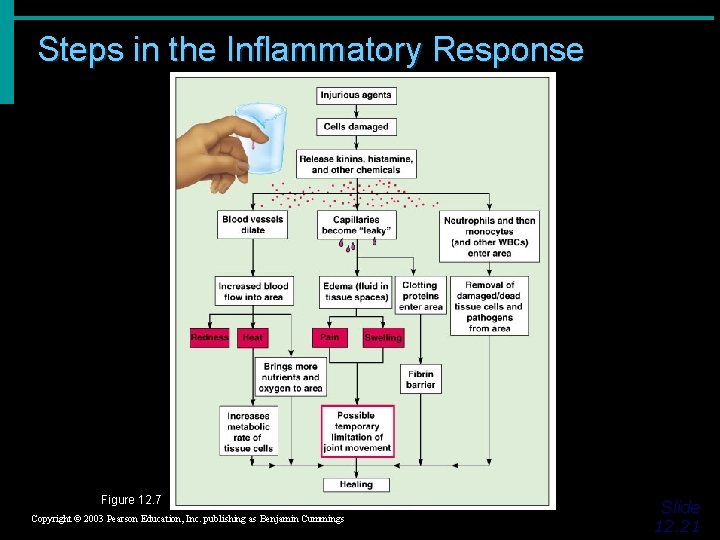
Steps in the Inflammatory Response Figure 12. 7 Copyright © 2003 Pearson Education, Inc. publishing as Benjamin Cummings Slide 12. 21
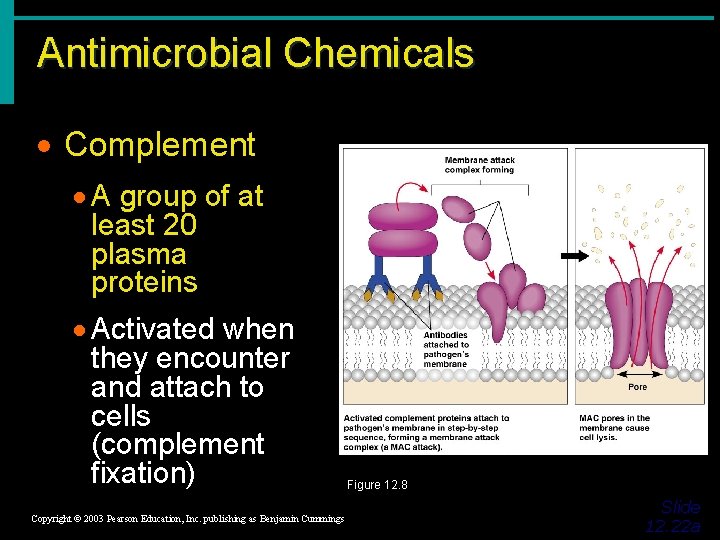
Antimicrobial Chemicals · Complement · A group of at least 20 plasma proteins · Activated when they encounter and attach to cells (complement fixation) Copyright © 2003 Pearson Education, Inc. publishing as Benjamin Cummings Figure 12. 8 Slide 12. 22 a
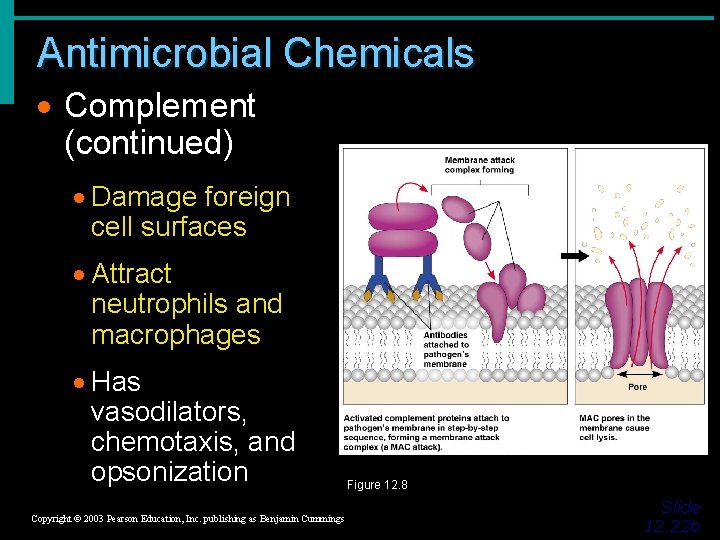
Antimicrobial Chemicals · Complement (continued) · Damage foreign cell surfaces · Attract neutrophils and macrophages · Has vasodilators, chemotaxis, and opsonization Copyright © 2003 Pearson Education, Inc. publishing as Benjamin Cummings Figure 12. 8 Slide 12. 22 b
Antimicrobial Chemicals · Interferon · Proteins secreted by cells that have been infected with a virus · The proteins bind to healthy cell surfaces to inhibit viruses binding to more cells Copyright © 2003 Pearson Education, Inc. publishing as Benjamin Cummings Slide 12. 22 c
Fever · Abnormally high body temperature · Hypothalmus heat regulation can be reset by pyrogens (secreted by white blood cells) · High temperatures inhibit the release of iron and zinc from liver and spleen needed by bacteria · Fever also increases the speed of tissue repair Copyright © 2003 Pearson Education, Inc. publishing as Benjamin Cummings Slide 12. 23
Quick Quiz • What are the functions of the inflammatory response? • How does fever help fight bacterial infections?
- Slides: 21