
BoBo doll experiment Bandura 1961 devised an experiment
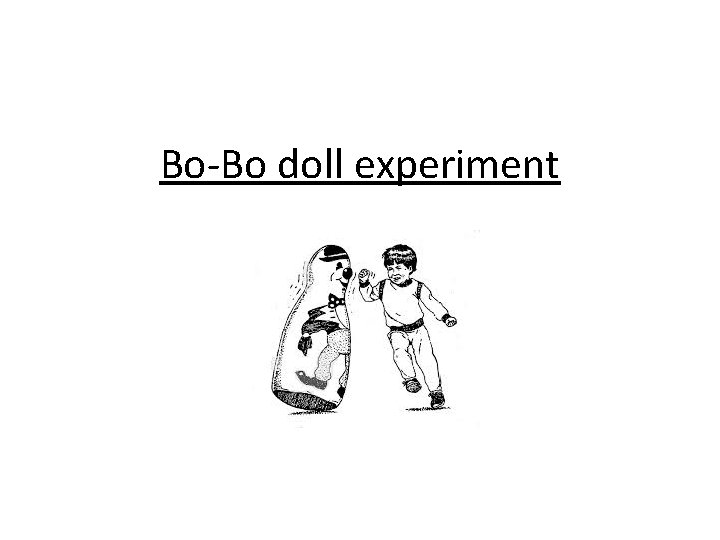
Bo-Bo doll experiment

Bandura (1961) devised an experiment to research if social behaviours could be acquired by observation and imitation, which are social theories of learning.
• The researchers pre-tested the children for how aggressive they were by observing the children in the nursery and judged their aggressive behaviour on four 5 -point rating scales. It was then possible to match the children in each group so that they had similar levels of aggression in their everyday behavior. The experiment is therefore an example of a matched pairs design.
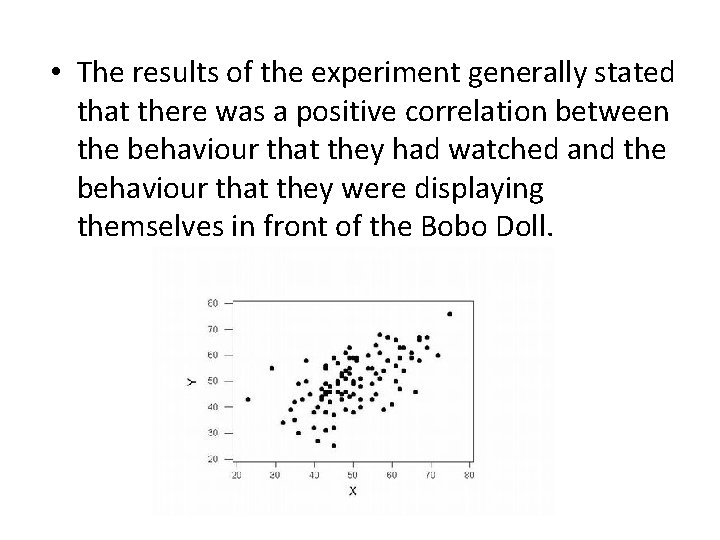
• The results of the experiment generally stated that there was a positive correlation between the behaviour that they had watched and the behaviour that they were displaying themselves in front of the Bobo Doll.

There are three main advantages of the experimental method. 1. Experiments are the only means by which cause and effect can be established. Thus it could be demonstrated that the model did have an effect on the child's subsequent behavior because all variables other than the independent variable are controlled. 2. It allows for precise control of variables. Many variables were controlled, such as the gender of the model, the time the children observed the model, the behavior of the model and so on. 3. Experiments can be replicated. Standardized procedures and instructions were used allowing for replicability. In fact the study has been replicated with slight changes, such as using videos and similar results were found (Bandura, 1963).
Limitations of the procedure include: 1. Many psychologists are very critical of laboratory studies of imitation - in particular because they tend to have low ecologically validity. The situation involves the child an adult model, which is a very limited social situation and there is no interaction between the child and the model at any point; certainly the child has no chance to influence the model in any way. Also the model and the child are strangers. This, of course, is quite unlike 'normal' modelling which often takes place within the family. 2. A further criticism of the study is that the demonstrations are measured almost immediately. With such snap shot studies we cannot discover if such a single exposure can have long-term effects. 3. It is possible to argue that the experiment was unethical. For example, there is the problem of whether or not the children suffered any long-term consequences as a result of the study. Although it is unlikely, we can never be certain.
• Adaptations of social learning theories can be used within coaching sessions as it could use the process of modelling and imitation to improve skills. • If a skilled coach displays a new technique Coachees are then able to imitate this behaviour in order for them to learn the skills themselves. • Banduras experiment has shown that modelled behaviour can be specifically imitated by others to enable to learn valuable new skills.
- Slides: 7