
Bob Gabriel Deloitte Tax LLP Trisha Hobler Deloitte
Bob Gabriel – Deloitte Tax LLP Trisha Hobler – Deloitte Tax LLP Tax Executives Institute May 2, 2017 Houston, Texas Accounting for Outside Basis Differences in Foreign Investments
Agenda Overview Calculating the DTL Disclosure of the outside basis difference Questions Copyright © 2017 Deloitte Development LLC. All rights reserved. 2

Overview 3
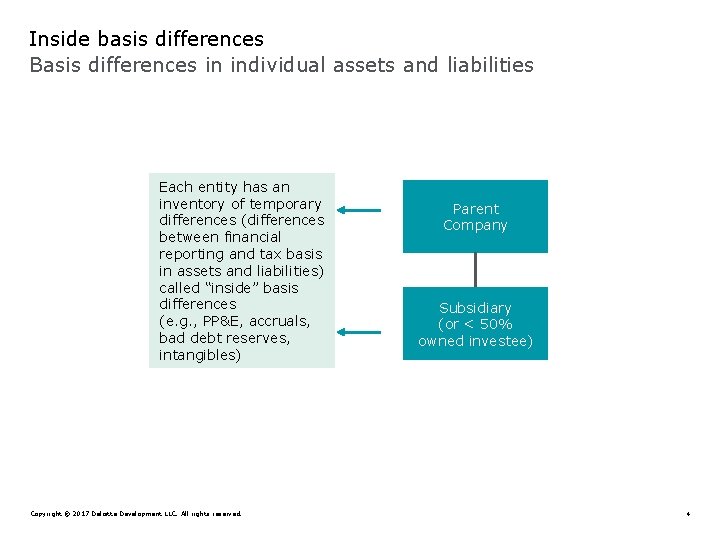
Inside basis differences Basis differences in individual assets and liabilities Each entity has an inventory of temporary differences (differences between financial reporting and tax basis in assets and liabilities) called “inside” basis differences (e. g. , PP&E, accruals, bad debt reserves, intangibles) Copyright © 2017 Deloitte Development LLC. All rights reserved. Parent Company Subsidiary (or < 50% owned investee) 4
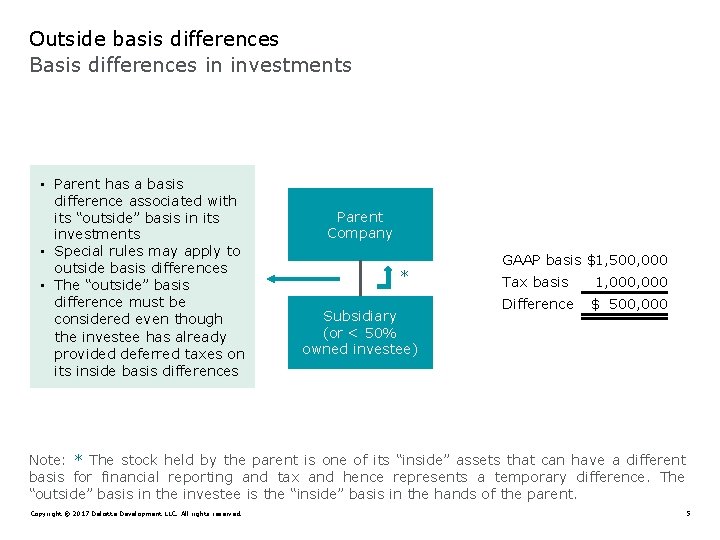
Outside basis differences Basis differences in investments • Parent has a basis difference associated with its “outside” basis in its investments • Special rules may apply to outside basis differences • The “outside” basis difference must be considered even though the investee has already provided deferred taxes on its inside basis differences Parent Company * Subsidiary (or < 50% owned investee) GAAP basis $1, 500, 000 Tax basis 1, 000 Difference $ 500, 000 Note: * The stock held by the parent is one of its “inside” assets that can have a different basis for financial reporting and tax and hence represents a temporary difference. The “outside” basis in the investee is the “inside” basis in the hands of the parent. Copyright © 2017 Deloitte Development LLC. All rights reserved. 5
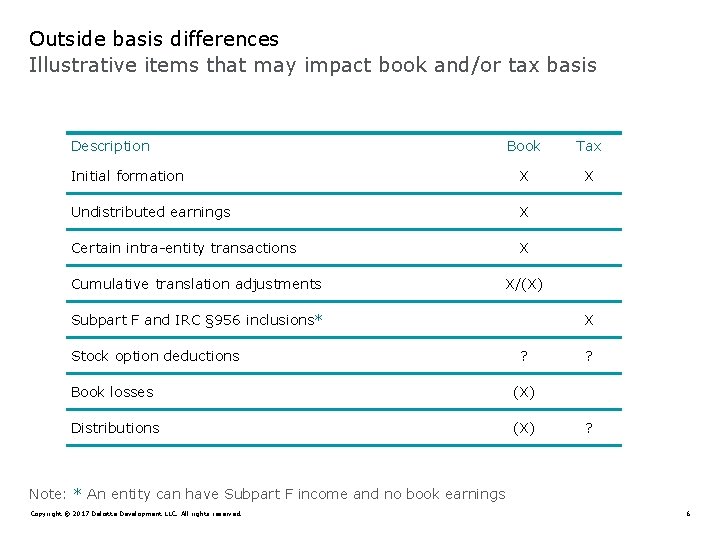
Outside basis differences Illustrative items that may impact book and/or tax basis Description Book Tax Initial formation X X Undistributed earnings X Certain intra-entity transactions X Cumulative translation adjustments X/(X) Subpart F and IRC § 956 inclusions* Stock option deductions X ? Book losses (X) Distributions (X) ? ? Note: * An entity can have Subpart F income and no book earnings Copyright © 2017 Deloitte Development LLC. All rights reserved. 6
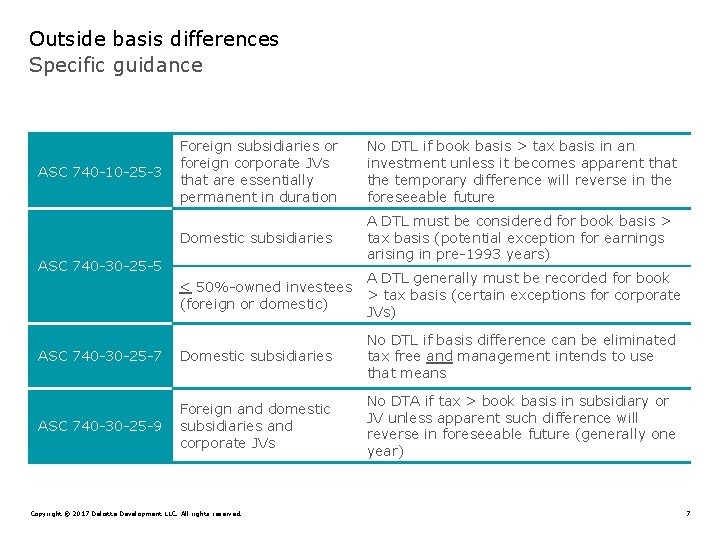
Outside basis differences Specific guidance ASC 740 -10 -25 -3 ASC 740 -30 -25 -5 Foreign subsidiaries or foreign corporate JVs that are essentially permanent in duration No DTL if book basis > tax basis in an investment unless it becomes apparent that the temporary difference will reverse in the foreseeable future Domestic subsidiaries A DTL must be considered for book basis > tax basis (potential exception for earnings arising in pre-1993 years) A DTL generally must be recorded for book < 50%-owned investees > tax basis (certain exceptions for corporate (foreign or domestic) JVs) ASC 740 -30 -25 -7 Domestic subsidiaries No DTL if basis difference can be eliminated tax free and management intends to use that means ASC 740 -30 -25 -9 Foreign and domestic subsidiaries and corporate JVs No DTA if tax > book basis in subsidiary or JV unless apparent such difference will reverse in foreseeable future (generally one year) Copyright © 2017 Deloitte Development LLC. All rights reserved. 7
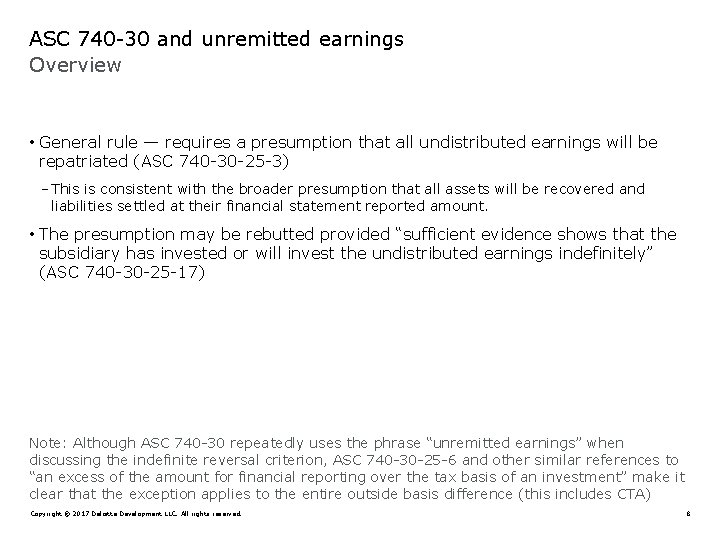
ASC 740 -30 and unremitted earnings Overview • General rule — requires a presumption that all undistributed earnings will be repatriated (ASC 740 -30 -25 -3) − This is consistent with the broader presumption that all assets will be recovered and liabilities settled at their financial statement reported amount. • The presumption may be rebutted provided “sufficient evidence shows that the subsidiary has invested or will invest the undistributed earnings indefinitely” (ASC 740 -30 -25 -17) Note: Although ASC 740 -30 repeatedly uses the phrase “unremitted earnings” when discussing the indefinite reversal criterion, ASC 740 -30 -25 -6 and other similar references to “an excess of the amount for financial reporting over the tax basis of an investment” make it clear that the exception applies to the entire outside basis difference (this includes CTA) Copyright © 2017 Deloitte Development LLC. All rights reserved. 8
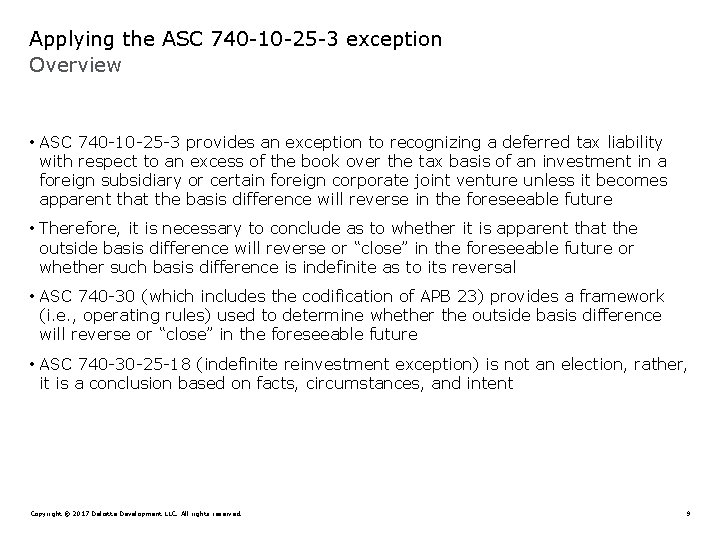
Applying the ASC 740 -10 -25 -3 exception Overview • ASC 740 -10 -25 -3 provides an exception to recognizing a deferred tax liability with respect to an excess of the book over the tax basis of an investment in a foreign subsidiary or certain foreign corporate joint venture unless it becomes apparent that the basis difference will reverse in the foreseeable future • Therefore, it is necessary to conclude as to whether it is apparent that the outside basis difference will reverse or “close” in the foreseeable future or whether such basis difference is indefinite as to its reversal • ASC 740 -30 (which includes the codification of APB 23) provides a framework (i. e. , operating rules) used to determine whether the outside basis difference will reverse or “close” in the foreseeable future • ASC 740 -30 -25 -18 (indefinite reinvestment exception) is not an election, rather, it is a conclusion based on facts, circumstances, and intent Copyright © 2017 Deloitte Development LLC. All rights reserved. 9
ASC 740 -30 and unremitted earnings General rules • Commitment to offshore investment must be supported by “evidence of specific plans for reinvestment of undistributed earnings of a subsidiary which demonstrate that remittance of earnings will be postponed indefinitely” (ASC 740 -30 -25 -17) − Plans must be specific and identifiable − Plans must be viable − Plans must be in writing • If circumstances change and it becomes apparent that some or all of the undistributed earnings of a subsidiary will be remitted in the foreseeable future (but income taxes have not been recognized), taxes attributable to that remittance should be accrued as an expense in the current period • Indefinite reinvestment exception is not “an all or nothing” proposition − A portion of unremitted earnings may be “indefinitely reinvested” − Specific amounts of earnings may be designated as indefinitely reinvested Copyright © 2017 Deloitte Development LLC. All rights reserved. 10
ASC 740 -30 and unremitted earnings Considerations ASC 740 -30 -05 -4 provides the following list of factors entities should consider in determining whether to repatriate earnings • Financial requirements of the parent company • Financial requirements of the subsidiary • Operational and fiscal objectives of the parent company, both long-term and short-term • Remittance restrictions imposed by governments • Remittance restrictions imposed by lease or financing agreements of the subsidiary • Tax consequences of the remittance Copyright © 2017 Deloitte Development LLC. All rights reserved. 11
Documenting the reinvestment assertion Considerations • An entity’s documented plan for reinvestment of foreign earnings would enable it to overcome the presumption that all undistributed earnings of a foreign subsidiary will be transferred to the parent entity (ASC 740‐ 30‐ 25‐ 17) − An entity should demonstrate that the foreign subsidiary has both the intent and ability to indefinitely reinvest undistributed earnings − Past experience with the entity, in and of itself, would not be sufficient for an entity to overcome the presumption • In documenting its written plan, an entity should consider all facts and circumstances, including factors provided in ASC 740 -30 -05 -4 Copyright © 2017 Deloitte Development LLC. All rights reserved. 12
ASC 740 -30 and unremitted earnings Documentation Examples of documentation to support the ASC 740 -30 position [1] • Management intentions[2] • Past experience • Working capital forecasts • EBITDA or cash flow projections by location • Long-term liquidity plans • Capital improvements plans • Merger and acquisition plans • Investment plans Notes [1] ASC 740 -10 -25 -3(a) and ASC 740 -30 are not elections [2] Supporting facts and circumstances regarding management’s intent requires representation in order to evidence that intent Copyright © 2017 Deloitte Development LLC. All rights reserved. 13
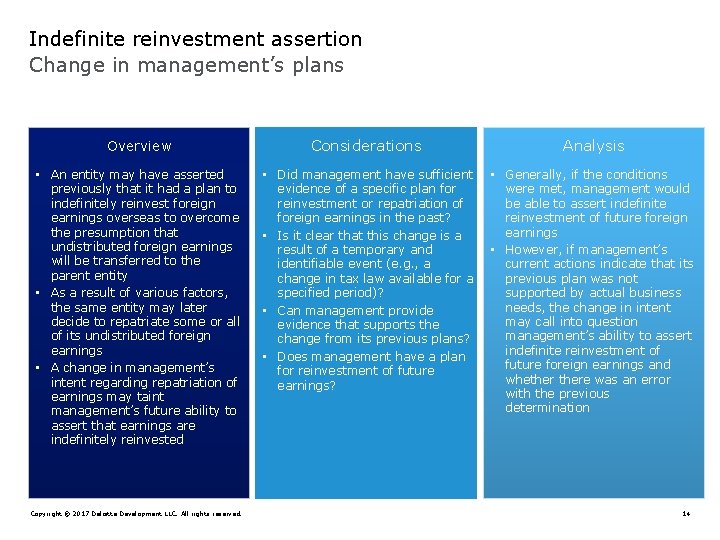
Indefinite reinvestment assertion Change in management’s plans Overview • An entity may have asserted previously that it had a plan to indefinitely reinvest foreign earnings overseas to overcome the presumption that undistributed foreign earnings will be transferred to the parent entity • As a result of various factors, the same entity may later decide to repatriate some or all of its undistributed foreign earnings • A change in management’s intent regarding repatriation of earnings may taint management’s future ability to assert that earnings are indefinitely reinvested Copyright © 2017 Deloitte Development LLC. All rights reserved. Considerations • Did management have sufficient evidence of a specific plan for reinvestment or repatriation of foreign earnings in the past? • Is it clear that this change is a result of a temporary and identifiable event (e. g. , a change in tax law available for a specified period)? • Can management provide evidence that supports the change from its previous plans? • Does management have a plan for reinvestment of future earnings? Analysis • Generally, if the conditions were met, management would be able to assert indefinite reinvestment of future foreign earnings • However, if management’s current actions indicate that its previous plan was not supported by actual business needs, the change in intent may call into question management’s ability to assert indefinite reinvestment of future foreign earnings and whethere was an error with the previous determination 14
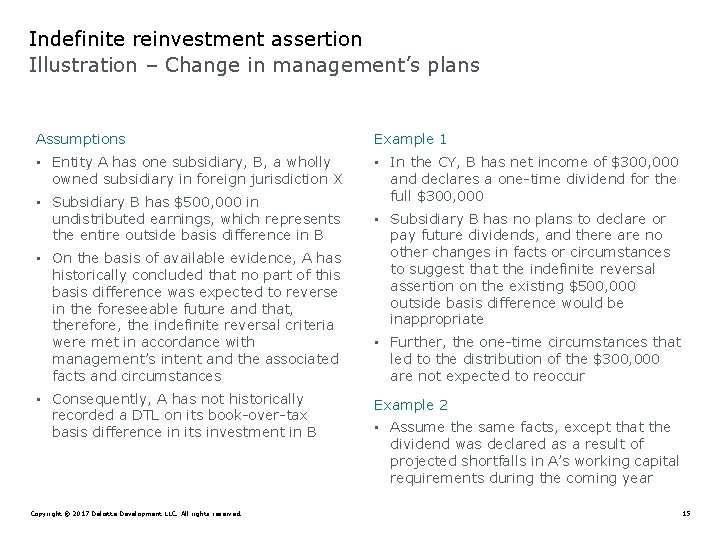
Indefinite reinvestment assertion Illustration – Change in management’s plans Assumptions Example 1 • Entity A has one subsidiary, B, a wholly owned subsidiary in foreign jurisdiction X • In the CY, B has net income of $300, 000 and declares a one-time dividend for the full $300, 000 • Subsidiary B has $500, 000 in undistributed earnings, which represents the entire outside basis difference in B • On the basis of available evidence, A has historically concluded that no part of this basis difference was expected to reverse in the foreseeable future and that, therefore, the indefinite reversal criteria were met in accordance with management’s intent and the associated facts and circumstances • Consequently, A has not historically recorded a DTL on its book-over-tax basis difference in its investment in B Copyright © 2017 Deloitte Development LLC. All rights reserved. • Subsidiary B has no plans to declare or pay future dividends, and there are no other changes in facts or circumstances to suggest that the indefinite reversal assertion on the existing $500, 000 outside basis difference would be inappropriate • Further, the one-time circumstances that led to the distribution of the $300, 000 are not expected to reoccur Example 2 • Assume the same facts, except that the dividend was declared as a result of projected shortfalls in A’s working capital requirements during the coming year 15
Calculating the DTL 16
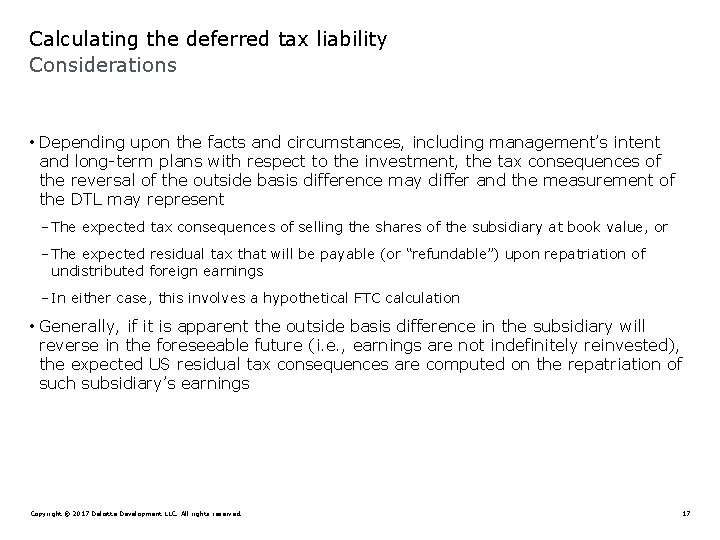
Calculating the deferred tax liability Considerations • Depending upon the facts and circumstances, including management’s intent and long-term plans with respect to the investment, the tax consequences of the reversal of the outside basis difference may differ and the measurement of the DTL may represent − The expected tax consequences of selling the shares of the subsidiary at book value, or − The expected residual tax that will be payable (or “refundable”) upon repatriation of undistributed foreign earnings − In either case, this involves a hypothetical FTC calculation • Generally, if it is apparent the outside basis difference in the subsidiary will reverse in the foreseeable future (i. e. , earnings are not indefinitely reinvested), the expected US residual tax consequences are computed on the repatriation of such subsidiary’s earnings Copyright © 2017 Deloitte Development LLC. All rights reserved. 17
Calculating the deferred tax liability Bottoms up • Consider all entities in the organization chart − Essentially start with the lowest tier entity in the organization chart and determine whether such entity’s consolidating shareholder has a higher financial reporting carrying amount than tax basis − After considering the consequences of that level, move up the chain to the next highest entity and so on until reaching the reporting entity − Consider whether the particular subsidiary and its consolidating shareholder are residents of the same country for income tax purposes to determine whether to apply the literature applicable to foreign or domestic subsidiaries • Consider withholding tax that would be applicable in distributing unremitted earnings of a foreign subsidiary to its consolidating shareholder Copyright © 2017 Deloitte Development LLC. All rights reserved. 18
Components of the deferred tax liability calculation Steps Step 1 • Determine the hypothetical repatriation amount (the amount of the outside basis difference that will reverse) − Book earnings or tax E&P or something else? Step 2 • Determine the resulting taxable income inclusion − Book earning or tax E&P or something else? Step 3 • Determine the applicable FTC − Actual tax credit pool − What about deferred taxes? Copyright © 2017 Deloitte Development LLC. All rights reserved. 19
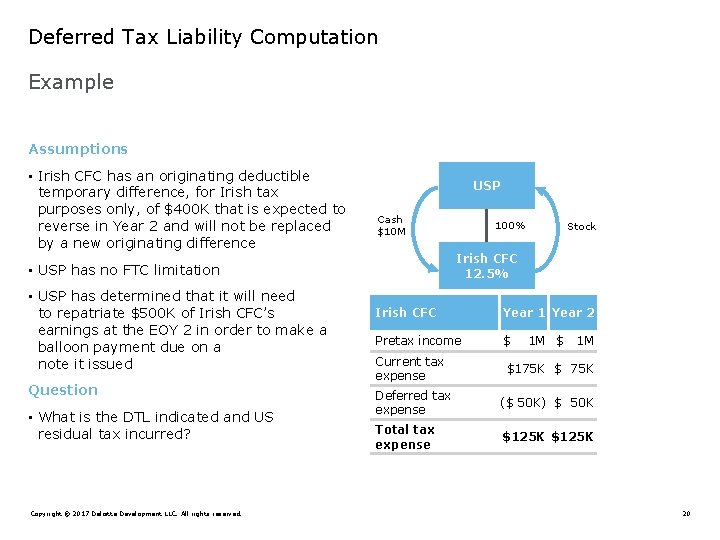
Deferred Tax Liability Computation Example Assumptions • Irish CFC has an originating deductible temporary difference, for Irish tax purposes only, of $400 K that is expected to reverse in Year 2 and will not be replaced by a new originating difference USP Cash $10 M Question • What is the DTL indicated and US residual tax incurred? Copyright © 2017 Deloitte Development LLC. All rights reserved. Stock Irish CFC 12. 5% • USP has no FTC limitation • USP has determined that it will need to repatriate $500 K of Irish CFC’s earnings at the EOY 2 in order to make a balloon payment due on a note it issued 100% Irish CFC Year 1 Year 2 Pretax income $ 1 M Current tax expense $175 K $ 75 K Deferred tax expense ($ 50 K) $ 50 K Total tax expense $125 K 20
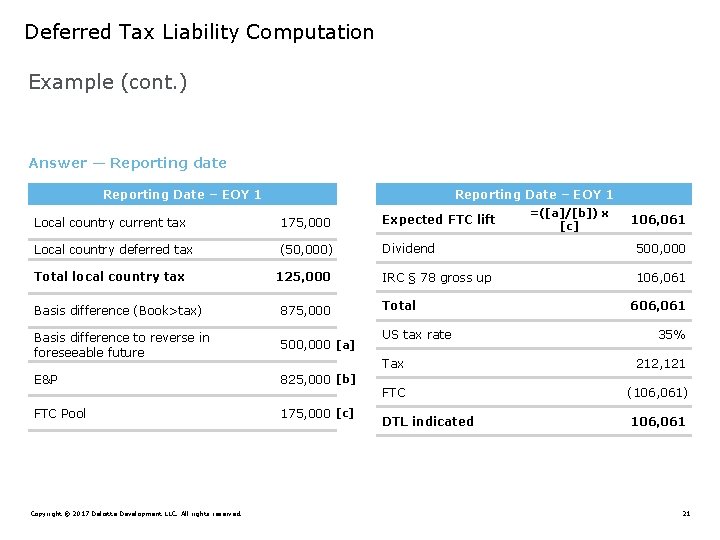
Deferred Tax Liability Computation Example (cont. ) Answer — Reporting date Reporting Date – EOY 1 =([a]/[b]) x [c] Local country current tax 175, 000 Expected FTC lift Local country deferred tax (50, 000) Dividend 500, 000 IRC § 78 gross up 106, 061 Total local country tax 125, 000 Basis difference (Book>tax) 875, 000 Basis difference to reverse in foreseeable future 500, 000 [a] E&P 825, 000 [b] FTC Pool 175, 000 [c] Copyright © 2017 Deloitte Development LLC. All rights reserved. Total US tax rate 106, 061 606, 061 35% Tax 212, 121 FTC (106, 061) DTL indicated 106, 061 21
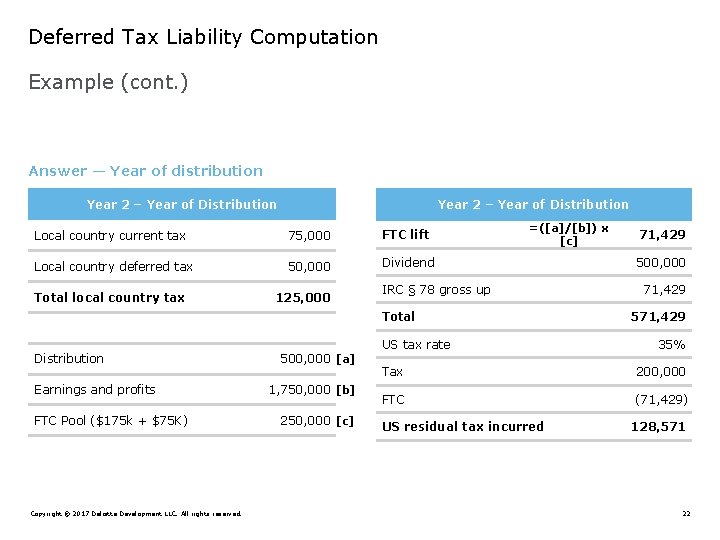
Deferred Tax Liability Computation Example (cont. ) Answer — Year of distribution Year 2 – Year of Distribution Local country current tax Local country deferred tax Total local country tax Year 2 – Year of Distribution 75, 000 FTC lift 50, 000 Dividend 125, 000 =([a]/[b]) x [c] IRC § 78 gross up Total Distribution Earnings and profits FTC Pool ($175 k + $75 K) Copyright © 2017 Deloitte Development LLC. All rights reserved. 500, 000 [a] 1, 750, 000 [b] 250, 000 [c] US tax rate 71, 429 500, 000 71, 429 571, 429 35% Tax 200, 000 FTC (71, 429) US residual tax incurred 128, 571 22
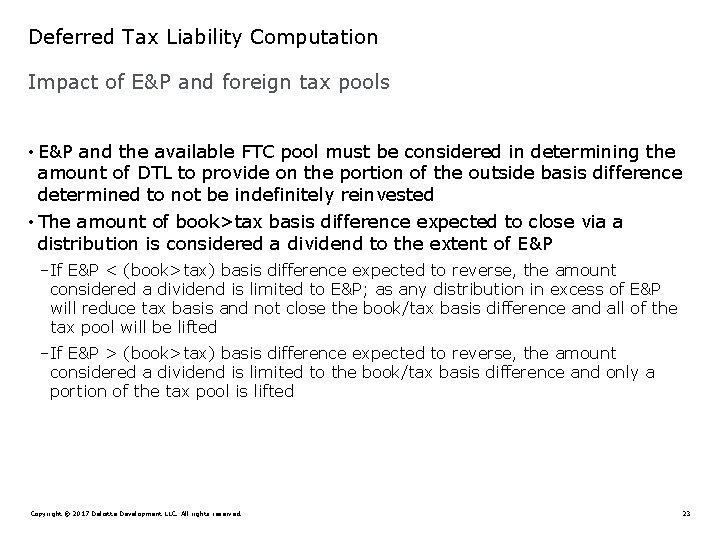
Deferred Tax Liability Computation Impact of E&P and foreign tax pools • E&P and the available FTC pool must be considered in determining the amount of DTL to provide on the portion of the outside basis difference determined to not be indefinitely reinvested • The amount of book>tax basis difference expected to close via a distribution is considered a dividend to the extent of E&P −If E&P < (book>tax) basis difference expected to reverse, the amount considered a dividend is limited to E&P; as any distribution in excess of E&P will reduce tax basis and not close the book/tax basis difference and all of the tax pool will be lifted −If E&P > (book>tax) basis difference expected to reverse, the amount considered a dividend is limited to the book/tax basis difference and only a portion of the tax pool is lifted Copyright © 2017 Deloitte Development LLC. All rights reserved. 23
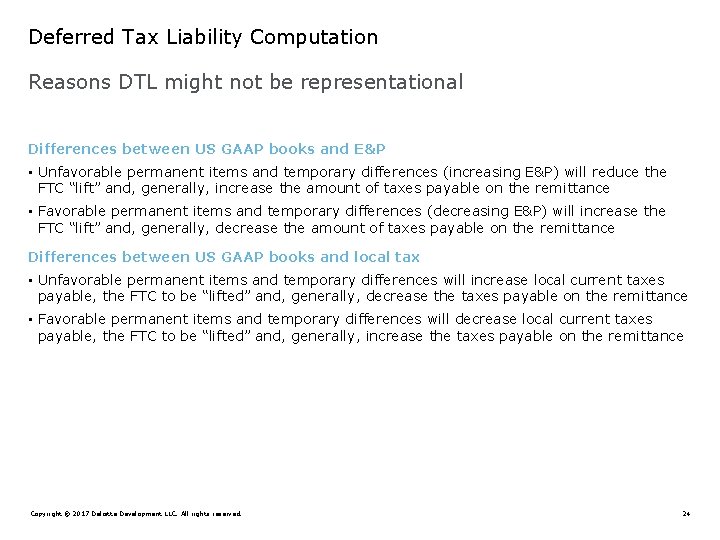
Deferred Tax Liability Computation Reasons DTL might not be representational Differences between US GAAP books and E&P • Unfavorable permanent items and temporary differences (increasing E&P) will reduce the FTC “lift” and, generally, increase the amount of taxes payable on the remittance • Favorable permanent items and temporary differences (decreasing E&P) will increase the FTC “lift” and, generally, decrease the amount of taxes payable on the remittance Differences between US GAAP books and local tax • Unfavorable permanent items and temporary differences will increase local current taxes payable, the FTC to be “lifted” and, generally, decrease the taxes payable on the remittance • Favorable permanent items and temporary differences will decrease local current taxes payable, the FTC to be “lifted” and, generally, increase the taxes payable on the remittance Copyright © 2017 Deloitte Development LLC. All rights reserved. 24
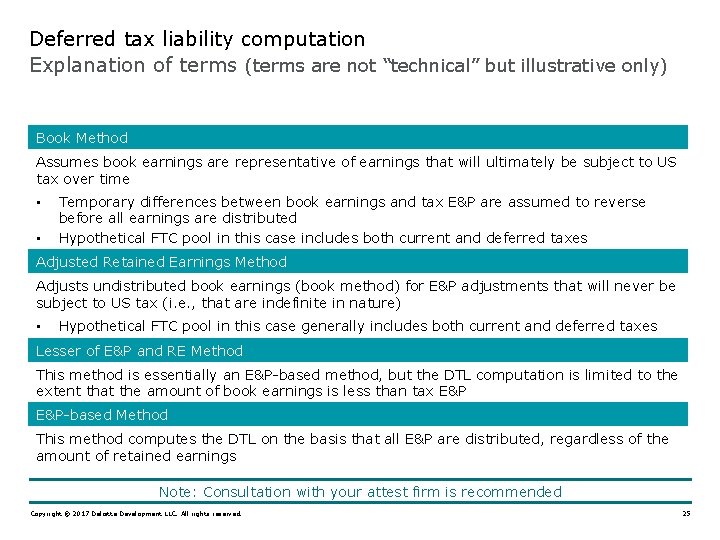
Deferred tax liability computation Explanation of terms (terms are not “technical” but illustrative only) Book Method Assumes book earnings are representative of earnings that will ultimately be subject to US tax over time • • Temporary differences between book earnings and tax E&P are assumed to reverse before all earnings are distributed Hypothetical FTC pool in this case includes both current and deferred taxes Adjusted Retained Earnings Method Adjusts undistributed book earnings (book method) for E&P adjustments that will never be subject to US tax (i. e. , that are indefinite in nature) • Hypothetical FTC pool in this case generally includes both current and deferred taxes Lesser of E&P and RE Method This method is essentially an E&P-based method, but the DTL computation is limited to the extent that the amount of book earnings is less than tax E&P-based Method This method computes the DTL on the basis that all E&P are distributed, regardless of the amount of retained earnings Note: Consultation with your attest firm is recommended Copyright © 2017 Deloitte Development LLC. All rights reserved. 25

Disclosure of the outside basis difference 26
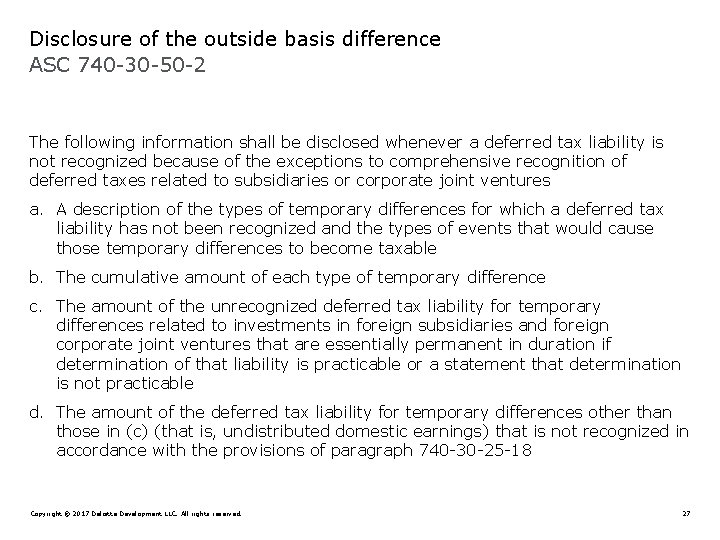
Disclosure of the outside basis difference ASC 740 -30 -50 -2 The following information shall be disclosed whenever a deferred tax liability is not recognized because of the exceptions to comprehensive recognition of deferred taxes related to subsidiaries or corporate joint ventures a. A description of the types of temporary differences for which a deferred tax liability has not been recognized and the types of events that would cause those temporary differences to become taxable b. The cumulative amount of each type of temporary difference c. The amount of the unrecognized deferred tax liability for temporary differences related to investments in foreign subsidiaries and foreign corporate joint ventures that are essentially permanent in duration if determination of that liability is practicable or a statement that determination is not practicable d. The amount of the deferred tax liability for temporary differences other than those in (c) (that is, undistributed domestic earnings) that is not recognized in accordance with the provisions of paragraph 740 -30 -25 -18 Copyright © 2017 Deloitte Development LLC. All rights reserved. 27
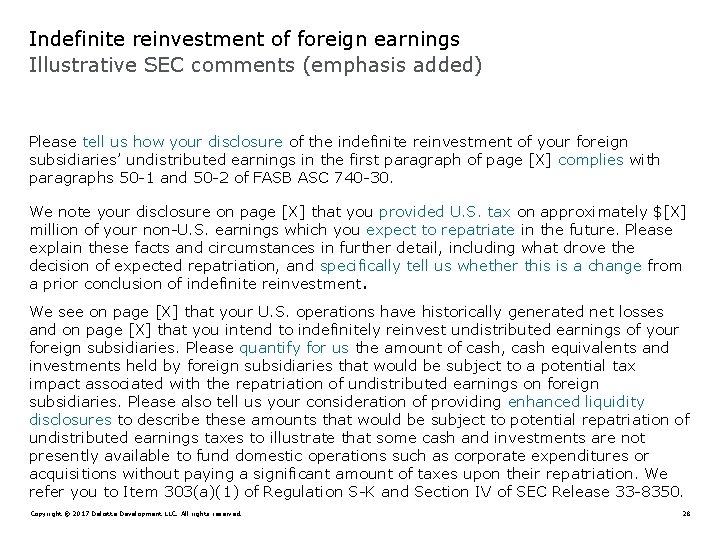
Indefinite reinvestment of foreign earnings Illustrative SEC comments (emphasis added) Please tell us how your disclosure of the indefinite reinvestment of your foreign subsidiaries’ undistributed earnings in the first paragraph of page [X] complies with paragraphs 50 -1 and 50 -2 of FASB ASC 740 -30. We note your disclosure on page [X] that you provided U. S. tax on approximately $[X] million of your non-U. S. earnings which you expect to repatriate in the future. Please explain these facts and circumstances in further detail, including what drove the decision of expected repatriation, and specifically tell us whether this is a change from a prior conclusion of indefinite reinvestment. We see on page [X] that your U. S. operations have historically generated net losses and on page [X] that you intend to indefinitely reinvest undistributed earnings of your foreign subsidiaries. Please quantify for us the amount of cash, cash equivalents and investments held by foreign subsidiaries that would be subject to a potential tax impact associated with the repatriation of undistributed earnings on foreign subsidiaries. Please also tell us your consideration of providing enhanced liquidity disclosures to describe these amounts that would be subject to potential repatriation of undistributed earnings taxes to illustrate that some cash and investments are not presently available to fund domestic operations such as corporate expenditures or acquisitions without paying a significant amount of taxes upon their repatriation. We refer you to Item 303(a)(1) of Regulation S-K and Section IV of SEC Release 33 -8350. Copyright © 2017 Deloitte Development LLC. All rights reserved. 28
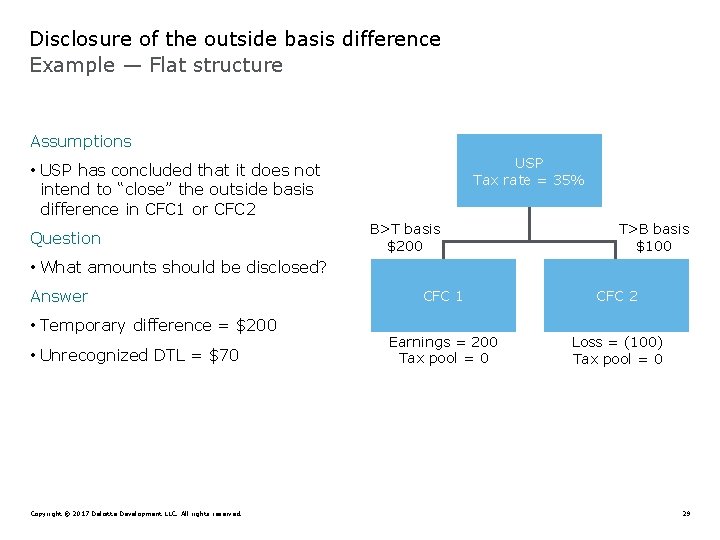
Disclosure of the outside basis difference Example — Flat structure Assumptions USP Tax rate = 35% • USP has concluded that it does not intend to “close” the outside basis difference in CFC 1 or CFC 2 Question B>T basis $200 T>B basis $100 • What amounts should be disclosed? Answer • Temporary difference = $200 • Unrecognized DTL = $70 Copyright © 2017 Deloitte Development LLC. All rights reserved. CFC 1 CFC 2 Earnings = 200 Tax pool = 0 Loss = (100) Tax pool = 0 29
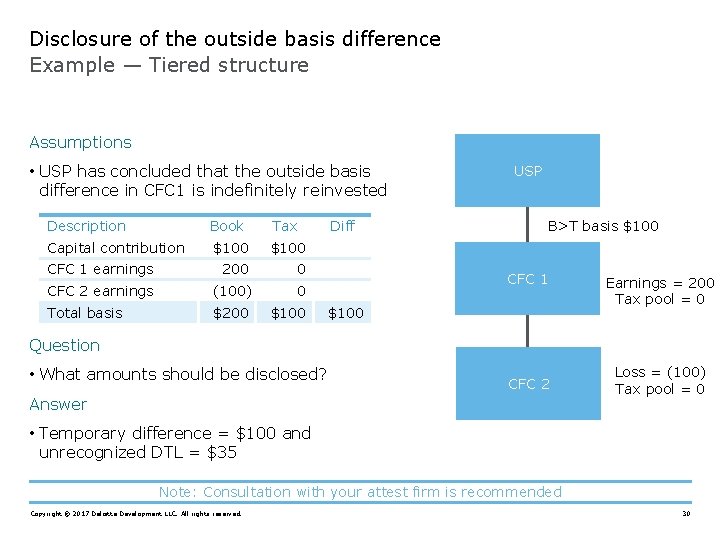
Disclosure of the outside basis difference Example — Tiered structure Assumptions • USP has concluded that the outside basis difference in CFC 1 is indefinitely reinvested Description Book Tax Diff Capital contribution $100 CFC 1 earnings 200 0 CFC 2 earnings (100) 0 Total basis $200 $100 USP B>T basis $100 CFC 1 $100 Earnings = 200 Tax pool = 0 Question • What amounts should be disclosed? CFC 2 Answer Loss = (100) Tax pool = 0 • Temporary difference = $100 and unrecognized DTL = $35 Note: Consultation with your attest firm is recommended Copyright © 2017 Deloitte Development LLC. All rights reserved. 30
Income tax disclosures Proposed ASU — Indefinitely reinvested foreign earnings Disclose (all entities) • Amount of undistributed foreign earnings for which there is a change in assertion during the period regarding indefinite reinvestment of such earnings and explain circumstances that caused such assertion change* • The aggregate of cash, cash equivalents, and marketable securities held by foreign subsidiaries* Note: * Commonly requested in SEC comments Copyright © 2017 Deloitte Development LLC. All rights reserved. 31
Income tax disclosures Proposed ASU — Disclosures about foreign and domestic amounts Disclose (all entities) • Pretax income (or loss) from continuing operations disaggregated by foreign and domestic amounts* • Disaggregation of income tax expense (benefit) between foreign and domestic jurisdictions* • Disaggregation of the income taxes paid between foreign/domestic jurisdictions − Foreign income taxes paid further disaggregated for any country significant to total Note: * Existing requirement in SEC regulations Copyright © 2017 Deloitte Development LLC. All rights reserved. 32
Income tax disclosures Proposed ASU — Income tax disclosures Transition guidance • The proposed amendments would be applied on a prospective basis Effective date • An effective date will be determined after consideration of all stakeholder feedback Comment period • The proposed ASU comment period ended on September 30, 2016 Copyright © 2017 Deloitte Development LLC. All rights reserved. 33

Copyright © 2017 Deloitte Development LLC. All rights reserved. 34
Bob Gabriel Bob is a Tax Partner in the Business Tax Services practice and has more than 15 years of experience in public accounting providing services to public and private clients in a variety of industries including integrated energy, oilfield service, engineering and construction, and manufacturing and distribution. Bob specializes in accounting for income taxes and assists clients with tax process and systems improvements and global tax provision issues including tax basis balance sheet analysis, currency issues, and uncertain tax positions. Bob has been an instructor and speaker at internal and external tax training sessions relating to income tax accounting issues including the Tax Executive Institute and Deloitte’s Financial Reporting of Taxes Dbrief Series for Tax Executives. Bob received a Bachelor of Business Administration degree and a Masters in Professional Accounting from the University of Texas at Austin. rgabriel@deloitte. com Copyright © 2017 Deloitte Development LLC. All rights reserved. 35
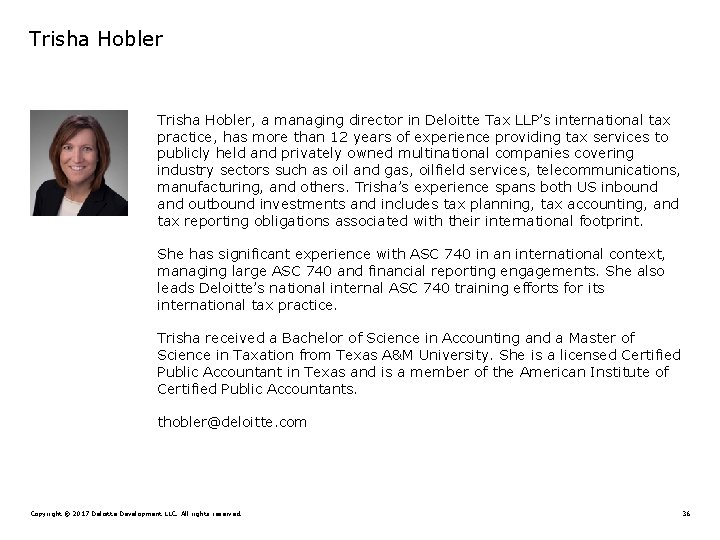
Trisha Hobler, a managing director in Deloitte Tax LLP’s international tax practice, has more than 12 years of experience providing tax services to publicly held and privately owned multinational companies covering industry sectors such as oil and gas, oilfield services, telecommunications, manufacturing, and others. Trisha’s experience spans both US inbound and outbound investments and includes tax planning, tax accounting, and tax reporting obligations associated with their international footprint. She has significant experience with ASC 740 in an international context, managing large ASC 740 and financial reporting engagements. She also leads Deloitte’s national internal ASC 740 training efforts for its international tax practice. Trisha received a Bachelor of Science in Accounting and a Master of Science in Taxation from Texas A&M University. She is a licensed Certified Public Accountant in Texas and is a member of the American Institute of Certified Public Accountants. thobler@deloitte. com Copyright © 2017 Deloitte Development LLC. All rights reserved. 36

This presentation contains general information only and Deloitte is not, by means of this presentation, rendering accounting, business, financial, investment, legal, tax, or other professional advice or services. This presentation is not a substitute for such professional advice or services, nor should it be used as a basis for any decision or action that may affect your business. Before making any decision or taking any action that may affect your business, you should consult a qualified professional advisor. Deloitte shall not be responsible for any loss sustained by any person who relies on this presentation. Copyright © 2017 Deloitte Development LLC. All rights reserved. 37

About Deloitte refers to one or more of Deloitte Touche Tohmatsu Limited, a UK private company limited by guarantee (“DTTL”), its network of member firms, and their related entities. DTTL and each of its member firms are legally separate and independent entities. DTTL (also referred to as “Deloitte Global”) does not provide services to clients. Please see www. deloitte. com/about for a detailed description of DTTL and its member firms. Please see www. deloitte. com/us/about for a detailed description of the legal structure of Deloitte LLP and its subsidiaries. Certain services may not be available to attest clients under the rules and regulations of public accounting. Copyright © 2016 Deloitte Development LLC. All rights reserved. Member of Deloitte Touche Tohmatsu Limited
- Slides: 38