
Bob Gabriel Deloitte Tax LLP Paul Rasmussen Deloitte

Bob Gabriel – Deloitte Tax LLP Paul Rasmussen – Deloitte Tax LLP Tax Executives Institute May 2, 2017 Houston, TX Accounting for Investments in Pass -through Entities
Agenda Overview Measuring deferred taxes for investments in pass-through entities Other considerations Tax receivable agreements Questions Copyright © 2017 Deloitte Development LLC. All rights reserved. 2

Pass-through entities — Overview 3
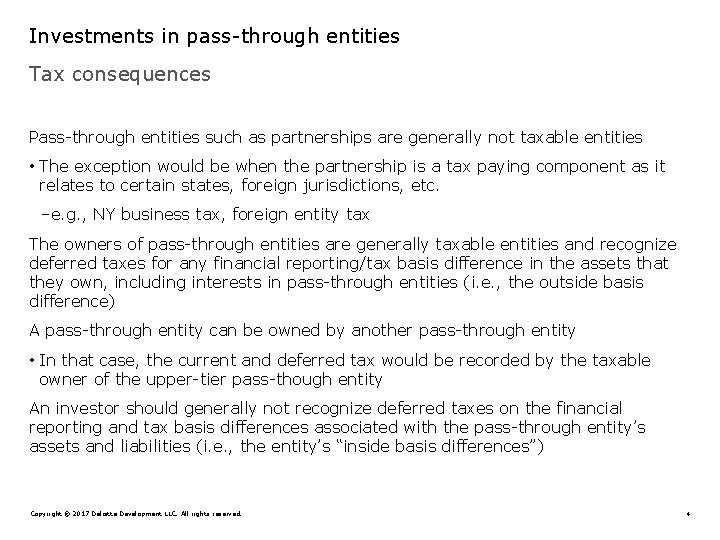
Investments in pass-through entities Tax consequences Pass-through entities such as partnerships are generally not taxable entities • The exception would be when the partnership is a tax paying component as it relates to certain states, foreign jurisdictions, etc. −e. g. , NY business tax, foreign entity tax The owners of pass-through entities are generally taxable entities and recognize deferred taxes for any financial reporting/tax basis difference in the assets that they own, including interests in pass-through entities (i. e. , the outside basis difference) A pass-through entity can be owned by another pass-through entity • In that case, the current and deferred tax would be recorded by the taxable owner of the upper-tier pass-though entity An investor should generally not recognize deferred taxes on the financial reporting and tax basis differences associated with the pass-through entity’s assets and liabilities (i. e. , the entity’s “inside basis differences”) Copyright © 2017 Deloitte Development LLC. All rights reserved. 4
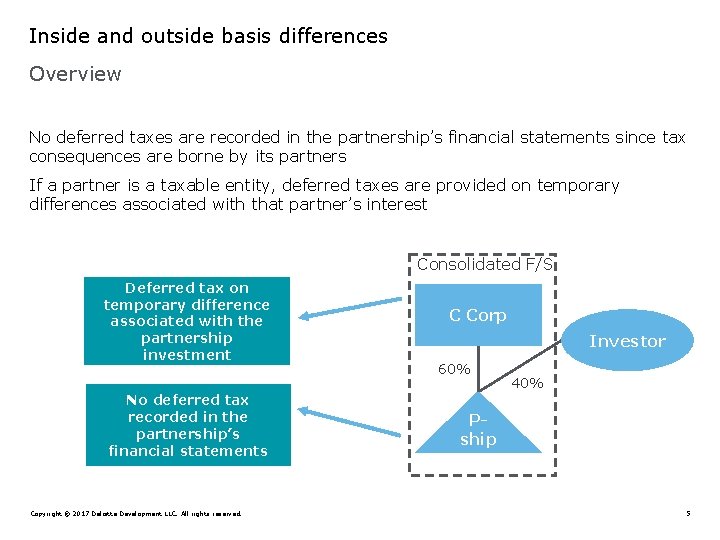
Inside and outside basis differences Overview No deferred taxes are recorded in the partnership’s financial statements since tax consequences are borne by its partners If a partner is a taxable entity, deferred taxes are provided on temporary differences associated with that partner’s interest Consolidated F/S Deferred tax on temporary difference associated with the partnership investment No deferred tax recorded in the partnership’s financial statements Copyright © 2017 Deloitte Development LLC. All rights reserved. C Corp Investor 60% 40% Pship P-Ship 5
Measuring deferred taxes for investments in pass‐through entities 6
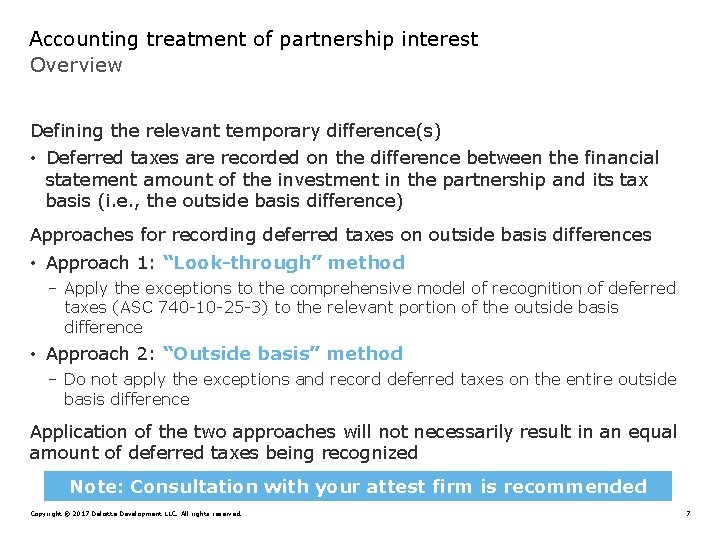
Accounting treatment of partnership interest Overview Defining the relevant temporary difference(s) • Deferred taxes are recorded on the difference between the financial statement amount of the investment in the partnership and its tax basis (i. e. , the outside basis difference) Approaches for recording deferred taxes on outside basis differences • Approach 1: “Look-through” method − Apply the exceptions to the comprehensive model of recognition of deferred taxes (ASC 740 -10 -25 -3) to the relevant portion of the outside basis difference • Approach 2: “Outside basis” method − Do not apply the exceptions and record deferred taxes on the entire outside basis difference Application of the two approaches will not necessarily result in an equal amount of deferred taxes being recognized Note: Consultation with your attest firm is recommended Copyright © 2017 Deloitte Development LLC. All rights reserved. 7
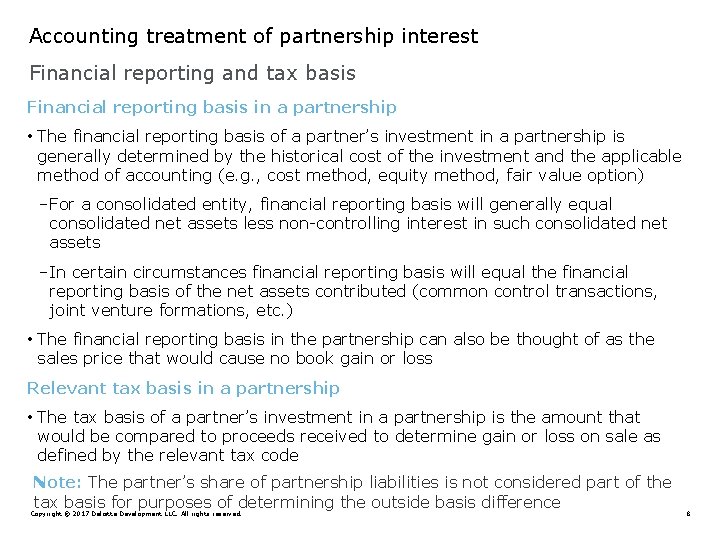
Accounting treatment of partnership interest Financial reporting and tax basis Financial reporting basis in a partnership • The financial reporting basis of a partner’s investment in a partnership is generally determined by the historical cost of the investment and the applicable method of accounting (e. g. , cost method, equity method, fair value option) −For a consolidated entity, financial reporting basis will generally equal consolidated net assets less non-controlling interest in such consolidated net assets −In certain circumstances financial reporting basis will equal the financial reporting basis of the net assets contributed (common control transactions, joint venture formations, etc. ) • The financial reporting basis in the partnership can also be thought of as the sales price that would cause no book gain or loss Relevant tax basis in a partnership • The tax basis of a partner’s investment in a partnership is the amount that would be compared to proceeds received to determine gain or loss on sale as defined by the relevant tax code Note: The partner’s share of partnership liabilities is not considered part of the tax basis for purposes of determining the outside basis difference Copyright © 2017 Deloitte Development LLC. All rights reserved. 8
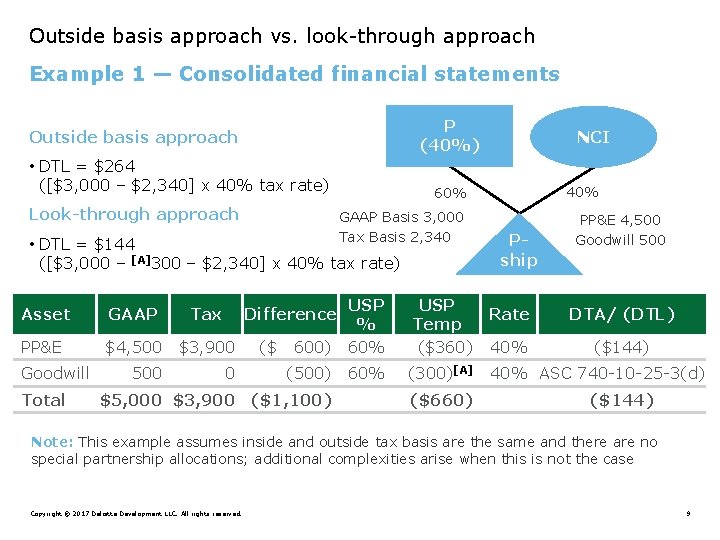
Outside basis approach vs. look-through approach Example 1 — Consolidated financial statements P (40%) Outside basis approach • DTL = $264 ([$3, 000 ‒ $2, 340] x 40% tax rate) Look-through approach GAAP Basis 3, 000 Tax Basis 2, 340 Pship ($ 600) USP % 60% USP Rate Temp ($360) 40% 0 (500) 60% (300)[A] $5, 000 $3, 900 ($1, 100) Asset GAAP Tax PP&E $4, 500 $3, 900 500 Total 40% 60% • DTL = $144 ([$3, 000 – [A]300 ‒ $2, 340] x 40% tax rate) Goodwill NCI Difference ($660) PP&E 4, 500 Goodwill 500 DTA/ (DTL) ($144) 40% ASC 740 -10 -25 -3(d) ($144) Note: This example assumes inside and outside tax basis are the same and there are no special partnership allocations; additional complexities arise when this is not the case Copyright © 2017 Deloitte Development LLC. All rights reserved. 9
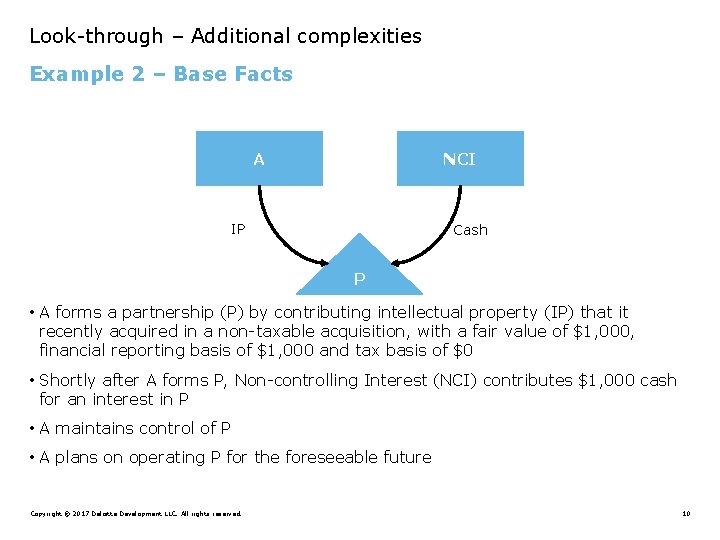
Look-through – Additional complexities Example 2 – Base Facts A NCI IP Cash P • A forms a partnership (P) by contributing intellectual property (IP) that it recently acquired in a non-taxable acquisition, with a fair value of $1, 000, financial reporting basis of $1, 000 and tax basis of $0 • Shortly after A forms P, Non-controlling Interest (NCI) contributes $1, 000 cash for an interest in P • A maintains control of P • A plans on operating P for the foreseeable future Copyright © 2017 Deloitte Development LLC. All rights reserved. 10
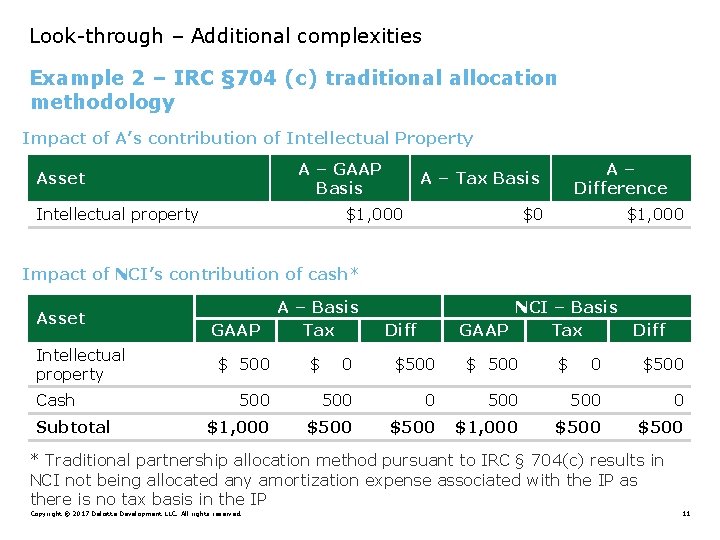
Look-through – Additional complexities Example 2 – IRC § 704 (c) traditional allocation methodology Impact of A’s contribution of Intellectual Property A – GAAP Basis Asset Intellectual property A – Tax Basis $1, 000 A– Difference $0 $1, 000 Impact of NCI’s contribution of cash* Asset Intellectual property Cash Subtotal GAAP A – Basis Tax NCI – Basis GAAP Tax Diff $ 500 $ 0 $500 500 500 0 $1, 000 $500 * Traditional partnership allocation method pursuant to IRC § 704(c) results in NCI not being allocated any amortization expense associated with the IP as there is no tax basis in the IP Copyright © 2017 Deloitte Development LLC. All rights reserved. 11
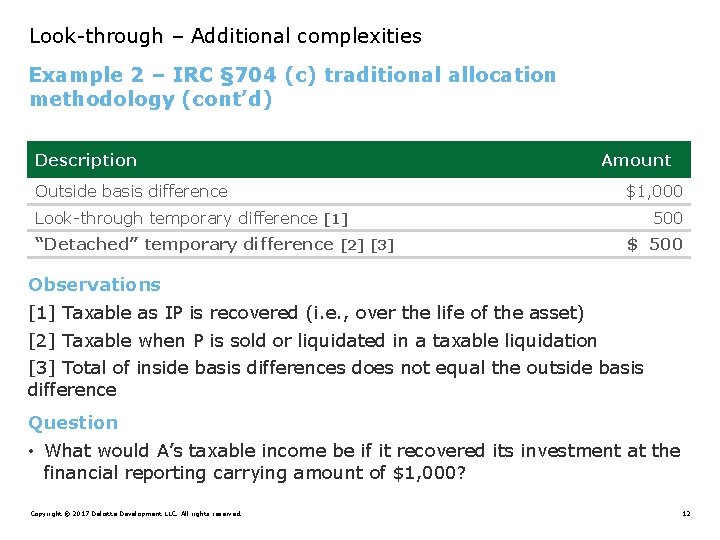
Look-through – Additional complexities Example 2 – IRC § 704 (c) traditional allocation methodology (cont’d) Description Outside basis difference Amount $1, 000 Look-through temporary difference [1] “Detached” temporary difference [2] [3] 500 $ 500 Observations [1] Taxable as IP is recovered (i. e. , over the life of the asset) [2] Taxable when P is sold or liquidated in a taxable liquidation [3] Total of inside basis differences does not equal the outside basis difference Question • What would A’s taxable income be if it recovered its investment at the financial reporting carrying amount of $1, 000? Copyright © 2017 Deloitte Development LLC. All rights reserved. 12
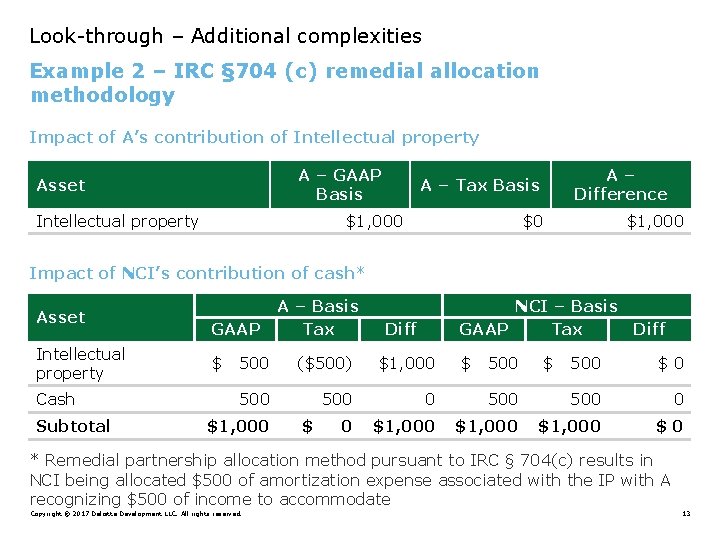
Look-through – Additional complexities Example 2 – IRC § 704 (c) remedial allocation methodology Impact of A’s contribution of Intellectual property A – GAAP Basis Asset Intellectual property A – Tax Basis $1, 000 A– Difference $0 $1, 000 Impact of NCI’s contribution of cash* Asset Intellectual property Cash Subtotal GAAP A – Basis Tax NCI – Basis GAAP Tax Diff $ 500 ($500) $1, 000 $ 500 $ 0 500 500 0 0 $1, 000 $ * Remedial partnership allocation method pursuant to IRC § 704(c) results in NCI being allocated $500 of amortization expense associated with the IP with A recognizing $500 of income to accommodate Copyright © 2017 Deloitte Development LLC. All rights reserved. 13
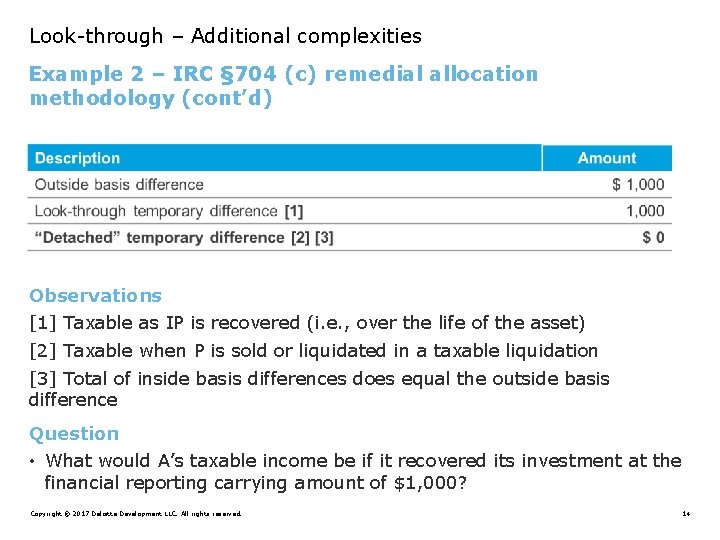
Look-through – Additional complexities Example 2 – IRC § 704 (c) remedial allocation methodology (cont’d) Observations [1] Taxable as IP is recovered (i. e. , over the life of the asset) [2] Taxable when P is sold or liquidated in a taxable liquidation [3] Total of inside basis differences does equal the outside basis difference Question • What would A’s taxable income be if it recovered its investment at the financial reporting carrying amount of $1, 000? Copyright © 2017 Deloitte Development LLC. All rights reserved. 14
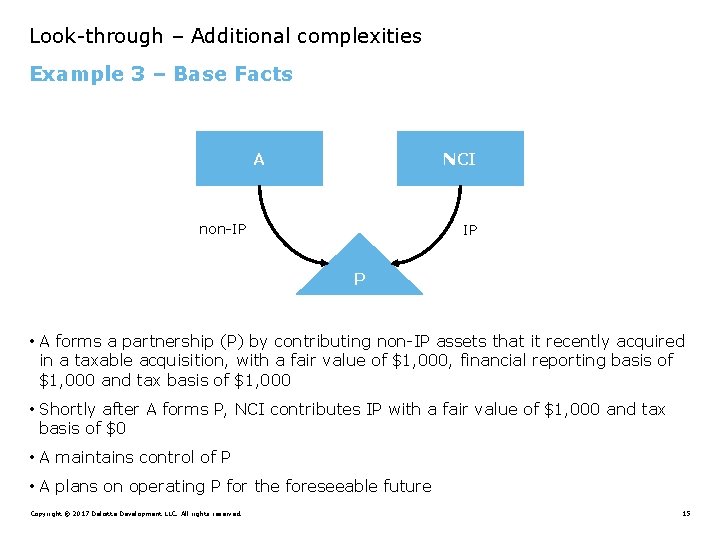
Look-through – Additional complexities Example 3 – Base Facts A NCI non-IP IP P • A forms a partnership (P) by contributing non-IP assets that it recently acquired in a taxable acquisition, with a fair value of $1, 000, financial reporting basis of $1, 000 and tax basis of $1, 000 • Shortly after A forms P, NCI contributes IP with a fair value of $1, 000 and tax basis of $0 • A maintains control of P • A plans on operating P for the foreseeable future Copyright © 2017 Deloitte Development LLC. All rights reserved. 15
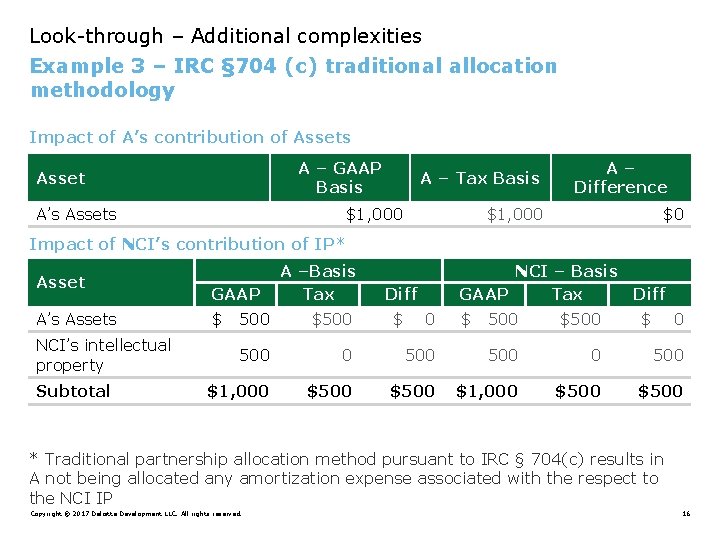
Look-through – Additional complexities Example 3 – IRC § 704 (c) traditional allocation methodology Impact of A’s contribution of Assets A – GAAP Basis Asset A’s Assets A – Tax Basis $1, 000 A– Difference $1, 000 $0 Impact of NCI’s contribution of IP* Asset A’s Assets NCI’s intellectual property Subtotal GAAP A –Basis Tax Diff NCI – Basis GAAP Tax Diff $ 500 $500 $ 0 500 $1, 000 $500 * Traditional partnership allocation method pursuant to IRC § 704(c) results in A not being allocated any amortization expense associated with the respect to the NCI IP Copyright © 2017 Deloitte Development LLC. All rights reserved. 16
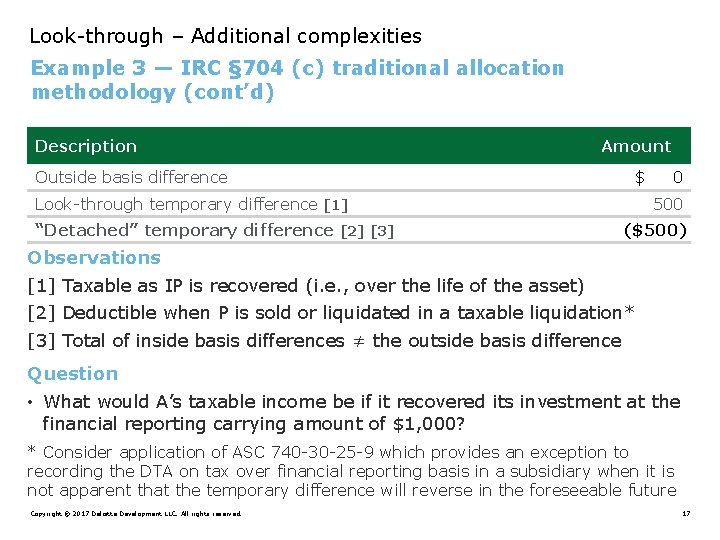
Look-through – Additional complexities Example 3 — IRC § 704 (c) traditional allocation methodology (cont’d) Description Amount Outside basis difference $ 0 Look-through temporary difference [1] “Detached” temporary difference [2] [3] 500 ($500) Observations [1] Taxable as IP is recovered (i. e. , over the life of the asset) [2] Deductible when P is sold or liquidated in a taxable liquidation* [3] Total of inside basis differences ≠ the outside basis difference Question • What would A’s taxable income be if it recovered its investment at the financial reporting carrying amount of $1, 000? * Consider application of ASC 740 -30 -25 -9 which provides an exception to recording the DTA on tax over financial reporting basis in a subsidiary when it is not apparent that the temporary difference will reverse in the foreseeable future Copyright © 2017 Deloitte Development LLC. All rights reserved. 17
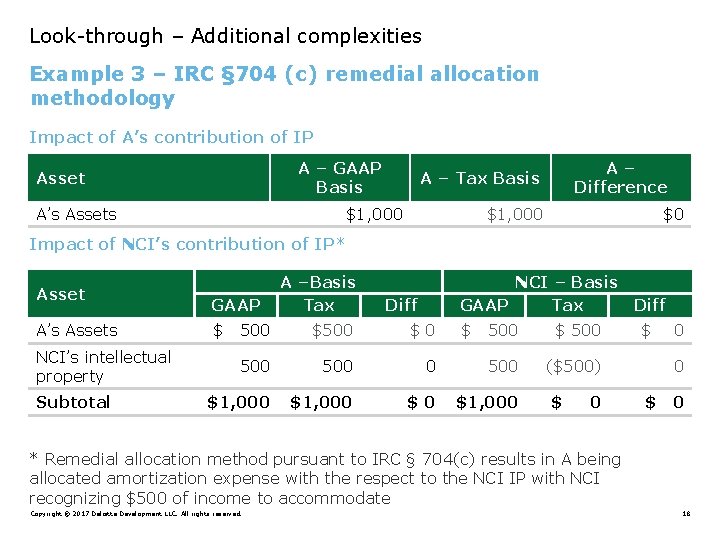
Look-through – Additional complexities Example 3 – IRC § 704 (c) remedial allocation methodology Impact of A’s contribution of IP A – GAAP Basis Asset A’s Assets A– Difference A – Tax Basis $1, 000 $0 Impact of NCI’s contribution of IP* Asset A’s Assets NCI’s intellectual property Subtotal GAAP A –Basis Tax NCI – Basis GAAP Tax Diff $ 500 $ 0 $ 500 $ 0 500 ($500) 0 $1, 000 $0 $1, 000 $ 0 * Remedial allocation method pursuant to IRC § 704(c) results in A being allocated amortization expense with the respect to the NCI IP with NCI recognizing $500 of income to accommodate Copyright © 2017 Deloitte Development LLC. All rights reserved. 18
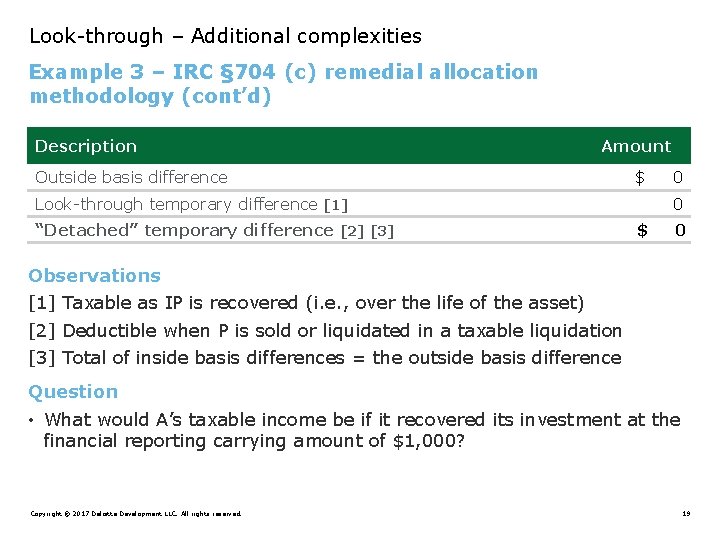
Look-through – Additional complexities Example 3 – IRC § 704 (c) remedial allocation methodology (cont’d) Description Amount Outside basis difference $ 0 Look-through temporary difference [1] “Detached” temporary difference [2] [3] 0 $ 0 Observations [1] Taxable as IP is recovered (i. e. , over the life of the asset) [2] Deductible when P is sold or liquidated in a taxable liquidation [3] Total of inside basis differences = the outside basis difference Question • What would A’s taxable income be if it recovered its investment at the financial reporting carrying amount of $1, 000? Copyright © 2017 Deloitte Development LLC. All rights reserved. 19
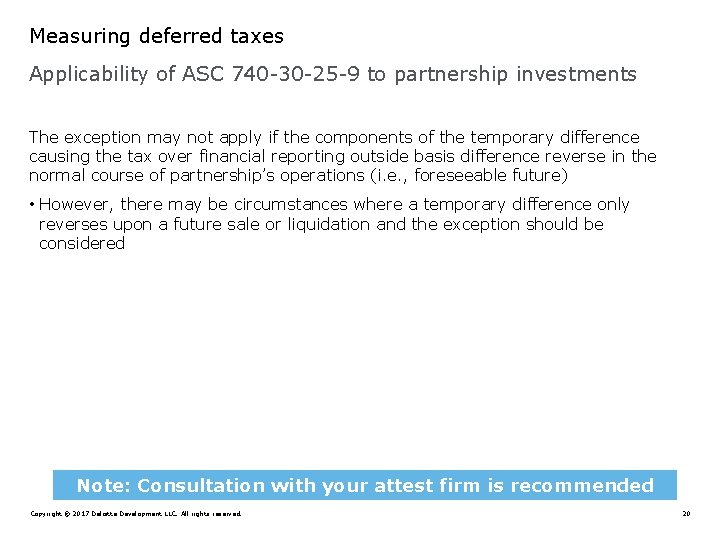
Measuring deferred taxes Applicability of ASC 740 -30 -25 -9 to partnership investments The exception may not apply if the components of the temporary difference causing the tax over financial reporting outside basis difference reverse in the normal course of partnership’s operations (i. e. , foreseeable future) • However, there may be circumstances where a temporary difference only reverses upon a future sale or liquidation and the exception should be considered Note: Consultation with your attest firm is recommended Copyright © 2017 Deloitte Development LLC. All rights reserved. 20
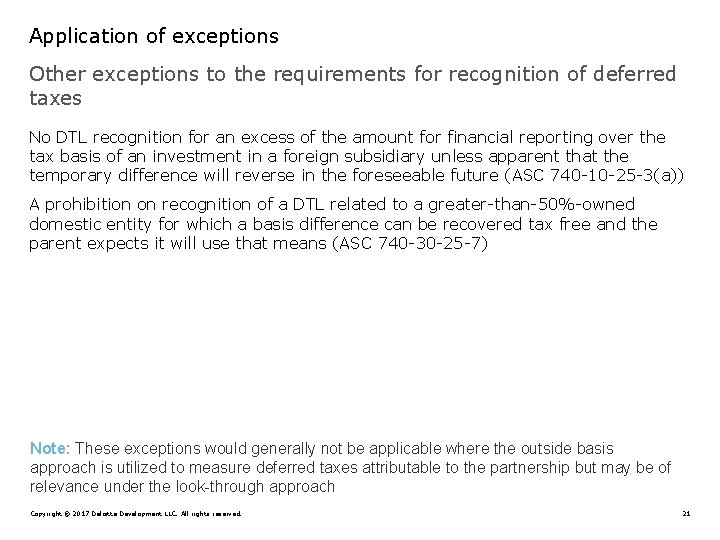
Application of exceptions Other exceptions to the requirements for recognition of deferred taxes No DTL recognition for an excess of the amount for financial reporting over the tax basis of an investment in a foreign subsidiary unless apparent that the temporary difference will reverse in the foreseeable future (ASC 740 -10 -25 -3(a)) A prohibition on recognition of a DTL related to a greater-than-50%-owned domestic entity for which a basis difference can be recovered tax free and the parent expects it will use that means (ASC 740 -30 -25 -7) Note: These exceptions would generally not be applicable where the outside basis approach is utilized to measure deferred taxes attributable to the partnership but may be of relevance under the look-through approach Copyright © 2017 Deloitte Development LLC. All rights reserved. 21
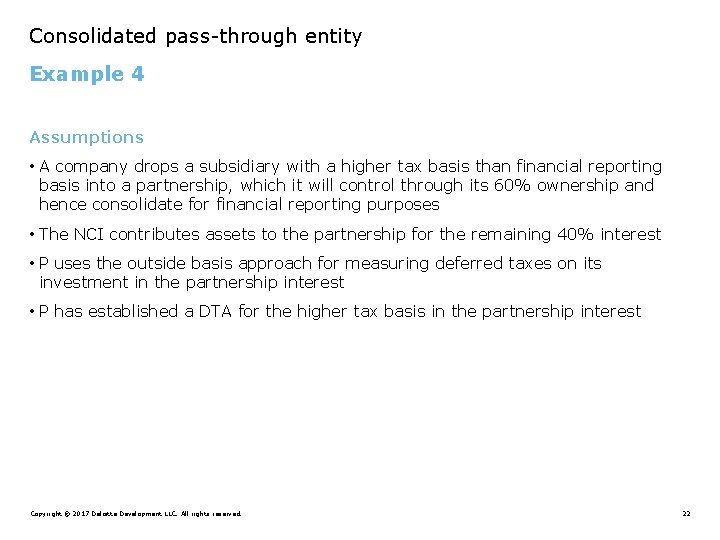
Consolidated pass-through entity Example 4 Assumptions • A company drops a subsidiary with a higher tax basis than financial reporting basis into a partnership, which it will control through its 60% ownership and hence consolidate for financial reporting purposes • The NCI contributes assets to the partnership for the remaining 40% interest • P uses the outside basis approach for measuring deferred taxes on its investment in the partnership interest • P has established a DTA for the higher tax basis in the partnership interest Copyright © 2017 Deloitte Development LLC. All rights reserved. 22
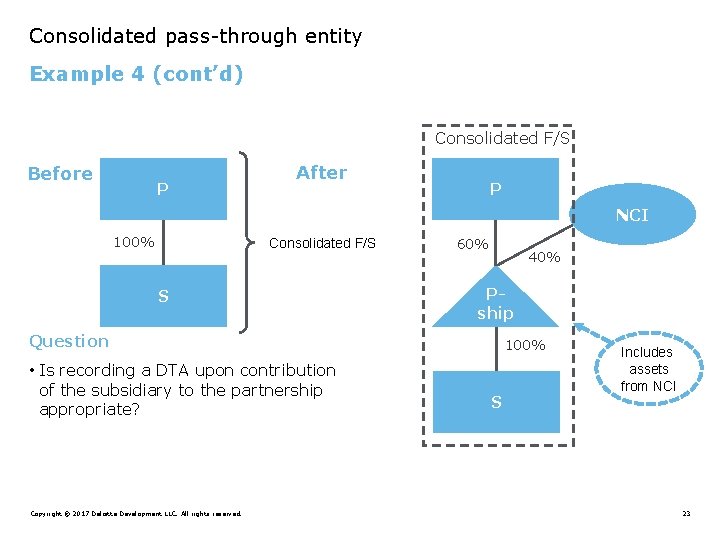
Consolidated pass-through entity Example 4 (cont’d) Consolidated F/S Before P After P NCI 100% Consolidated F/S S 60% 40% Pship P-Ship Question • Is recording a DTA upon contribution of the subsidiary to the partnership appropriate? Copyright © 2017 Deloitte Development LLC. All rights reserved. 100% S Includes assets from NCI 23
Consolidated pass-through entity Example 4 (cont’d) Answer • The corporation that was dropped into the partnership was a subsidiary and was subject to ASC 740 -30 -25 -9; no DTA was permitted • After dropping the corporation into the partnership, the “subsidiary” relationship to the “parent” continues as the partnership would be consolidated any subsidiary of the partnership will be reported as a subsidiary of the parent • One view is that ASC 740 -30 -25 -9 should be continued so long as corporation and its former parent continue to have a parent/subsidiary relationship • If the ASC 740 -30 -25 -9 prohibition was continued, the financial reporting and tax basis in the partnership would be bifurcated between that part attributable to the partnership’s basis in the corporation (no DTA) and that part attributable to its other assets (normal deferred tax accounting) Note: Consultation with your attest firm is recommended Copyright © 2017 Deloitte Development LLC. All rights reserved. 24

Pass-through entities other considerations 25
ETR consequences
ETR consequences of non-controlling interests Overview The financial statement amounts reported for income tax expense and net income attributable to non-controlling interest differ based on whether the subsidiary is a C‐corporation or a partnership • C-corporation: A C-corporation is generally a taxpayer −Therefore, a parent that consolidates a C-corporation would include 100% of the income tax expense attributable to the C-corporation’s pre-tax income • Partnership: Income taxes related to income of a partnership is generally not the obligation of the partnership itself −Instead, the partners are responsible for income taxes on their share of the partnership’s income −Therefore, a parent that consolidates a partnership would consolidate 100% of the partnership pre-tax income, but only include income taxes on its share of the partnership’s income in the consolidated income tax provision (results in a reconciling item in the parent’s income tax rate reconciliation) Copyright © 2017 Deloitte Development LLC. All rights reserved. 27
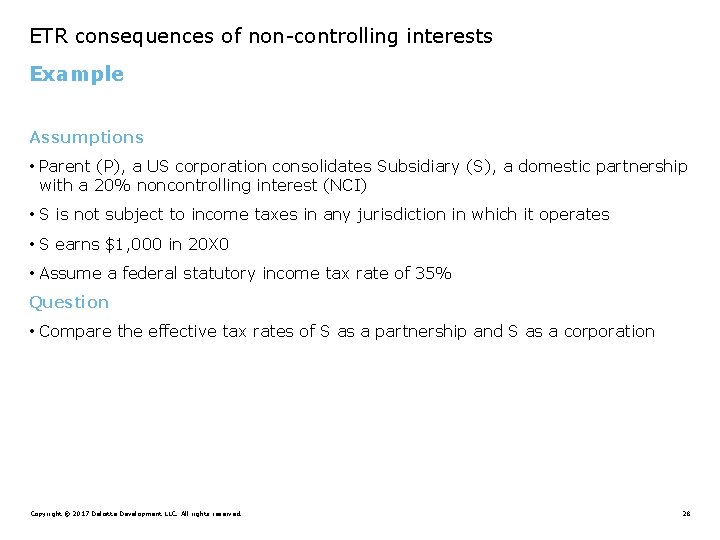
ETR consequences of non-controlling interests Example Assumptions • Parent (P), a US corporation consolidates Subsidiary (S), a domestic partnership with a 20% noncontrolling interest (NCI) • S is not subject to income taxes in any jurisdiction in which it operates • S earns $1, 000 in 20 X 0 • Assume a federal statutory income tax rate of 35% Question • Compare the effective tax rates of S as a partnership and S as a corporation Copyright © 2017 Deloitte Development LLC. All rights reserved. 28
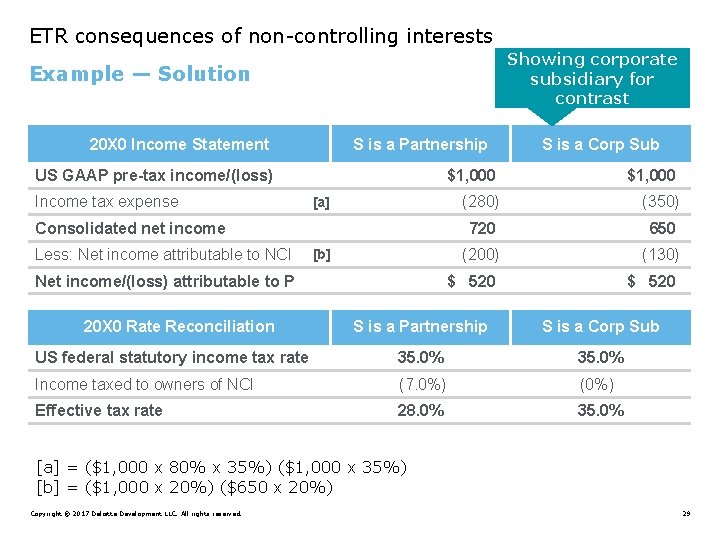
ETR consequences of non-controlling interests Showing corporate subsidiary for contrast Example — Solution 20 X 0 Income Statement S is a Partnership US GAAP pre-tax income/(loss) Income tax expense [a] Consolidated net income Less: Net income attributable to NCI [b] Net income/(loss) attributable to P 20 X 0 Rate Reconciliation S is a Corp Sub $1, 000 (280) (350) 720 650 (200) (130) $ 520 S is a Partnership S is a Corp Sub US federal statutory income tax rate 35. 0% Income taxed to owners of NCI (7. 0%) (0%) Effective tax rate 28. 0% 35. 0% [a] = ($1, 000 x 80% x 35%) ($1, 000 x 35%) [b] = ($1, 000 x 20%) ($650 x 20%) Copyright © 2017 Deloitte Development LLC. All rights reserved. 29
Pass-through entities tax receivable agreements 30
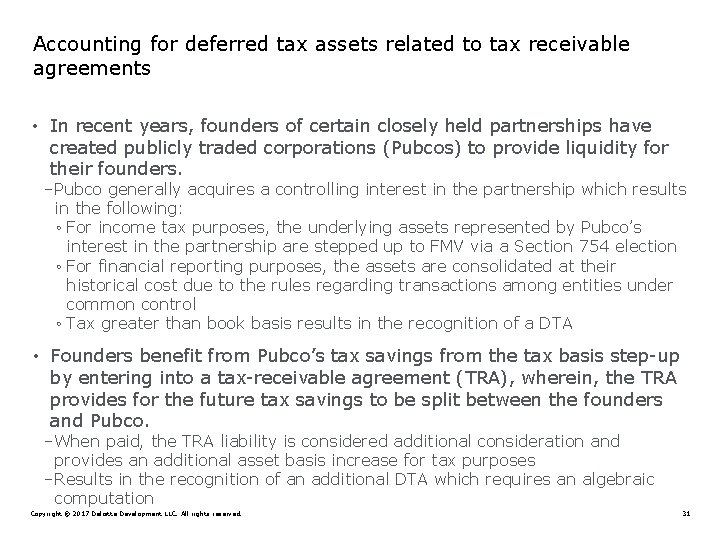
Accounting for deferred tax assets related to tax receivable agreements • In recent years, founders of certain closely held partnerships have created publicly traded corporations (Pubcos) to provide liquidity for their founders. −Pubco generally acquires a controlling interest in the partnership which results in the following: ◦ For income tax purposes, the underlying assets represented by Pubco’s interest in the partnership are stepped up to FMV via a Section 754 election ◦ For financial reporting purposes, the assets are consolidated at their historical cost due to the rules regarding transactions among entities under common control ◦ Tax greater than book basis results in the recognition of a DTA • Founders benefit from Pubco’s tax savings from the tax basis step-up by entering into a tax-receivable agreement (TRA), wherein, the TRA provides for the future tax savings to be split between the founders and Pubco. −When paid, the TRA liability is considered additional consideration and provides an additional asset basis increase for tax purposes −Results in the recognition of an additional DTA which requires an algebraic computation Copyright © 2017 Deloitte Development LLC. All rights reserved. 31
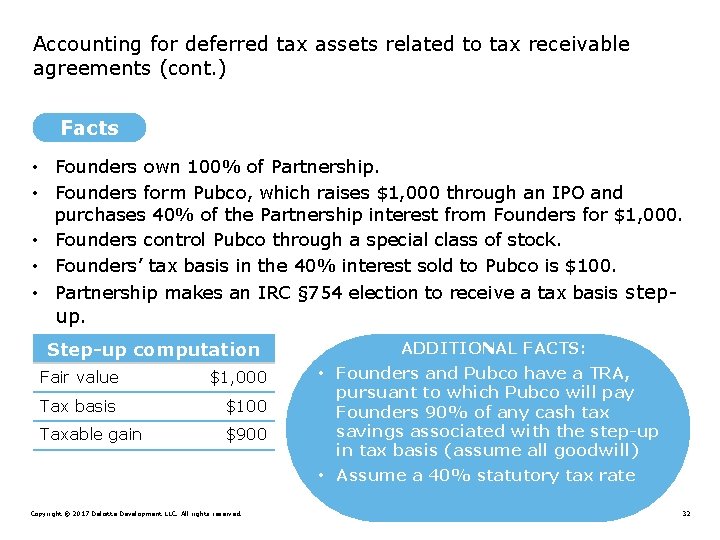
Accounting for deferred tax assets related to tax receivable agreements (cont. ) Facts • Founders own 100% of Partnership. • Founders form Pubco, which raises $1, 000 through an IPO and purchases 40% of the Partnership interest from Founders for $1, 000. • Founders control Pubco through a special class of stock. • Founders’ tax basis in the 40% interest sold to Pubco is $100. • Partnership makes an IRC § 754 election to receive a tax basis step- up. Step-up computation Fair value $1, 000 Tax basis $100 Taxable gain $900 ADDITIONAL FACTS: • Founders and Pubco have a TRA, pursuant to which Pubco will pay Founders 90% of any cash tax savings associated with the step-up in tax basis (assume all goodwill) • Assume a 40% statutory tax rate Copyright © 2017 Deloitte Development LLC. All rights reserved. 32
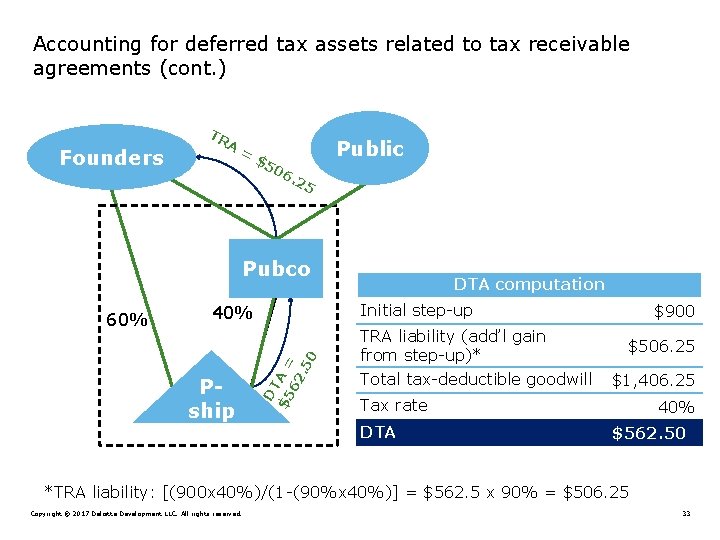
Accounting for deferred tax assets related to tax receivable agreements (cont. ) Founders TR A = Public $5 06 . 2 5 Pubco Initial step-up 40% Pship DT $5 A = 62. 5 0 60% DTA computation TRA liability (add’l gain from step-up)* Total tax-deductible goodwill $900 $506. 25 $1, 406. 25 Tax rate DTA 40% $562. 50 *TRA liability: [(900 x 40%)/(1 -(90%x 40%)] = $562. 5 x 90% = $506. 25 Copyright © 2017 Deloitte Development LLC. All rights reserved. 33

Copyright © 2017 Deloitte Development LLC. All rights reserved. 34
Speaker Bios Paul Rasmussen Bob Gabriel Tax Senior Manager Deloitte Tax LLP Houston, TX Tax Partner Deloitte Tax LLP Houston, TX Phone +1 713 982 4347 Email: paurasmussen@deloitte. com Phone +1 713 982 4826 Email: rgabriel@deloitte. com Relevant Experience Paul has more than 10 years of experience in public accounting. His time has been dedicated to providing tax provision and compliance services for energy related businesses. He has served companies within both public and private sectors and has experience with corporate and partnership tax structures. He is a specialist with respect to income tax accounting issues including global tax provision processes, tax basis balance sheet testing, purchase accounting, and deficiency remediation. Paul works on a number of tax provision preparation and attest engagements covering financial reporting under both US GAAP and IFRS. Bob is a Tax Partner in the Business Tax Services practice and has more than 15 years of experience in public accounting providing services to public and private clients in a variety of industries including integrated energy, oilfield service, engineering and construction, and manufacturing and distribution. Paul is a regular speaker at Tax Executive Institute and regular instructor at Deloitte ASC 740 national training. Education Bob has been an instructor and speaker at internal and external tax training sessions relating to income tax accounting issues including the Tax Executive Institute and Deloitte’s Financial Reporting of Taxes Dbrief Series for Tax Executives. Paul received a Bachelor of Science degree in Accounting and a Masters degree in Accounting from Brigham Young University. Education Bob specializes in accounting for income taxes and assists clients with tax process and systems improvements and global tax provision issues including tax basis balance sheet analysis, currency issues, and uncertain tax positions. Bob received a Bachelor of Business Administration degree and a Masters in Professional Accounting from the University of Texas at Austin. Copyright © 2017 Deloitte Development LLC. All rights reserved. 35
This presentation contains general information only and Deloitte is not, by means of this presentation, rendering accounting, business, financial, investment, legal, tax, or other professional advice or services. This presentation is not a substitute for such professional advice or services, nor should it be used as a basis for any decision or action that may affect your business. Before making any decision or taking any action that may affect your business, you should consult a qualified professional advisor. Deloitte shall not be responsible for any loss sustained by any person who relies on this presentation. Copyright © 2017 Deloitte Development LLC. All rights reserved. 36

About Deloitte refers to one or more of Deloitte Touche Tohmatsu Limited, a UK private company limited by guarantee (“DTTL”), its network of member firms, and their related entities. DTTL and each of its member firms are legally separate and independent entities. DTTL (also referred to as “Deloitte Global”) does not provide services to clients. Please see www. deloitte. com/about for a detailed description of DTTL and its member firms. Please see www. deloitte. com/us/about for a detailed description of the legal structure of Deloitte LLP and its subsidiaries. Certain services may not be available to attest clients under the rules and regulations of public accounting. Copyright © 2016 Deloitte Development LLC. All rights reserved. Member of Deloitte Touche Tohmatsu Limited
- Slides: 37