
Boating 1 PCOC WELCOME White Rock Power and
Boating 1 (PCOC) WELCOME! White Rock Power and Sail Squadron
Boating 1: PCOC Instructors: Harald Hanssen cps. hhanssen 99@gmail. com 604 538 7311 Classroom slide presentations posted weekly at: http: //www. whiterocksquadron. org/Basics. html
Pleasure Craft Operators Card (PCOC) • Anyone who operates a motorized vessel must have the PCOC available (few exceptions) • Regardless of age – including children • Regardless of motor size or type • PCOC credential ensures that operators have rudimentary knowledge of safe boating
Course Schedule Tonight: Sections 1 to 3 and 5 Next Week: Sections 4 and 6 to 8 Third Week: Sections 9 to 14 and a Quiz Fourth Week: Review and then the Exam PCOC Exam is 50 questions, multiple choice – Your book has typical exam questions at the end of each section (Do them!!)
CLASS ROOM RULES Do not use the trash cans in the class room – use the barrels out by the coffee machine. We have to leave the class room the way we got it – desks in the same orientation Room to be left clean, neat Washrooms down the hall, near Library NO SMOKING ON SCHOOL PROPERTY!
Boating 1 CD v 1. 0 • Has LOTS of material in it: – Word doc “Description” – Word doc “How to use” – 3 videos called Cruise 1, 2 and 3 (sorry Mac users) – Homework questions to test yourself – A copy of PPT viewer if you need it – The Buoys file has a quiz on buoy recognition to test yourself – A copy of PPT slides for each section (similar, but not identical to what we’ll be showing you)
Introduction • Boating can be a dangerous activity, but it doesn’t have to be • In this section: – Causes of On-Water incidents – Acts, Codes & Regulations aiding your safety and survival
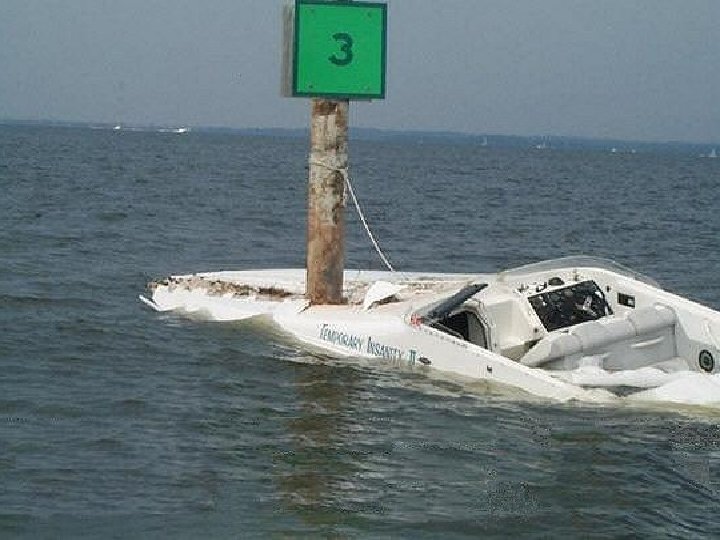
Causes of Fatalities • Not wearing a Personal Floatation Device (PFD) or Lifejacket • Person falling overboard • Capsizing (sink, swamp, grounding) and collision • Alcohol and drug-related operation
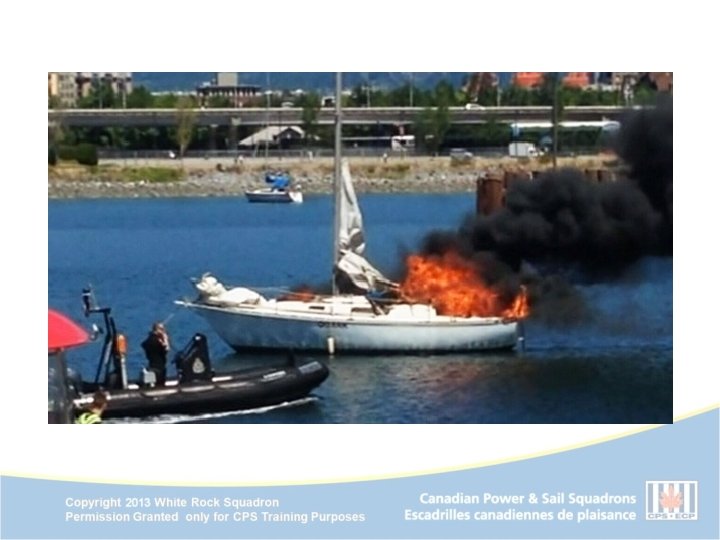
Causes of Incidents • Running out of fuel • Mechanical problems • Non-fatal: collisions of boats with fixed objects e. g. running aground • Major property loss: fire and fuel explosion - improper maintenance of gasoline or propane equipment - most common cause of fires is DC electical
Acts & Regulations • Canada Shipping Act – Governs all boating and boat operators in Canada • Contraventions Act – Describes fines and penalties for which a ticket can be issued • Criminal Code – Many boating offenses are criminal offenses for which a court summons is issued!
Regulations under Canada Shipping Act • Small Vessel Regulations • Collision Regulations (COLREGS) – the “nautical rules of the road” • Charts and Nautical Publications Regulations • Boating Restrictions Regulations – Provides for protection of the environment • Age and Horsepower Regulations • Operator Competency Regulations
Acts & Regulations: Competency • Proof of Competency required for all operators of any powered craft as of 2009 (and must be carried): – Pleasure Craft Operator Card (good for life). Card issued by CPS is also accepted in US. or – Certificate that you successfully completed a boating safety course in Canada before April 1, 1999 – A completed rental boat safety checklist • Proof of competency NOT required for boats with no motors (rowboats, kayaks, sailboats etc. )
Maritime Criminal Offences • Criminal offences include: Operating a boat that is not seaworthy Operating a vessel while impaired Dangerous vessel operation Failing to stop at scene of accident Failing to obey law officer Sending false distress signal Tying up to a navigation aid • Requirements are enforced by RCMP and community police • You can lose your automobile driver’s license
Acts & Regulations: Vessel Operator Responsibilities • When operating a boat YOU (the skipper) are responsible for: – Safety of the boat – Safety of your guests – Any damage caused by your boat or its wake (wash)
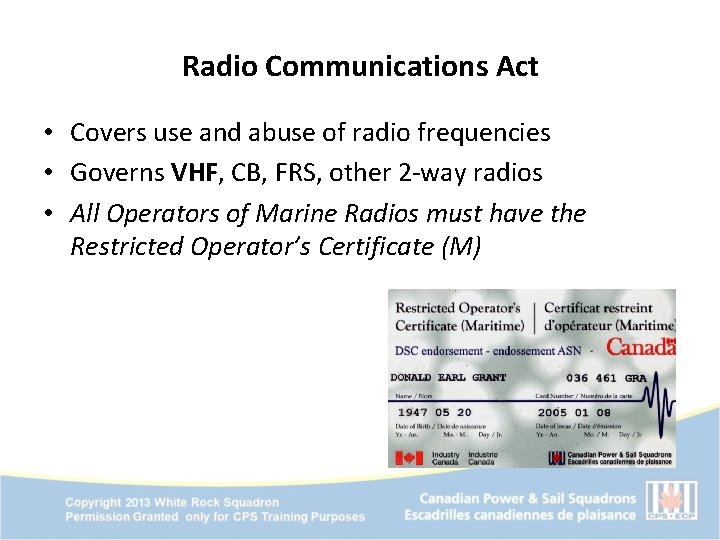
Radio Communications Act • Covers use and abuse of radio frequencies • Governs VHF, CB, FRS, other 2 -way radios • All Operators of Marine Radios must have the Restricted Operator’s Certificate (M)
Age and Horsepower Regulations • Children (if they have a PCOC) – Under 12 can operate a powered boat up to 7. 5 kw (10 hp) without supervision – Between 12 and 16 can operate a powered boat up to 30 kw (40 hp) without supervision – Over 16, no hp restrictions • Only those 16 years of age and older can operate a PWC (personal water craft) • Children without PCOC cannot operate a power boat, supervised or not
Regulatory Authorities: Safety • Transport Canada, Coast Guard and or Fisheries and Oceans Canada approves safety equipment for all boats • Requirements covered in later section
Know Your Boat Section 2 • We will briefly cover: – Types of boats, motors, compliance plates, licensing – Nautical terminology
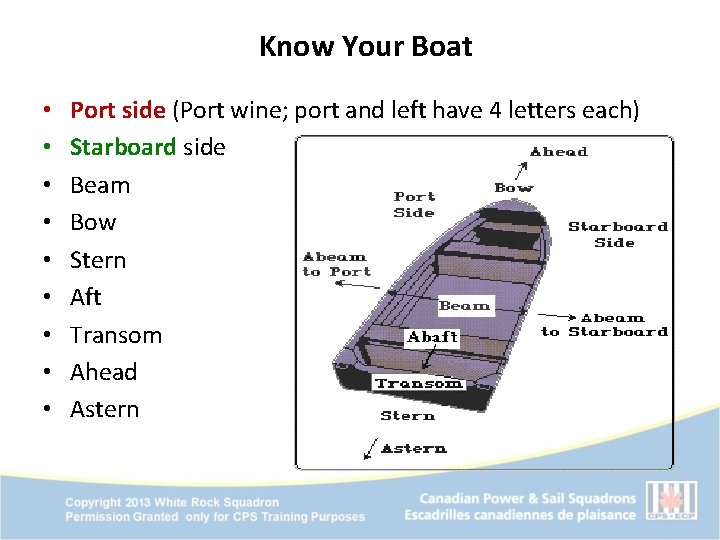
Know Your Boat • • • Port side (Port wine; port and left have 4 letters each) Starboard side Beam Bow Stern Aft Transom Ahead Astern
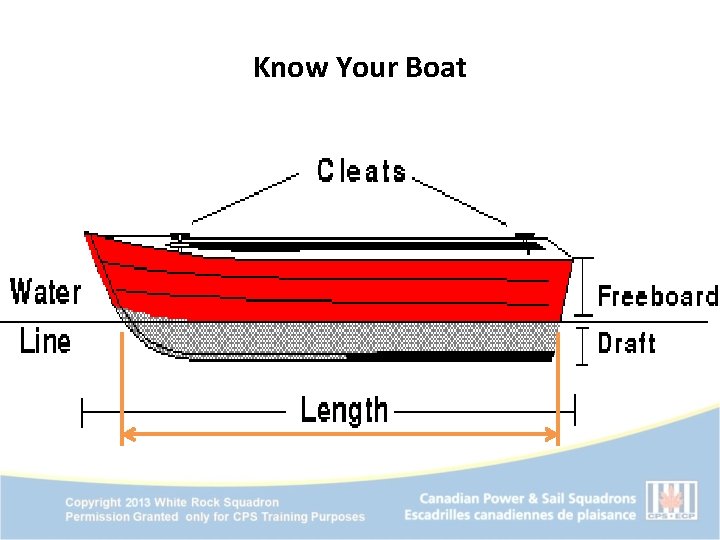
Know Your Boat
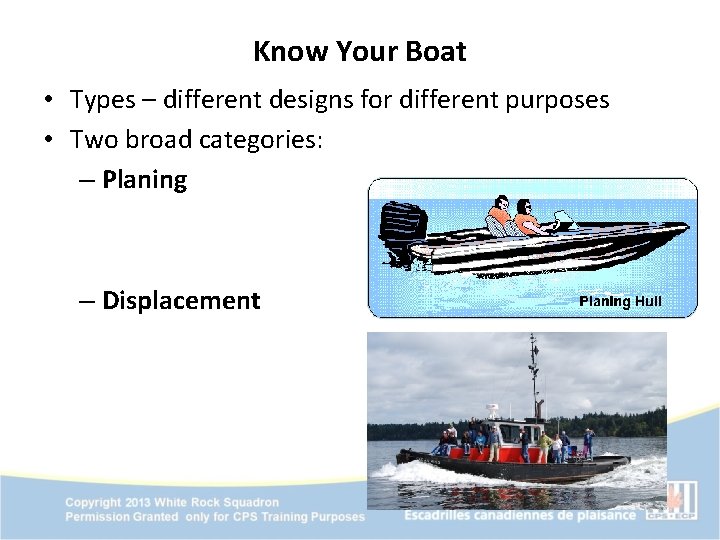
Know Your Boat • Types – different designs for different purposes • Two broad categories: – Planing – Displacement
Know Your Boat • Planing hull: – Skims fast over water surface once it climbs over its bow wave – Tends to pound in waves; shallow draft • Displacement hull: – – pushes water aside Top speed is limited by the waterline length Rides comfortably in waves Deeper draft • Both types can create significant wake with a wash – increases with speed
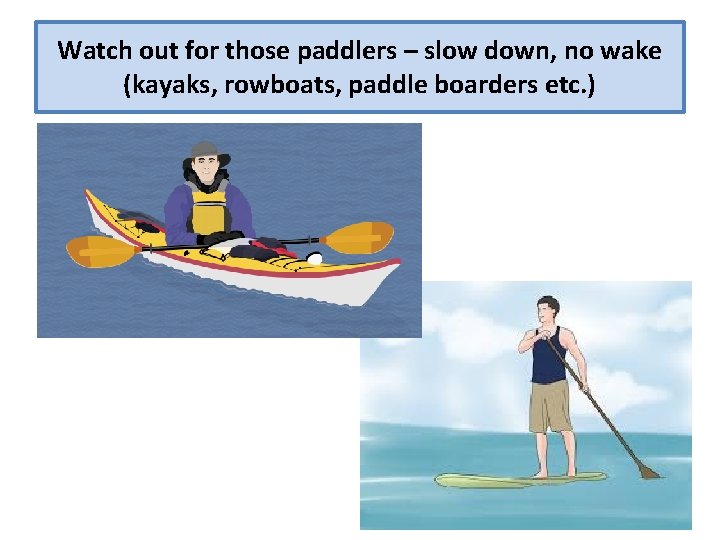
Watch out for those paddlers – slow down, no wake (kayaks, rowboats, paddle boarders etc. )
Know Your Boat • Flat Bottom boat – Shallow draft, planes easily, tippy in rough water • Round bottom boat – Canoes and some sailboats, less stable • Vee-bottom boat – Stable, smoother ride in rough water • Multi-hull boat – Catamarans, Trimarans, very stable and fast
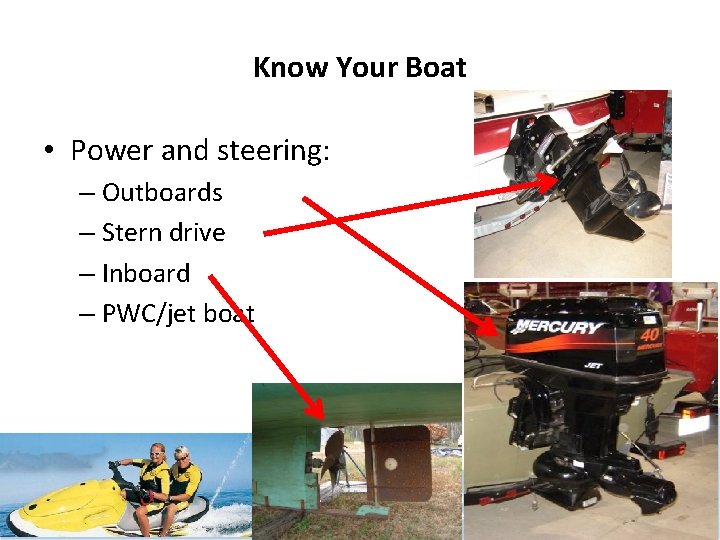
Know Your Boat • Power and steering: – Outboards – Stern drive – Inboard – PWC/jet boat
PWC/Jet Drives • Engine drives a pump that sucks water from an intake and discharges it through a nozzle at the rear. • Boat is steered by moving the nozzle left or right. • If the engine is at idle (no water being discharged) the boat cannot be steered!
Know Your Boat • Engine too small – works too hard, may be prone to overheating, slow • Engine too large, can damage boat, cause instability, high fuel consumption • Sailboat under power is a power boat (and loses sailboat rights of way); must meet all power boat safety requirements, rules of the road
Know Your Boat • Canadian Compliance and Capacity Plates, – required for boats up to 6 m (~19 ft) in length, and engine capability of 7. 5 k. W (~10 hp) or greater – Permanently attached, plain view on transom – States safe limits for vessel in fair weather: • Engine horsepower • Amount (weight) of equipment • Number of passengers • Confirms built to Canadian Gov. construction standards
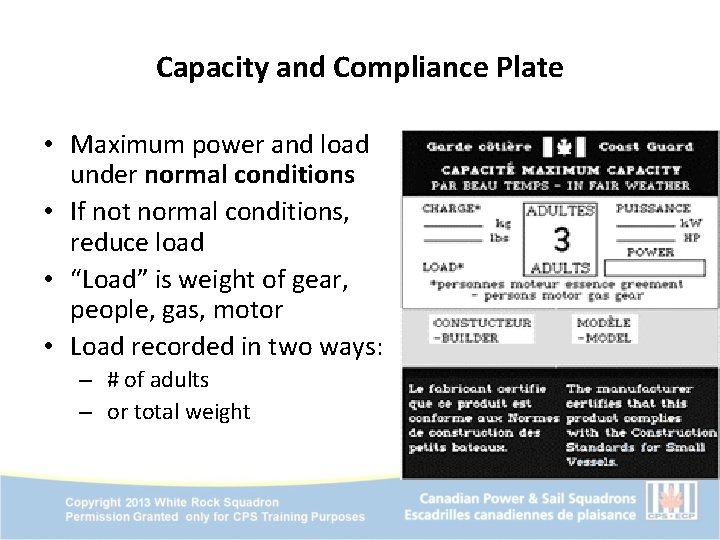
Capacity and Compliance Plate • Maximum power and load under normal conditions • If not normal conditions, reduce load • “Load” is weight of gear, people, gas, motor • Load recorded in two ways: – # of adults – or total weight
Know Your Boat • Conformity Plates – Applies to all other (bigger) motorized pleasure craft – States vessel meets construction standards • Single Vessel Label (being phased out) – Home built boats
Hull Identification Number (HIN) • Boat’s unique serial number, applied by mfgr • 12 characters, not less that ¼” high • Boats with transom, HIN on stbd side, within 2” of top; if no transom, on top of hull within 2’ of stern • 2 nd copy may also be in interior or under a fitting or hardware. • Essential for insurance purposes, like VIN on land
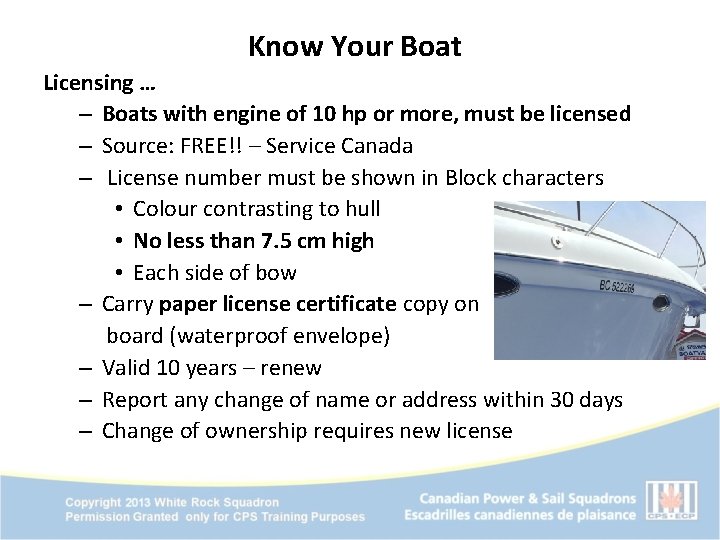
Know Your Boat Licensing … – Boats with engine of 10 hp or more, must be licensed – Source: FREE!! – Service Canada – License number must be shown in Block characters • Colour contrasting to hull • No less than 7. 5 cm high • Each side of bow – Carry paper license certificate copy on board (waterproof envelope) – Valid 10 years – renew – Report any change of name or address within 30 days – Change of ownership requires new license
Know Your Boat International Registration … – Pleasure craft > 15 tons no longer have to be registered • But you can do so if you wish – Permanent name on bow – Registration Number permanently marked inside boat – Port of Registry on stern
Entering USA Waters • See Annex A at back of course book • Note that US requirements change frequently – it is your responsibility to verify the latest requirements. - especially pollution regulations • Ignorance cannot be used as an excuse. Note: You will need to have - station license for your VHF radio - CPS issued PCOC or the American equivalent - sewage holding tank
Equipping Your Boat Section 3 • We will cover: – Mandatory equipment, navigation lights, equipment knowledge, optional equipment – Remember these are just minimums: • Best to exceed minimums!
Recreational Vessel Checks • CPS offers free courtesy checks for pleasure craft, by arrangement • Several WR Squadron members have been trained to provide this service. • Coast Guard and RCMP can require a vessel to undergo a check of safety equipment, may issue fines for missing items
Required Equipment See pages 16 -18 for complete listings … • • PFD or Lifejacket for each person aboard Buoyant Heaving Line or Life Ring with line Re-boarding Device Bailer or Manual Pump Water Tight Flashlight and possibly Flares Sound-Signaling Device Either: paddles/oars or anchor & rode
Required Equipment • PFD or lifejacket – Must fit properly – Must be Canadian approved (usually Transport Canada) – One of correct size for every person on board; should be a little snug – Children should wear pfd/lifejacket specifically designed for children – wt. distribution different from adults
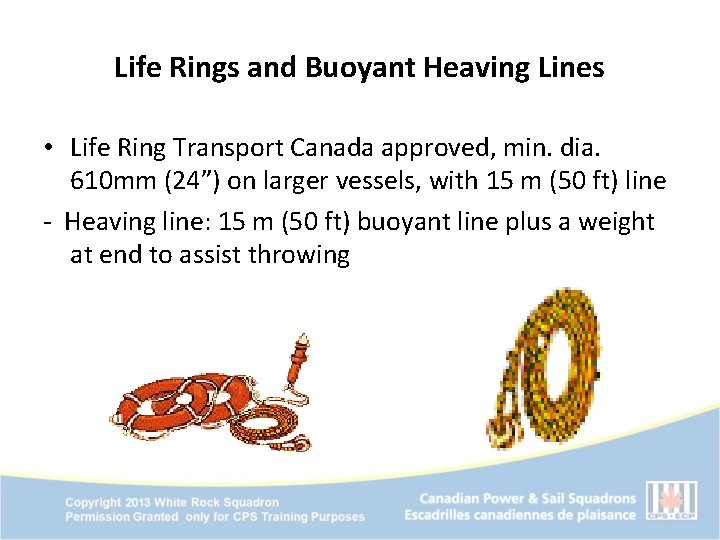
Life Rings and Buoyant Heaving Lines • Life Ring Transport Canada approved, min. dia. 610 mm (24”) on larger vessels, with 15 m (50 ft) line - Heaving line: 15 m (50 ft) buoyant line plus a weight at end to assist throwing
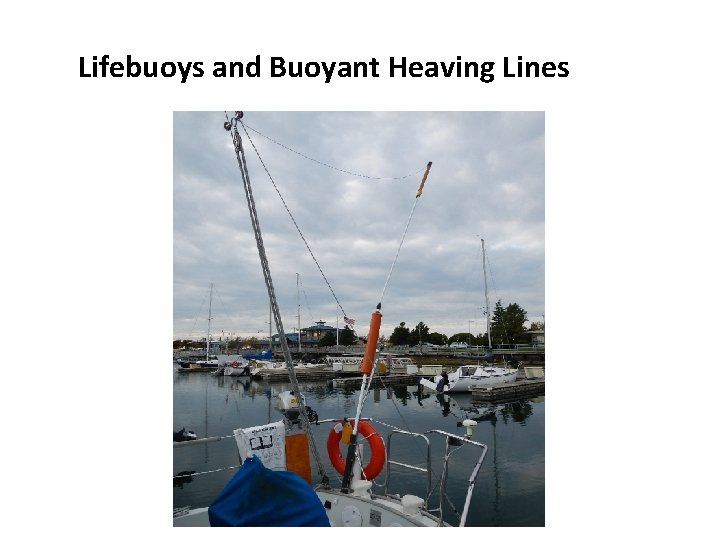
Lifebuoys and Buoyant Heaving Lines
Required Equipment • Personal Flotation Device – PFD vest required: – PWC rider, – white water paddler, – under 16 years or weight less than 36. 3 kg (80 lb) – Must be inherently buoyant, not inflatable – In all other cases an inflatable vest may be worn.
Required Equipment • PFDs and Life jackets only work if you wear them - • ALWAYS wear them – especially when in: – – – Severe weather Dangerous water High boat traffic Dangerous water hazards Away from shore, at night or in fog Solo • Putting them on in the water is VERY difficult – try it!!
Required Equipment • Inflatable PFDs should be serviced annually, at minimum • Test your PFD by wading into chest deep water and bend your knees to insure you float, chin should be above water! • Store accessible in dry, well ventilated area of boat – your life may depend on it
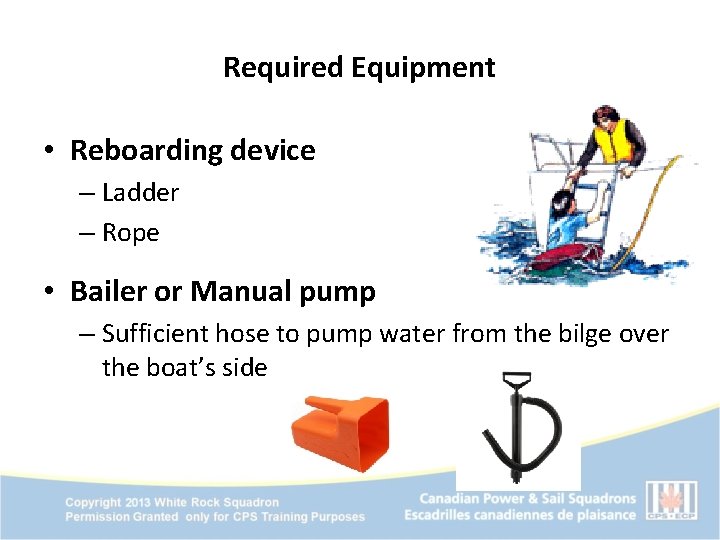
Required Equipment • Reboarding device – Ladder – Rope • Bailer or Manual pump – Sufficient hose to pump water from the bilge over the boat’s side
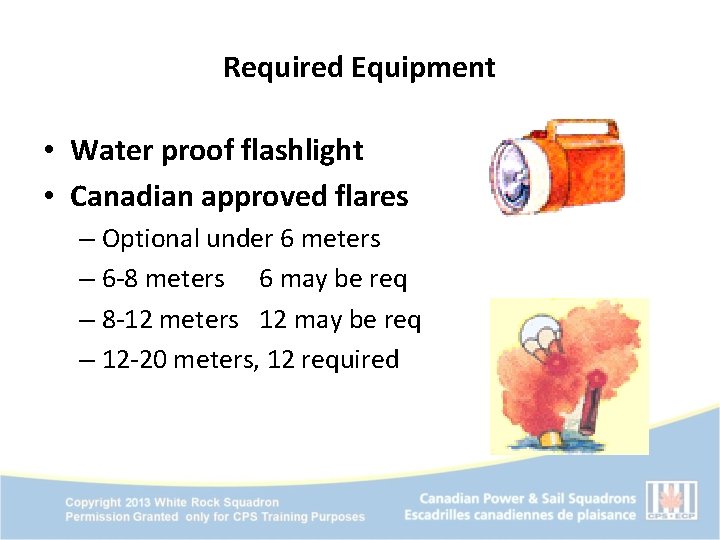
Required Equipment • Water proof flashlight • Canadian approved flares – Optional under 6 meters – 6 -8 meters 6 may be req – 8 -12 meters 12 may be req – 12 -20 meters, 12 required
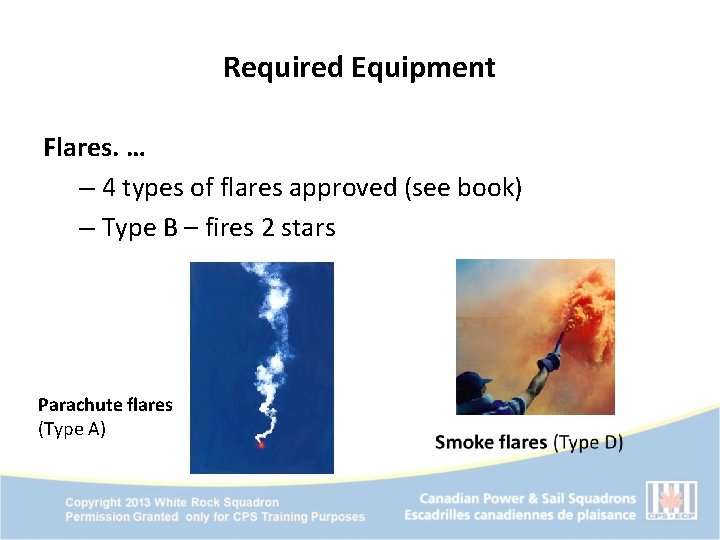
Required Equipment Flares. … – 4 types of flares approved (see book) – Type B – fires 2 stars Parachute flares (Type A)
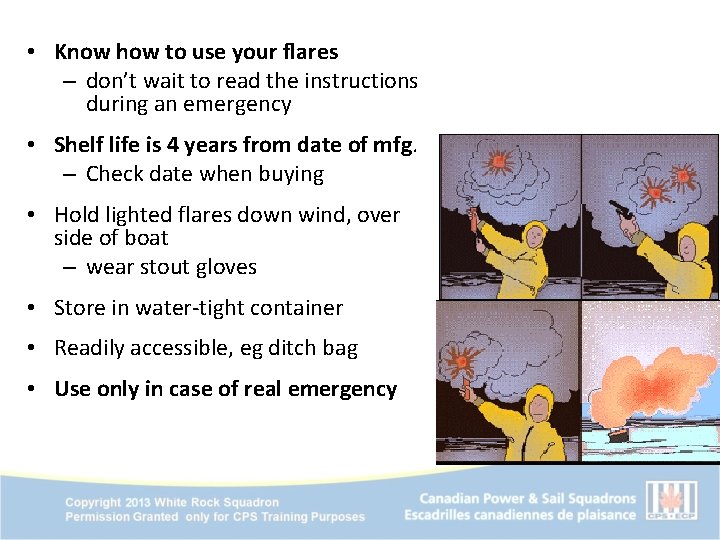
• Know how to use your flares – don’t wait to read the instructions during an emergency • Shelf life is 4 years from date of mfg. – Check date when buying • Hold lighted flares down wind, over side of boat – wear stout gloves • Store in water-tight container • Readily accessible, eg ditch bag • Use only in case of real emergency
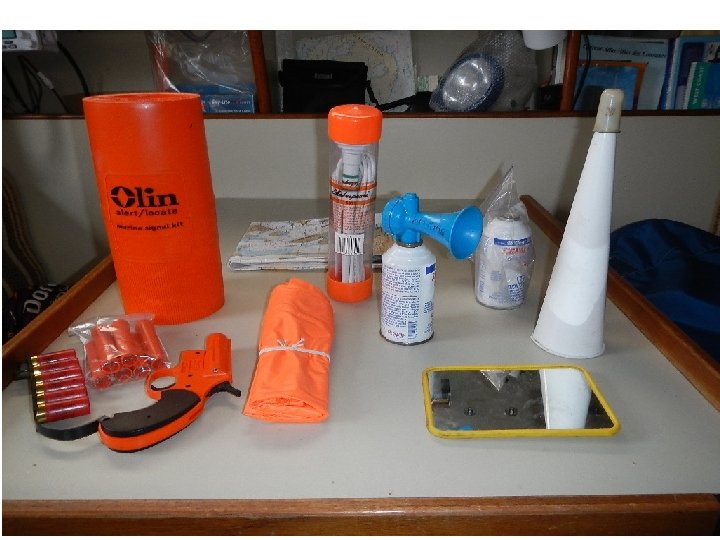
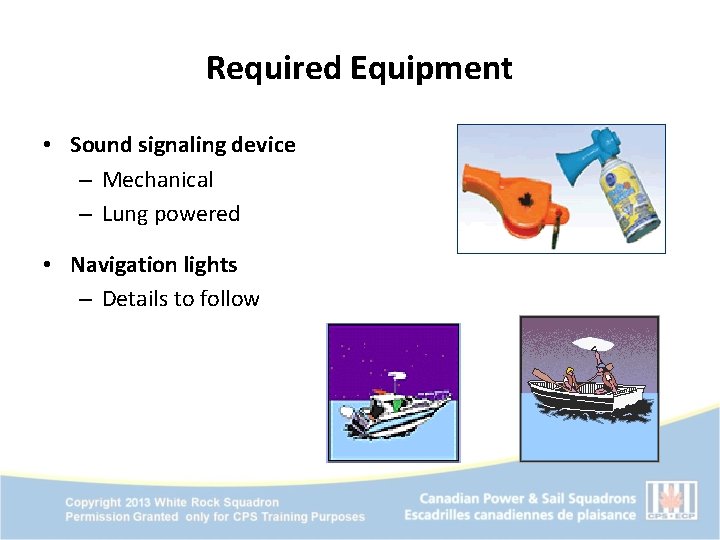
Required Equipment • Sound signaling device – Mechanical – Lung powered • Navigation lights – Details to follow
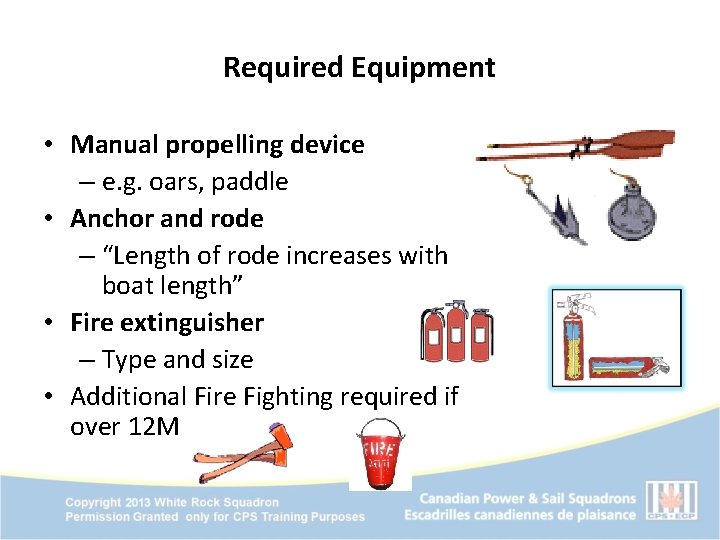
Required Equipment • Manual propelling device – e. g. oars, paddle • Anchor and rode – “Length of rode increases with boat length” • Fire extinguisher – Type and size • Additional Fire Fighting required if over 12 M
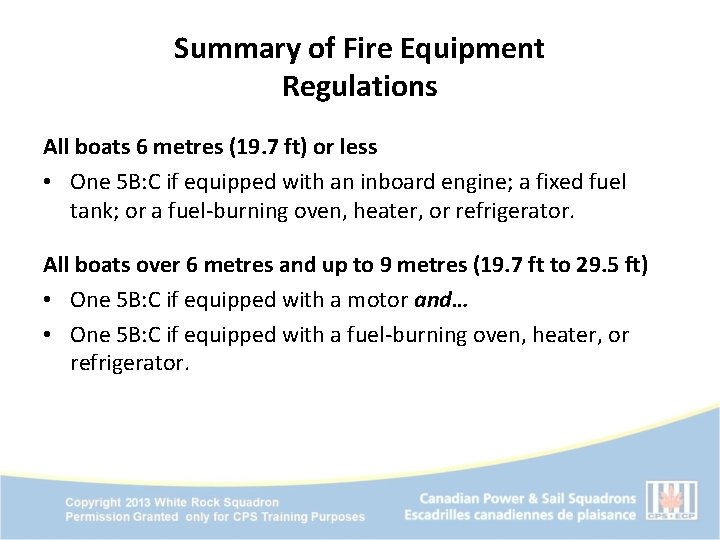
Summary of Fire Equipment Regulations All boats 6 metres (19. 7 ft) or less • One 5 B: C if equipped with an inboard engine; a fixed fuel tank; or a fuel-burning oven, heater, or refrigerator. All boats over 6 metres and up to 9 metres (19. 7 ft to 29. 5 ft) • One 5 B: C if equipped with a motor and… • One 5 B: C if equipped with a fuel-burning oven, heater, or refrigerator.
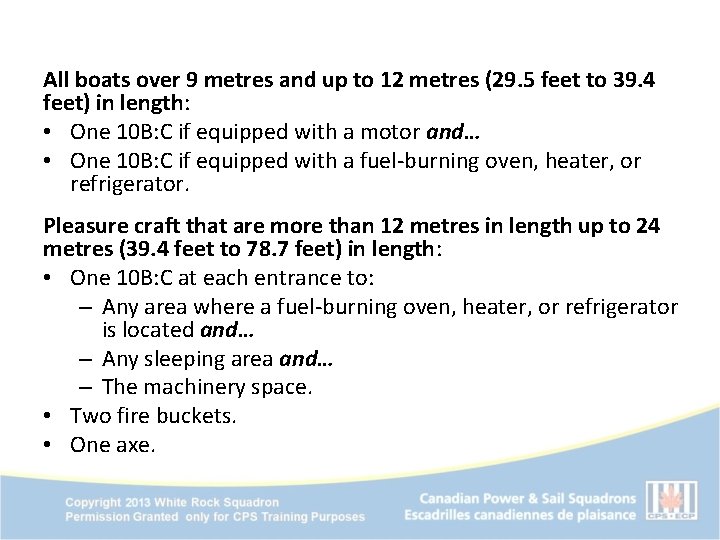
All boats over 9 metres and up to 12 metres (29. 5 feet to 39. 4 feet) in length: • One 10 B: C if equipped with a motor and… • One 10 B: C if equipped with a fuel-burning oven, heater, or refrigerator. Pleasure craft that are more than 12 metres in length up to 24 metres (39. 4 feet to 78. 7 feet) in length: • One 10 B: C at each entrance to: – Any area where a fuel-burning oven, heater, or refrigerator is located and… – Any sleeping area and… – The machinery space. • Two fire buckets. • One axe.
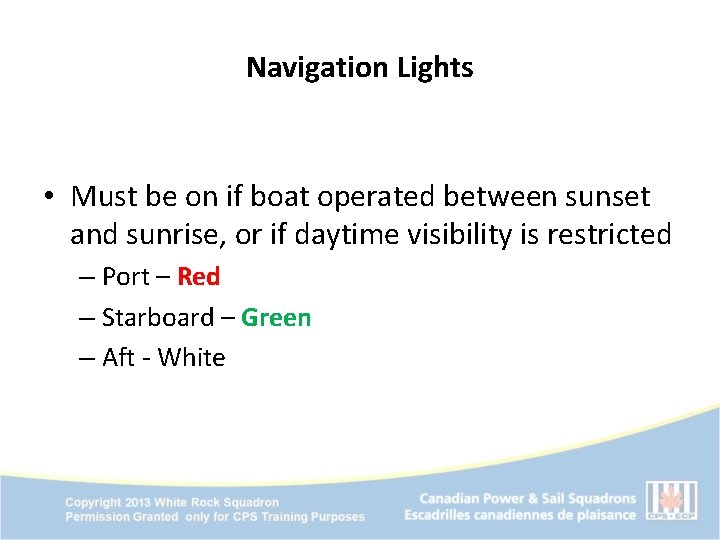
Navigation Lights • Must be on if boat operated between sunset and sunrise, or if daytime visibility is restricted – Port – Red – Starboard – Green – Aft - White
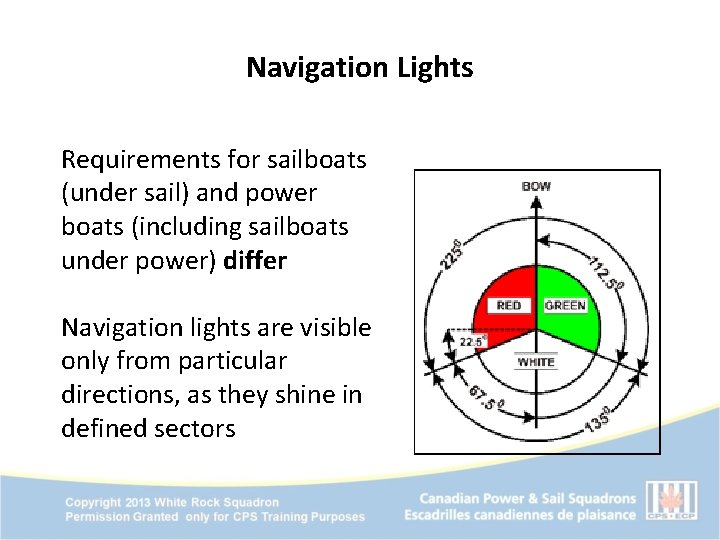
Navigation Lights Requirements for sailboats (under sail) and power boats (including sailboats under power) differ Navigation lights are visible only from particular directions, as they shine in defined sectors
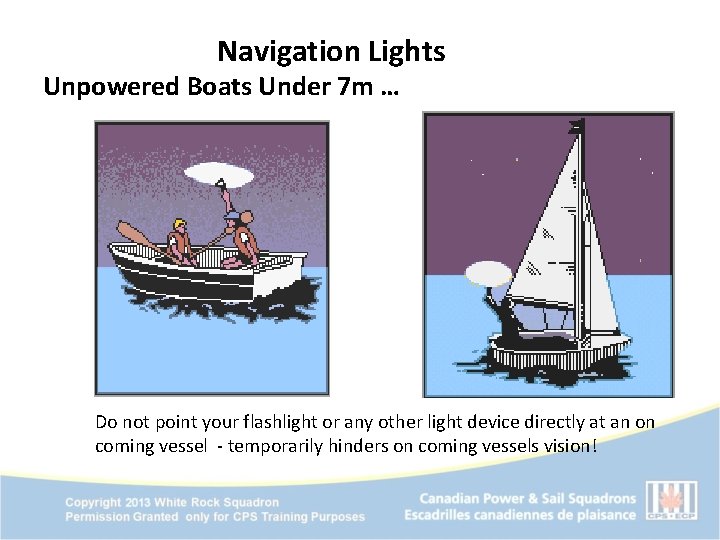
Navigation Lights Unpowered Boats Under 7 m … Do not point your flashlight or any other light device directly at an on coming vessel - temporarily hinders on coming vessels vision!
Navigation Lights • At night (sunset to sunrise), unpowered boats should have a watertight flashlight or a lighted lantern handy to display so that if they come across other vessels, they can show a light and avoid a collision.
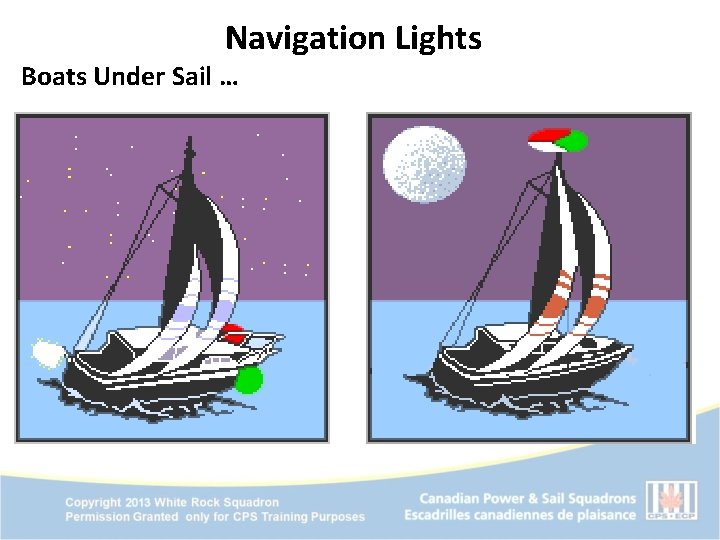
Navigation Lights Boats Under Sail …
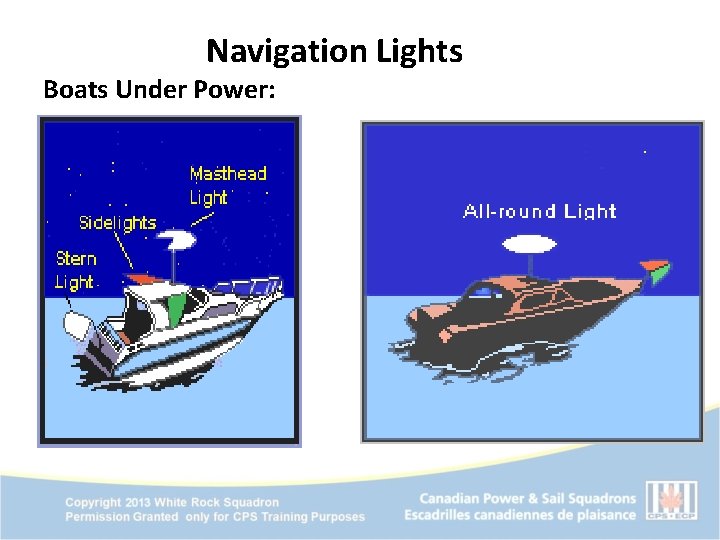
Navigation Lights Boats Under Power:
Signaling Devices • Daytime: – – Mirrors (optional) Distress flags (optional, rarely used) Signals (e. g. orange smoke flares) Horn, whistle • Night-time – Flares – Horn, whistle – Flashlight • EPIRBs – Emergency Position Indicating Radio Beacon – emits distress call when activated
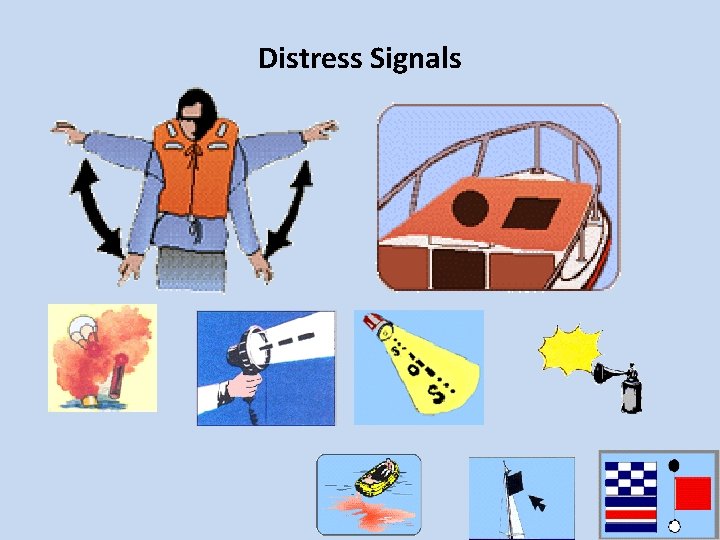
Distress Signals
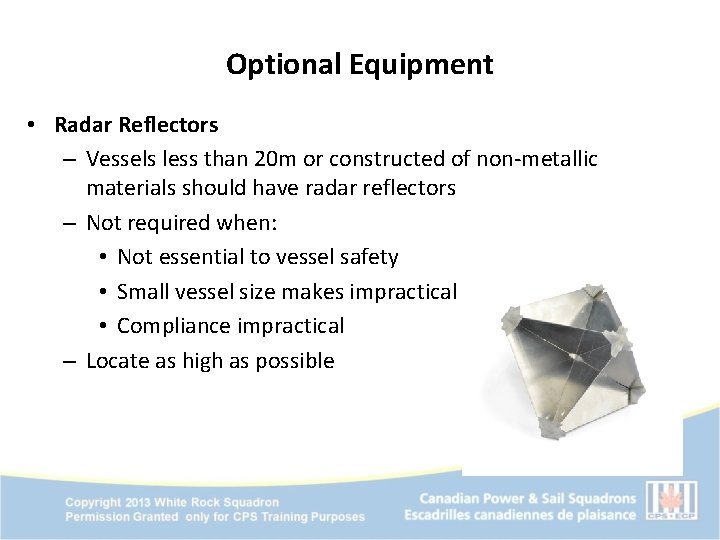
Optional Equipment • Radar Reflectors – Vessels less than 20 m or constructed of non-metallic materials should have radar reflectors – Not required when: • Not essential to vessel safety • Small vessel size makes impractical • Compliance impractical – Locate as high as possible
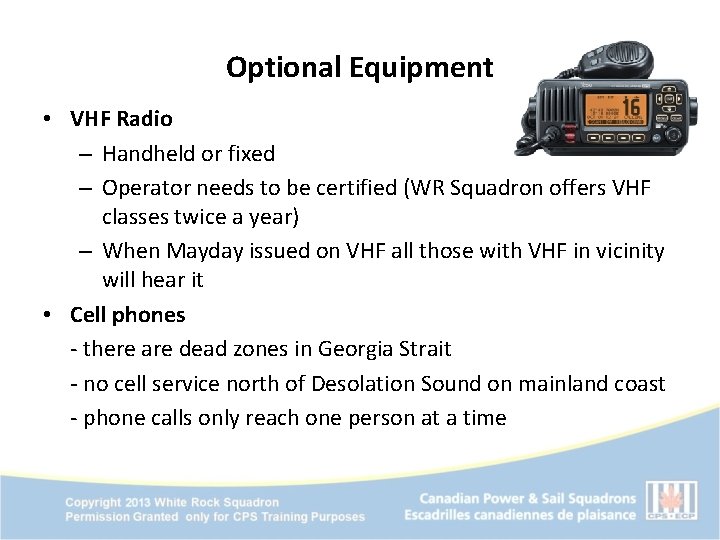
Optional Equipment • VHF Radio – Handheld or fixed – Operator needs to be certified (WR Squadron offers VHF classes twice a year) – When Mayday issued on VHF all those with VHF in vicinity will hear it • Cell phones - there are dead zones in Georgia Strait - no cell service north of Desolation Sound on mainland coast - phone calls only reach one person at a time
At Anchor • All pleasure craft less than 50 m long must display a 360 o white light when at anchor at night as high up and visible as possible. • Anchor light is not required in designated anchorages – but if in doubt, turn it on. • Not used in marinas
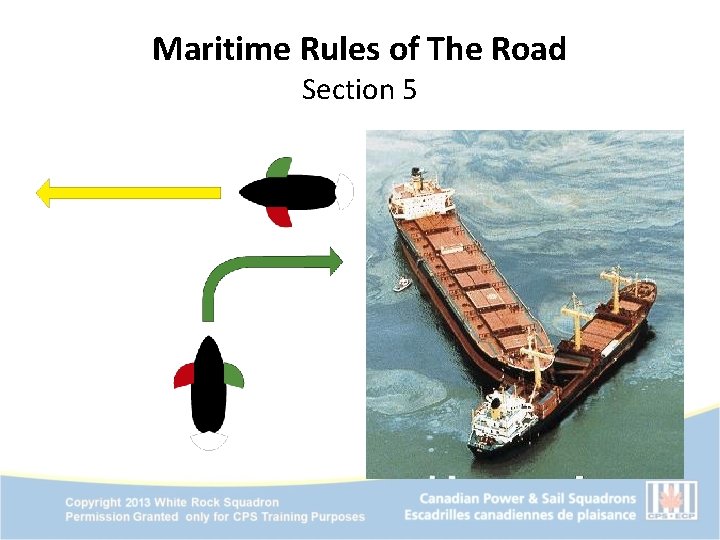
Maritime Rules of The Road Section 5
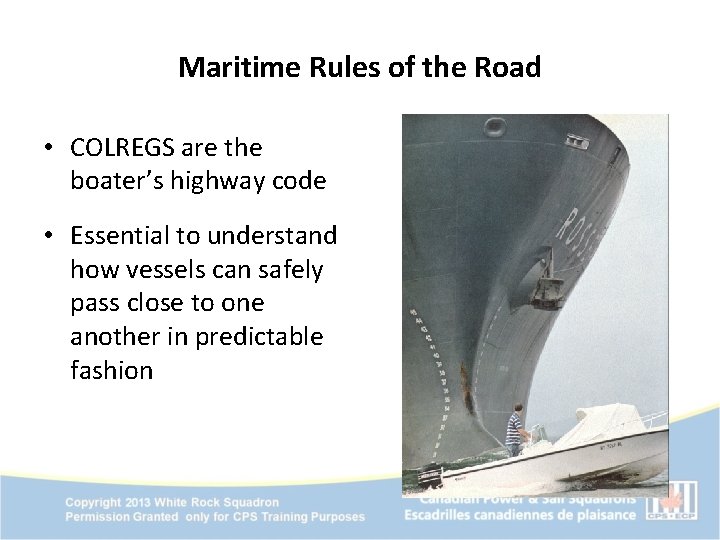
Maritime Rules of the Road • COLREGS are the boater’s highway code • Essential to understand how vessels can safely pass close to one another in predictable fashion
Maritime Rules of the Road • Rules are described in Collision Avoidance Regulations (COLREGS), understood internationally • Key is knowing who should give way in each near passage situation • Your intentions are best signaled by early course alteration; horn signals exist but are rarely used and may confuse others
Maritime Rules of the Road EVERYONE must follow the COLREGS – ignorance is no defense. • BUT don’t be “dead” right • When you take control of a boat you become legally responsible for the safety of your passengers AND the safety of people on other vessels. • Rules of Road apply to ALL vessels. - Sailboats are power boats when under power, even though a sail may be up
Maritime Rules of the Road • If you see the port side of a boat or its red light, YOU are the “give way” boat – you must stay clear • At the same time the other boat will see your stb side or green light and knows he has right of way - “stand on” boat is obligated to maintain course and speed • Manually powered boats have right of way over sailboats and sailboats have right of way over motorboats
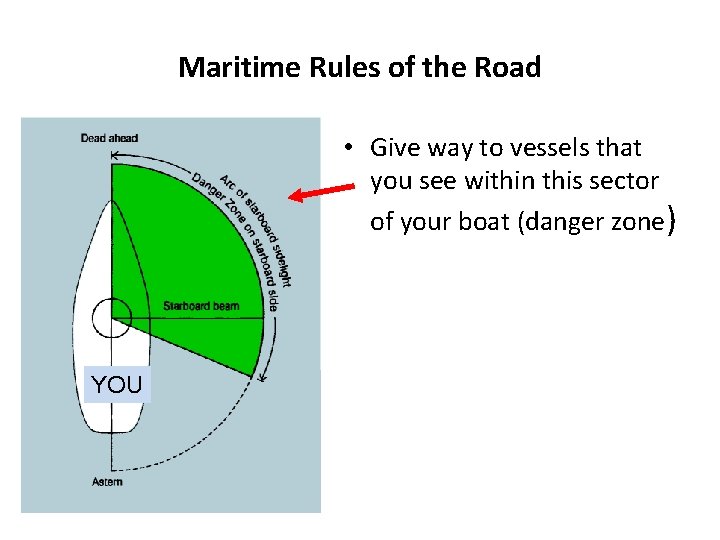
Maritime Rules of the Road • Give way to vessels that you see within this sector of your boat (danger zone) YOU
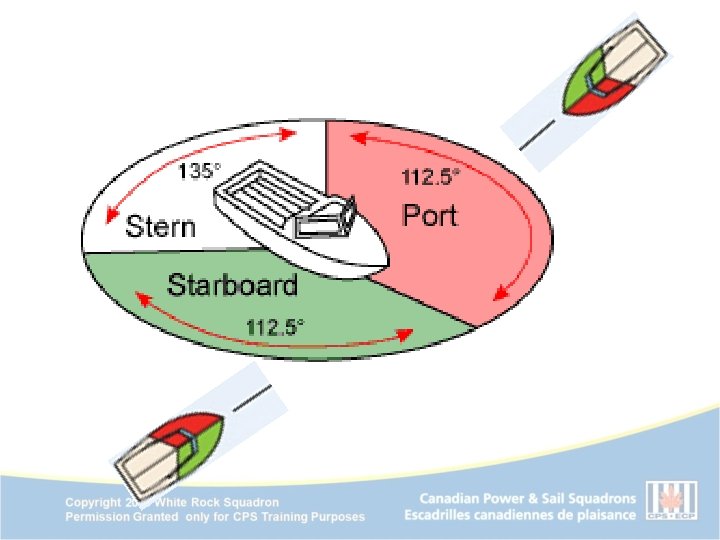
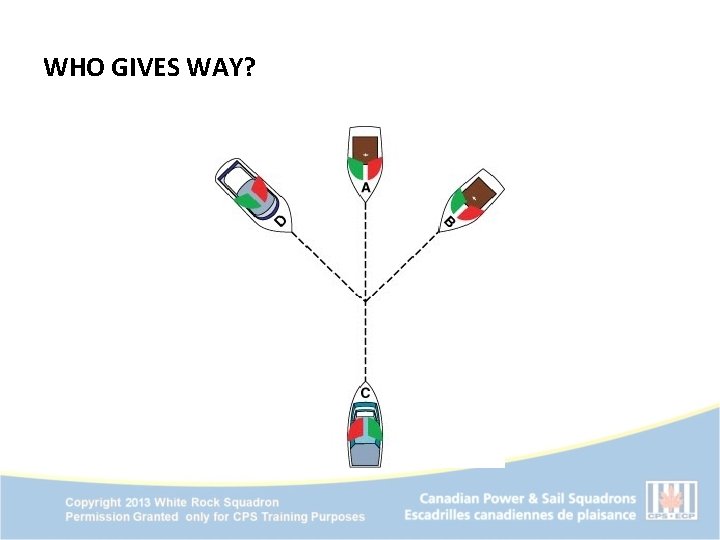
WHO GIVES WAY?
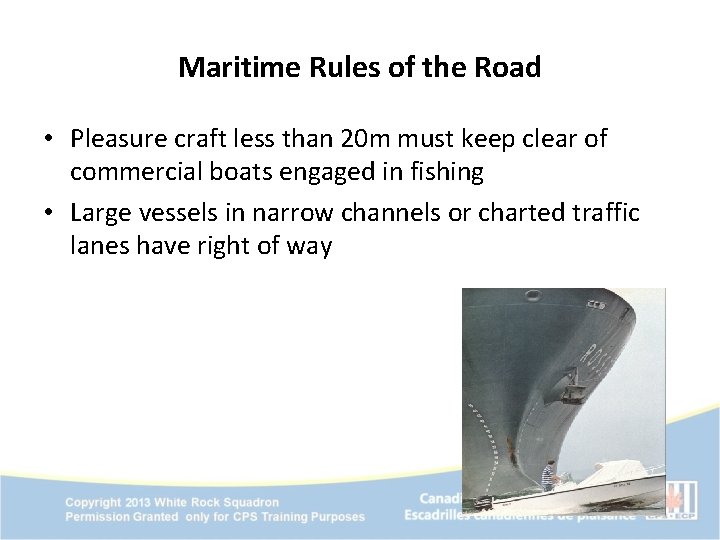
Maritime Rules of the Road • Pleasure craft less than 20 m must keep clear of commercial boats engaged in fishing • Large vessels in narrow channels or charted traffic lanes have right of way
Maritime Rules Sound Signals In poor visibility (i. e. fog, smog) … Sailboats – 1 long blast, 2 short blasts every 2 minutes Power boats – 1 long blast every 2 minutes when under way, – 2 long blasts every 2 minutes when stopped. – Remember: a sailboat under power is a power boat
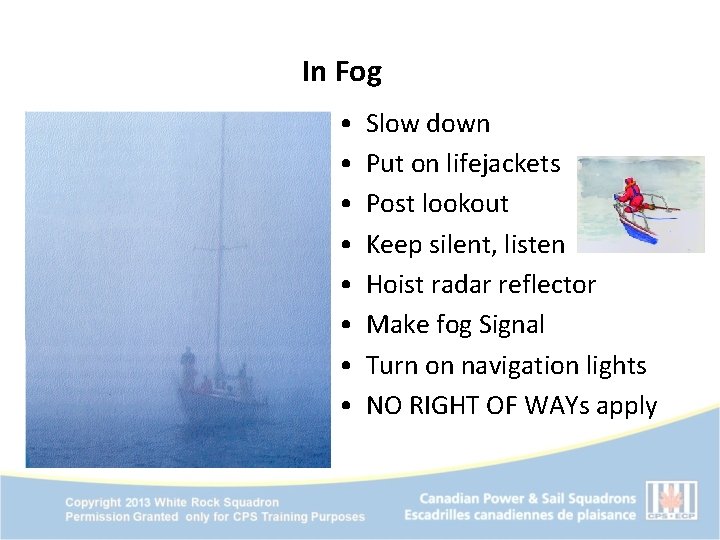
In Fog • • Slow down Put on lifejackets Post lookout Keep silent, listen Hoist radar reflector Make fog Signal Turn on navigation lights NO RIGHT OF WAYs apply

Maritime Rules for Overtaking boat must keep clear (give way) Overtaken boat must keep steady course, speed (stand on) - Allow good distance between vessels to minimize wake effects
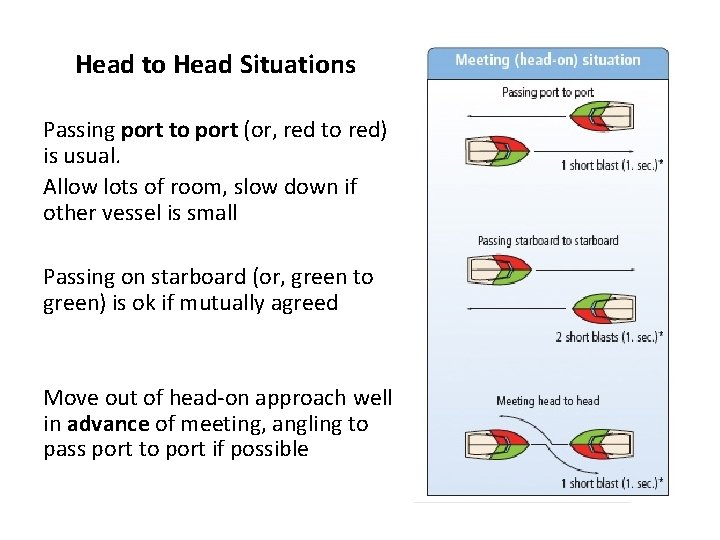
Head to Head Situations Passing port to port (or, red to red) is usual. Allow lots of room, slow down if other vessel is small Passing on starboard (or, green to green) is ok if mutually agreed Move out of head-on approach well in advance of meeting, angling to pass port to port if possible
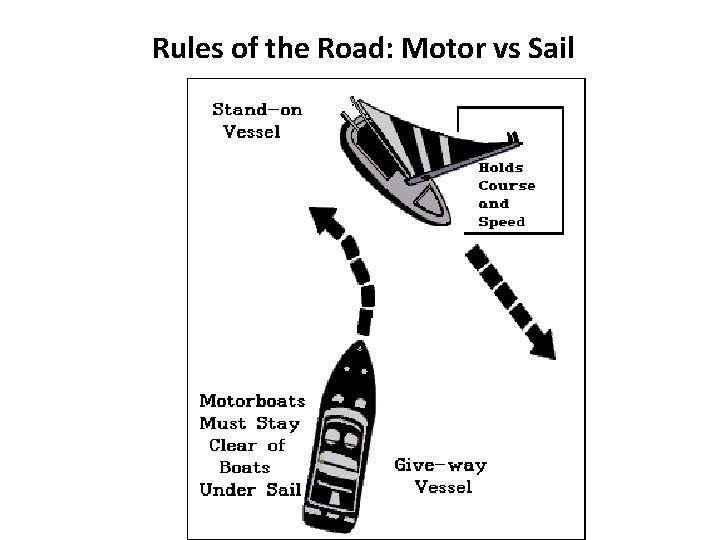
Rules of the Road: Motor vs Sail
Rules of the Road for Sail Boats - Port/Starboard tack rule (look at mainsail) – Port tack = wind coming over port side – Starboard tack = wind over starboard side – Boat on Port tack gives way to boat on Starboard tack. – Windward boat rule applies when both are on same tack: vessel nearer to wind gives way as it has more options
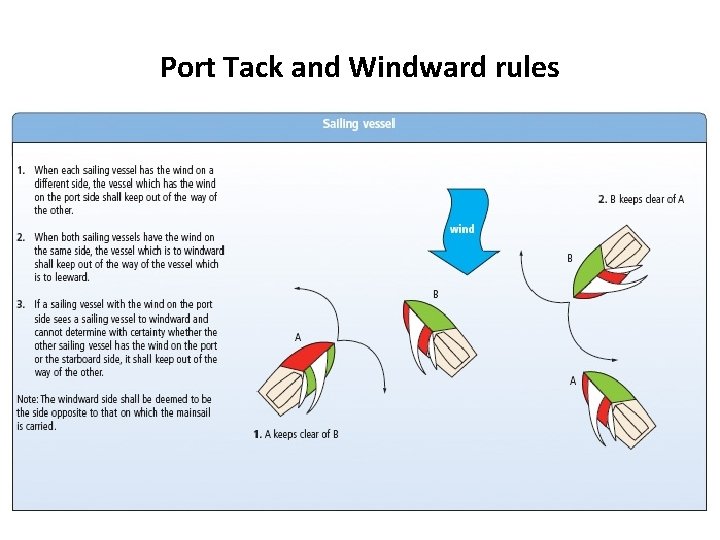
Port Tack and Windward rules
If you are the ‘Stand On’ vessel… • You maintain course and speed, but you still must watch to make sure that the ‘give way’ boat reacts properly. • If there is risk of collision. . . – You MUST alter course and/or speed and avoid the collision.
• Flashing Blue lights are restricted to law enforcement boats, treat them as you would on land • Additional lights are displayed in special circumstances, such as tug with tow and large vessel “not under command”
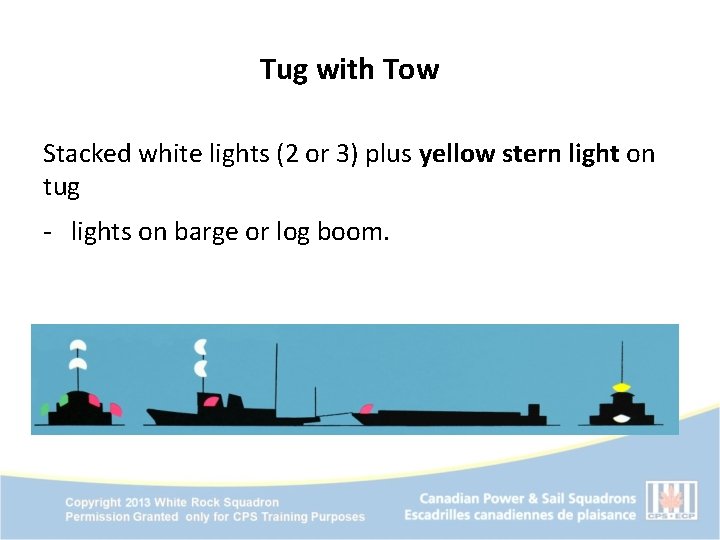
Tug with Tow Stacked white lights (2 or 3) plus yellow stern light on tug - lights on barge or log boom.
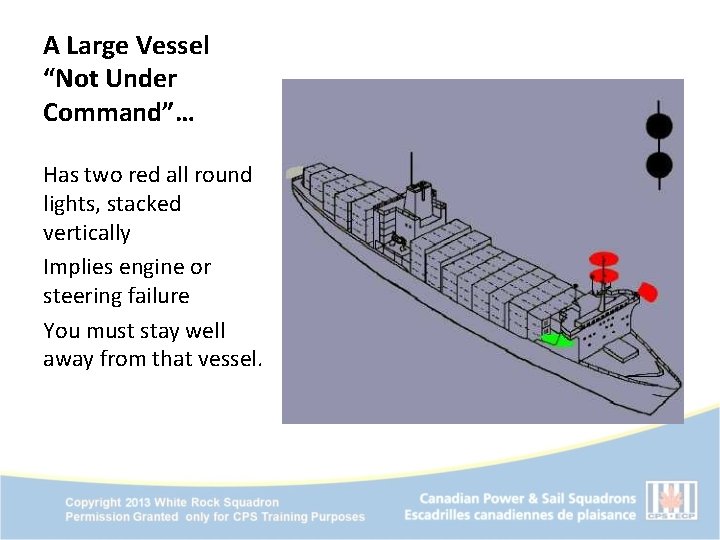
A Large Vessel “Not Under Command”… Has two red all round lights, stacked vertically Implies engine or steering failure You must stay well away from that vessel.
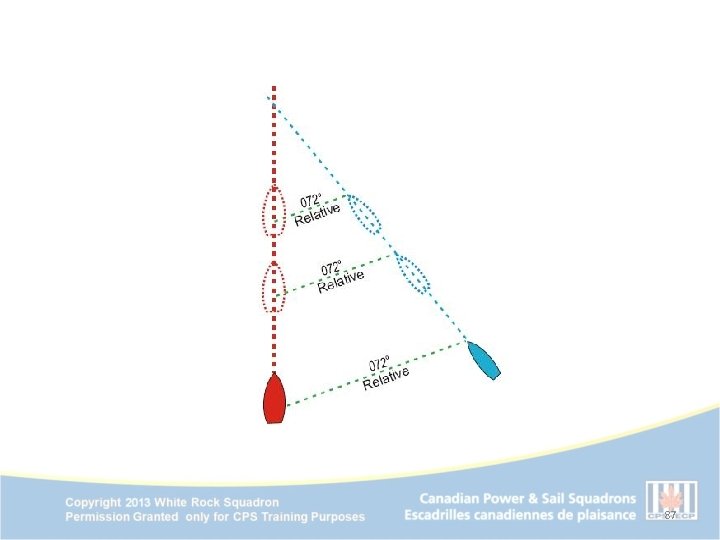
Some good advice… • NEVER pass between a tug boat and vessel being towed. • When in or near shipping lanes, try to stay in company of other small boats to help enhance your visibility. • If you are near a vessel in tow, stay well away • If you are near a fishing vessel, stay well away. • If a freighter or ferry is approaching take early action to stay well away. • If a vessel crossing your path remains in the same relative position as you get closer, you are probably on a collision path, so take evasive action early.
87
One overriding rule: • Do what must be done to avoid an accident, no matter who is in the right!!!
For Next Week • Read Sections 1 -3, and 5 (this evening’s class) • Read Sections 4, 6 – 9 (for next week’s class) • Do the quizzes at the end of each section after you have finished reading that section • Bring your questions to class, or send us an email or call.
- Slides: 89