
Board Secretary Training Gemma Parker Student Records Student
Board Secretary Training Gemma Parker Student Records Student Administration Training
Glossary Student Administration Training
Session overview • An introduction to the regulatory framework • A brief overview of Panels and Boards of Examiners, and the Awards and Assessments Process • The key roles and responsibilities for board members • Senate Regulation 5 • My. Student. Record and Business Objects Overview • Running a board report • What do you need to do now? studentrecords@le. ac. uk or qualoffice@le. ac. uk Student Administration Training

Regulatory Framework • QAA (Quality Assurance Agency) • The framework for how we operate the assessment, progression and award of students is set out in the Senate Regulations: – – SR 7: Assessment SR 5: Progression and Award for undergraduates SR 6: Progression and Award for postgraduates SR 11: Plagiarism • Designed to ensure a transparent process and consistent treatment of students across the institution • Define the roles of individuals in the process • Address themes such as consistency of academic standards, mitigating circumstances and borderline cases Student Administration Training
Awards and Assessment Process • Purpose: – To capture and hold student results in a single, secure location; – To calculate student progression and awards securely and in accordance with Senate Regulations in order to support transparent and consistent Panel and Board decisions; – To enable student access to their results via secure access • Actions: maintain SITS with progression and award rules consistent with regulations, to generate progressions and award calculations once Panels have met, to finalise progression and award calculations after Board outcomes have been notified • Outputs: release of progression and award outcomes to student via My. Student. Record Student Administration Training

Process diagram Assessment My. Student. Record marks entered SITS into Marks Entry Module marks Business Objects considered by SITS Panel of Examiners Marks released after Semester 1 panels Students’ overall performance considered by Board of Examiners My. Student. Record SITS Student Administration Training Business Objects SITS Results released to students via My. Student. Record
Panel of Examiners • Senate Regulation 7. 61 – 7. 75 • Purpose: – – Confirm if appropriate module marking processes have taken place; Approve the award of re-assessment opportunities; Approve module outcomes to report to Boards of Examiners; Agree the release of provisional module outcomes to students, with the exception of midsummer marks on campus-based programmes • Actions: consider assessment marks to compile record of module outcomes, taking into account decisions of the Mitigating Circumstances Panel • Outputs: record of mark for each student for each module and to confirm this to the Student Records team Student Administration Training
Boards of Examiners • Senate Regulation 7. 76 – 7. 89 • Purpose: – confirm module outcomes from Panels of Examiners; – consider the academic performance of individual students as it relates to progression or award decisions; – agree progression from one stage of a programme to another, agree awards and their classification, and determine prize winners; – invite the External Examiners to comment on standards • Actions: consider module and overall outcomes for each student, agree degree classification for finalists, and consider borderline cases for eligible UG students • Outputs: record of award or progression decisions for each student, in order to update SITS and allow results to be released to students (signed copy of board report) Student Administration Training
Resit Boards • After Semester 1 panels, provisional results are released to students • After Semester 2 panels, there is a moratorium period before students are assessed by a Board of Examiners for a progression decision to be made • Due to time constraints, after the resit period in the summer, Resit Boards tend to be a panel and board in one: – The first half of the meeting should be a panel and the second half the board – The Data Officer will run the board report based on marks entered in SITS prior to the summer moratorium period – The moratorium period is important as it allows Data Officers to run through the progression/awarding algorithms with static data – The marks will be confirmed by the panel half of the meeting and the progression decision by the board half of the meeting Student Administration Training
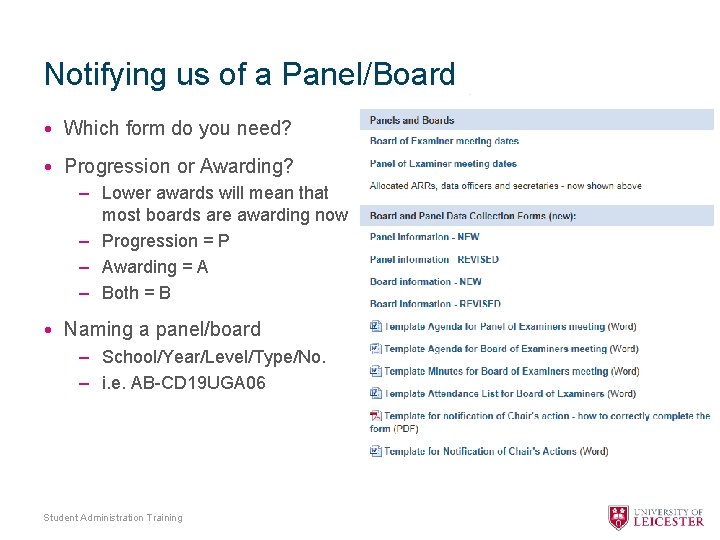
Notifying us of a Panel/Board • Which form do you need? • Progression or Awarding? – Lower awards will mean that most boards are awarding now – Progression = P – Awarding = A – Both = B • Naming a panel/board – School/Year/Level/Type/No. – i. e. AB-CD 19 UGA 06 Student Administration Training
Panel/Board Chair • Chairs are appointed by the Head of School • The Chair of a Board must be on the University’s Register of Approved Chairs (maintained by the Quality Office) and have completed University Examination Board chair training within the last three years • Before the Panel/Board: – Work with the Panel/Board Secretary, that the dates for Panels/Boards of Examiners are agreed and published well in advance of meetings; – Work with the Panel/Board Secretary and/or Examinations Officer ensure that any difficult cases are flagged to the Academic Registrar’s Representative (ARR) and discussed in advance of the meeting; Student Administration Training
Panel/Board Chair • During the Panel/Board – Ensure that the meeting takes place in accordance with the standard agenda, and consideration is given to each item of business; – Ensure that the Panel/Board reaches clear decisions for the purposes of the formal record; – If there is a vote at a meeting the Chair will only vote if there is a tie in which case he/she will have the casting vote; – Ensure that proceedings are properly conducted and managed, that the prescribed documentation is used and members are appropriately briefed; – Ensure that students are treated equitably and in accordance with programme and University regulations, guiding the Board to clear recommendations and decisions; – Ensure that where external examiners are present they are invited to comment on the proceedings, assessments and marking practices; – Sign the Board Report as an accurate record of the meeting; Student Administration Training
Panel/Board Chair • After the Panel/Board meeting – Be responsible for taking any subsequent action on behalf of the Board; – Approve the minutes • Chair’s Action – The Chair of a Panel/Board may have delegated powers to act in relation to deferred decisions, with the prior agreement of the Board; – Chair’s Action may only be taken on other occasions where there are urgent circumstances. Chair’s action should be avoided where an issue is likely to be contentious and would normally be one of the following: • Administrative action, i. e. correcting an error; • Delegated action, i. e. where the Board has authorised the Chair to act on its behalf following consideration of a case at its previous meeting; • Academic action, i. e. where it is necessary to exercise academic judgement in order to allow a student to progress or be awarded. Student Administration Training
Academic Registrar’s Representative (ARR) • Before the meeting: – Meet the Board Secretary and, where necessary, the Chair of the Board to discuss the meeting – Review difficult cases in advance and provide advice – Review Board paperwork with Secretary • During the meeting: – Provide advice to the Board on senate regulations and interpretation – Ensure senate regulations are being applied correctly and consistently; intervening when they are not – Take details of cases where the Board proposes action outside of regulations and to refer these higher where necessary • After the meeting: – Follow up on any cases requiring referral – Report on conduct of Board if required Student Administration Training
External Examiners • External Examiners provide impartial advice and informed comment on the University’s standards and student achievement • They are equal members of the Board and are not the final arbiter of marks or grades. They may, however, request that marks be re-visited across a whole cohort if they consider there is evidence of under- or over-marking. • They should be requested to endorse, or not, the decisions of a Board of Examiners rather than decisions relating to individual students • The Panel/Board Secretary, is responsible for ensuring that Externals have all of the required documentation to support the process, and sign the Board report at the end of the meeting; • The Chair is responsible for ensuring that Externals are given the opportunity to reflect on the year’s assessment process, standards of student achievement and any other matters they consider relevant Student Administration Training
Your Role as Panel/Board Secretary • Before the meeting: – Ensure that dates of meetings (and later changes) are agreed well in advance with the Chair and notified to members and Student Records; – Ensure that the necessary administrative arrangements are made in advance of meetings; – Draft agendas in consultation with the Chair and circulate them at least 7 days in advance of the meeting; – Ensure the requisite Panel/Board report is produced in preparation for the meeting, including liaison with the Data Officer, and agreement of results release date after the Board – Ensure that they are familiar with programme regulations and University regulations for progression and award; – Maintain a list of cases to discuss with the ARR – Arrange for someone to take minutes (doesn’t have to be you!) Student Administration Training
Your Role as Panel/Board Secretary • During the meeting: – Ensure that a formal record of attendance is maintained; – Ensure that the Panel and Board reports are annotated to reflect decisions taken at the meeting; – Ensure that the formal paperwork is signed by the Chair and External Examiner(s) (where present); – Ensure that a record of prizes is made and that these are forwarded to the Quality Office after the meeting. – Be aware of GDPR! Don’t leave personal data where it could be found and collect any copies of the board report. – Remember: You don’t have to do everything yourself! Your role is to ensure everything gets done but you can delegate i. e. minute writing Student Administration Training
Your Role as Panel/Board Secretary • After the meeting: – Amend any resit recommendations on My. Student. Record; – Add any specific information to students; – Ensure that full and accurate minutes are produced (doesn’t have to be you); – Ensure that decisions are updated on the relevant student record system, working with the designated Data Officer where appropriate; – Ensure that confidential paperwork is shredded after Board meetings; – Follow up any deferred decisions and work with the Chair to ensure that a formal report of Chair’s Action is made where appropriate, including to Student Records by the prescribed deadline. Student Administration Training
The Role of the Data Officer • To manage progression and award on students’ records; • To use progression profiles in SITS to calculate what should happen to students at particular points in their studies based on senate regulations; • To notify the Board Secretary when the board paperwork is ready to be printed; • To work with the Board Secretary after the meeting to input all progression and award data into SITS • To publish confirmed module results and award/progression data; • To process chair’s actions after the Panel/Board Student Administration Training
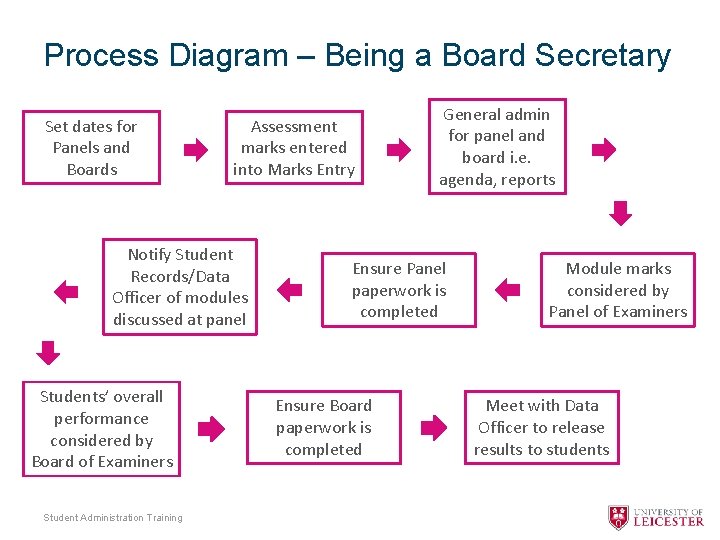
Process Diagram – Being a Board Secretary Set dates for Panels and Boards Assessment marks entered into Marks Entry Notify Student Records/Data Officer of modules discussed at panel Students’ overall performance considered by Board of Examiners Student Administration Training General admin for panel and board i. e. agenda, reports Ensure Panel paperwork is completed Ensure Board paperwork is completed Module marks considered by Panel of Examiners Meet with Data Officer to release results to students
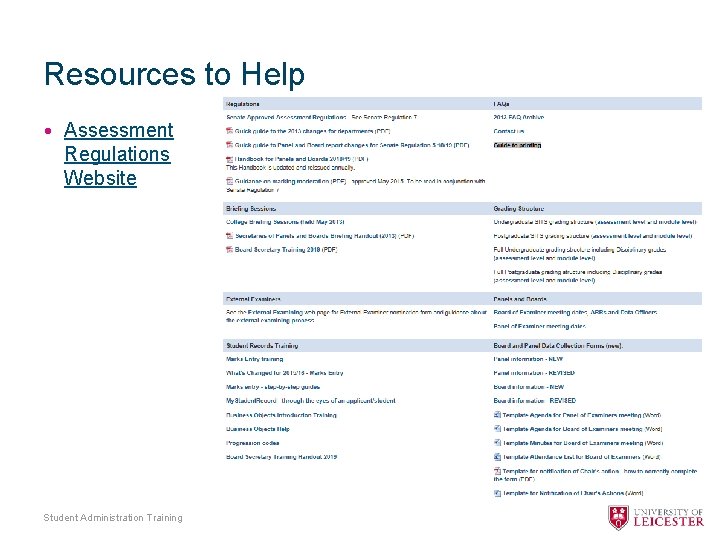
Resources to Help • Assessment Regulations Website Student Administration Training
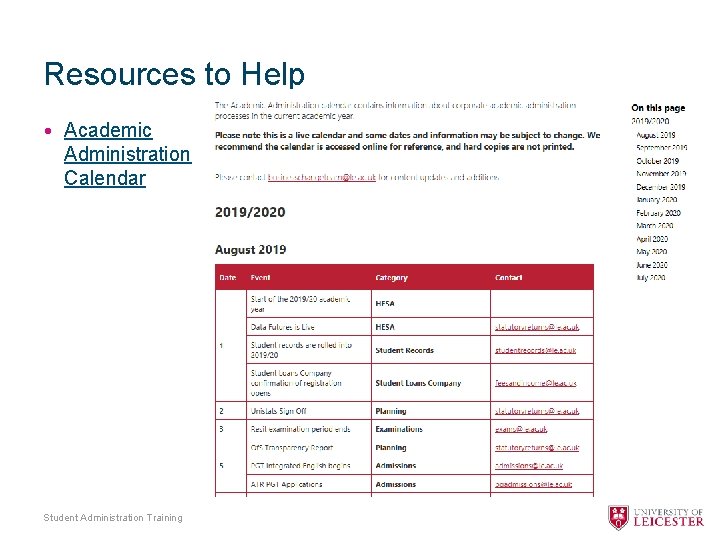
Resources to Help • Academic Administration Calendar Student Administration Training
Marks Entry • All marks should be entered before the panel takes place • All marks should be entered via My Student Record • Any changes to marks after the panel has taken place should be amended via a chair’s action • There is a separate marks entry training session if you feel you need further training • Marks Entry will close during the moratorium periods so that preboard processes can be run. During moratorium periods you will not be able to enter marks. Student Administration Training
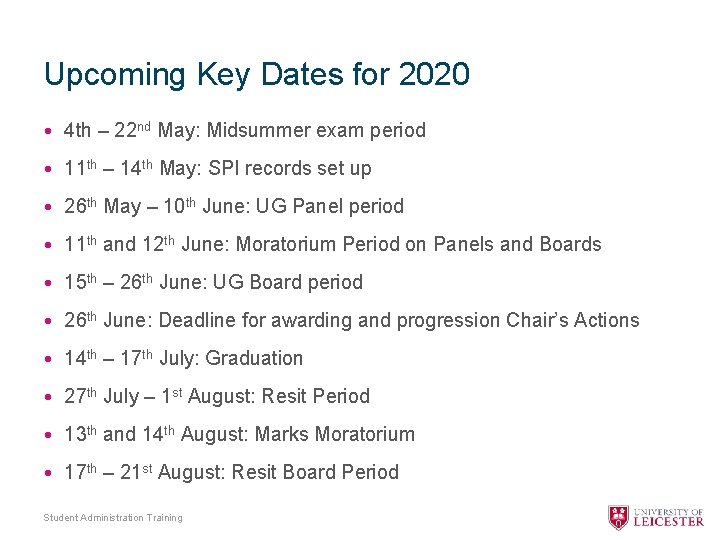
Upcoming Key Dates for 2020 • 4 th – 22 nd May: Midsummer exam period • 11 th – 14 th May: SPI records set up • 26 th May – 10 th June: UG Panel period • 11 th and 12 th June: Moratorium Period on Panels and Boards • 15 th – 26 th June: UG Board period • 26 th June: Deadline for awarding and progression Chair’s Actions • 14 th – 17 th July: Graduation • 27 th July – 1 st August: Resit Period • 13 th and 14 th August: Marks Moratorium • 17 th – 21 st August: Resit Board Period Student Administration Training
Chair’s Actions • Used when a Panel/Board to change or defer a decision in the following circumstances: – Administrative action, i. e. correcting an error; – Delegated action, i. e. where the Board has authorised the Chair to act on its behalf following consideration of a case at its previous meeting; – Academic action, i. e. where it is necessary to exercise academic judgement in order to allow a student to progress or be awarded. • Must be signed by the chair or sent from their registered university email address • Awarding Chair’s Actions must be signed by the External Examiner and seen by the ARR. They should also include the classification of the award • Deadline for Chair’s Actions in the Midsummer period is 26 th June Student Administration Training
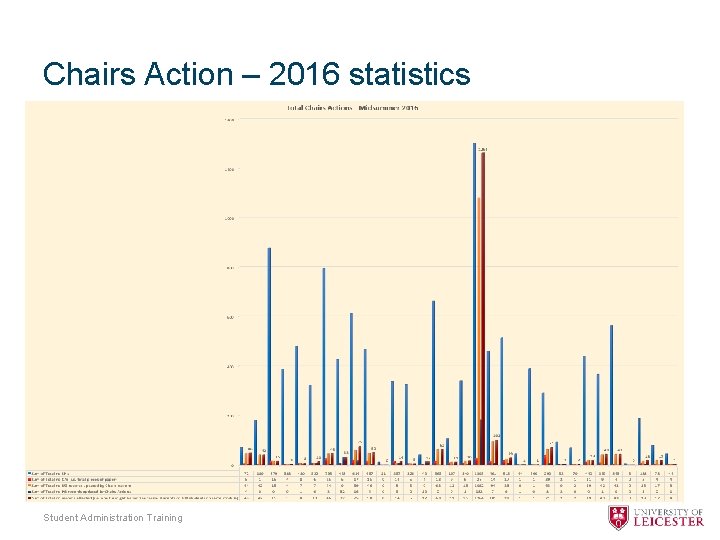
Chairs Action – 2016 statistics Student Administration Training
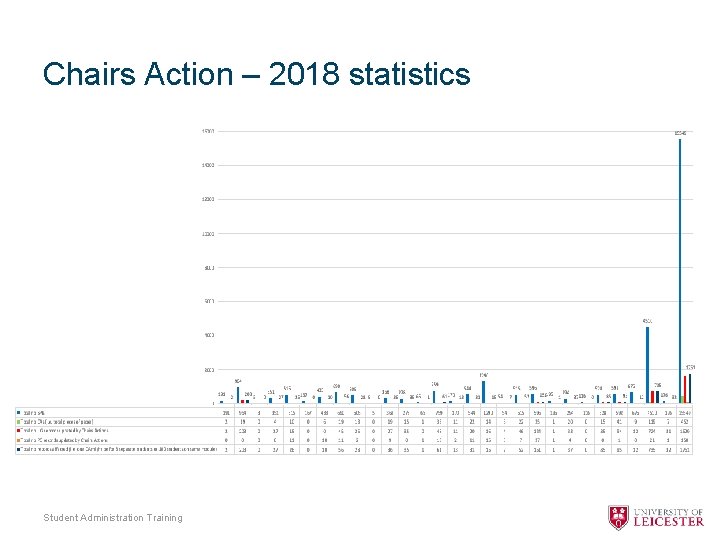
Chairs Action – 2018 statistics Student Administration Training
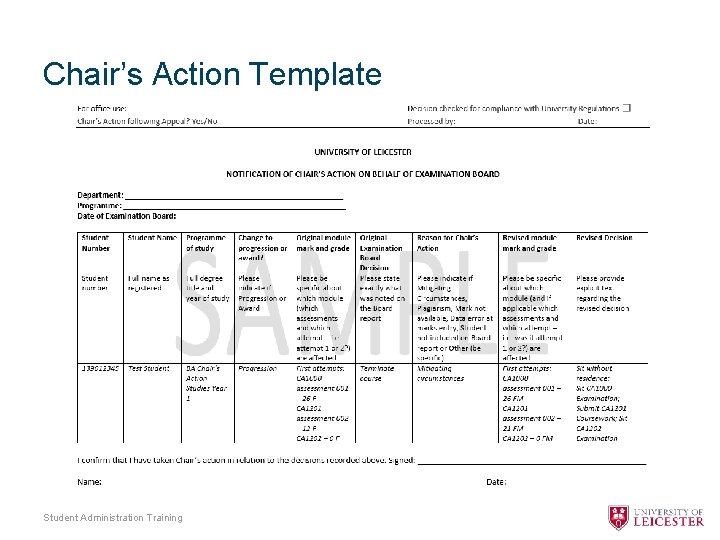
Chair’s Action Template Student Administration Training
My. Student. Record Overview • My Student Record (TEST) • My Student Record (LIVE) • Exam Board Departmental View – – Student Lookup View Board of Examiners (addition to Board Report) Reassessment Recommendations Staff View of Student Results Student Administration Training
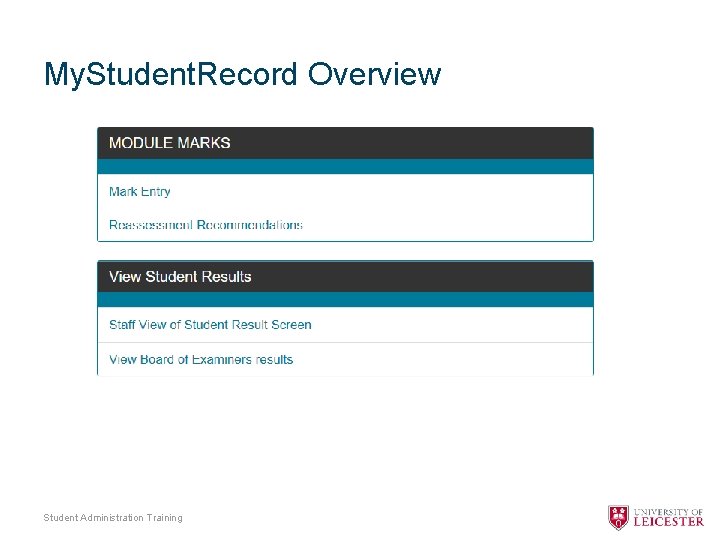
My. Student. Record Overview Student Administration Training
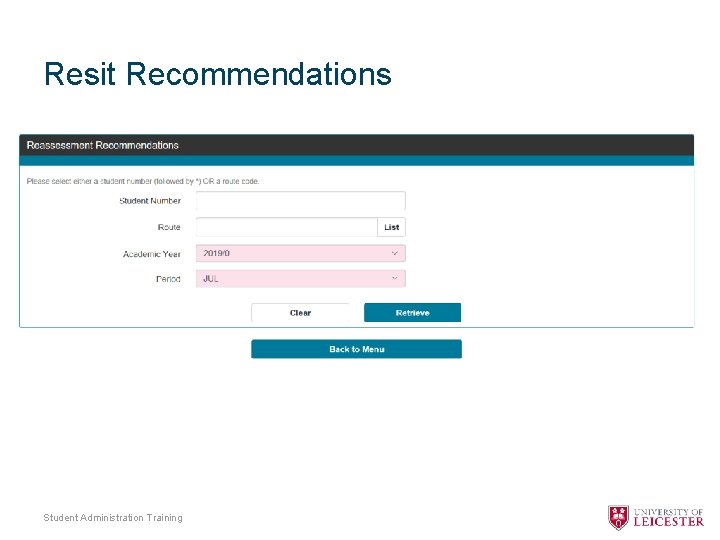
Resit Recommendations Student Administration Training
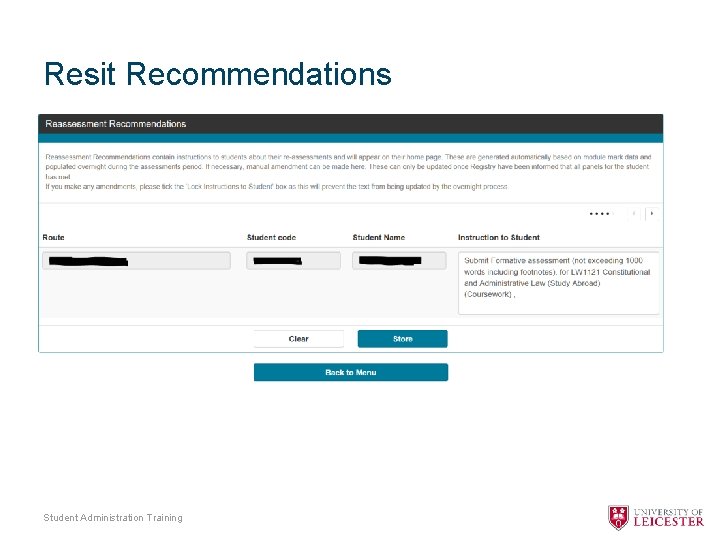
Resit Recommendations Student Administration Training
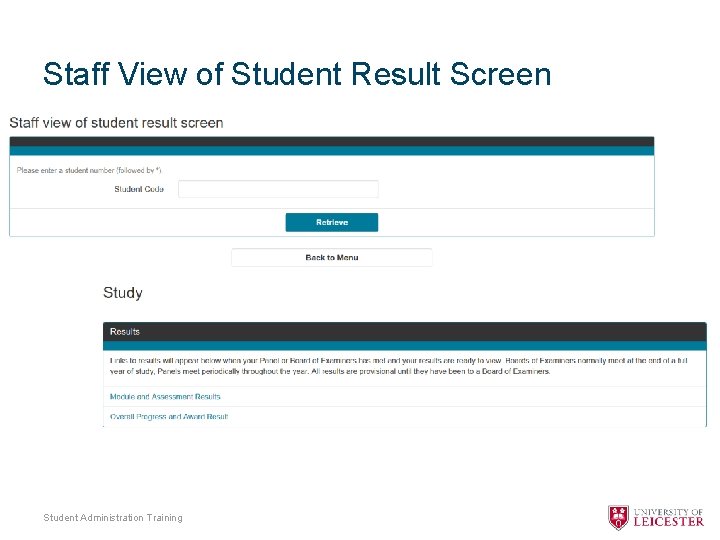
Staff View of Student Result Screen Student Administration Training
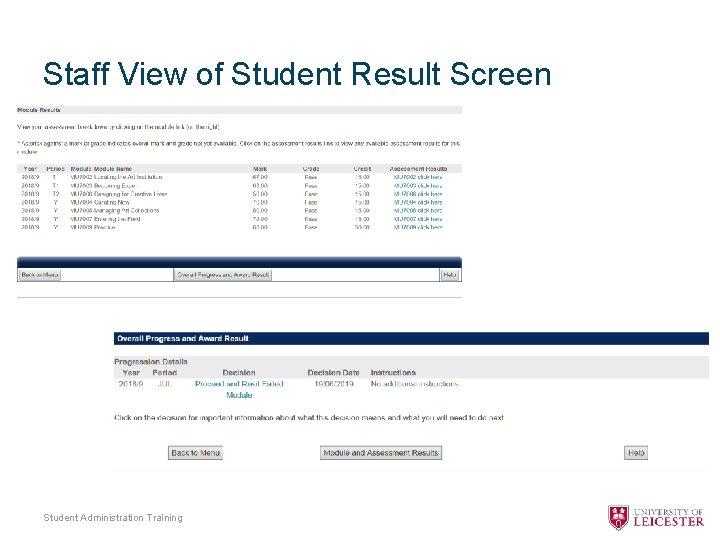
Staff View of Student Result Screen Student Administration Training
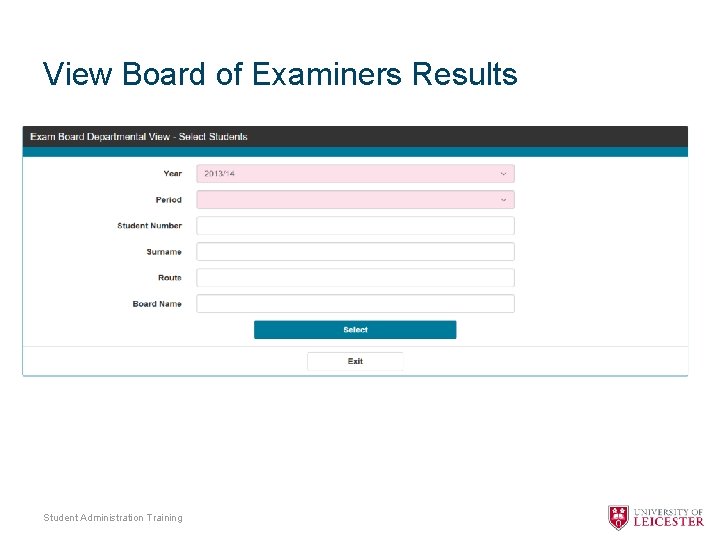
View Board of Examiners Results Student Administration Training
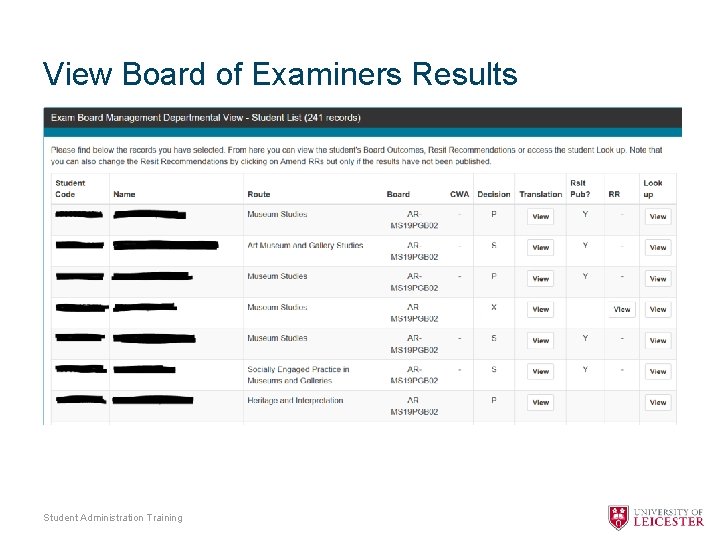
View Board of Examiners Results Student Administration Training
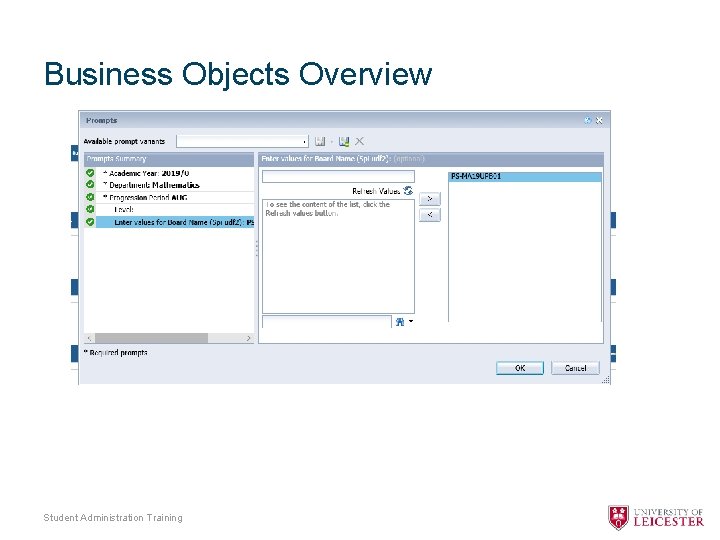
Business Objects Overview • Business Objects (TEST) • Business Objects (LIVE) • Student List for Boards • Panel/Board Report – – Select the correct report! Make sure you use the right prompts Resit Recommendations Let your Data Officer know if you are either missing students or if you have some extras Student Administration Training
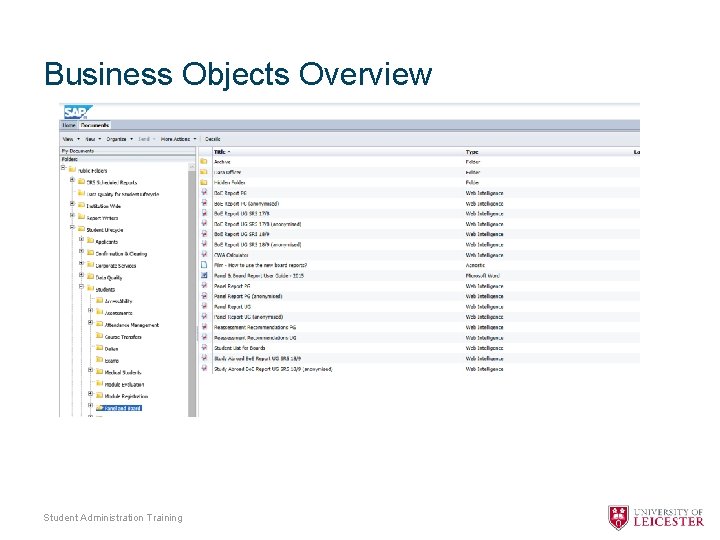
Business Objects Overview Student Administration Training
Business Objects Overview Student Administration Training
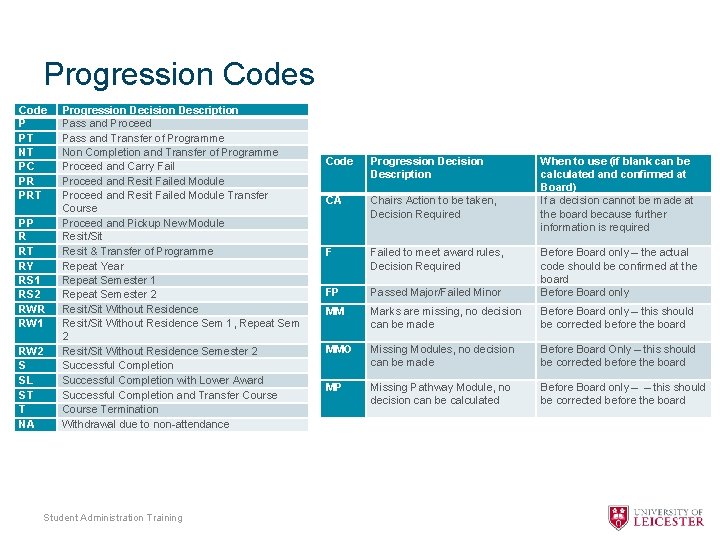
Progression Codes Code P PT NT PC PR PRT PP R RT RY RS 1 RS 2 RWR RW 1 RW 2 S SL ST T NA Progression Decision Description Pass and Proceed Pass and Transfer of Programme Non Completion and Transfer of Programme Proceed and Carry Fail Proceed and Resit Failed Module Transfer Course Proceed and Pickup New Module Resit/Sit Resit & Transfer of Programme Repeat Year Repeat Semester 1 Repeat Semester 2 Resit/Sit Without Residence Sem 1, Repeat Sem 2 Resit/Sit Without Residence Semester 2 Successful Completion with Lower Award Successful Completion and Transfer Course Termination Withdrawal due to non-attendance Student Administration Training Code Progression Decision Description When to use (if blank can be calculated and confirmed at Board) If a decision cannot be made at the board because further information is required CA Chairs Action to be taken, Decision Required F Failed to meet award rules, Decision Required FP Passed Major/Failed Minor Before Board only – the actual code should be confirmed at the board Before Board only MM Marks are missing, no decision can be made Before Board only – this should be corrected before the board MMO Missing Modules, no decision can be made Before Board Only – this should be corrected before the board MP Missing Pathway Module, no decision can be calculated Before Board only – – this should be corrected before the board
The Perfect Paperwork Student Administration Training
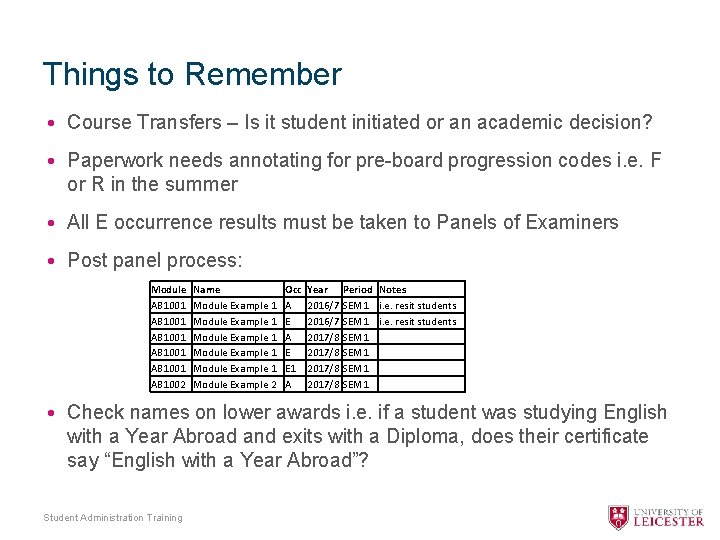
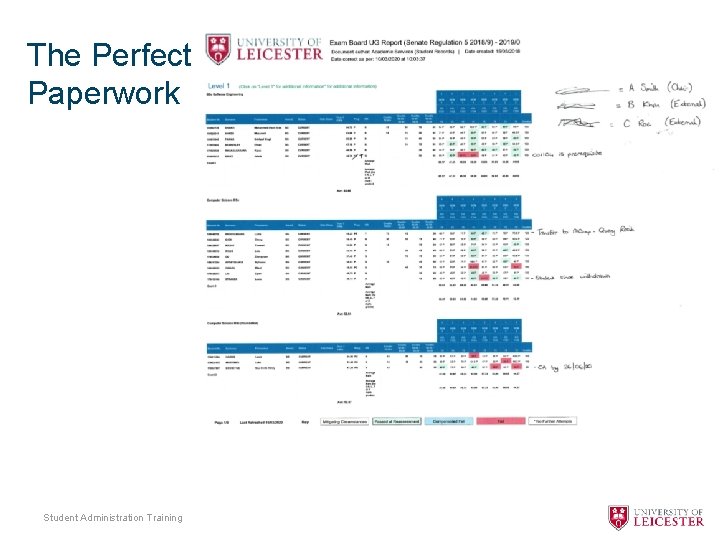
Things to Remember • Course Transfers – Is it student initiated or an academic decision? • Paperwork needs annotating for pre-board progression codes i. e. F or R in the summer • All E occurrence results must be taken to Panels of Examiners • Post panel process: Module AB 1001 AB 1001 AB 1002 Name Module Example 1 Module Example 1 Module Example 2 Occ A E E 1 A Year 2016/7 2017/8 Period SEM 1 SEM 1 Notes i. e. resit students • Check names on lower awards i. e. if a student was studying English with a Year Abroad and exits with a Diploma, does their certificate say “English with a Year Abroad”? Student Administration Training
Things to Remember • Students awarded an “exit” award will be invited to graduation • Take debtors to Board (contradicting Senate Regulation 3. 29) – “ 3. 29. No degree, diploma or certificate will be awarded to a student who has an unpaid tuition fee liability. ” • Award Calculator – use it to calculate awards for chair’s actions or to determine if a student can improve their classification with resits • Category 2 or 3 Plagiarism – students can resubmit for credit but Student Records need to be notified to manually apply the module credit • Marks entry will be closed during the moratorium periods • You are responsible for checking resit recommendations for your boards • Lower awards for withdrawn students Student Administration Training
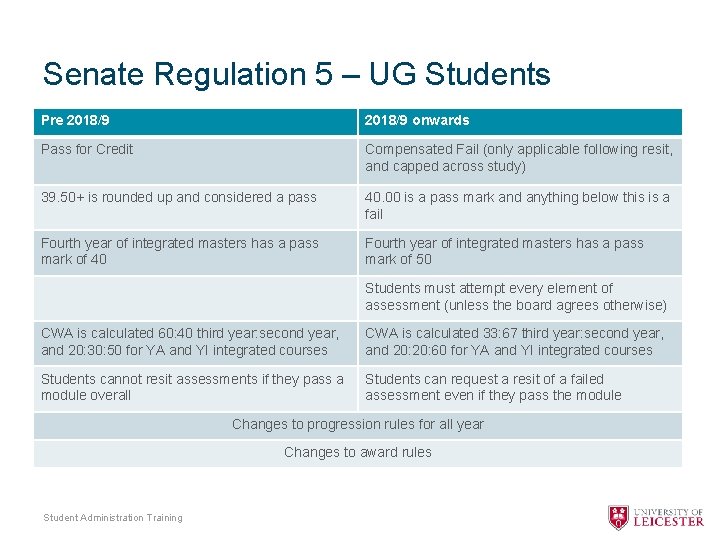
Senate Regulation 5 – UG Students Pre 2018/9 onwards Pass for Credit Compensated Fail (only applicable following resit, and capped across study) 39. 50+ is rounded up and considered a pass 40. 00 is a pass mark and anything below this is a fail Fourth year of integrated masters has a pass mark of 40 Fourth year of integrated masters has a pass mark of 50 Students must attempt every element of assessment (unless the board agrees otherwise) CWA is calculated 60: 40 third year: second year, and 20: 30: 50 for YA and YI integrated courses CWA is calculated 33: 67 third year: second year, and 20: 60 for YA and YI integrated courses Students cannot resit assessments if they pass a module overall Students can request a resit of a failed assessment even if they pass the module Changes to progression rules for all year Changes to award rules Student Administration Training
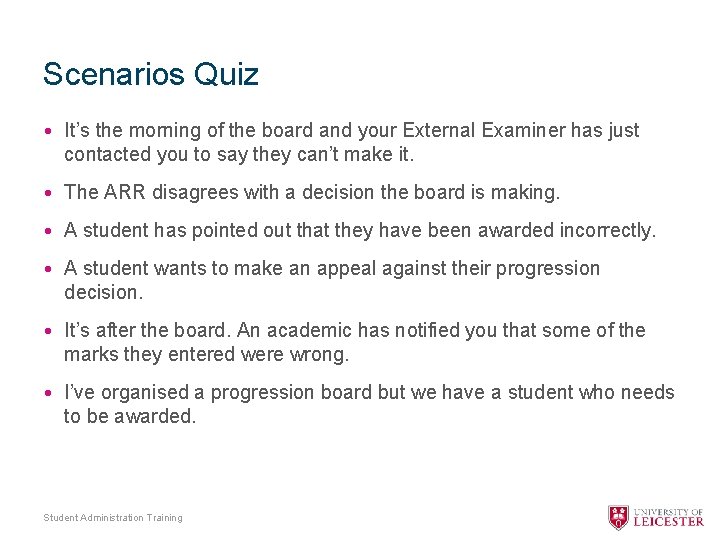
Scenarios Quiz • It’s the morning of the board and your External Examiner has just contacted you to say they can’t make it. • The ARR disagrees with a decision the board is making. • A student has pointed out that they have been awarded incorrectly. • A student wants to make an appeal against their progression decision. • It’s after the board. An academic has notified you that some of the marks they entered were wrong. • I’ve organised a progression board but we have a student who needs to be awarded. Student Administration Training
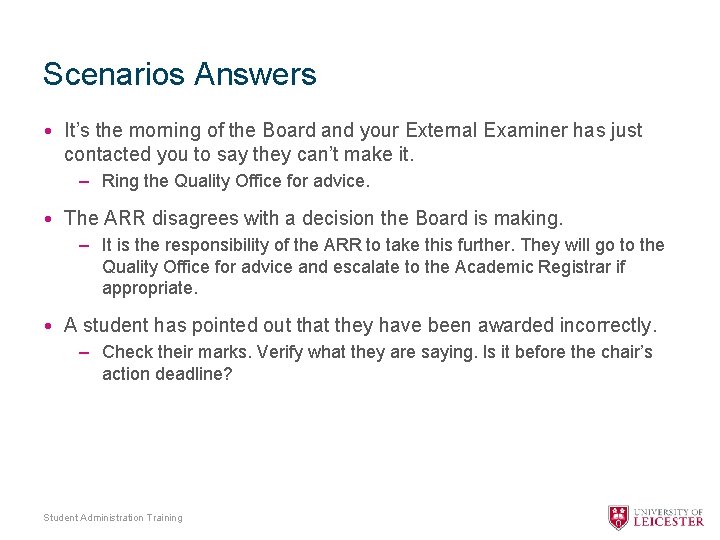
Scenarios Answers • It’s the morning of the Board and your External Examiner has just contacted you to say they can’t make it. – Ring the Quality Office for advice. • The ARR disagrees with a decision the Board is making. – It is the responsibility of the ARR to take this further. They will go to the Quality Office for advice and escalate to the Academic Registrar if appropriate. • A student has pointed out that they have been awarded incorrectly. – Check their marks. Verify what they are saying. Is it before the chair’s action deadline? Student Administration Training
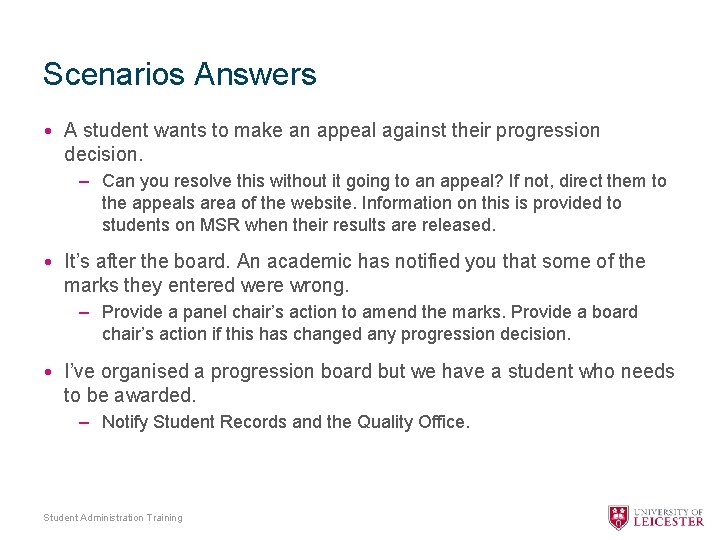
Scenarios Answers • A student wants to make an appeal against their progression decision. – Can you resolve this without it going to an appeal? If not, direct them to the appeals area of the website. Information on this is provided to students on MSR when their results are released. • It’s after the board. An academic has notified you that some of the marks they entered were wrong. – Provide a panel chair’s action to amend the marks. Provide a board chair’s action if this has changed any progression decision. • I’ve organised a progression board but we have a student who needs to be awarded. – Notify Student Records and the Quality Office. Student Administration Training
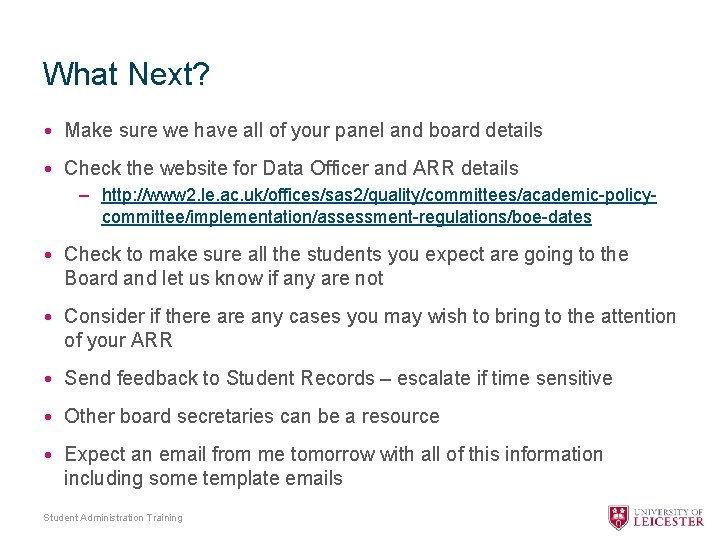
What Next? • Make sure we have all of your panel and board details • Check the website for Data Officer and ARR details – http: //www 2. le. ac. uk/offices/sas 2/quality/committees/academic-policycommittee/implementation/assessment-regulations/boe-dates • Check to make sure all the students you expect are going to the Board and let us know if any are not • Consider if there any cases you may wish to bring to the attention of your ARR • Send feedback to Student Records – escalate if time sensitive • Other board secretaries can be a resource • Expect an email from me tomorrow with all of this information including some template emails Student Administration Training
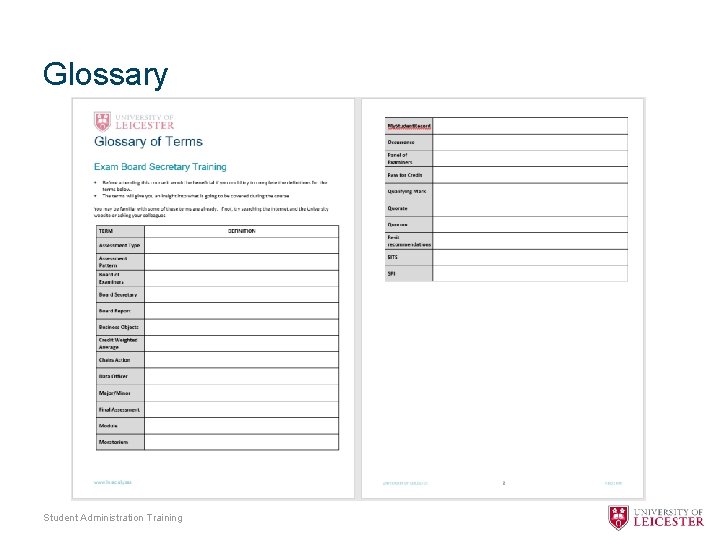
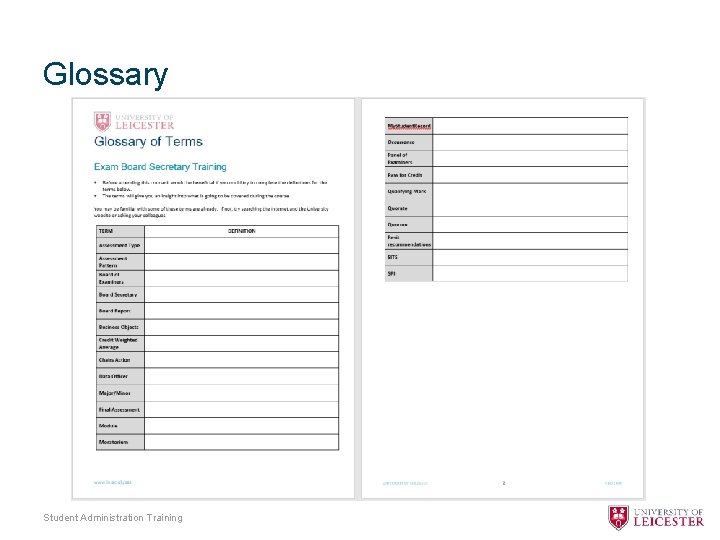
Glossary Student Administration Training
Contacts – Data Officers • • • • Stacy Hall Dave Eyres Gemma Parker Sarah Al-Sayed Christian Kitchener Laura Berry Nicole London Bev Ireland Vienna Bradley Tom Manton James Foster Sam Hill Simon Parkinson Ian Harmer Anna Brownlow s. hall@Leicester. ac. uk dse 3@le. ac. uk gp 171@le. ac. uk sas 82@le. ac. uk ck 154@le. ac. uk leb 40@le. ac. uk nal 22@le. ac. uk bi 6@le. ac. uk vmb 6@le. ac. uk tm 314@le. ac. uk jrf 17@le. ac. uk sh 208@le. ac. uk sjp 34@le. ac. uk idh 6@le. ac. uk ackb 1@le. ac. uk studentrecords@le. ac. uk dlstudy@le. ac. uk ulsb. study@le. ac. uk Student Administration Training
Any questions? Student Administration Training
- Slides: 51