
BOARD ON SCIENCE EDUCATION Roundtable on Systemic Change
BOARD ON SCIENCE EDUCATION Roundtable on Systemic Change in Undergraduate STEM Education ASCN Webinar December 4, 2019 Sponsors: W. M. Keck Foundation Educational Testing Service National Science Foundation
Roundtable on Systemic Change in Undergraduate STEM Education How do you envision undergraduate STEM education will look in 20 years?
Roundtable on Systemic Change in Undergraduate STEM Education A Vision for the Future of Post-secondary STEM Learning The roundtable will focus on the future of undergraduate STEM learning and help drive a national effort on how best to educate students to be informed members of society and/or participate in the future STEM workforce. The vision will take into account the dynamic context and build strategies to direct action and inspire change.
Roundtable on Systemic Change in Undergraduate STEM Education Goals • Link the full spectrum of stakeholders in higher education. • Coordinate and catalyze actions to make undergraduate STEM learning more inclusive and engaging. • Use evidenced-based approaches and build on successful reform efforts.
Roundtable on Systemic Change in Undergraduate STEM Education Goals • Work to expand access, increase equity, and support quality learning experiences for all learners. • Consider changes in technology, workforce, demographics, and society. • Help create a scientifically literate public and a wellprepared STEM workforce.
Roundtable Themes/Work Groups 1. Meeting Students Where They Are 2. Inclusive Evidence-Based Instruction 3. Changing Campus Incentives, Rewards, and Culture 4. Managing Institutional, State, and National System Change 5. Responding to Changing Workforce Needs 6. Forces Disrupting Undergraduate STEM Education 7. Strategies for Tracking and Evaluating Reform Efforts
Examples of Roundtable Discussions Panel on the Changing Face of International Students – Jenny Lee, Center for the Study of Higher Education, University of Arizona – Sharon Fries-Britt, Department of Counseling, Higher Education, and Special Education, University of Maryland Panel on Leadership and Systemic Change to Improve STEM Learning – Jaime Lester, George Mason University – Vincent Manno, Olin College of Engineering – Jeffrey Osborn, The College of New Jersey – Uri Treisman, Charles A. Dana Center, University of Texas at Austin Presentations on Future Technology • Salim Ismail, founding director of Singularity University on Thinking Outside the Box on Undergraduate STEM Education • Andreas Oranje of ETS on Artificial Intelligence and the Future of Education
Your Input • We will next be talking about evidenced-based instruction, recognizing and evaluations teaching, and preparing the future workforce. • Please share your work and ideas on these topics at https: //bit. ly/2 Lis. Zh 3 • Please share your questions about today’s presentation in the Zoom chat.
Increasing adoption of Evidenced-Based Pedagogies Work Group #2 Cassandra Horii, Kacy Redd, Jim Swartz, Cordelia Ontiveros There is much evidence that engaged learning approaches: • Substantially improve student learning, sense of self-efficacy, and retention over traditional content delivery. • Improves the kinds of skills, like continuous learning and complex problem solving that employers say are critical. • Are particularly effective for members of groups who have been underserved by more traditional pedagogical approaches. Nevertheless, change to these demonstrably more effective teaching and learning strategies has been agonizingly slow.
Roundtable ideas for increasing evidenced-based instruction • Increase availability, discoverability, and use of evidence-based course materials and methods • Advance a synthesis and research agenda on change processes and barriers to STEM education change. • Link disciplinary and campus-based faculty development efforts • Advance effective practices and models for working with adjunct and part-time faculty • Effectively involve institutions with less structure and/or resources for faculty development
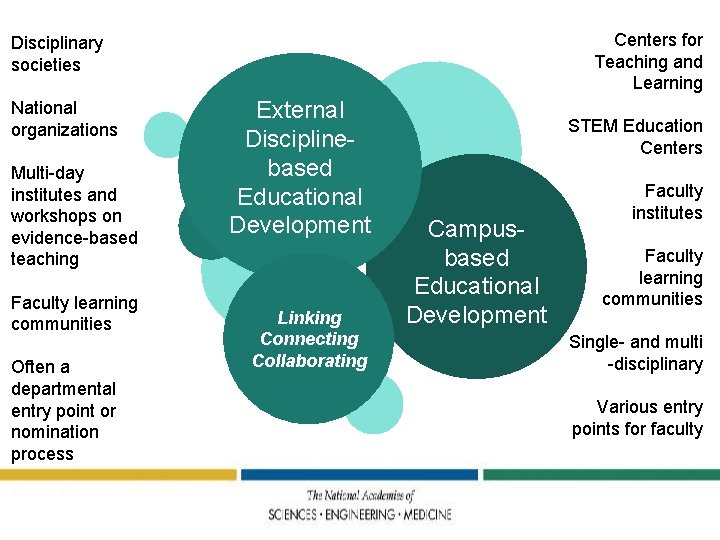
Centers for Teaching and Learning Disciplinary societies National organizations Multi-day institutes and workshops on evidence-based teaching Faculty learning communities Often a departmental entry point or nomination process External Disciplinebased Educational Development Linking Connecting Collaborating STEM Education Centers Campusbased Educational Development Faculty institutes Faculty learning communities Single- and multi -disciplinary Various entry points for faculty
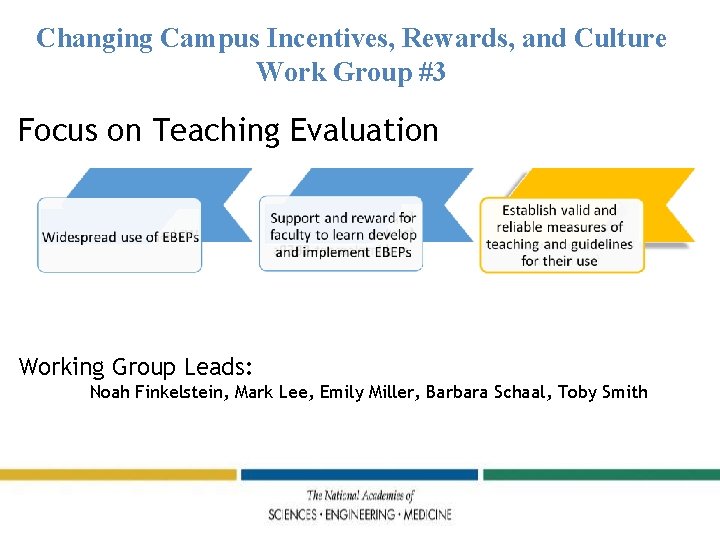
Changing Campus Incentives, Rewards, and Culture Work Group #3 Focus on Teaching Evaluation Working Group Leads: Noah Finkelstein, Mark Lee, Emily Miller, Barbara Schaal, Toby Smith
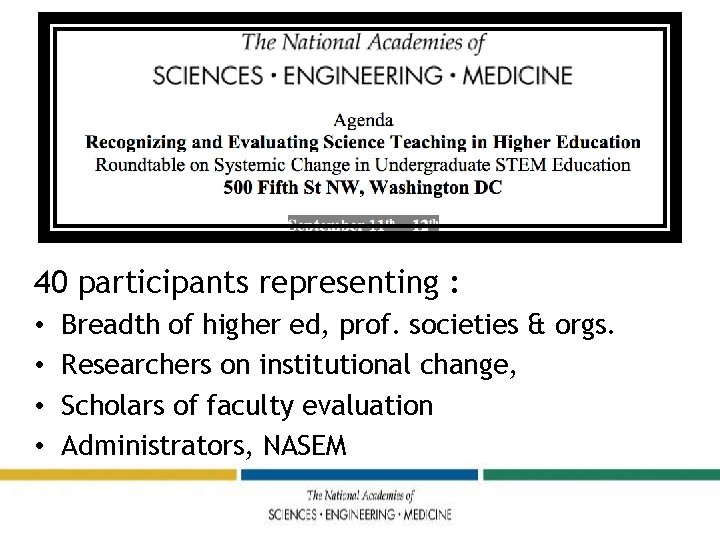
40 participants representing : • • Breadth of higher ed, prof. societies & orgs. Researchers on institutional change, Scholars of faculty evaluation Administrators, NASEM
Transforming Teaching Evaluation - Focus Workshop Goals: • Identify the breadth of approaches/practices/strategies • Identify shared goals across these efforts and explore strategies for addressing the common barriers to implement methods to use multiple sources of information to evaluate teaching. • Build a community among the early adopters that provides credibility and continued incentives for this work at the institutional level as well as a forum for the needed individual emotional support • public dissemination convocation (2020); and 2) the launch of a consensus study on Professional Standards for Teaching Foundation for 1) STEM in Higher Education that examines the existing evidence base
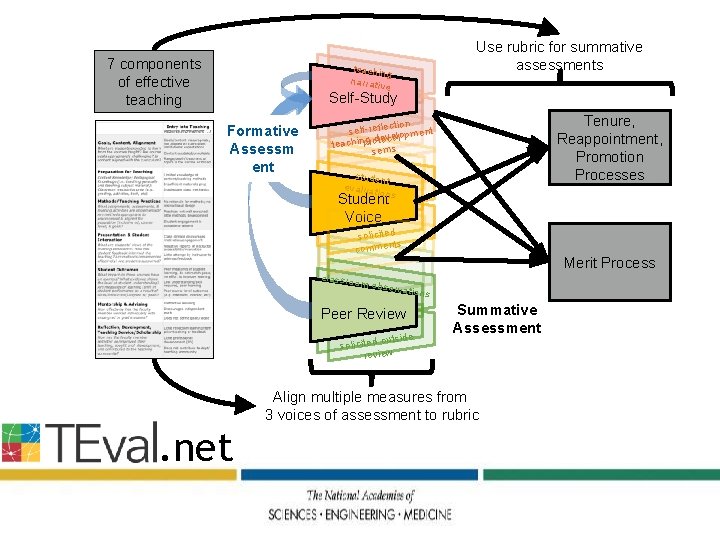
7 components of effective teaching Use rubric for summative assessments teachin g narrativ e Self-Study Formative Assessm ent Tenure, Reappointment, Promotion Processes ction self-refle elopment devcol teachinpgroto s sem student evaluati ons Student Voice solicited ts commen classroo Merit Process m obse rvations Peer Review outside solicited review Summative Assessment Align multiple measures from 3 voices of assessment to rubric . net
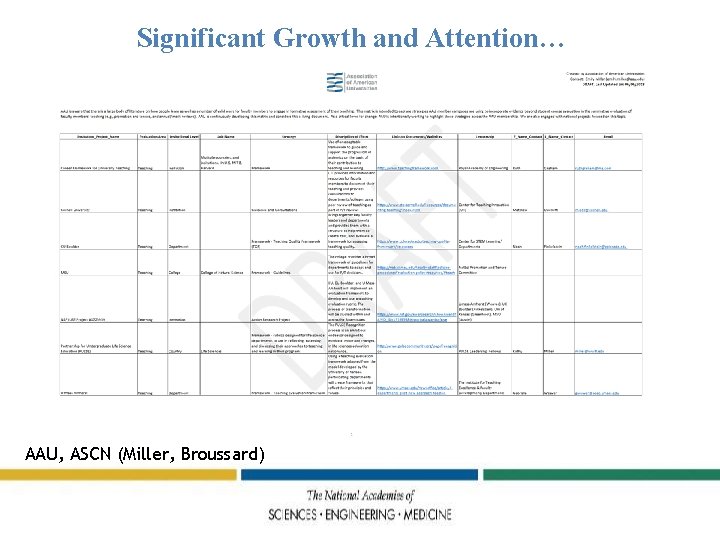
Significant Growth and Attention… AAU, ASCN (Miller, Broussard)
Significant Growth and Attention… Outcomes: Growing Network / Coordinating Taxonomy / Language 2020 National Convening (100+ institutions) NSEC Jun Meeting, St. Louis
Meeting students where they are Work Group #1 Ann Gates, Mary Heiss, John Lee, Patty Lopez, and Kyle Swanson • Consider variations in students’ – Backgrounds – Pathways – Goals Panel in September 2018 on Changes in the Learners: Increased Variety of Students and Student Goals • • • Ryan Kelsey, Achieving the Dream John Michael Lee, Elizabeth City State University Lindsey Malcom-Piqueux, California Institute of Technology Pablo Sacasa, Miami Dade College Mica Estrada, University of California, San Francisco
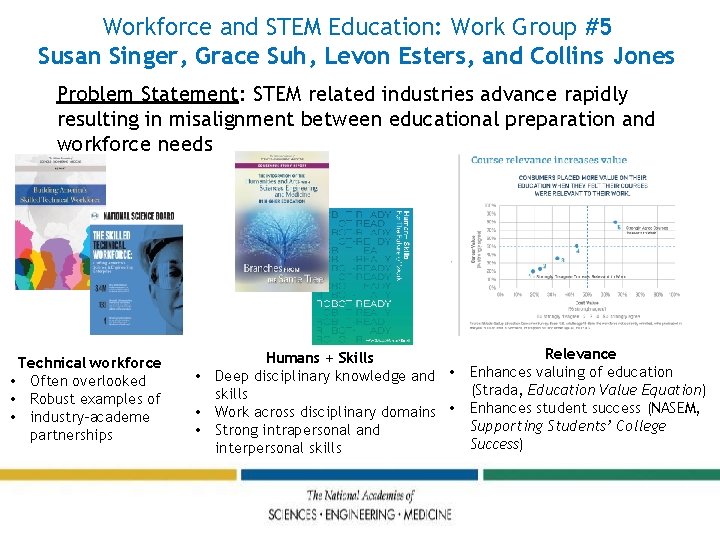
Workforce and STEM Education: Work Group #5 Susan Singer, Grace Suh, Levon Esters, and Collins Jones Problem Statement: STEM related industries advance rapidly resulting in misalignment between educational preparation and workforce needs Technical workforce • Often overlooked • Robust examples of • industry-academe partnerships Relevance Humans + Skills • Deep disciplinary knowledge and • Enhances valuing of education (Strada, Education Value Equation) skills • Work across disciplinary domains • Enhances student success (NASEM, Supporting Students’ College • Strong intrapersonal and Success) interpersonal skills
Roundtable Potential • Encourage synergistic partnerships through convening power – Bring together stakeholders who otherwise do not connect – Enhance academic and industry understanding of needs – Aligning both technical and interpersonal/intrapersonal skills development – Profile and share highly effective practices – Exchange of promising practices between 2 -year and 4 year institutions • Enhance visibility and efficacy of multiple pathways into STEM careers – Role of credentialing and certificates – Increasing diversity and inclusion
Roundtable Contributions • Work to date: Panel with federal and industry stakeholders, • How are workforce needs changing? • What role can the roundtable play in helping higher ed navigate these changes and helping them to provide appropriate undergraduate STEM education to all students? Allyson Knox, Senior Director of Education and Policy Programs, Microsoft Cindy Hasselbring, Senior Policy Advisor, OSTP Erik Noble, Senior Policy Advisor, OSTP Dorn Carranza, Innovation & Industrial Partnerships, Venture. Well Moderator: Susan Singer, Rollins College • Next: Workshop with industry, academic, federal, and foundation stakeholders focused on innovative strategies for workplace-based education and upskilling, building upon NASEM consensus studies
Please ask questions in the chat about the Roundtable work on • Evidence-based instruction • Teaching Evaluation • Preparing the workforce of the future
What will the Roundtable catalyze next? • Examining issues related to students, workforce, technology, changes in the academy • Priority areas – Impact of Technology – Access and Equity
Upcoming Roundtable Activities – Teaching Evaluation • • Summary of September working meeting-release this winter Presentation at AAC&U Annual Meeting-January 2020 Webinar for ASCN on teaching evaluation work-March 24, 2020 Convocation planned for later in 2020 – Planning for a Distributed Workshop on Inclusive Evidence-Based Instruction-Summer/Fall 2020 Other Upcoming NASEM Activities – Symposium on Imagining the Future of Undergraduate STEM Education-September 2020
Your Thoughts • How do you envision undergraduate STEM education will look in 20 years?
Information about BOSE & BOSE projects including the Roundtable: http: //nas. edu/BOSE Ideas or suggestions kbrenner@nas. edu
- Slides: 26