
Board of Pharmacy Specialties Pharmacist Credentialing and Specialization
Board of Pharmacy Specialties: Pharmacist Credentialing and Specialization William M. Ellis, RPh, MS Executive Director Brian Lawson, Pharm. D Director, Professional Affairs February 5, 2014
Learning Objectives • Describe the various credentialing processes commonly • • used by pharmacists Describe the board certification process of pharmacy specialists List the current specialties approved by the Board of Pharmacy Specialties
COUNCIL ON CREDENTIALING IN PHARMACY (CCP)
Council on Credentialing in Pharmacy (CCP) • Founded 1999; operates as a coalition • Mission: To provide leadership, guidance, public information, and coordination for the profession of pharmacy's credentialing programs • Vision: All credentialing programs in pharmacy will meet established standards of quality and contribute to improvement in patient care and the overall public health
CCP Member Organizations American Association of Colleges of Pharmacy American College of Clinical Pharmacy Accreditation Council for Pharmacy Education Academy of Managed Care Pharmacy American Pharmacists Association American Society of Consultant Pharmacists American Society of Health-System Pharmacists Board of Pharmacy Specialties Commission for Certification in Geriatric Pharmacy Technician Educators Council
Credentials • Credentials are indicators that a pharmacist or pharmacy technician holds the qualifications needed to practice in the profession of pharmacy and is therefore worthy of the trust of patients, of other health care professionals, and of society as a whole
Credentialing and Privileging of Pharmacists A Resource Paper from the Council on Credentialing in Pharmacy Publication Date - March 2014
CCP Resource Paper All U. S. Pharmacists have a fundamental set of credentials: An accredited professional pharmacy degree and A license awarded upon successful completion of a national, post-graduate examination
CCP Resource Paper • Evolving patient care and health system needs and demands have heightened the requisite skills needed by pharmacists to deliver more complex services • Ongoing professional development and competency assessment are integral parts of health professionals’ expectations to maintain a contemporary practice.
Credentials (3 Categories) 1. Credentials needed to prepare for practice (i. e. , academic degrees); 2. Credentials needed to enter practice (i. e. , licensure) and to update professional knowledge and skills (i. e. , re-licensure) under state law; and 3. Credentials that pharmacists voluntarily earn to document their specialized or advanced knowledge and skills (i. e. , postgraduate degrees, certificates, board certification).
Definitions • The purpose of a “credentialing process” is to document and demonstrate that the health care professional being evaluated has attained the credentials and qualifications to provide the scope of care expected for patient care services in a particular setting.
Definitions • The purpose of a “privileging process” is to assure that the health care professional being considered for certain privileges has the specific competencies and experience for specific services that the organization provides and/or supports.
“Drivers” of Credentials • Pace of change and the increasing complexity of health • • • care. The pharmacist’s expanding patient-centered role. Growing trend toward specialization in pharmacy practice. Need to document the pharmacist’s ability to provide specialty care.
“Drivers” of Credentials • Need to assure the public, employers, payers, other • • health providers, and other pharmacists that practitioners are competent no matter where they are in their careers and where they practice. Pharmacists who are providing cognitive services or specialized care that should be compensated. Payers expect and deserve to receive validation that pharmacists are qualified to provide such services. Credentialing and privileging are tailored to the complexity of services being provided at the setting.
Era of Accountability • Expanded health care accountability has demanded the • expansion of clinical knowledge and competence of all pharmacists Gaps in accountability are being closed through new care delivery and payment models: – Pay for Performance – Accountable Care Organizations – Medical Home Care is moving to a team-based approach
CCP Resource Documents • List of Certification Programs for Pharmacists • Guiding Principles for Post-licensure Credentialing of • • Pharmacists Credentialing in Pharmacy Technician Credentialing Framework Scope of Contemporary Pharmacy Practice Guiding Principles for Accreditation of Organizations, Sites or Programs in Pharmacy Guiding Principles for Certification of Individuals in Pharmacy Continuing Professional Development White Paper on Pharmacy Technicians: Needed Changes Can No Longer Wait Continuing Professional Development in Pharmacy
CCP Website http: //www. pharmacycredentialing. org
BOARD OF PHARMACY SPECIALTIES (BPS)
BPS Purpose § Established in 1976 as an autonomous division of APh. A to: § Recognize specialty practice areas § Define standards for recognized specialties § Evaluate the knowledge and skills of individual pharmacy specialists § Communicate the importance of specialization in pharmacy
![BPS Governance and Credentials Board of Directors Specialty Council on Nuclear Pharmacy (1978) [BCNP]](http://slidetodoc.com/presentation_image_h/c94b98abb10293032fef00d4eab20bc4/image-20.jpg "BPS Governance and Credentials Board of Directors Specialty Council on Nuclear Pharmacy (1978) [BCNP]")
BPS Governance and Credentials Board of Directors Specialty Council on Nuclear Pharmacy (1978) [BCNP] Specialty Council on Nutrition Support Pharmacy (1988) [BCSNP] Specialty Council on Pharmacotherapy (1988) [BCPS] Added Qualifications in Infectious Diseases Specialty Council on Psychiatric Pharmacy (1992) [BCPP] Specialty Council on Oncology Pharmacy (1996) [BCOP] Specialty Council on Critical Care Pharmacy (2013) Added Qualifications in Cardiology Specialty Council on Ambulatory Care Pharmacy (2009) [BCACP] Specialty Council on Pediatric Pharmacy (2013)
BPS Exam Eligibility Criteria • Graduation from an accredited pharmacy program • Current, active license to practice pharmacy • Practice Experience • Completion of two (2) to four (4) years of practice experience with at least 50% of time spent in the pharmacy specialty practice activities (as defined by the applicable BPS Specialty Content Outline) OR • Completion of a PGY 1 residency*, specialty PGY 2 residency*, and/or one additional year of practice with at least 50% of time spent in the pharmacy specialty practice activities (as defined by the BPS Ambulatory Care Content Outline) *Effective January 1, 2013, only residency programs accredited by the American Society of Health-System Pharmacists (ASHP) or new residency programs granted Candidate Status for accreditation by ASHP are creditable for this purpose.
BPS Exam Administration • Internet-based testing beginning in 2013 – Paper and Pencil based exam in 2012 • 200 exam questions, four-option multiple choice format – First 100 questions are administered for 2. 5 hours in the morning – Second 100 questions are administered for 2. 5 hours in the afternoon • Candidates can bookmark items, review and change • answers in each session Calculator, timer, chart available on the screen
BPS Recertification • Required every seven years • Documents a specialist’s current knowledge and skills – 100 -question recertification examination OR – Continuing education option available in all specialties except Nutrition Support Pharmacy
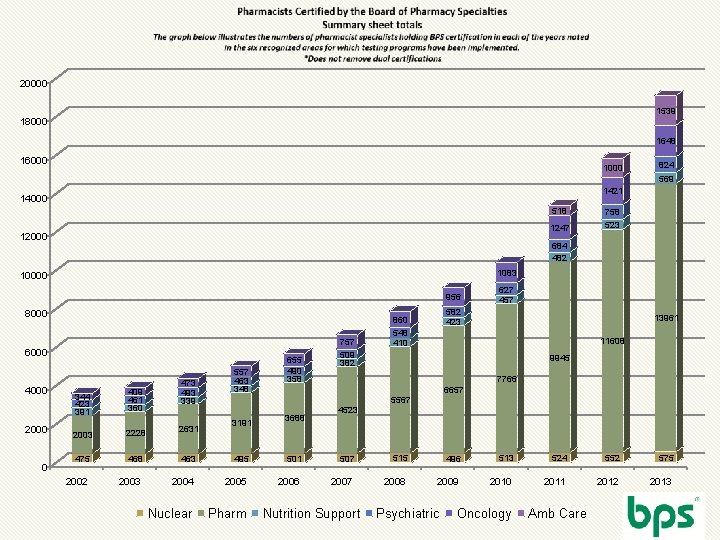
20000 1539 18000 1648 16000 1000 824 569 1421 14000 518 1247 12000 684 482 1083 10000 956 8000 6000 4000 2000 0 758 523 473 493 339 557 463 348 655 490 358 757 509 382 627 457 582 423 860 548 410 13961 11608 9945 7766 6657 344 423 391 409 461 360 2003 2228 2631 475 468 463 495 501 507 515 496 513 524 552 575 2002 2003 2004 2005 2006 2007 2008 2009 2010 2011 2012 2013 Nuclear Pharm 3191 3688 4523 Nutrition Support 5567 Psychiatric Oncology Amb Care
BPS Strategic Planning White Paper The White Paper focuses on: üGrowth of current specialties üAddition of new specialties and subspecialties üMarketing the value of board certification üContinually assess model for recertification
BPS 2017 Vision • The number of Board Certified Pharmacists will significantly increase to facilitate progress towards a future model where board certification will be the expectation for pharmacists engaged in direct patient care. Key Point • BPS further believes that the future growth of pharmacist board certification should progress in a manner consistent with the Council on Credentialing in Pharmacy Framework for Credentialing in Pharmacy Practice
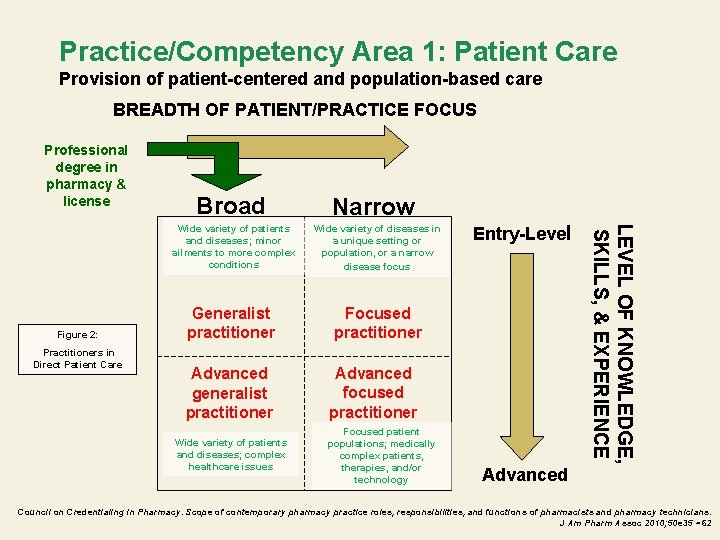
Practice/Competency Area 1: Patient Care Provision of patient-centered and population-based care BREADTH OF PATIENT/PRACTICE FOCUS Professional degree in pharmacy & license Broad Figure 2: Practitioners in Direct Patient Care Wide variety of diseases in a unique setting or population, or a narrow disease focus Generalist practitioner Focused practitioner Advanced generalist practitioner Advanced focused practitioner Wide variety of patients and diseases; complex healthcare issues Focused patient populations; medically complex patients, therapies, and/or technology Entry-Level LEVEL OF KNOWLEDGE, SKILLS, & EXPERIENCE Wide variety of patients and diseases; minor ailments to more complex conditions Narrow Advanced Council on Credentialing in Pharmacy. Scope of contemporary pharmacy practice roles, responsibilities, and functions of pharmacists and pharmacy technicians. J Am Pharm Assoc 2010; 50 e 35‐ 62
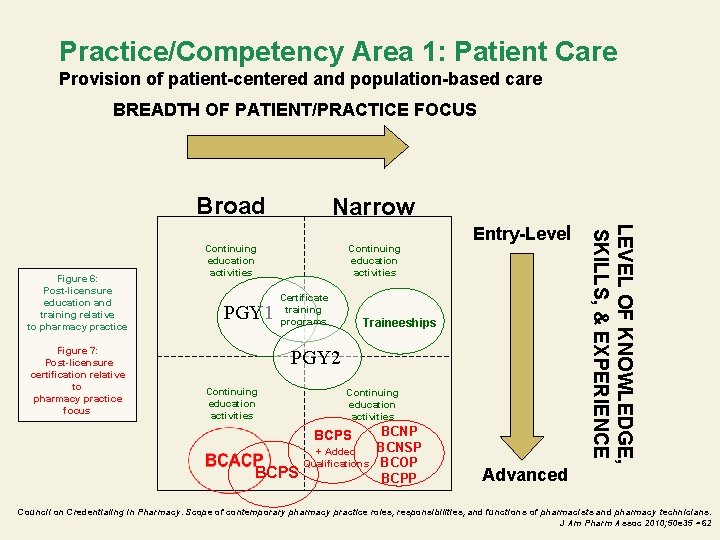
Practice/Competency Area 1: Patient Care Provision of patient-centered and population-based care BREADTH OF PATIENT/PRACTICE FOCUS Figure 7: Post-licensure certification relative to pharmacy practice focus Narrow Continuing education activities PGY 1 Certificate training programs Entry-Level Traineeships PGY 2 Continuing education activities BCPS + Added Qualifications BCNP BCNSP BCOP BCPP LEVEL OF KNOWLEDGE, SKILLS, & EXPERIENCE Figure 6: Post-licensure education and training relative to pharmacy practice Broad Advanced Council on Credentialing in Pharmacy. Scope of contemporary pharmacy practice roles, responsibilities, and functions of pharmacists and pharmacy technicians. J Am Pharm Assoc 2010; 50 e 35‐ 62
BPS 2017 Vision • BPS will recognize new pharmacy specialties and/or subspecialties in areas that are consistent with, but not limited to, the growth of accredited postgraduate year 2 (PGY 2) residency programs. In addition, BPS will evaluate the current specialty recognition structure and process and consider potential modifications. Key Point • Achieving the 2017 vision must occur in a way that accommodates and encourages the evolutionary growth of pharmacist board certification through flexibility and efficiency for all stakeholders.
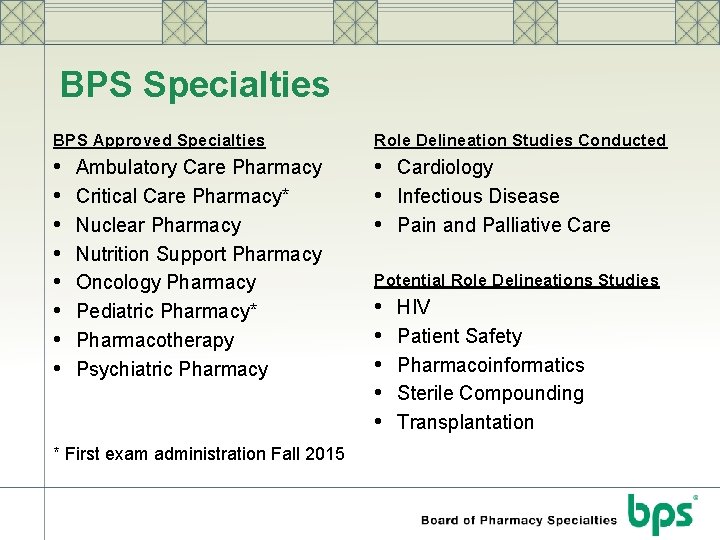
BPS Specialties BPS Approved Specialties Role Delineation Studies Conducted • • • Cardiology • Infectious Disease • Pain and Palliative Care Ambulatory Care Pharmacy Critical Care Pharmacy* Nuclear Pharmacy Nutrition Support Pharmacy Oncology Pharmacy Pediatric Pharmacy* Pharmacotherapy Psychiatric Pharmacy * First exam administration Fall 2015 Potential Role Delineations Studies • • • HIV Patient Safety Pharmacoinformatics Sterile Compounding Transplantation
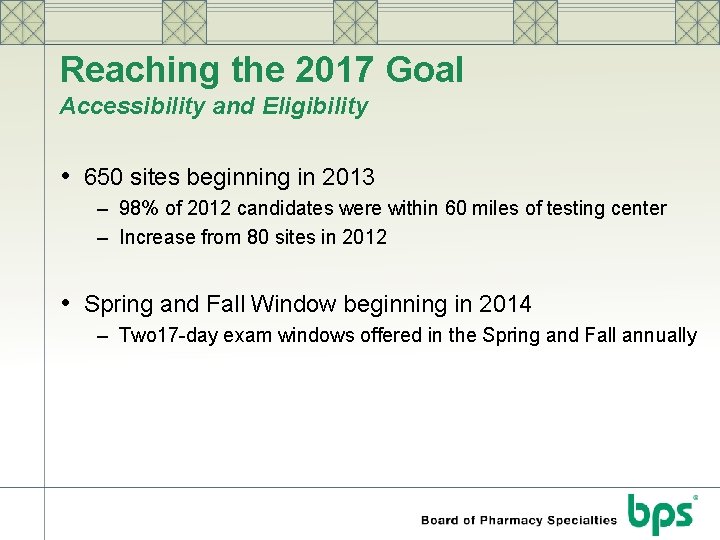
Reaching the 2017 Goal Accessibility and Eligibility • 650 sites beginning in 2013 – 98% of 2012 candidates were within 60 miles of testing center – Increase from 80 sites in 2012 • Spring and Fall Window beginning in 2014 – Two 17 -day exam windows offered in the Spring and Fall annually
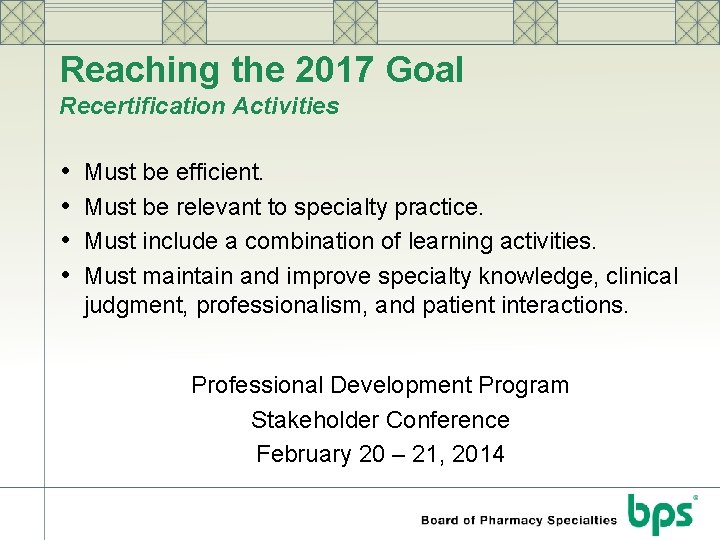
Reaching the 2017 Goal Recertification Activities • • Must be efficient. Must be relevant to specialty practice. Must include a combination of learning activities. Must maintain and improve specialty knowledge, clinical judgment, professionalism, and patient interactions. Professional Development Program Stakeholder Conference February 20 – 21, 2014
Reaching the 2017 Goal International Activities • Taskforce appointment to make recommendations to the BPS Board
Final Thoughts • As the scope of pharmacy practice evolves to • meet the complex medication-related needs of patients, board certification is critical to assure stakeholders of the level of knowledge and skills of pharmacists who provide direct patient care. BPS activities will increase to facilitate progress towards a future model where board certification will be the expectation for pharmacists engaged in direct patient care.
Contact BPS Board of Pharmacy Specialties 2215 Constitution Avenue NW Washington, DC 20037 Phone: 202 -429 -7591 • FAX: 202 -429 -6304 E-mail: info@bpsweb. org • Website: www. bpsweb. org
Thanks for your attention. What questions do you have?
- Slides: 36