
BNL Environmental Sciences Dept and Enviro Suite from
BNL Environmental Sciences Dept. and Enviro. Suite: from NSLS to NSLS-II Jeff Fitts July 18, 2007 Environmental Sciences Department Environmental Research and Technology
Enviro. Suite Strategic Initiative Initiated in 2002 by BNL Environmental Sciences Dept. ; BNL and DOE BER support for program Mission: Explore and quantify complex environmental processes and systems to better understand the longterm fate and transport of contaminants in the environment and to help develop technologies for longterm stewardship Approach: Develop & expand novel synchrotron-based techniques for exploring complex environmental processes Support Environmental Science users Environmental Sciences Department
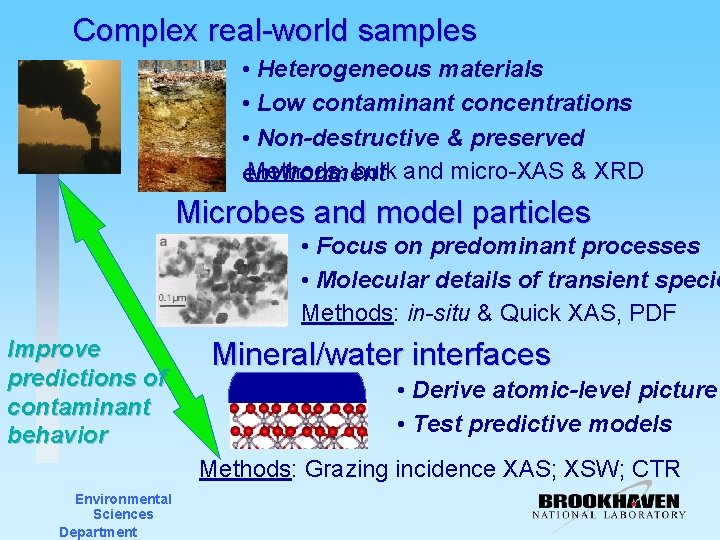
Complex real-world samples • Heterogeneous materials • Low contaminant concentrations • Non-destructive & preserved Methods: bulk and micro-XAS & XRD environment Microbes and model particles • Focus on predominant processes • Molecular details of transient specie Methods: in-situ & Quick XAS, PDF Improve predictions of contaminant behavior Mineral/water interfaces • Derive atomic-level picture • Test predictive models Methods: Grazing incidence XAS; XSW; CTR Environmental Sciences Department
Enviro. Suite involvement at NSLS beamlines • X 27 A (CU member): Hard X-ray microprobe • X 11 A, X 11 B (Manage PRT): Bulk XAS • X 15 B (Manage PRT): Bulk XAS at 1 -5 ke. V • X 1 A (PRT member): Soft X-ray STXM Environmental Sciences Department
Future research directions enabled by NSLS II • XAS studies of lower concentration samples, approaching real-world concentrations • Pore-scale transport processes captured using microprobe/fluorescence tomography • Sub-cellular features using x-ray microscopy and nanoprobe • Fundamental research in interfacial chemistry mineral-water-organic-biological systems Environmental Sciences Department
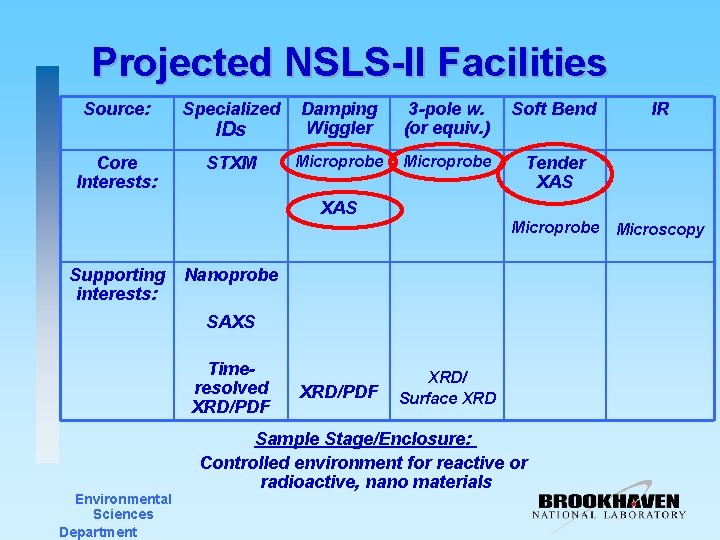
Projected NSLS-II Facilities Source: Specialized IDs Damping Wiggler 3 -pole w. (or equiv. ) Soft Bend Core Interests: STXM Microprobe Tender XAS IR XAS Microprobe Supporting interests: Nanoprobe SAXS Timeresolved XRD/PDF Environmental Sciences Department XRD/PDF XRD/ Surface XRD Sample Stage/Enclosure: Controlled environment for reactive or radioactive, nano materials Microscopy
Hard X-ray Microprobe • • • 0. 3 -15 micron tunable resolution Stable beam position over 1000 e. V Stable/repeatable energy calibration High quality optical imaging Simultaneous XRF and XRD Microtomography • Conventional K-B optics • Damping wiggler vs hard bend… Environmental Sciences Department
Bulk XAS (damping wiggler) Two operating modes: • 1. High flux 4 -35 ke. V at standard energy resolution (2 x 10 -4) • For low concentrations, GIXAS, etc. • 2. High energy resolution 5 -50 ke. V • 1 x 10 -5 or better (without extraordinary measures) Requirements: • Stable beam position over 1000 e. V, energy stability/repeatability, environmental end station Add these capabilities for DW microprobe Environmental Sciences Department
“Tender” 1 -5 ke. V X-ray beamlines 1. Bulk XAS: • Macro focused beam (1 mm) • Energy and positional stability • He atmosphere end station • NSLS-developed Si detector 2. Microprobe: • Duplicate (1), K-B second stage focus • 0. 3 -15 micron tunable spot size Environmental Sciences Department
Environmental end station • High resolution positioning and optical imaging • Sample cooling and interchangeability • Operable as: • 1. Open air • 2. Exhaust hood/clean stage for nano and rad materials • 3. Controlled atmosphere glove box • Valuable for other disciplines as well Environmental Sciences Department
Supporting, developing interests • Nanoprobe • Subcellular structures related; Nanoparticles and nanoscale coatings • STXM beamline with improved spatial • • • resolution and brightness IR microscopy and microspectroscopy SAXS Time-resolved XRD & PDF Full-field microscopy Quick EXAFS Environmental Sciences Department
Development strategy Assemble pieces and programs at NSLS: • Existing beamlines and collaborations New programs from elsewhere: • SAXS, PDF, surface diffraction… Community involvement: • Enviro. Sync organization, summer workshop Geography: • Sector: canted damping wigglers, hard bend, soft bends, supporting lab Environmental Sciences Department
- Slides: 12