
BMS 631 Lecture 3 Light and Fluorescence J
BMS 631: Lecture 3 Light and Fluorescence J. Paul Robinson, Ph. D Professor of Immunopharmacology and Bioengineering Purdue University www. cyto. purdue. edu © 2002 J. Paul Robinson, Purdue University
Absorption • Basic quantum mechanics requires that molecules absorb energy as quanta (photons) based upon a criteria specific for each molecular structure • Absorption of a photon raises the molecule from ground state to an excited state • Total energy is the sum of all components (electronic, vibrational, rotational, translations, spin orientation energies) (vibrational energies are quite small) • The structure of the molecule dictates the likely-hood of absorption of energy to raise the energy state to an excited one 3 rd Ed Shapiro p 84 © 2002 J. Paul Robinson, Purdue University
Lifetime • Absorption associated with electronic transitions (electrons changing states) occurs in about 1 femptosecond (10 -15 s) • The lifetime of a molecule depends on how the molecule disposes of the extra energy • Because of the uncertainty principle, the more rapidly the energy is changing, the less precisely we can define the energy • So, long-lifetime-excited-states have narrow absorption peaks, and short-lifetime-excited-states have broad absorption peaks © 2002 J. Paul Robinson, Purdue University 3 rd Ed. Shapiro p 85
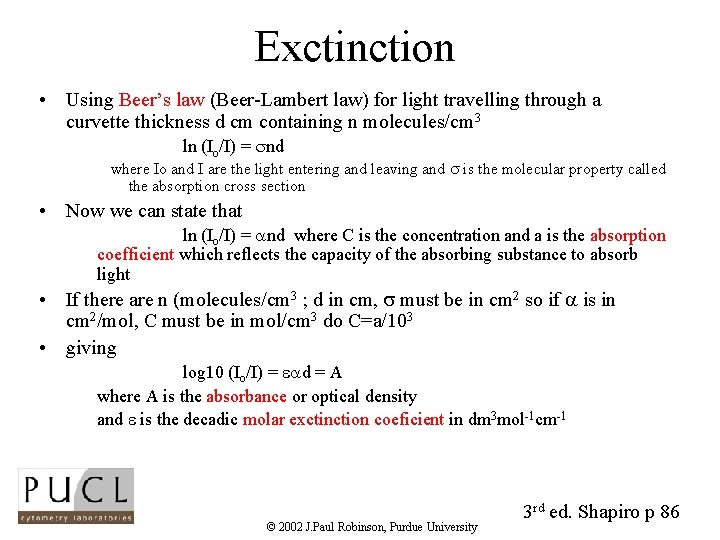
Exctinction • Using Beer’s law (Beer-Lambert law) for light travelling through a curvette thickness d cm containing n molecules/cm 3 ln (Io/I) = nd where Io and I are the light entering and leaving and is the molecular property called the absorption cross section • Now we can state that ln (Io/I) = nd where C is the concentration and a is the absorption coefficient which reflects the capacity of the absorbing substance to absorb light • If there are n (molecules/cm 3 ; d in cm, must be in cm 2 so if is in cm 2/mol, C must be in mol/cm 3 do C=a/103 • giving log 10 (Io/I) = d = A where A is the absorbance or optical density and is the decadic molar exctinction coeficient in dm 3 mol-1 cm-1 © 2002 J. Paul Robinson, Purdue University 3 rd ed. Shapiro p 86
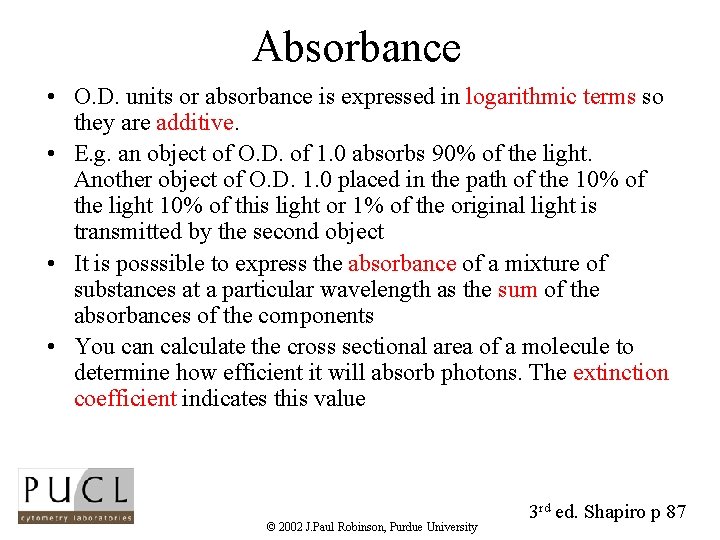
Absorbance • O. D. units or absorbance is expressed in logarithmic terms so they are additive. • E. g. an object of O. D. of 1. 0 absorbs 90% of the light. Another object of O. D. 1. 0 placed in the path of the 10% of the light 10% of this light or 1% of the original light is transmitted by the second object • It is posssible to express the absorbance of a mixture of substances at a particular wavelength as the sum of the absorbances of the components • You can calculate the cross sectional area of a molecule to determine how efficient it will absorb photons. The extinction coefficient indicates this value © 2002 J. Paul Robinson, Purdue University 3 rd ed. Shapiro p 87
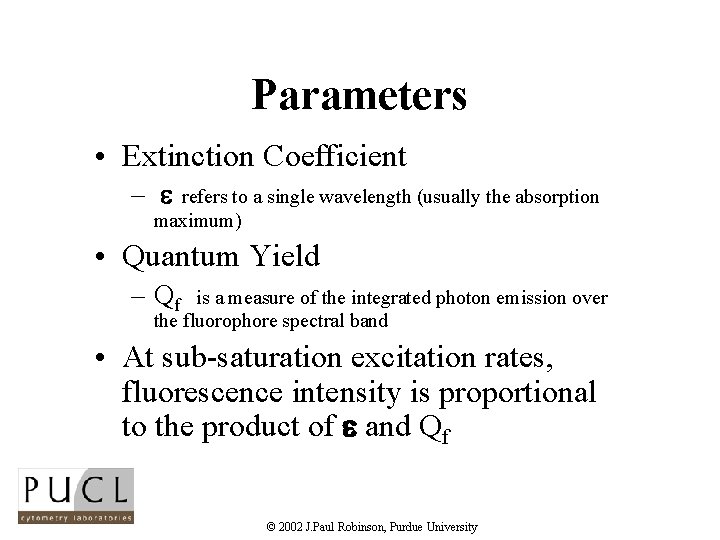
Parameters • Extinction Coefficient – refers to a single wavelength (usually the absorption maximum) • Quantum Yield – Qf is a measure of the integrated photon emission over the fluorophore spectral band • At sub-saturation excitation rates, fluorescence intensity is proportional to the product of and Qf © 2002 J. Paul Robinson, Purdue University
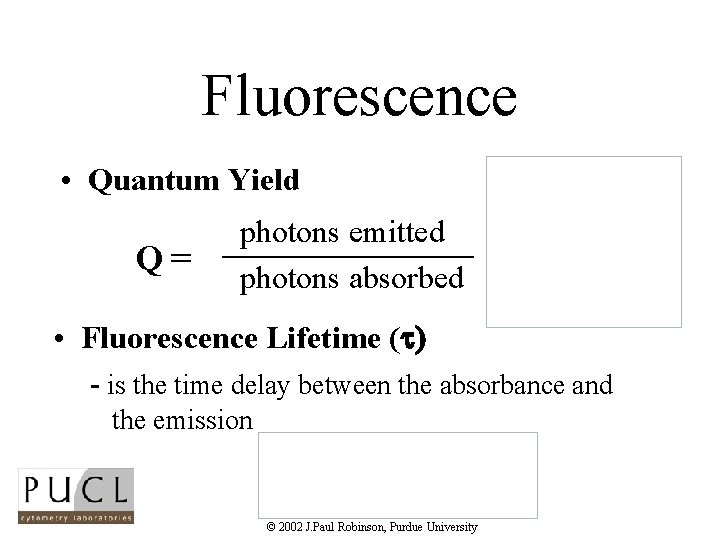
Fluorescence • Quantum Yield Q= photons emitted = photons absorbed kr kr + knr • Fluorescence Lifetime ( ) - is the time delay between the absorbance and the emission 1 = k +k r nr © 2002 J. Paul Robinson, Purdue University
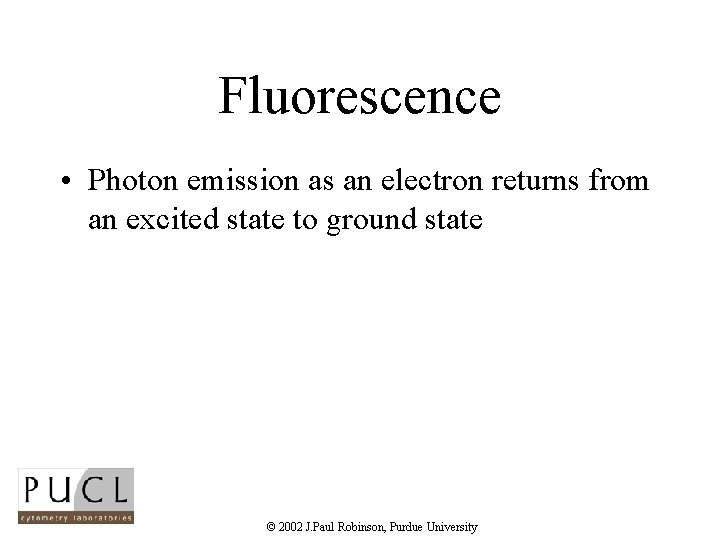
Fluorescence • Photon emission as an electron returns from an excited state to ground state © 2002 J. Paul Robinson, Purdue University
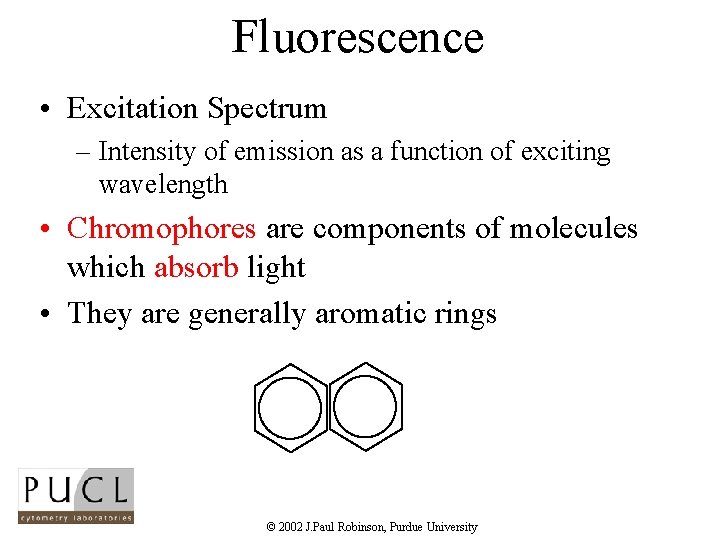
Fluorescence • Excitation Spectrum – Intensity of emission as a function of exciting wavelength • Chromophores are components of molecules which absorb light • They are generally aromatic rings © 2002 J. Paul Robinson, Purdue University
Fluorescence • The wavelength of absorption is related to the size of the chromophores • Smaller chromophores, higher energy (shorter wavelength) © 2002 J. Paul Robinson, Purdue University
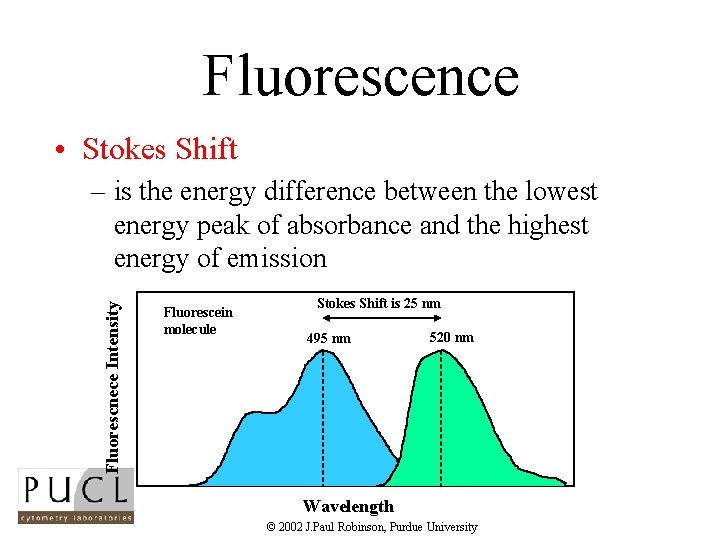
Fluorescence • Stokes Shift Fluorescnece Intensity – is the energy difference between the lowest energy peak of absorbance and the highest energy of emission Fluorescein molecule Stokes Shift is 25 nm 495 nm 520 nm Wavelength © 2002 J. Paul Robinson, Purdue University
Fluorescence • The longer the wavelength the lower the energy • The shorter the wavelength the higher the energy – eg. UV light from sun - this causes the sunburn, not the red visible light © 2002 J. Paul Robinson, Purdue University
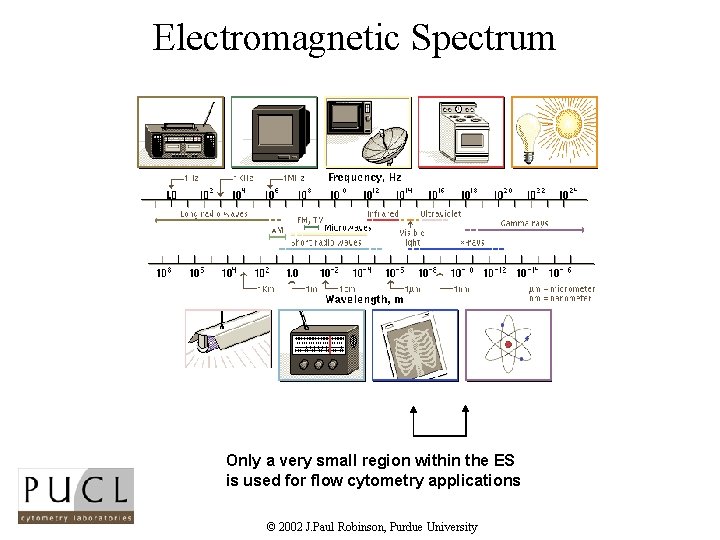
Electromagnetic Spectrum © Microsoft Corp, 1995 Only a very small region within the ES is used for flow cytometry applications © 2002 J. Paul Robinson, Purdue University
Properties of Fluorescent Molecules Large extinction coefficient at the region of excitation n High quantum yield n Optimal excitation wavelength n Photostability n Excited-state lifetime n Minimal perturbation by probe n © 2002 J. Paul Robinson, Purdue University
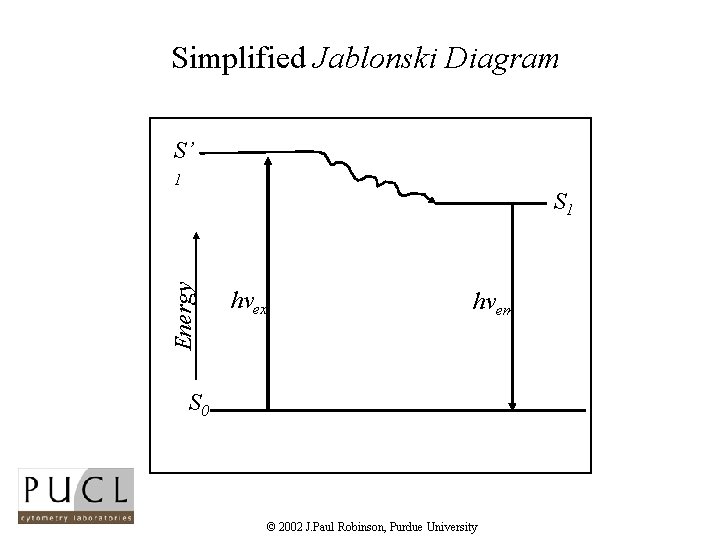
Simplified Jablonski Diagram S’ 1 Energy S 1 hvex hvem S 0 © 2002 J. Paul Robinson, Purdue University
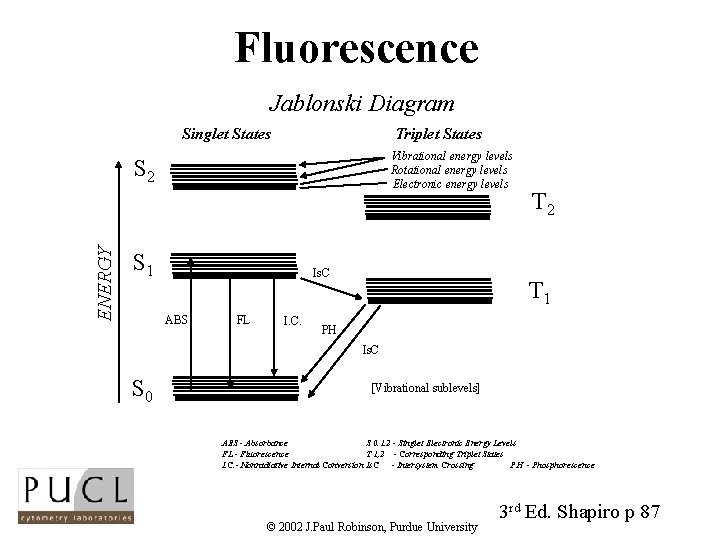
Fluorescence Jablonski Diagram Singlet States Triplet States Vibrational energy levels Rotational energy levels Electronic energy levels ENERGY S 2 S 1 Is. C ABS FL I. C. T 2 T 1 PH Is. C S 0 [Vibrational sublevels] ABS - Absorbance S 0. 1. 2 - Singlet Electronic Energy Levels FL - Fluorescence T 1, 2 - Corresponding Triplet States I. C. - Nonradiative Internal Conversion Is. C - Intersystem Crossing PH - Phosphorescence © 2002 J. Paul Robinson, Purdue University 3 rd Ed. Shapiro p 87
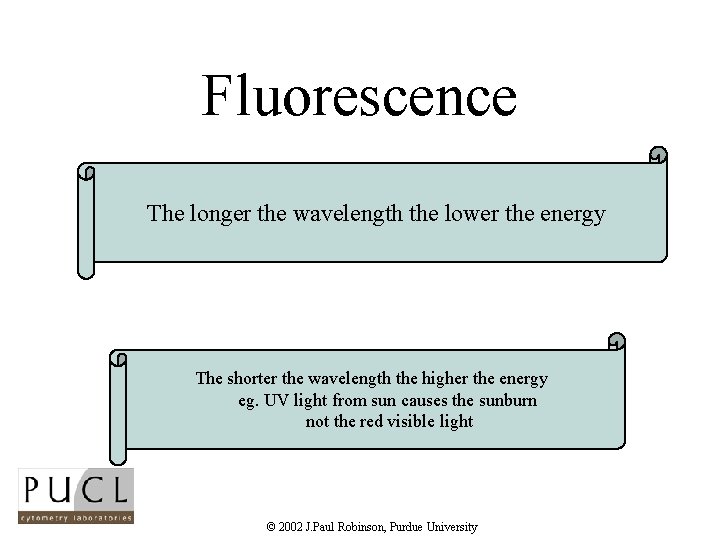
Fluorescence The longer the wavelength the lower the energy The shorter the wavelength the higher the energy eg. UV light from sun causes the sunburn not the red visible light © 2002 J. Paul Robinson, Purdue University
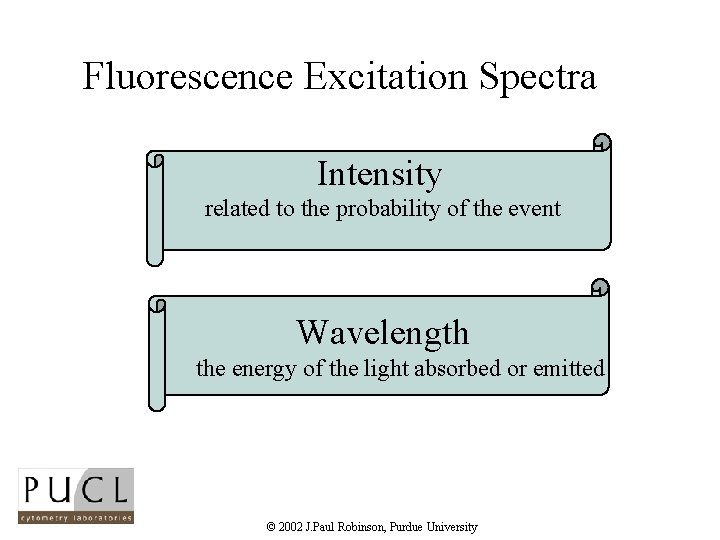
Fluorescence Excitation Spectra Intensity related to the probability of the event Wavelength the energy of the light absorbed or emitted © 2002 J. Paul Robinson, Purdue University
Conclusions • Dye molecules must be close to but below saturation levels for optimum emission • Fluorescence emission is longer than the exciting wavelength • The energy of the light increases with reduction of wavelength © 2002 J. Paul Robinson, Purdue University
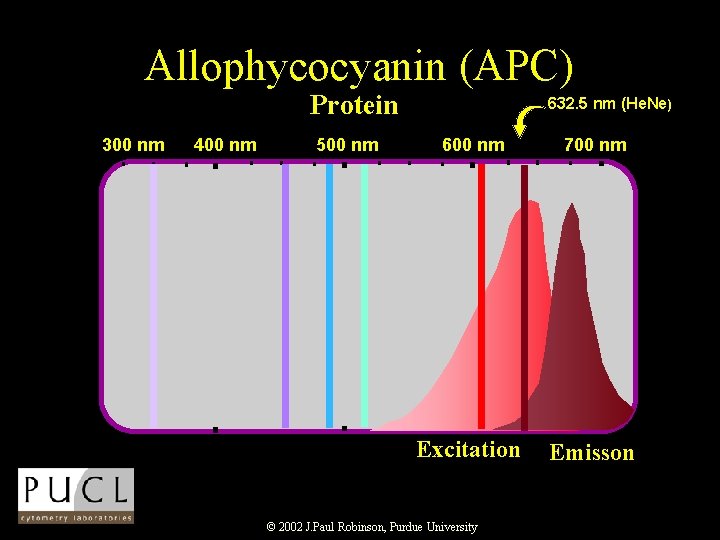
Allophycocyanin (APC) Protein 300 nm 400 nm 500 nm 632. 5 nm (He. Ne) 600 nm 700 nm Excitation Emisson © 2002 J. Paul Robinson, Purdue University
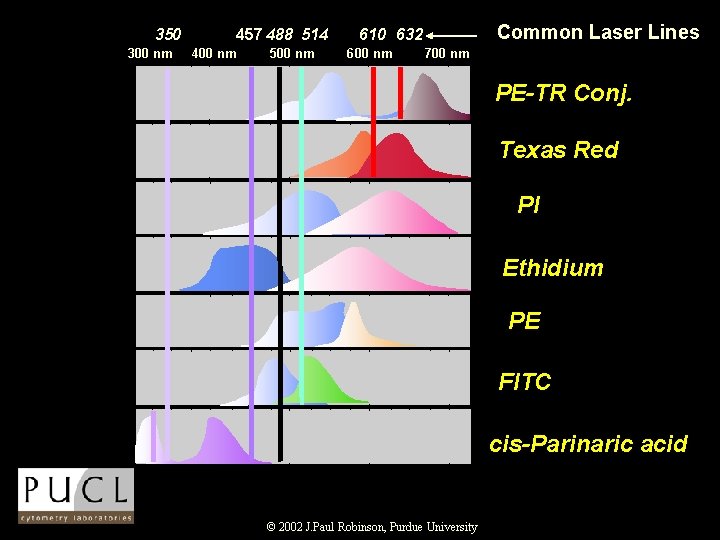
350 300 nm 457 488 514 400 nm 500 nm Common Laser Lines 610 632 600 nm 700 nm PE-TR Conj. Texas Red PI Ethidium PE FITC cis-Parinaric acid © 2002 J. Paul Robinson, Purdue University
• • • Excitation Saturation The rate of emission is dependent upon the time the molecule remains within the excitation state (the excited state lifetime f) Optical saturation occurs when the rate of excitation exceeds the reciprocal of f In a scanned image of 512 x 768 pixels (400, 000 pixels) if scanned in 1 second requires a dwell time per pixel of 2 x 10 -6 sec. Molecules that remain in the excitation beam for extended periods have higher probability of interstate crossings and thus phosphorescence Usually, increasing dye concentration can be the most effective means of increasing signal when energy is not the limiting factor (i. e. laser based confocal systems) © 2002 J. Paul Robinson, Purdue University
Phosphorescence • Following absorption, molecules can relax via a non-radiative transition to the T 1 rather than the S 1 state - this is called an intersystem crossing, • While it is forbidden it does happen and has a low probability and takes a longer time - the energy dissipated is called phosphorescence • Phosphorescence has a longer lifetime than fluorescence (milliseconds rather than femptoseconds • Phosphorescence generally occurs at longer wavelengths than fluorescence because the energy difference between S 0 and T 1 is lower © 2002 J. Paul Robinson, Purdue University Shapiro p 88
Resonance Energy Transfer • Resonance energy transfer can occur when the donor and acceptor molecules are less than 100 A of one another • Energy transfer is non-radiative which means the donor is not emitting a photon which is absorbed by the acceptor • Fluorescence RET (FRET) can be used to spectrally shift the fluorescence emission of a molecular combination. © 2002 J. Paul Robinson, Purdue University Shapiro p 90
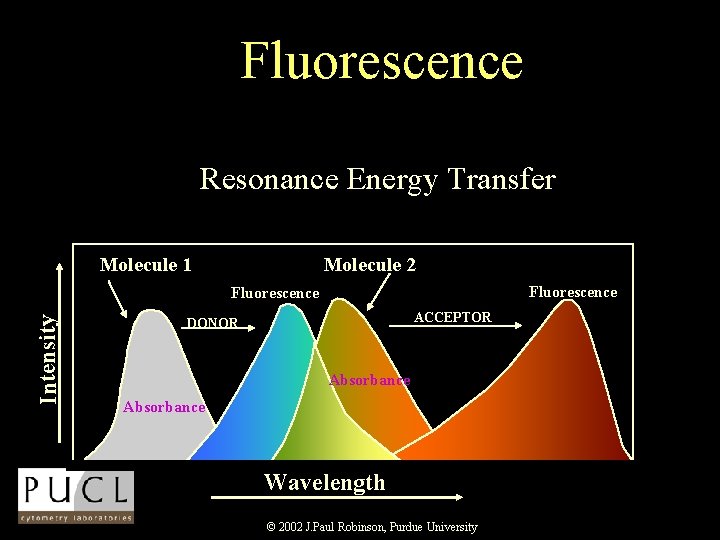
Fluorescence Resonance Energy Transfer Molecule 1 Molecule 2 Fluorescence Intensity Fluorescence ACCEPTOR DONOR Absorbance Wavelength © 2002 J. Paul Robinson, Purdue University
Raman Scatter • A molecule may undergo a vibrational transition (not an electronic shift) at exactly the same time as scattering occurs • This results in a photon emission of a photon differing in energy from the energy of the incident photon by the amount of the above energy - this is Raman scattering. • The dominant effect in flow cytometry is the stretch of the O-H bonds of water. At 488 nm excitation this would give emission at 575 -595 nm © 2002 J. Paul Robinson, Purdue University Shapiro p 93
Quenching, Bleaching & Saturation • Quenching is when excited molecules relax to ground stat 5 es via nonradiative pathways avoiding fluorescence emission (vibration, collision, intersystem crossing) • Molecular oxygen quenches by increasing the probability of intersystem crossing • Polar solvents such as water generally quench fluorescence by orienting around the exited state dipoles © 2002 J. Paul Robinson, Purdue University Shapiro p 90
Lecture Summary • Light and Matter • Absorption • Fluorescence • From this lecture you should understand: – – – The nature of fluorescence molecules How fluorescence is generated Why molecules have different excitation and emission What Resonance Energy Transfer is What quantum yield is © 2002 J. Paul Robinson, Purdue University
- Slides: 28