
BMS 602631 LECTURE 8 Flow Cytometry Theory J
BMS 602/631 - LECTURE 8 Flow Cytometry: Theory J. Paul Robinson Professor of Immunopharmacology& Biomedical Engineering Purdue University Detectors Hansen Hall, B 050 Purdue University Office: 494 0757 Fax 494 0517 email: robinson@flowcyt. cyto. purdue. edu WEB http: //www. cyto. purdue. edu Notes: 1. 2. 3. Material is taken from the course text: Howard M. Shapiro, Practical Flow Cytometry, 3 nd edition (1994), Wiley-Liss, New York. RFM =Slides taken from Dr. Robert Murphy MLM – Material taken from Melamed, et al, Flow Cytometry & Sorting, Wiley-Liss, 2 nd Ed. 3 rd Ed. Shapiro 127 -133 4 th Ed. Shapiro 160 -166 © 1990 -2004 J. Paul Robinson, Purdue University BMS 631 – LECTURE 007. PPT Page 1
Detectors • Light must be converted from photons into volts to be measured • We must select the correct detector system according to how many photons we have available • In general, we use photodiodes forward scatter and absorption and PMTs for fluorescence and side scatter Page 2 © 1990 -2004 J. Paul Robinson, Purdue University BMS 631 – LECTURE 007. PPT
Silicon photodiodes • A silicon photodiode produces current when photons impinge upon it (example are solar cells) • Does not require an external power source to operate • Peak sensitivity is about 900 nm • At 900 nm the responsivity is about 0. 5 amperes/watt, at 500 nm it is 0. 28 A/W • Are usually operated in the photovoltaic mode (no external voltage) (alternative is photoconductive mode with a bias voltage) • Have no gain so must have external amps • quantum efficiency ( )% = 100 x (electrons out/(photons in) Page 3 © 1990 -2004 J. Paul Robinson, Purdue University BMS 631 – LECTURE 007. PPT
PMT • Produce current at their anodes when photons impinge upon their light-sensitive cathodes • Require external powersource • Their gain is as high as 107 electrons out per photon in • Noise can be generated from thermionic emission of electrons this is called “dark current” • If very low levels of signal are available, PMTs are often cooled to reduce heat effects • Spectral response of PMTs is determined by the composition of the photocathode • Bi-alkali PMTs have peak sensitivity at 400 nm • Multialkali PMTs extend to 750 nm • Gallium Arsenide (Ga. As) cathodes operate from 300 -850 nm (very costly and have lower gain) Page 4 © 1990 -2004 J. Paul Robinson, Purdue University BMS 631 – LECTURE 007. PPT
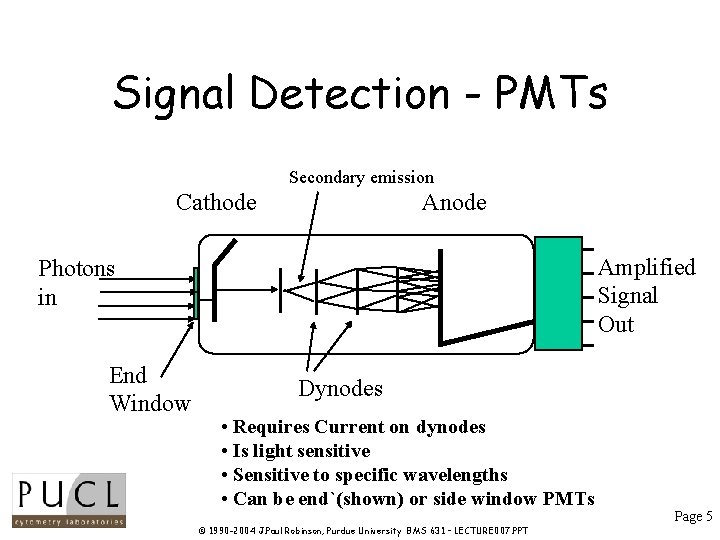
Signal Detection - PMTs Secondary emission Cathode Anode Amplified Signal Out Photons in End Window Dynodes • Requires Current on dynodes • Is light sensitive • Sensitive to specific wavelengths • Can be end`(shown) or side window PMTs © 1990 -2004 J. Paul Robinson, Purdue University BMS 631 – LECTURE 007. PPT Page 5
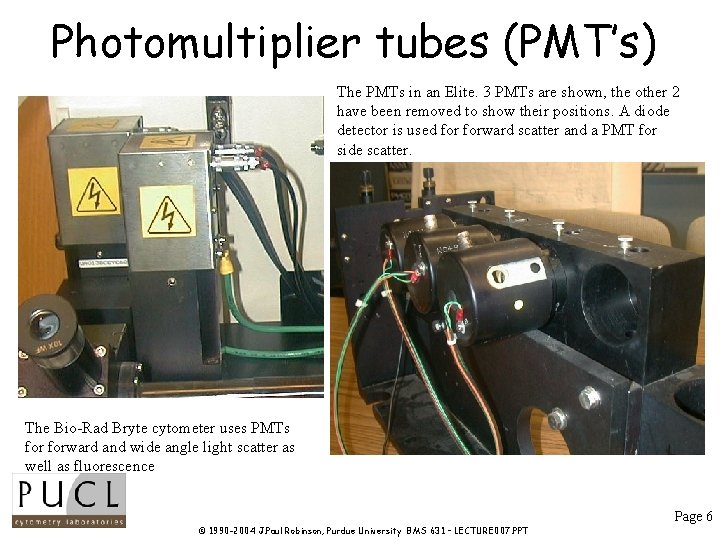
Photomultiplier tubes (PMT’s) The PMTs in an Elite. 3 PMTs are shown, the other 2 have been removed to show their positions. A diode detector is used forward scatter and a PMT for side scatter. The Bio-Rad Bryte cytometer uses PMTs forward and wide angle light scatter as well as fluorescence Page 6 © 1990 -2004 J. Paul Robinson, Purdue University BMS 631 – LECTURE 007. PPT
PMTs • High voltage regulation is critical because the relationship between the high voltage and the PMT gain is non-linear (almost logarithmic) • PMTs must be shielded from stray light and magnetic fields • Room light will destroy a PMT if connected to a power supply • There are side-window and end-window PMTs • While photodiodes are efficient, they produce too small a signal to be useful for fluorescence Page 7 © 1990 -2004 J. Paul Robinson, Purdue University BMS 631 – LECTURE 007. PPT
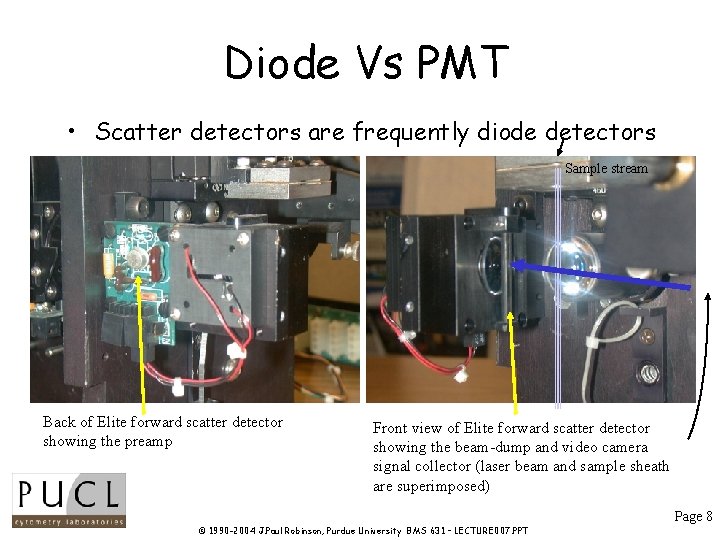
Diode Vs PMT • Scatter detectors are frequently diode detectors Sample stream Back of Elite forward scatter detector showing the preamp Front view of Elite forward scatter detector showing the beam-dump and video camera signal collector (laser beam and sample sheath are superimposed) Page 8 © 1990 -2004 J. Paul Robinson, Purdue University BMS 631 – LECTURE 007. PPT
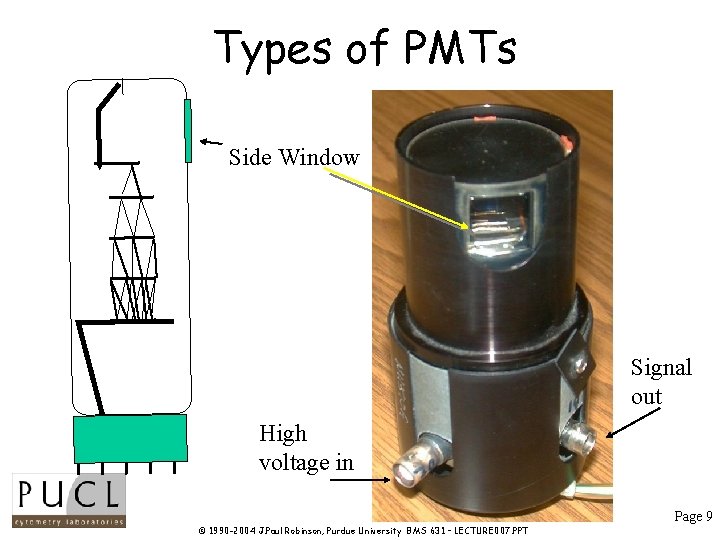
Types of PMTs Side Window Signal out High voltage in Page 9 © 1990 -2004 J. Paul Robinson, Purdue University BMS 631 – LECTURE 007. PPT
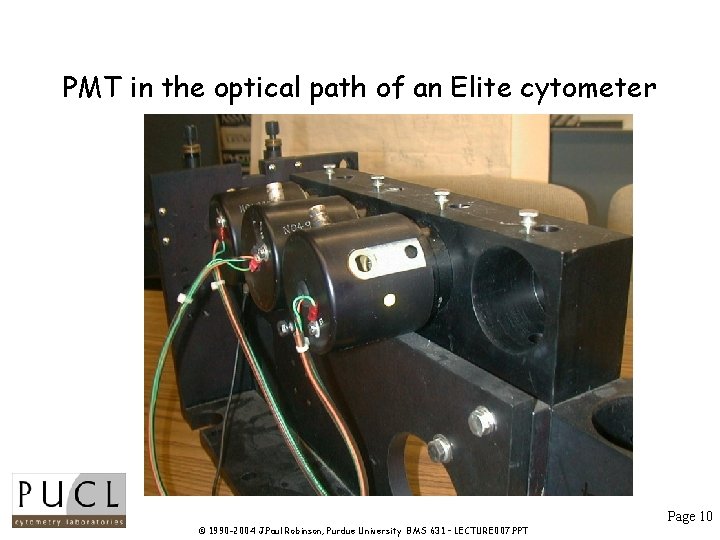
PMT in the optical path of an Elite cytometer Page 10 © 1990 -2004 J. Paul Robinson, Purdue University BMS 631 – LECTURE 007. PPT
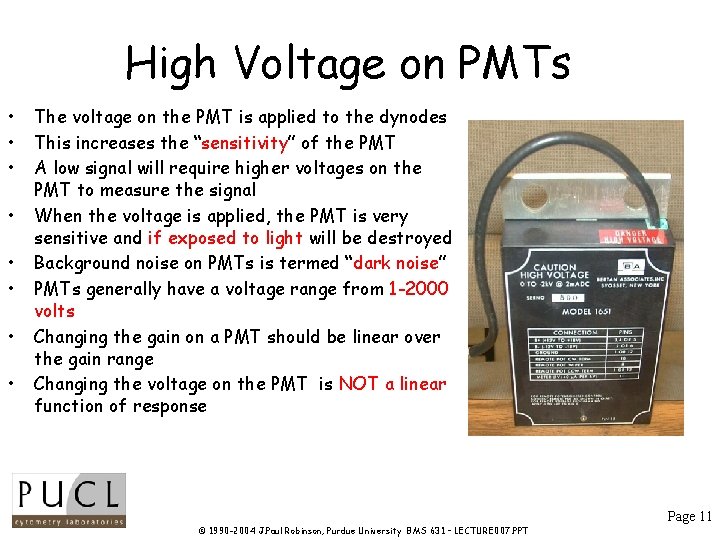
High Voltage on PMTs • • The voltage on the PMT is applied to the dynodes This increases the “sensitivity” of the PMT A low signal will require higher voltages on the PMT to measure the signal When the voltage is applied, the PMT is very sensitive and if exposed to light will be destroyed Background noise on PMTs is termed “dark noise” PMTs generally have a voltage range from 1 -2000 volts Changing the gain on a PMT should be linear over the gain range Changing the voltage on the PMT is NOT a linear function of response Page 11 © 1990 -2004 J. Paul Robinson, Purdue University BMS 631 – LECTURE 007. PPT
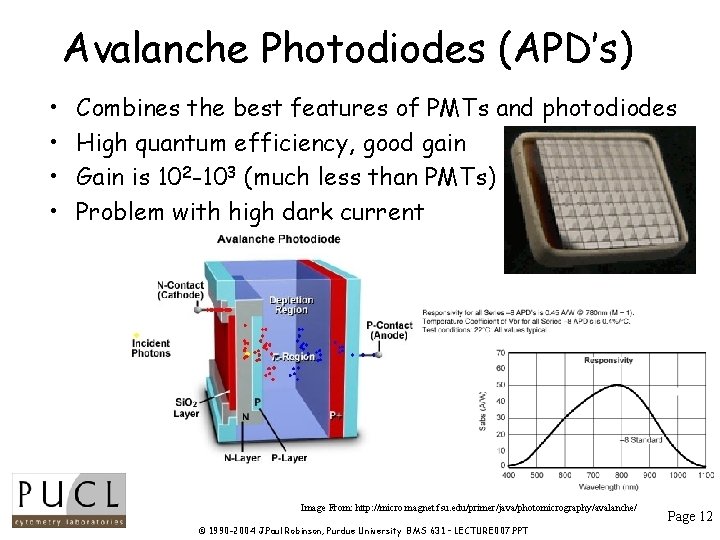
Avalanche Photodiodes (APD’s) • • Combines the best features of PMTs and photodiodes High quantum efficiency, good gain Gain is 102 -103 (much less than PMTs) Problem with high dark current Image From: http: //micro. magnet. fsu. edu/primer/java/photomicrography/avalanche/ © 1990 -2004 J. Paul Robinson, Purdue University BMS 631 – LECTURE 007. PPT Page 12
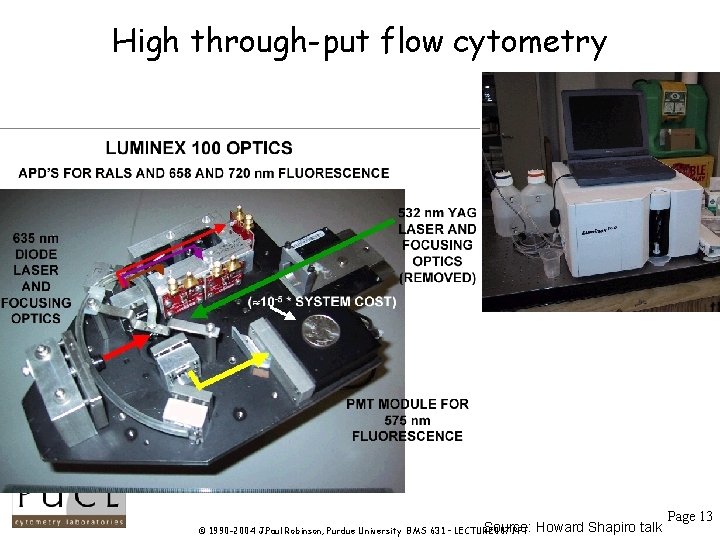
High through-put flow cytometry Source: © 1990 -2004 J. Paul Robinson, Purdue University BMS 631 – LECTURE 007. PPT Howard Shapiro talk Page 13
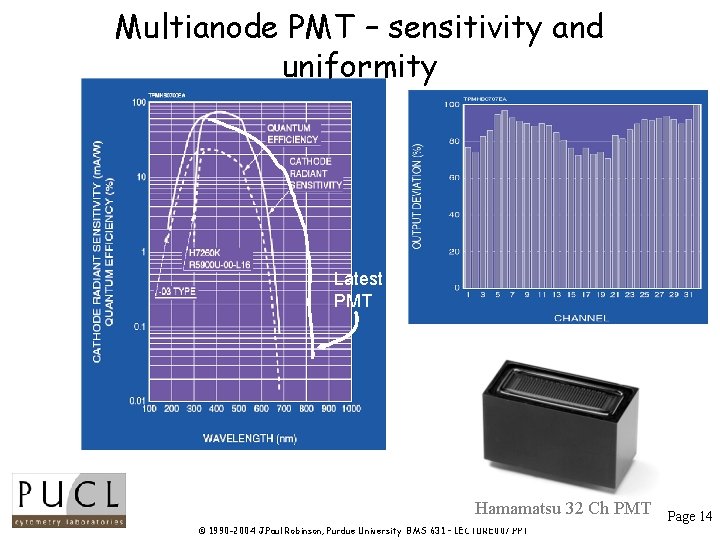
Multianode PMT – sensitivity and uniformity Latest PMT Hamamatsu 32 Ch PMT © 1990 -2004 J. Paul Robinson, Purdue University BMS 631 – LECTURE 007. PPT Page 14
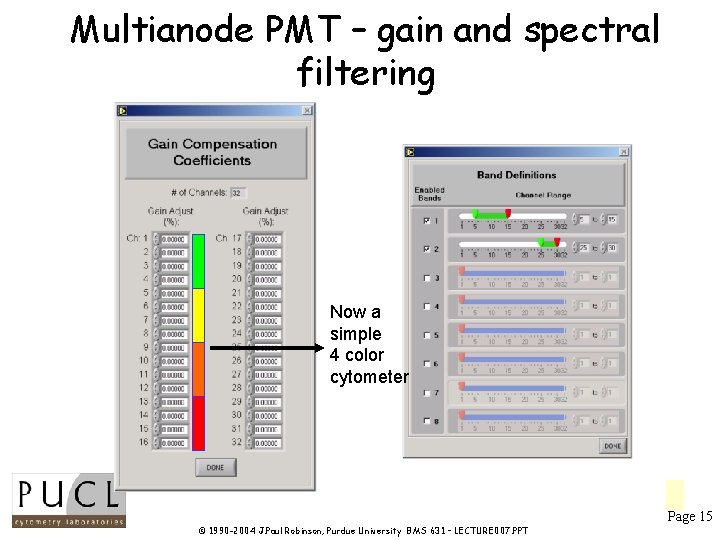
Multianode PMT – gain and spectral filtering Now a simple 4 color cytometer Page 15 © 1990 -2004 J. Paul Robinson, Purdue University BMS 631 – LECTURE 007. PPT
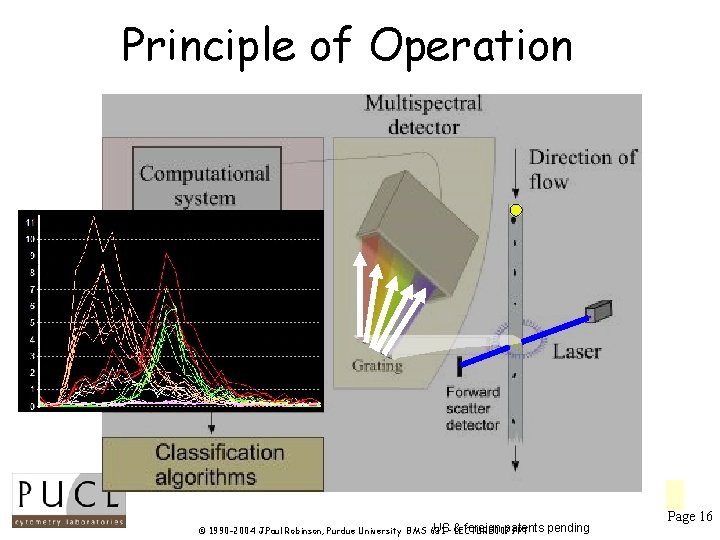
Principle of Operation US– & foreign patents © 1990 -2004 J. Paul Robinson, Purdue University BMS 631 LECTURE 007. PPT pending Page 16
CCDs • Charge Coupled devices (CCD) usually in our video cameras (also called charged transfer devices) • light causes accumulation of electric charge in individual elements which release the charge at regular intervals • Useful in imaging because they can integrate over time • Not fast enough for flow cytometry application in general Page 17 © 1990 -2004 J. Paul Robinson, Purdue University BMS 631 – LECTURE 007. PPT
Summary…. • Photodiodes can operate in two modes - photovoltaic and photoconductive • Photodiodes are usually used for scatter • Photodiodes are more sensitive than PMTs but because of their low gain, they are not as useful for low level signals (too much noise) • PMTs are usually used for fluorescence measurements • PMTS are sensitive to different wavelengths according to the construction of the photocathode • PMTs are subject to dark current • High Voltages are not linear across the entire range Page 18 © 1990 -2004 J. Paul Robinson, Purdue University BMS 631 – LECTURE 007. PPT
Lecture Summary (cont) • There is a very small time scale for measurements • Most fluorescence detectors are PMTs • PMTs can be destroyed if they receive a lot of light when powered • Standard PMTs do not have good sensitivity over 650 nm – you must use a multi-alkali PMT • New versions of Multanode PMTs are now available up to 880 nm WEB http: //www. cyto. purdue. edu Page 19 © 1990 -2004 J. Paul Robinson, Purdue University BMS 631 – LECTURE 007. PPT
- Slides: 19