
bml SUP A SMPL Unity Player Adam O
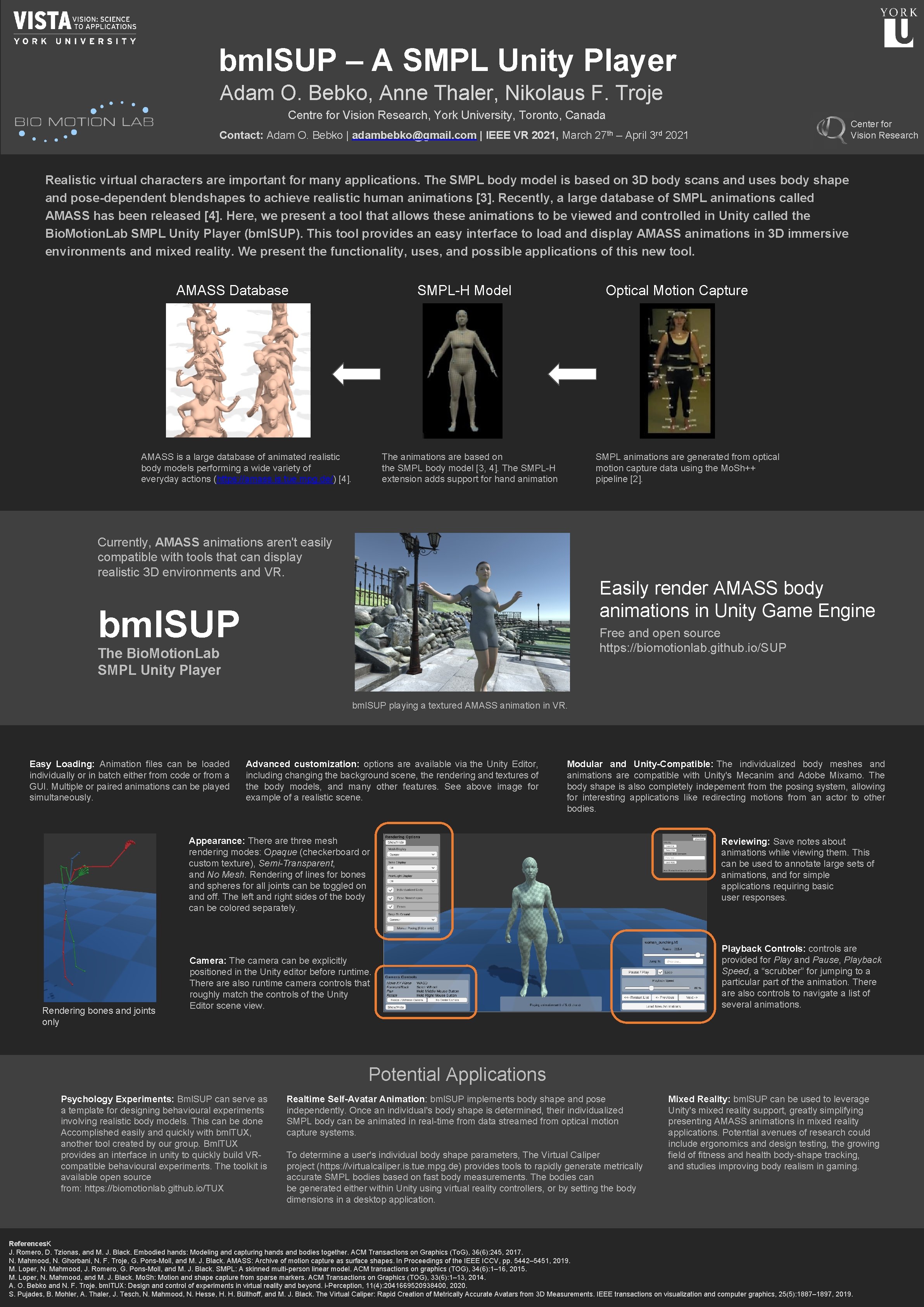
bml. SUP – A SMPL Unity Player Adam O. Bebko, Anne Thaler, Nikolaus F. Troje Centre for Vision Research, York University, Toronto, Canada Center for Vision Research Contact: Adam O. Bebko | adambebko@gmail. com | IEEE VR 2021, March 27 th – April 3 rd 2021 Realistic virtual characters are important for many applications. The SMPL body model is based on 3 D body scans and uses body shape and pose-dependent blendshapes to achieve realistic human animations [3]. Recently, a large database of SMPL animations called AMASS has been released [4]. Here, we present a tool that allows these animations to be viewed and controlled in Unity called the Bio. Motion. Lab SMPL Unity Player (bml. SUP). This tool provides an easy interface to load and display AMASS animations in 3 D immersive environments and mixed reality. We present the functionality, uses, and possible applications of this new tool. AMASS Database SMPL-H Model AMASS is a large database of animated realistic body models performing a wide variety of everyday actions (https: //amass. is. tue. mpg. de/) [4]. Optical Motion Capture The animations are based on the SMPL body model [3, 4]. The SMPL-H extension adds support for hand animation SMPL animations are generated from optical motion capture data using the Mo. Sh++ pipeline [2]. Currently, AMASS animations aren't easily compatible with tools that can display realistic 3 D environments and VR. Easily render AMASS body animations in Unity Game Engine bml. SUP Free and open source https: //biomotionlab. github. io/SUP The Bio. Motion. Lab SMPL Unity Player bml. SUP playing a textured AMASS animation in VR. Easy Loading: Animation files can be loaded individually or in batch either from code or from a GUI. Multiple or paired animations can be played simultaneously. Advanced customization: options are available via the Unity Editor, including changing the background scene, the rendering and textures of the body models, and many other features. See above image for example of a realistic scene. Modular and Unity-Compatible: The individualized body meshes and animations are compatible with Unity's Mecanim and Adobe Mixamo. The body shape is also completely indepement from the posing system, allowing for interesting applications like redirecting motions from an actor to other bodies. Appearance: There are three mesh rendering modes: Opaque (checkerboard or custom texture), Semi-Transparent, and No Mesh. Rendering of lines for bones and spheres for all joints can be toggled on and off. The left and right sides of the body can be colored separately. Rendering bones and joints only Camera: The camera can be explicitly positioned in the Unity editor before runtime. There also runtime camera controls that roughly match the controls of the Unity Editor scene view. Reviewing: Save notes about animations while viewing them. This can be used to annotate large sets of animations, and for simple applications requiring basic user responses. Playback Controls: controls are provided for Play and Pause, Playback Speed, a “scrubber” for jumping to a particular part of the animation. There also controls to navigate a list of several animations. Potential Applications Psychology Experiments: Bml. SUP can serve as a template for designing behavioural experiments involving realistic body models. This can be done Accomplished easily and quickly with bml. TUX, another tool created by our group. Bml. TUX provides an interface in unity to quickly build VRcompatible behavioural experiments. The toolkit is available open source from: https: //biomotionlab. github. io/TUX Realtime Self-Avatar Animation: bml. SUP implements body shape and pose independently. Once an individual's body shape is determined, their individualized SMPL body can be animated in real-time from data streamed from optical motion capture systems. To determine a user's individual body shape parameters, The Virtual Caliper project (https: //virtualcaliper. is. tue. mpg. de) provides tools to rapidly generate metrically accurate SMPL bodies based on fast body measurements. The bodies can be generated either within Unity using virtual reality controllers, or by setting the body dimensions in a desktop application. Mixed Reality: bml. SUP can be used to leverage Unity's mixed reality support, greatly simplifying presenting AMASS animations in mixed reality applications. Potential avenues of research could include ergonomics and design testing, the growing field of fitness and health body-shape tracking, and studies improving body realism in gaming. References. K J. Romero, D. Tzionas, and M. J. Black. Embodied hands: Modeling and capturing hands and bodies together. ACM Transactions on Graphics (To. G), 36(6): 245, 2017. N. Mahmood, N. Ghorbani, N. F. Troje, G. Pons-Moll, and M. J. Black. AMASS: Archive of motion capture as surface shapes. In Proceedings of the IEEE ICCV, pp. 5442– 5451, 2019. M. Loper, N. Mahmood, J. Romero, G. Pons-Moll, and M. J. Black. SMPL: A skinned multi-person linear model. ACM transactions on graphics (TOG), 34(6): 1– 16, 2015. M. Loper, N. Mahmood, and M. J. Black. Mo. Sh: Motion and shape capture from sparse markers. ACM Transactions on Graphics (TOG), 33(6): 1– 13, 2014. A. O. Bebko and N. F. Troje. bml. TUX: Design and control of experiments in virtual reality and beyond. i-Perception, 11(4): 2041669520938400, 2020. S. Pujades, B. Mohler, A. Thaler, J. Tesch, N. Mahmood, N. Hesse, H. H. Bülthoff, and M. J. Black. The Virtual Caliper: Rapid Creation of Metrically Accurate Avatars from 3 D Measurements. IEEE transactions on visualization and computer graphics, 25(5): 1887– 1897, 2019.
- Slides: 1