
BME 452 Biomedical Signal Processing Lecture 6 v
BME 452 Biomedical Signal Processing Lecture 6 v. Biological Signals and Event Detection Lecture 6 BME 452 Biomedical Signal Processing 2013 (copyright Ali Işın, 2013) 1
Lecture 6 Outline o o o o Introduction to ECG , PCG and CP Event Detection: • Introduction • Problem statement • Detection of events and waves • QRS detection – Derivative-based methods – Pan-Tompkins algorithm Lecture 6 BME 452 Biomedical Signal Processing 2013 (copyright Ali Işın, 2013) 2
The Electro Cardio Gram (ECG) o ECG: electrical manifestation of of heart recorded from the body-surface • Heart rate monitoring • Wave shape change due to cardiovascular disease and abnormalities. Lecture 6 BME 452 Biomedical Signal Processing 2013 (copyright Ali Işın, 2013) 3
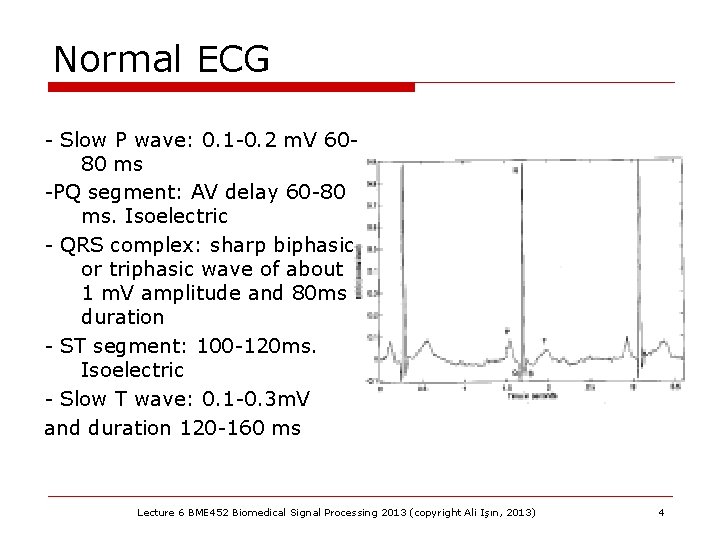
Normal ECG - Slow P wave: 0. 1 -0. 2 m. V 6080 ms -PQ segment: AV delay 60 -80 ms. Isoelectric - QRS complex: sharp biphasic or triphasic wave of about 1 m. V amplitude and 80 ms duration - ST segment: 100 -120 ms. Isoelectric - Slow T wave: 0. 1 -0. 3 m. V and duration 120 -160 ms Lecture 6 BME 452 Biomedical Signal Processing 2013 (copyright Ali Işın, 2013) 4

o Rectangular calibration pulse – 1 m. V amplitude and 200 ms duration Produce a pulse of 1 cm height on the paper plot. o ECG normaly is between 0. 05 -100 Hz and sampling rate is 500 Hz or 1 k. Hz o 12 -lead ECG I, II, a. VR, a. VL, a. VF, V 1, V 2, V 3, V 4, V 5, V 6. Einthoven’s triangle Lecture 6 BME 452 Biomedical Signal Processing 2013 (copyright Ali Işın, 2013) 5

Arrhythmias o Disturbances in regular rhthym o Irregular firing patterns from SA node o Abnormal or additional pacing activity from other parts of the heart o VF: Ventricular fibrillation - Ineffective pumping -> possibly death - Disorganized contraction of ventricles Lecture 6 BME 452 Biomedical Signal Processing 2013 (copyright Ali Işın, 2013) 6
ECG Abnormalities o Premature beats (PVC), ectopic beats o ST segment depression or elevation - Ischemia: reduced blood supply to a tissue due to a block in an artery. - Infarction: dead tissue -> incapable of contraction o QRS widening - Hypertrophy - Bundle-branch block Lecture 6 BME 452 Biomedical Signal Processing 2013 (copyright Ali Işın, 2013) 7
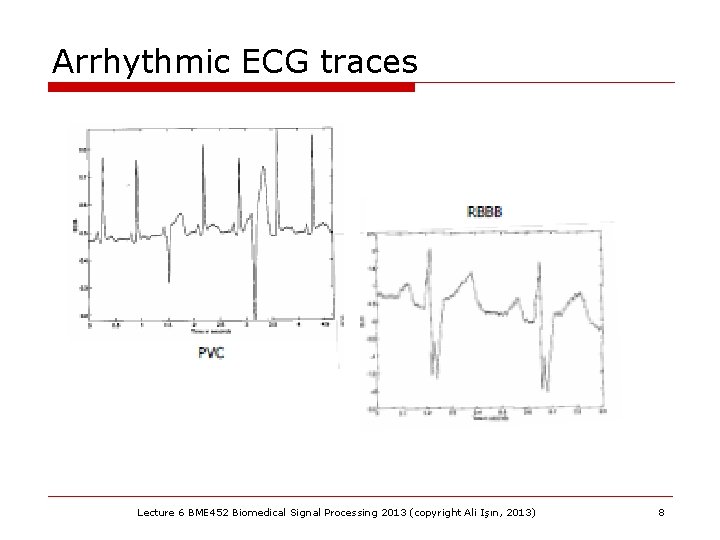
Arrhythmic ECG traces Lecture 6 BME 452 Biomedical Signal Processing 2013 (copyright Ali Işın, 2013) 8

The Phono Cardio Gram (PCG) • Stethoscope: heart sound listening device • PCG: vibration or sound signal - Contractile activity of the heart and blood together – Represents a recording of heart sound signal • Measurement: - Requires a transducer to convert vibration or sound signal into an electronic signal – Microphones or pressure transducers placed on chest • Diagnosis: – Cardiovascular diseases and defects cause changes and additional sounds and murmurs. Lecture 6 BME 452 Biomedical Signal Processing 2013 (copyright Ali Işın, 2013) 9
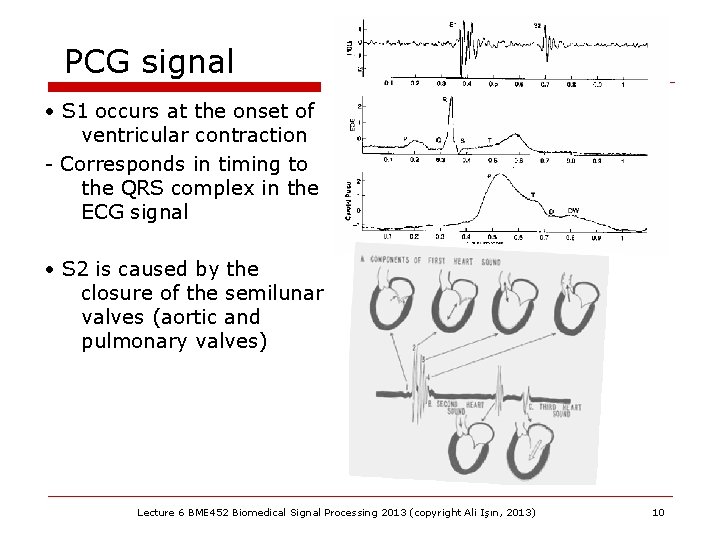
PCG signal • S 1 occurs at the onset of ventricular contraction - Corresponds in timing to the QRS complex in the ECG signal • S 2 is caused by the closure of the semilunar valves (aortic and pulmonary valves) Lecture 6 BME 452 Biomedical Signal Processing 2013 (copyright Ali Işın, 2013) 10
Heart murmurs • Occur due to certain cardiovascular defects and diseases • Are caused by turbulance in blood flow – Valvular stenosis: deposition of calcium or other reasons, the valve leaflets are stiffened and dont open completely – Insufficiency: valves can not close effectively and causes leakage of blood • The intervals between S 1 and S 2, S 2 and S 1 of the next cycle are normally silent. • Are high-frequency, noise like sounds that arise when the velocity of blood becomes high as it flows through an irregularity (such as a constriction) Lecture 6 BME 452 Biomedical Signal Processing 2013 (copyright Ali Işın, 2013) 11
CP: Carotid Pulse • Pressure signal recorded over carotid artery. – Near the surface of the body at the neck • Provides arterial blood pressure and blood volume with each heart beat • Similar morphology of the pressure signal at the root of the aorta - But can not measure absolute pressure • Is useful with PCG - Can assist in the identification of S 2 and its components Lecture 6 BME 452 Biomedical Signal Processing 2013 (copyright Ali Işın, 2013) 12

CP signal - P: percussion wave - T: tidal wave - D: dicrotic notch Lecture 6 BME 452 Biomedical Signal Processing 2013 (copyright Ali Işın, 2013) 13
Introduction to Event Detection o Biomedical signals carry signatures of physiological events • Part of a signal related to a specific event of interest is referred to as an “ epoch” • Analysis requires identification of epochs – For monitoring and diagnosis • The corresponding waveform may be segmented analyzed in terms of its – Amplitude, waveform, time-duration, intervals between events, energy distribution, frequency content Lecture 6 BME 452 Biomedical Signal Processing 2013 (copyright Ali Işın, 2013) 14
Problem statement • Given a biomedical signal, identify discrete signal epochs and correlate them with events in the related physiological process Lecture 6 BME 452 Biomedical Signal Processing 2013 (copyright Ali Işın, 2013) 15
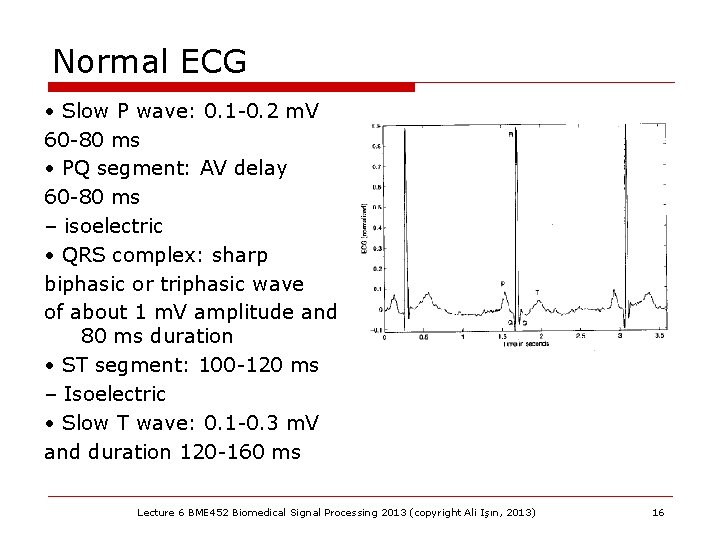
Normal ECG • Slow P wave: 0. 1 -0. 2 m. V 60 -80 ms • PQ segment: AV delay 60 -80 ms – isoelectric • QRS complex: sharp biphasic or triphasic wave of about 1 m. V amplitude and 80 ms duration • ST segment: 100 -120 ms – Isoelectric • Slow T wave: 0. 1 -0. 3 m. V and duration 120 -160 ms Lecture 6 BME 452 Biomedical Signal Processing 2013 (copyright Ali Işın, 2013) 16
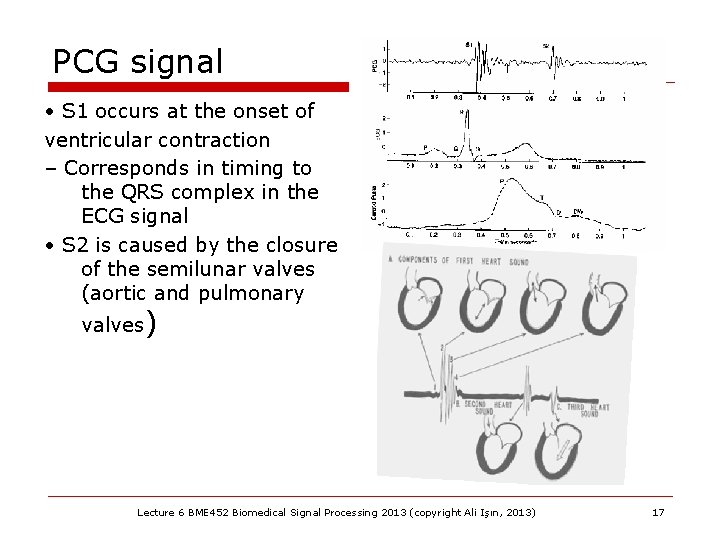
PCG signal • S 1 occurs at the onset of ventricular contraction – Corresponds in timing to the QRS complex in the ECG signal • S 2 is caused by the closure of the semilunar valves (aortic and pulmonary valves) Lecture 6 BME 452 Biomedical Signal Processing 2013 (copyright Ali Işın, 2013) 17
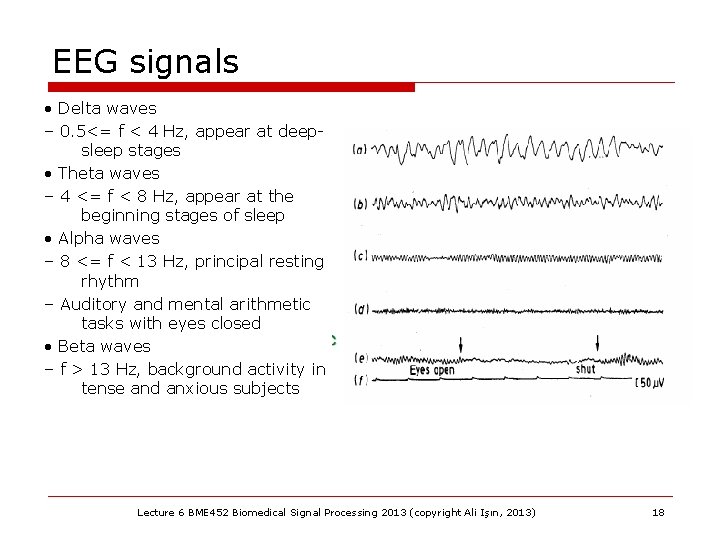
EEG signals • Delta waves – 0. 5<= f < 4 Hz, appear at deepsleep stages • Theta waves – 4 <= f < 8 Hz, appear at the beginning stages of sleep • Alpha waves – 8 <= f < 13 Hz, principal resting rhythm – Auditory and mental arithmetic tasks with eyes closed • Beta waves – f > 13 Hz, background activity in tense and anxious subjects Lecture 6 BME 452 Biomedical Signal Processing 2013 (copyright Ali Işın, 2013) 18
Detection of Events and Waves • QRS detection – Derivative- based methods – Pan-Tompkins algorithm • Correlation analysis of EEG channels – Detection of EEG rhythms – Template matching for EEG spike-and wave detection Lecture 6 BME 452 Biomedical Signal Processing 2013 (copyright Ali Işın, 2013) 19
Detection of Events and Waves • Matched filter • P-wave detection Lecture 6 BME 452 Biomedical Signal Processing 2013 (copyright Ali Işın, 2013) 20
Applications o ECG rhythm analysis o ECG Waveform Classification Lecture 6 BME 452 Biomedical Signal Processing 2013 (copyright Ali Işın, 2013) 21
QRS Detection • Derivative-based methods • Pan-Tompkins algorithm Lecture 6 BME 452 Biomedical Signal Processing 2013 (copyright Ali Işın, 2013) 22
Derivative-based methods • QRS might not always be the highest wave in a cardiac cycle – artifacts may upset the peak search algorithm • QRS complex has the largest slope (rate of change of voltage) • Rate of change = derivative operator (d/dt ) • Derivative operator: – P and T waves will be suppressed – Output is the highest at the QRS Lecture 6 BME 452 Biomedical Signal Processing 2013 (copyright Ali Işın, 2013) 23
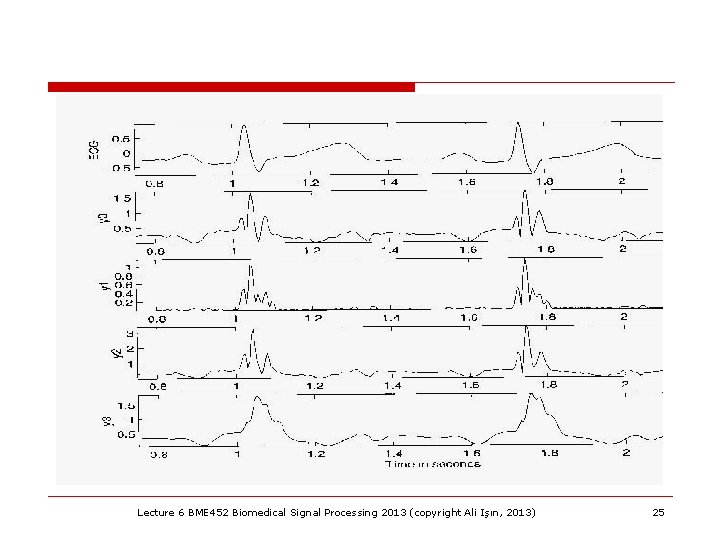
Derivative-based algorithm • Balda et al proposed an algorithm – Three-point first derivative • y 0[n] = | x[n] – x[n-2] | – Second derivative • y 1[n] = | x[n] – 2 x[n-2] + x[n-4] | – The two results are weighted and combined as y 2[n] – The result y 2[n] is scanned with a threshold of 1. 0 – Whenever threshold is crossed • Subsequent 8 samples also tested against the same threshold • If at least one pass the threshold test – The segment of eight samples is taken to be a part of a QRS complex Lecture 6 BME 452 Biomedical Signal Processing 2013 (copyright Ali Işın, 2013) 24
Lecture 6 BME 452 Biomedical Signal Processing 2013 (copyright Ali Işın, 2013) 25
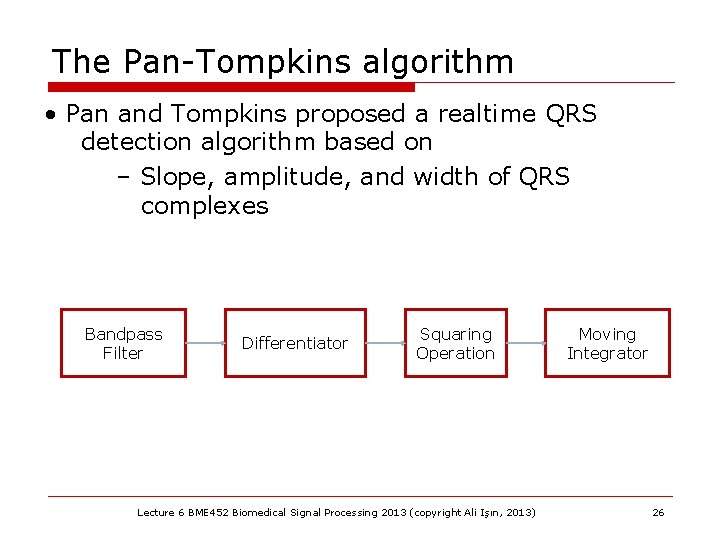
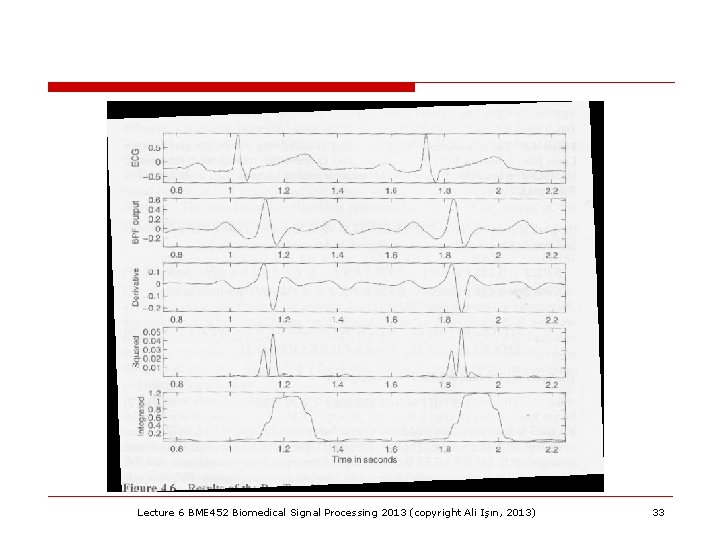
The Pan-Tompkins algorithm • Pan and Tompkins proposed a realtime QRS detection algorithm based on – Slope, amplitude, and width of QRS complexes Bandpass Filter Differentiator Squaring Operation Lecture 6 BME 452 Biomedical Signal Processing 2013 (copyright Ali Işın, 2013) Moving Integrator 26
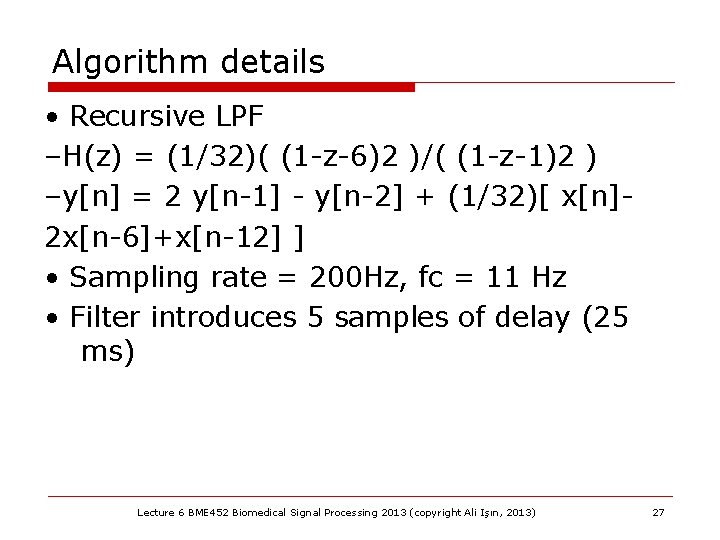
Algorithm details • Recursive LPF –H(z) = (1/32)( (1 -z-6)2 )/( (1 -z-1)2 ) –y[n] = 2 y[n-1] - y[n-2] + (1/32)[ x[n]2 x[n-6]+x[n-12] ] • Sampling rate = 200 Hz, fc = 11 Hz • Filter introduces 5 samples of delay (25 ms) Lecture 6 BME 452 Biomedical Signal Processing 2013 (copyright Ali Işın, 2013) 27

Algorithm details • HPF • Allpass filter minus a LPF – H_lp(z) = (1 -z-32)/(1 -z-1) – y[n] = y[n-1] + x[n] - x[n-32] • H_hp(z) = z-16 – (1/32)H_lp(z) – p[n] = x[n-16] – (1/32)[y[n-1] + x[n] x[n-32]] • fc =5 Hz • Filter introduces 80 ms of delay Lecture 6 BME 452 Biomedical Signal Processing 2013 (copyright Ali Işın, 2013) 28
![Derivative operator • y[n] = (1/8) [ 2 x[n] + x[n-1] – x[n-3] –](http://slidetodoc.com/presentation_image_h/76f8a753fa4860ebb06d55e9e3801401/image-29.jpg "Derivative operator • y[n] = (1/8) [ 2 x[n] + x[n-1] – x[n-3] –")
Derivative operator • y[n] = (1/8) [ 2 x[n] + x[n-1] – x[n-3] – 2 x[n-4] ] –Approximates the ideal d/dt operator up to 30 Hz • Suppresses P and T waves Lecture 6 BME 452 Biomedical Signal Processing 2013 (copyright Ali Işın, 2013) 29

Squaring Operation • Makes the result positive and emphasizes large differences resulting from QRS complexes • Small differences arising from P and T waves are suppressed Lecture 6 BME 452 Biomedical Signal Processing 2013 (copyright Ali Işın, 2013) 30
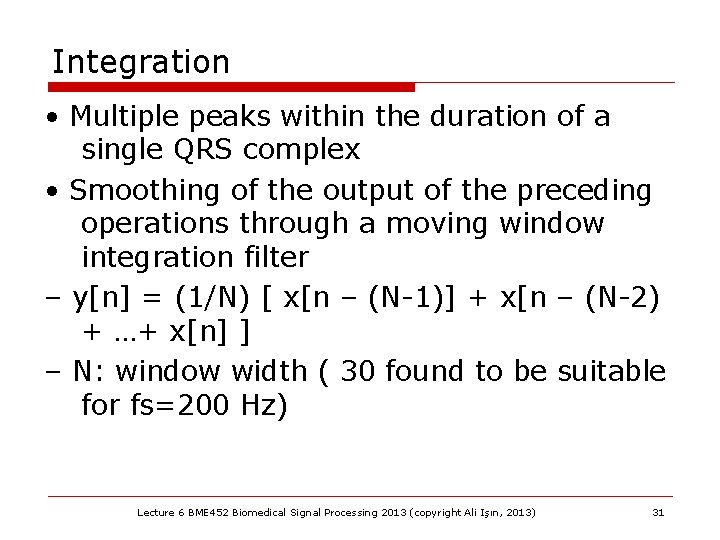
Integration • Multiple peaks within the duration of a single QRS complex • Smoothing of the output of the preceding operations through a moving window integration filter – y[n] = (1/N) [ x[n – (N-1)] + x[n – (N-2) + …+ x[n] ] – N: window width ( 30 found to be suitable for fs=200 Hz) Lecture 6 BME 452 Biomedical Signal Processing 2013 (copyright Ali Işın, 2013) 31
Adaptive thresholding • Thresholding procedure adapts to changes in ECG signal by computing running estimates of signal and noise peaks • A peak is said to be detected whenever the final output changes direction within a specified interval Lecture 6 BME 452 Biomedical Signal Processing 2013 (copyright Ali Işın, 2013) 32
Lecture 6 BME 452 Biomedical Signal Processing 2013 (copyright Ali Işın, 2013) 33
- Slides: 33