
Bluetooth Technology Farinaz Edalat Ganesh Gopal Saswat Misra
Bluetooth Technology Farinaz Edalat, Ganesh Gopal, Saswat Misra, Deepti Rao April 26, 2001 Bluetooth
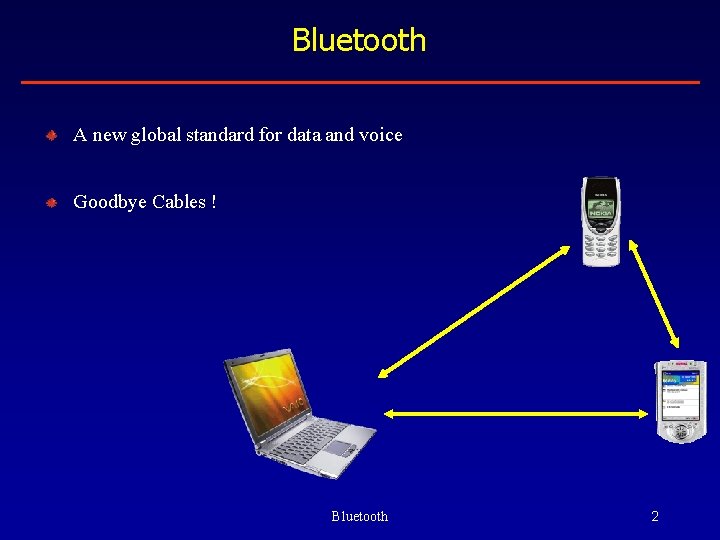
Bluetooth A new global standard for data and voice Goodbye Cables ! Bluetooth 2
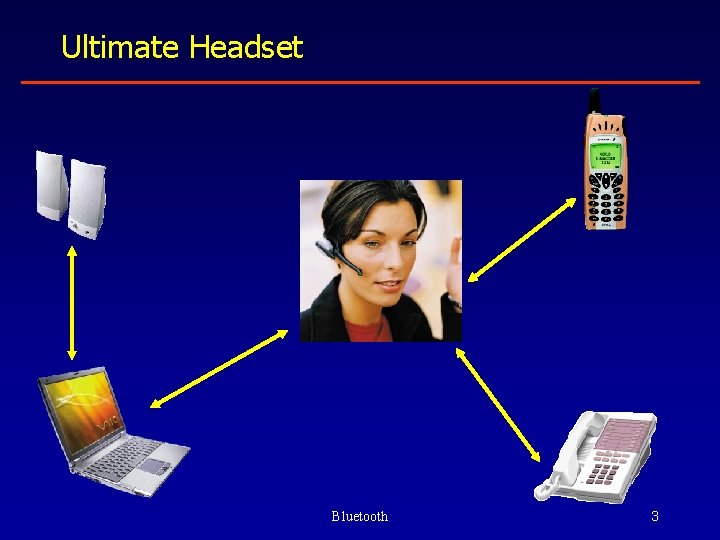
Ultimate Headset Bluetooth 3
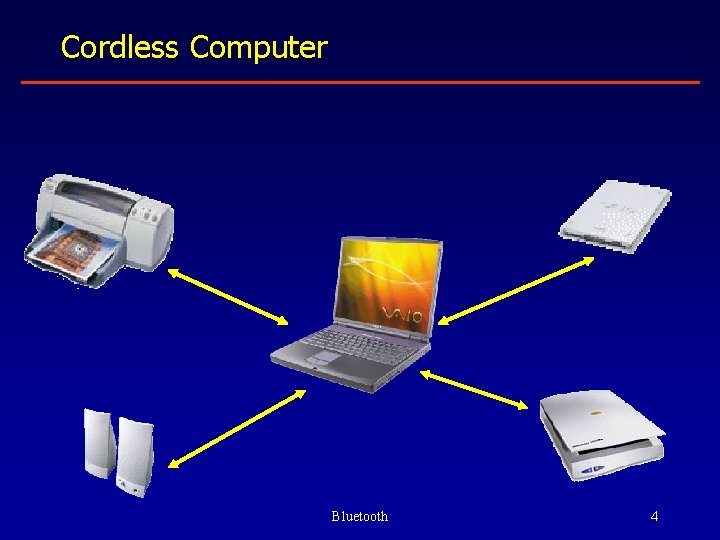
Cordless Computer Bluetooth 4
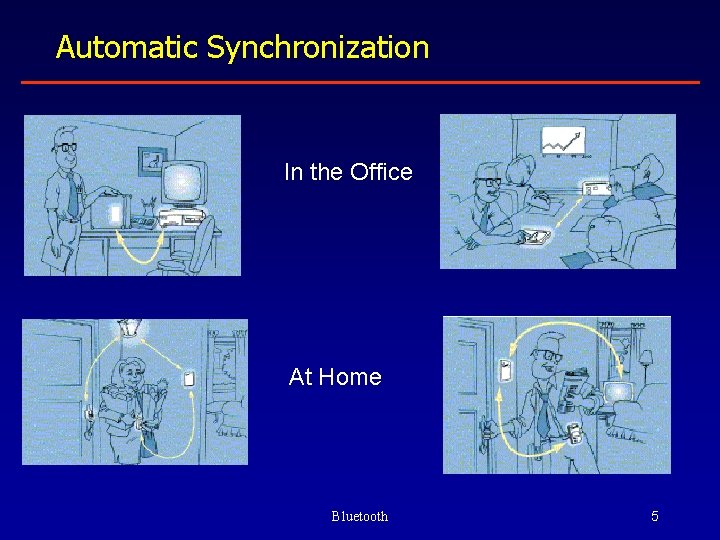
Automatic Synchronization In the Office At Home Bluetooth 5
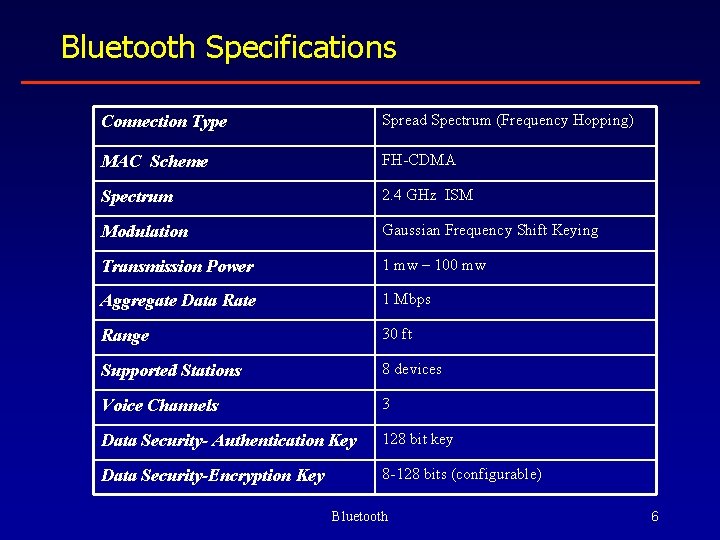
Bluetooth Specifications Connection Type Spread Spectrum (Frequency Hopping) MAC Scheme FH-CDMA Spectrum 2. 4 GHz ISM Modulation Gaussian Frequency Shift Keying Transmission Power 1 mw – 100 mw Aggregate Data Rate 1 Mbps Range 30 ft Supported Stations 8 devices Voice Channels 3 Data Security- Authentication Key 128 bit key Data Security-Encryption Key 8 -128 bits (configurable) Bluetooth 6
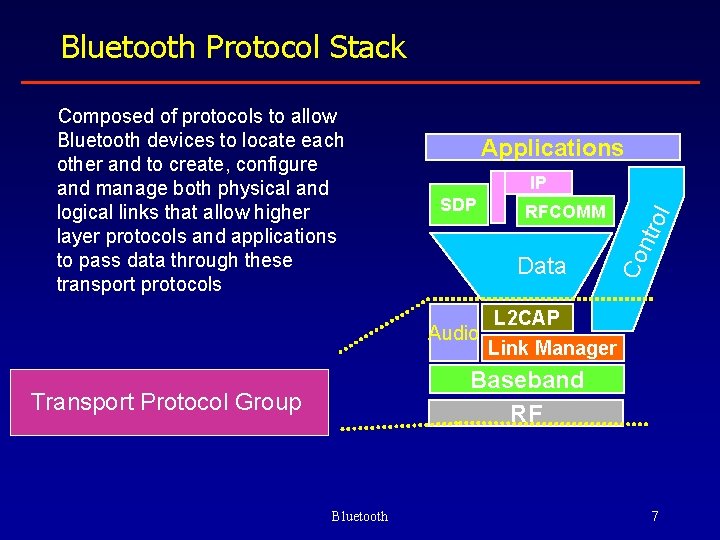
Bluetooth Protocol Stack Applications IP RFCOMM Data Audio rol SDP Co nt Composed of protocols to allow Bluetooth devices to locate each other and to create, configure and manage both physical and logical links that allow higher layer protocols and applications to pass data through these transport protocols L 2 CAP Link Manager Baseband RF Transport Protocol Group Bluetooth 7
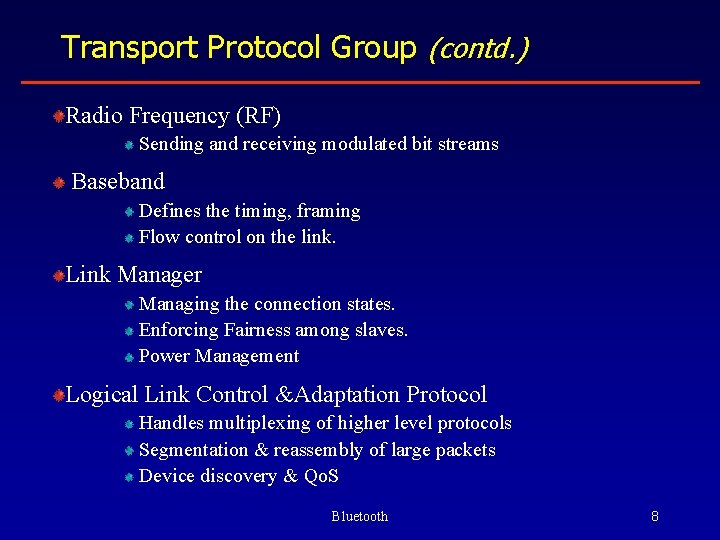
Transport Protocol Group (contd. ) Radio Frequency (RF) Sending and receiving modulated bit streams Baseband Defines the timing, framing Flow control on the link. Link Manager Managing the connection states. Enforcing Fairness among slaves. Power Management Logical Link Control &Adaptation Protocol Handles multiplexing of higher level protocols Segmentation & reassembly of large packets Device discovery & Qo. S Bluetooth 8
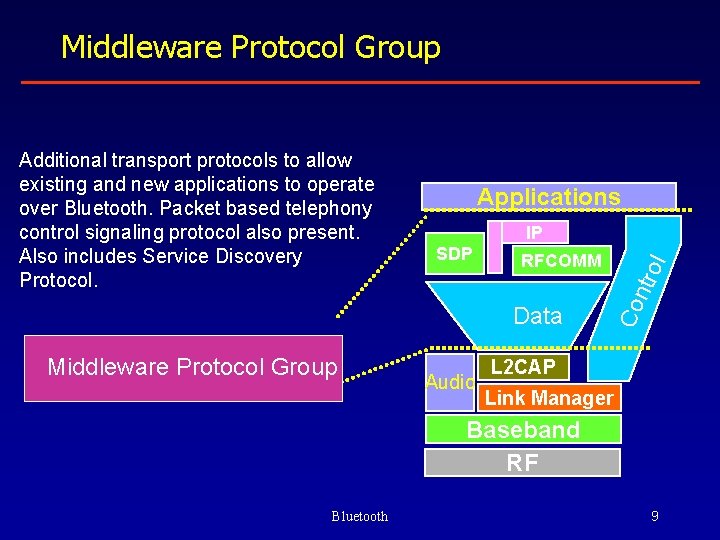
Middleware Protocol Group Applications IP RFCOMM Data Middleware. Protocol. Group Audio rol SDP Co nt Additional transport protocols to allow existing and new applications to operate over Bluetooth. Packet based telephony control signaling protocol also present. Also includes Service Discovery Protocol. L 2 CAP Link Manager Baseband RF Bluetooth 9
Middleware Protocol Group (contd. ) 1. Service Discovery Protocol (SDP) 1. 2. TCP/IP 1. 3. Means for applications to discover device info, services and its characteristics. Network Protocols for packet data communication, routing RFCOMM 1. Cable replacement protocol, emulation of serial ports over wireless network Bluetooth 10
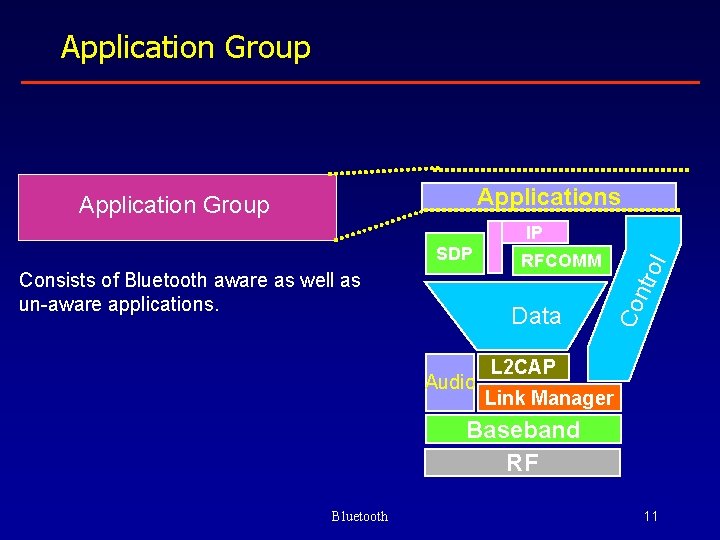
Application Group Applications Application Group IP Data Audio rol Consists of Bluetooth aware as well as un-aware applications. RFCOMM Co nt SDP L 2 CAP Link Manager Baseband RF Bluetooth 11
Master - Slave Master Device in Piconet whose clock and hopping sequence are used to synchronize all other devices (slaves) in the Piconet. It also carries out Paging procedure and also Connection Establishment. Slaves Units within the piconet that are syncronized to the master via its clock and hopping sequence. After connetion establishment, Slaves are assigned a temporary 3 bit member address to reduce the no. of addresing bits required Bluetooth 12
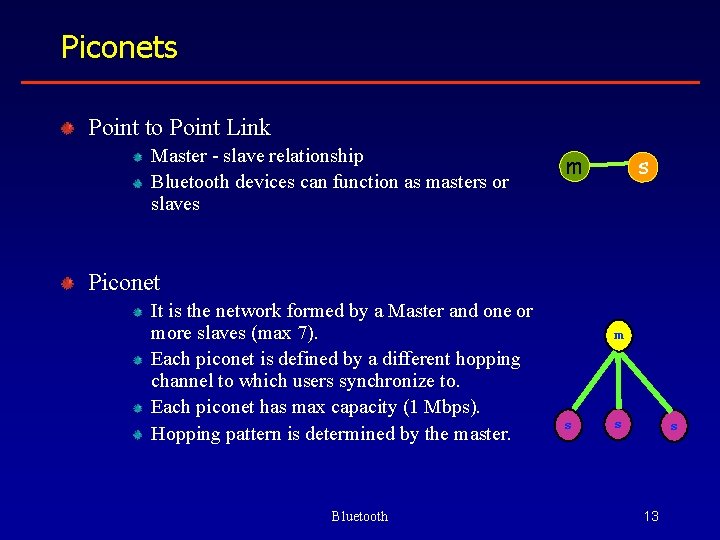
Piconets Point to Point Link Master - slave relationship Bluetooth devices can function as masters or slaves m s Piconet It is the network formed by a Master and one or more slaves (max 7). Each piconet is defined by a different hopping channel to which users synchronize to. Each piconet has max capacity (1 Mbps). Hopping pattern is determined by the master. Bluetooth m s s s 13
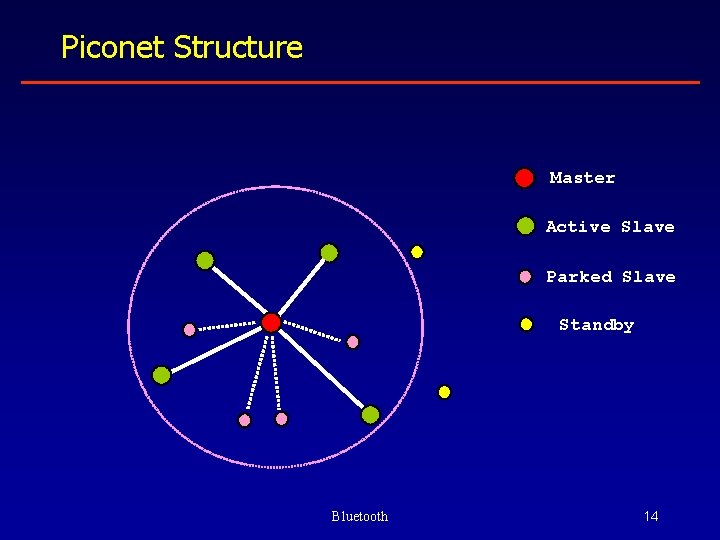
Piconet Structure Master Active Slave Parked Slave Standby Bluetooth 14
Physical Link Types 1. Synchronous Connection Oriented (SCO) 1. 2. 3. 4. 2. Point to Point Full Duplex between Master & Slave Established once by master & kept alive till released by Master Typically used for Voice connection ( to guarantee continuity ) Master reserves slots used for SCO link on the channel to preserve time sensitive information Asynchronous Connection Link (ACL) 1. 2. 3. 4. It is a momentary link between master and slave. No slots are reserved. It is a Point to Multipoint connection. Symmetric & Asymmetric links possible Bluetooth 15
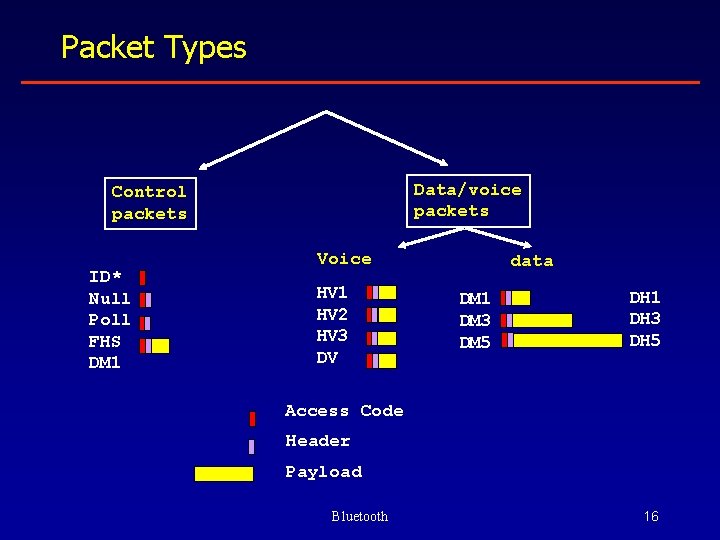
Packet Types Data/voice packets Control packets ID* Null Poll FHS DM 1 Voice HV 1 HV 2 HV 3 DV data DM 1 DM 3 DM 5 DH 1 DH 3 DH 5 Access Code Header Payload Bluetooth 16
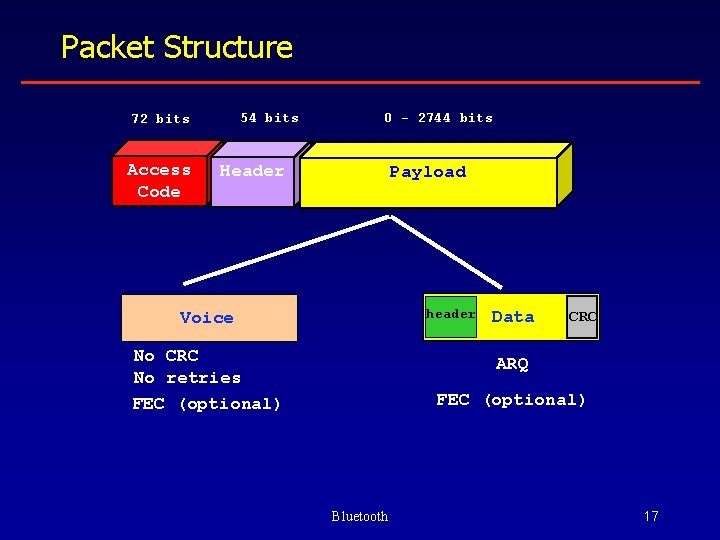
Packet Structure 54 bits 72 bits Access Code 0 - 2744 bits Header Payload header Voice No CRC No retries FEC (optional) Data CRC ARQ FEC (optional) Bluetooth 17
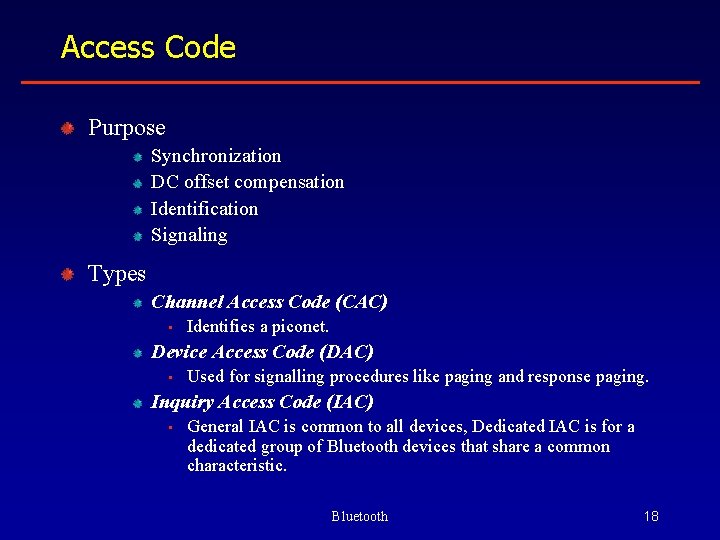
Access Code Purpose Synchronization DC offset compensation Identification Signaling Types Channel Access Code (CAC) • Identifies a piconet. Device Access Code (DAC) • Used for signalling procedures like paging and response paging. Inquiry Access Code (IAC) • General IAC is common to all devices, Dedicated IAC is for a dedicated group of Bluetooth devices that share a common characteristic. Bluetooth 18
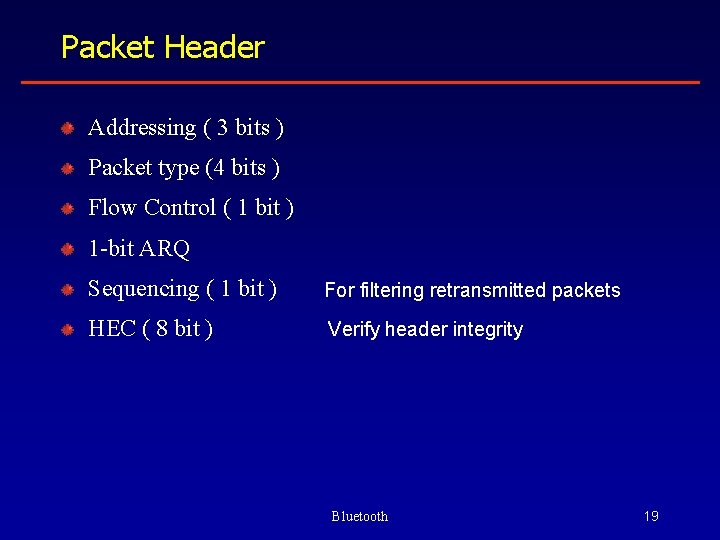
Packet Header Addressing ( 3 bits ) Packet type (4 bits ) Flow Control ( 1 bit ) 1 -bit ARQ Sequencing ( 1 bit ) For filtering retransmitted packets HEC ( 8 bit ) Verify header integrity Bluetooth 19
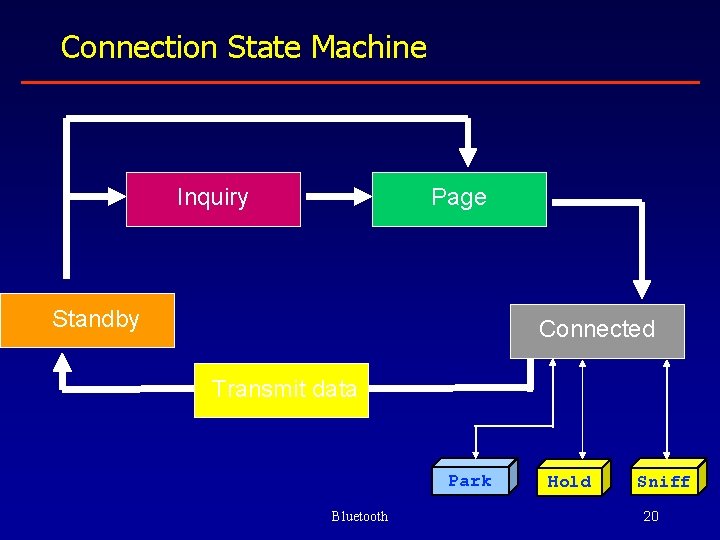
Connection State Machine Inquiry Page Standby Connected Transmit data Park Bluetooth Hold Sniff 20
Connection State Machine (contd. ) 1. Inquiry Scan 1. 2. Inquiry 1. 2. 3. A device that wants to be discovered will periodically enter this mode and listen for inquiry packets. Device sends an Inquiry packet addressed to GIAC or DIAC Transmission is repeated on the inquiry hop sequence of frequencies. Inquiry Response 1. When an inquiry message is received in the inquiry scan state, a response packet (FHS) containing the responding device address must be sent after a random number of slots. Bluetooth 21
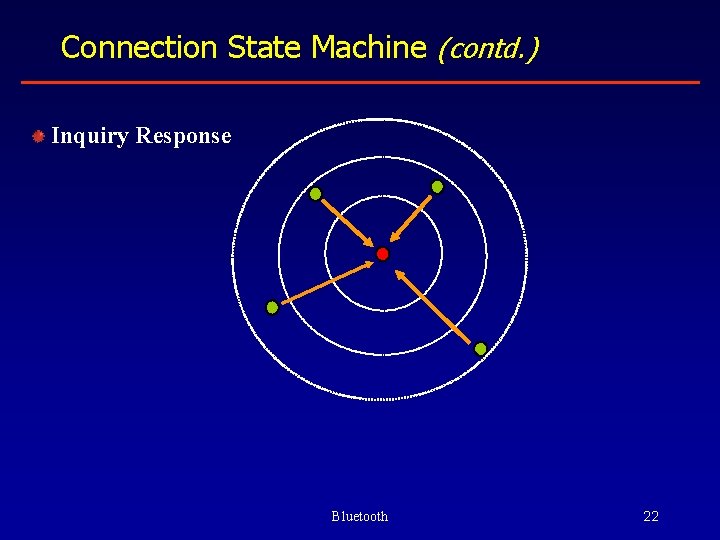
Connection State Machine (contd. ) Inquiry Response Bluetooth 22
Connection State Machine (contd. ) Page The master uses the clock information, about the slave to be paged, to determine where in the hop sequence, the slave might be listening in the page scan mode. The master sends a page message Page Scan The page scan substate can be entered by the slave from the standby state or the connection state. It listens to packets addressed to its DAC. Page Response On receiving the page message, the slave enters the slave page response substate. It sends back a page response consisting of its ID packet which contains its DAC, at the frequency for the next slot from the one in which page message was received. Bluetooth 23
Power Control Modes Sniff Mode This is a low power mode in which the listening activity of the slave is reduced. In the sniff mode, the slave listens for transmissions only at fixed intervals Tsniff, at the offset slot Dsniff for Nsniff times. These parameters are given by the LMP in the master when it issues the SNIFF command to the slave. Hold Mode Slave temporarily (for Thold sec) does not support ACL packets on the channel (possible SCO links will still be supported). By this capacity can be made free to do other things like scanning, paging, inquiring, or attending another piconet. The slave unit keeps its active member address (AM_ADDR). Bluetooth 24
Power Control Modes (contd. ) Park Mode This is a very low power mode with very little activity. The slave however, stays synchronized to the channel. The parked slaves regularly listen for beacon signals at intervals decided by the beacon structure communicated to the slave during the start of parking. The parked slave has to be informed about a transmission in a beacon channel which is supported by the master to keep parked slaves in synchronization and send them any other information. Any message to be sent to a parked member are sent over the broadcast channel. It also helps the master to have more than seven slaves. Bluetooth 25
Security Measures Limited/Restricted Access to authorized users. Both Link Level Encryption & Authentication. Personal Identification Numbers (PIN) for device access. Long encryption keys are used (128 bit keys). These keys are not transmitted over wireless. Other parameters are transmitted over wireless which in combination with certain information known to the device, can generate the keys. Further encryption can be done at the application layer. Security values Device Address-Public Authentication Key(128 bits)-Private Encryption Key(8 -128 bits)-Private Random Number Bluetooth 26
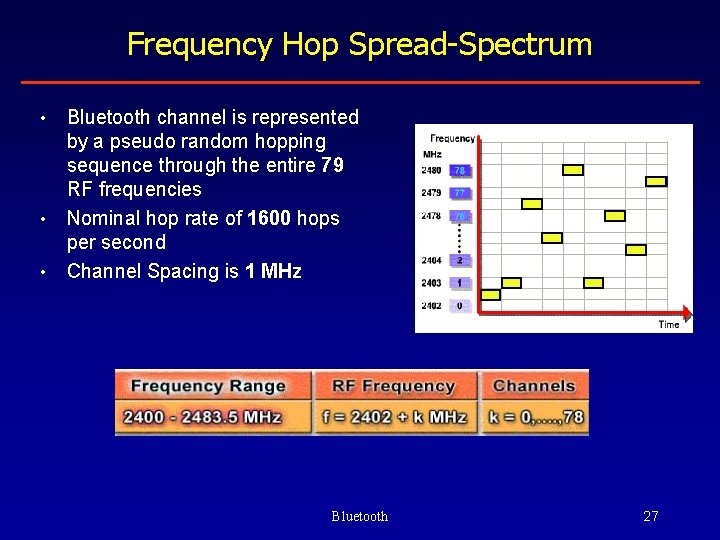
Frequency Hop Spread-Spectrum • • • Bluetooth channel is represented by a pseudo random hopping sequence through the entire 79 RF frequencies Nominal hop rate of 1600 hops per second Channel Spacing is 1 MHz Bluetooth 27
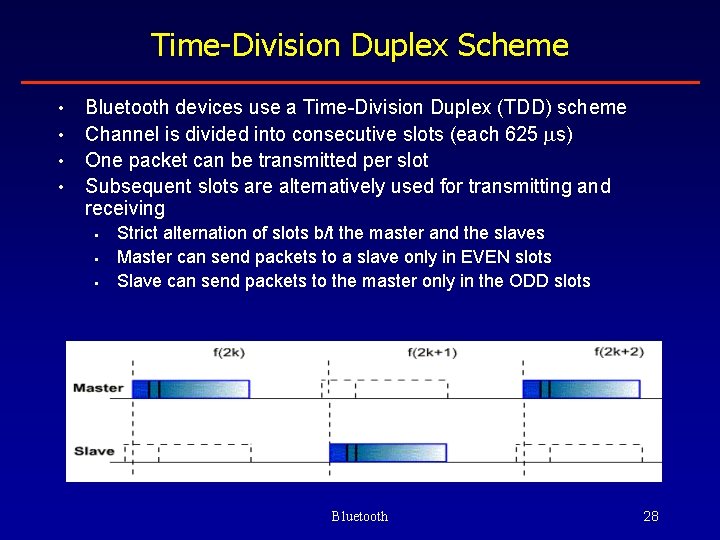
Time-Division Duplex Scheme • • Bluetooth devices use a Time-Division Duplex (TDD) scheme Channel is divided into consecutive slots (each 625 s) One packet can be transmitted per slot Subsequent slots are alternatively used for transmitting and receiving § § § Strict alternation of slots b/t the master and the slaves Master can send packets to a slave only in EVEN slots Slave can send packets to the master only in the ODD slots Bluetooth 28
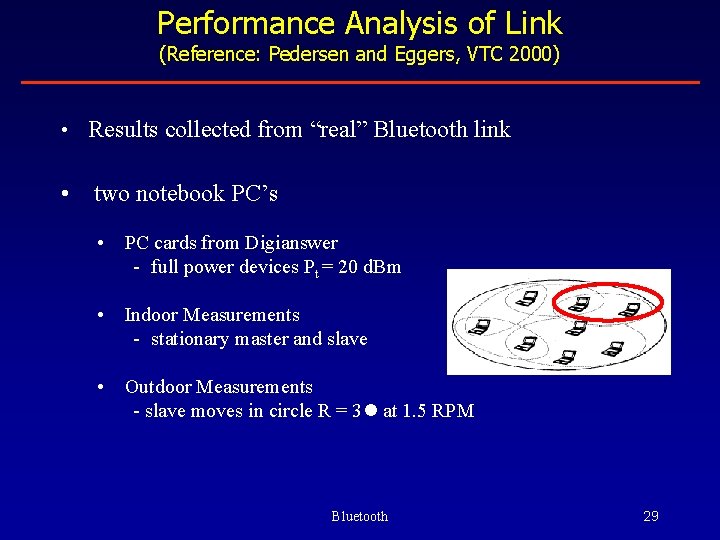
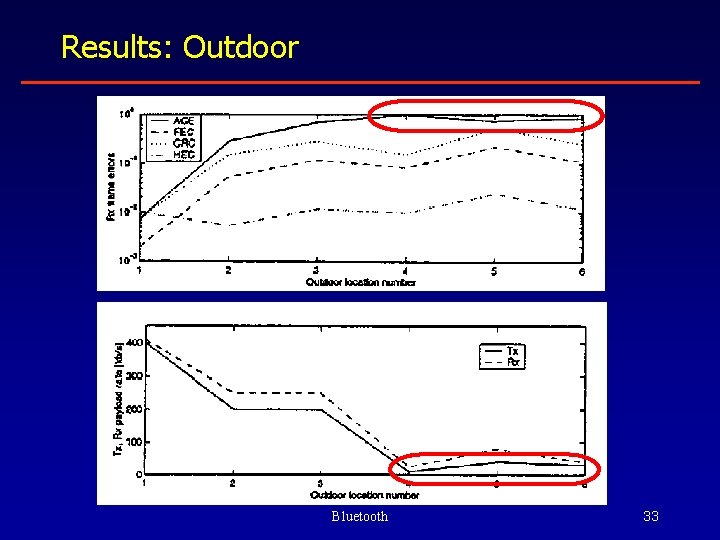
Performance Analysis of Link (Reference: Pedersen and Eggers, VTC 2000) • Results collected from “real” Bluetooth link • two notebook PC’s • PC cards from Digianswer - full power devices Pt = 20 d. Bm • Indoor Measurements - stationary master and slave • Outdoor Measurements - slave moves in circle R = 3 at 1. 5 RPM Bluetooth 29
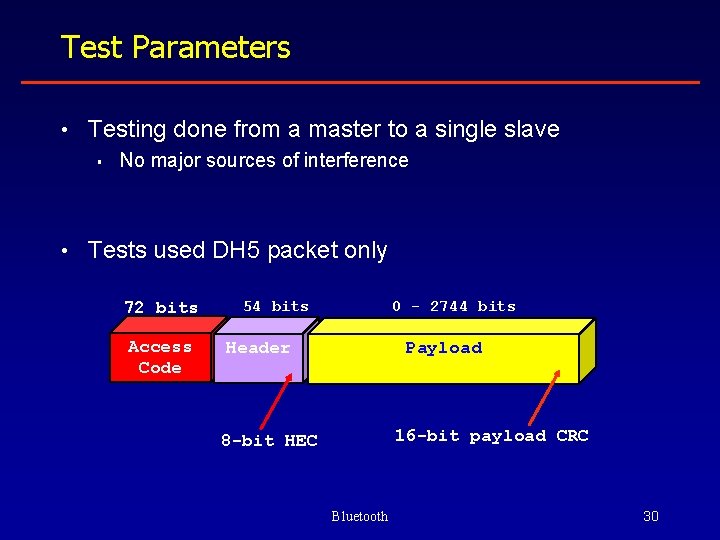
Test Parameters • Testing done from a master to a single slave § No major sources of interference • Tests used DH 5 packet only 72 bits Access Code 0 - 2744 bits 54 bits Header Payload 16 -bit payload CRC 8 -bit HEC Bluetooth 30
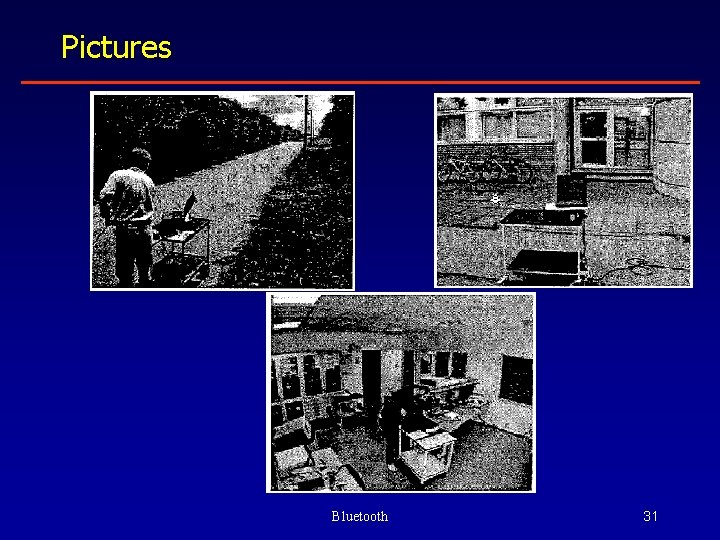
Pictures Bluetooth 31
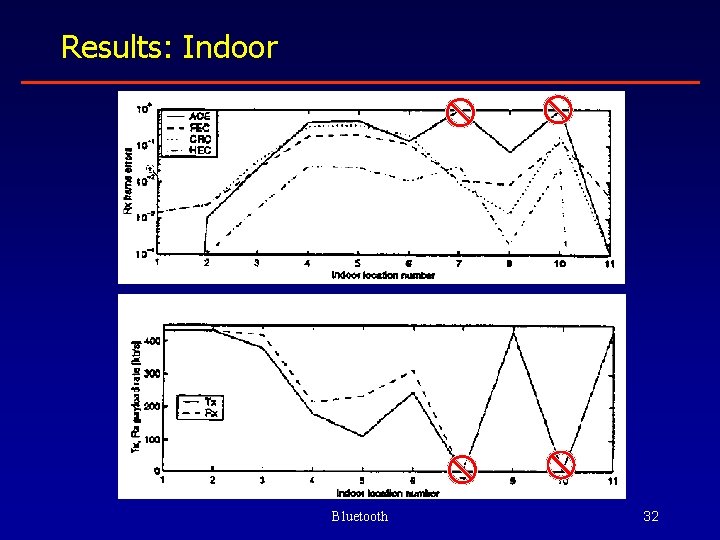
Results: Indoor Bluetooth 32
Results: Outdoor Bluetooth 33
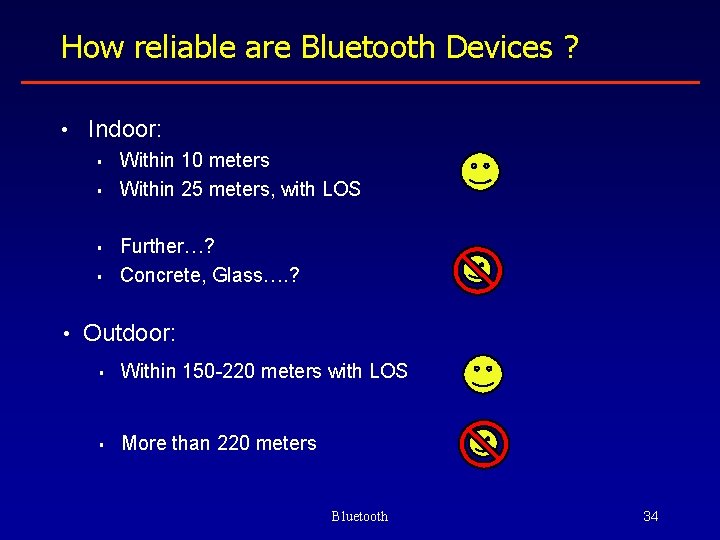
How reliable are Bluetooth Devices ? • Indoor: § Within 10 meters § Within 25 meters, with LOS § § Further…? Concrete, Glass…. ? • Outdoor: § Within 150 -220 meters with LOS § More than 220 meters Bluetooth 34
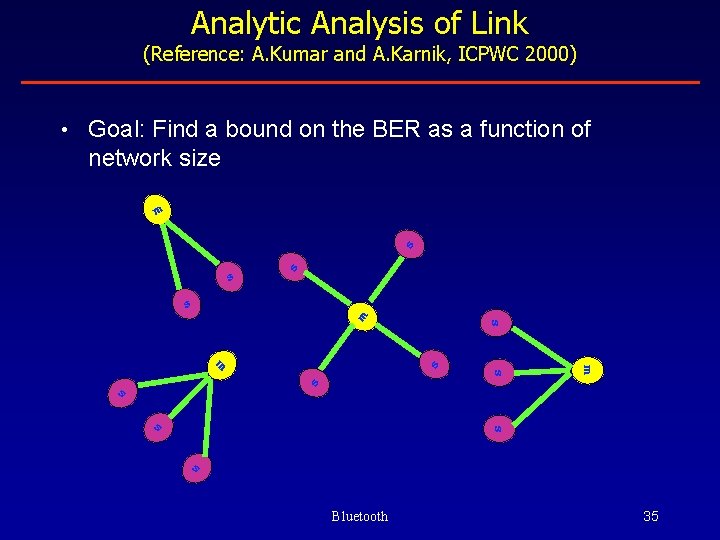
Analytic Analysis of Link (Reference: A. Kumar and A. Karnik, ICPWC 2000) • Goal: Find a bound on the BER as a function of network size s s s m s m s s s Bluetooth 35
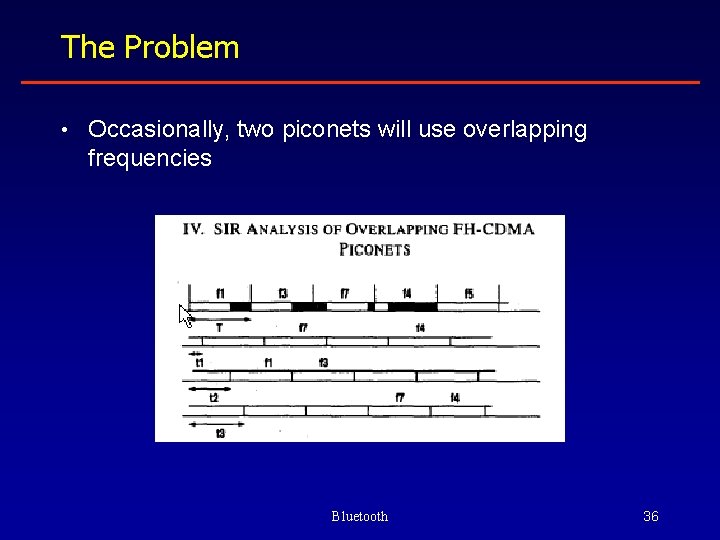
The Problem • Occasionally, two piconets will use overlapping frequencies Bluetooth 36
Assumptions and Parameters • “Open” (LOS) indoor room; circular with radius R • Received power is a random variable - mean received power falls off as d 2 - for fixed d, signal fading is Rician with K = 6 d. B • Interference from other Bluetooth devices only - ignore 802. 11, microwaves • Time offset of each Piconet is uniform [0, T] Bluetooth 37
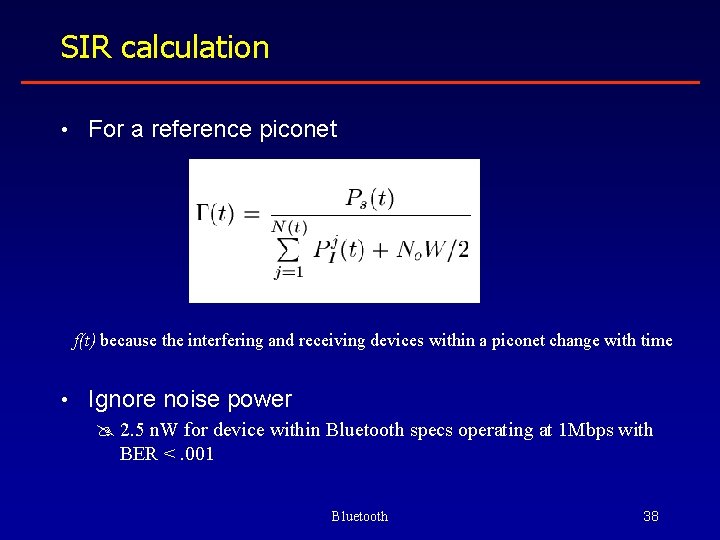
SIR calculation • For a reference piconet f(t) because the interfering and receiving devices within a piconet change with time • Ignore noise power 2. 5 n. W for device within Bluetooth specs operating at 1 Mbps with BER <. 001 Bluetooth 38
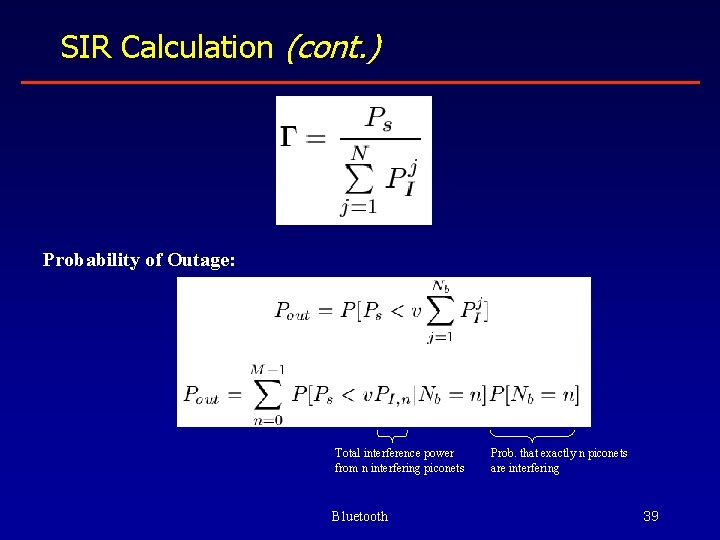
SIR Calculation (cont. ) Probability of Outage: Total interference power from n interfering piconets Bluetooth Prob. that exactly n piconets are interfering 39
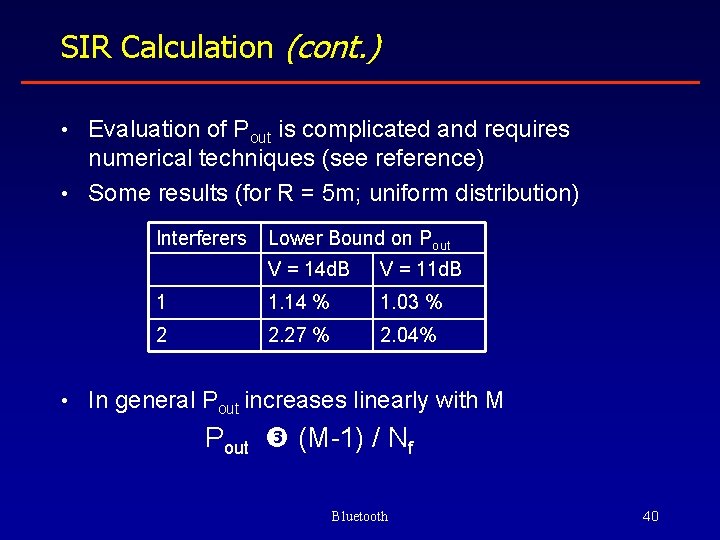
SIR Calculation (cont. ) • Evaluation of Pout is complicated and requires numerical techniques (see reference) • Some results (for R = 5 m; uniform distribution) Interferers Lower Bound on Pout V = 14 d. B V = 11 d. B 1 1. 14 % 1. 03 % 2 2. 27 % 2. 04% • In general Pout increases linearly with M Pout (M-1) / Nf Bluetooth 40
Other Technologies Ir. DA Infrared, LOS, serial data comm. Point to point Intended for Data Communication Simple to configure and use Both devices must be stationary, for synchronization Can not penetrate solid objects Bluetooth 41
Ir. DA vs Bluetooth Advantages Point to Multipoint Data & Voice Broadcast Easier Synchronization due to omnidirectional and no LOS requirement Devices can be mobile Range 10 m Ir. DA Currently 16 Mbps Ample security and very less interference Already ubiquitous & Low cost Bluetooth 42
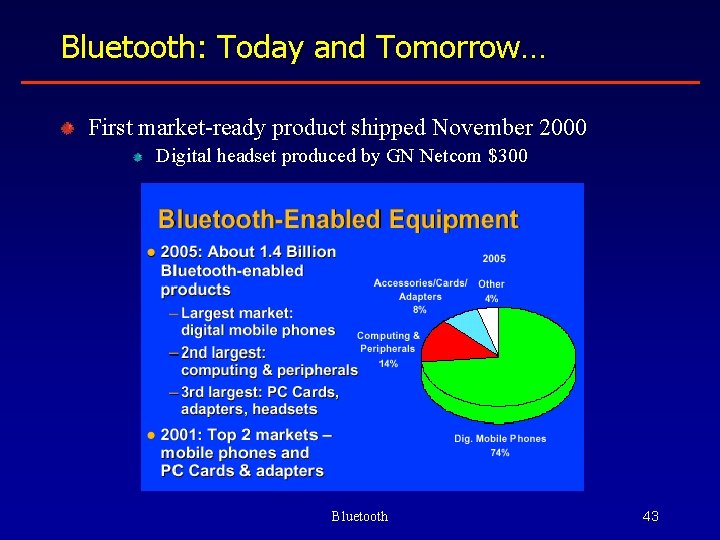
Bluetooth: Today and Tomorrow… First market-ready product shipped November 2000 Digital headset produced by GN Netcom $300 Bluetooth 43
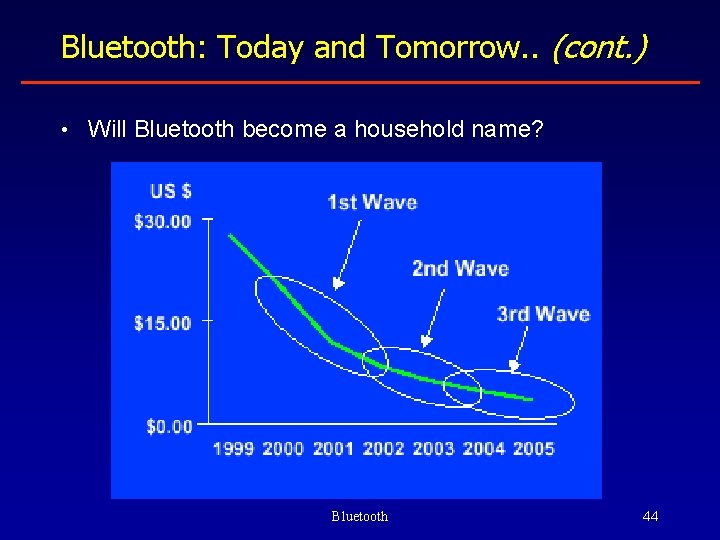
Bluetooth: Today and Tomorrow. . (cont. ) • Will Bluetooth become a household name? Bluetooth 44
Conclusions A new global standard for data and voice Eliminate Cables Low Power, Low range, Low Cost network devices Delivers Automatic synchronicity between devices Future Improvements Master-Slave relationship can be adjusted dynamically for optimal resource allocation and utilization Adaptive, closed loop transmit power control can be implemented to further reduce unnecessary power usage Bluetooth 45
![References [1] Bluetooth Consortium : http: //www. bluetooth. com http: //www. ericsson. com/bluetooth/ [2]](http://slidetodoc.com/presentation_image/23e9cb12901a89016bc8db6b68526e82/image-46.jpg "References [1] Bluetooth Consortium : http: //www. bluetooth. com http: //www. ericsson. com/bluetooth/ [2]")
References [1] Bluetooth Consortium : http: //www. bluetooth. com http: //www. ericsson. com/bluetooth/ [2] Bluetooth Tutorial : http: //www. ee. iitb. ernet. in/uma/~aman/bluetooth http: //www. palowireless. com [3] G. F. Pedersen, P. Eggers, “Initial Investigation of the Bluetooth Link”, VTC, pp 64 – 70 [4] J. C. Haartsen, et al, “Bluetooth – A New Low-Power Radio Internface Providing Short-Range Connectivity”, IEEE Proc. , Vol 88, No. 10, Oct 2000 [5] Min-Chul Ju, et al. , “Channel Estimation and DC-Offset Compensation Schemes for Frequency Hopped Bluetooth Networks”, IEEE Communications Letters, Vol 5, No. 1, Jan 2001 Bluetooth 46
- Slides: 46